
MAOI Tyramine Risk Checker
Check Food Safety for MAOI Medications
Tyramine Risk Assessment
Emergency Information
If you've accidentally consumed high-tyramine foods while on MAOIs:
- Monitor symptoms closely
- Check blood pressure immediately
- Call 911 if blood pressure exceeds 180/120 or symptoms include severe headache, chest pain, or palpitations
If you're taking an MAOI antidepressant like Nardil or Parnate, what you eat isn't just a matter of taste-it could save your life. Aged cheeses and processed meats aren't just flavorful additions to your plate; they're silent triggers for a dangerous spike in blood pressure that can land you in the emergency room. This isn't a myth or an old wives' tale. It's a well-documented, life-threatening interaction that still catches people off guard-even in 2025.
Why Tyramine Is the Real Culprit
Tyramine is a natural compound found in foods that have been aged, fermented, or cured. It comes from the breakdown of the amino acid tyrosine, and it's everywhere in foods that sit around for weeks or months. The name even comes from the Greek word for cheese, tyros. But here's the catch: your body normally breaks down tyramine using an enzyme called monoamine oxidase. When you're on an MAOI medication, that enzyme is blocked. Tyramine builds up in your system and forces your nerves to dump a flood of norepinephrine-a chemical that makes your heart race and your blood pressure skyrocket.That spike isn't mild. It can jump from normal (120/80) to dangerous (180/120 or higher) in under 30 minutes. Symptoms include a pounding headache-often at the back of your skull-sweating, chest tightness, blurred vision, and a feeling like your heart is trying to burst out of your chest. In extreme cases, it can lead to stroke or heart attack.
Which Cheeses Are Safe? Which Are Not?
Not all cheese is created equal when it comes to tyramine. Fresh cheeses made from pasteurized milk and eaten soon after production are generally safe. That includes:- Cottage cheese (under 30 mcg/g)
- Ricotta (under 40 mcg/g)
- Fresh mozzarella (under 25 mcg/g)
- Cream cheese (under 20 mcg/g)
- American cheese (under 50 mcg/g)
These are fine in normal portions. But aged cheeses? They're a different story. The longer cheese ages, the more tyramine builds up. Here's what to avoid:
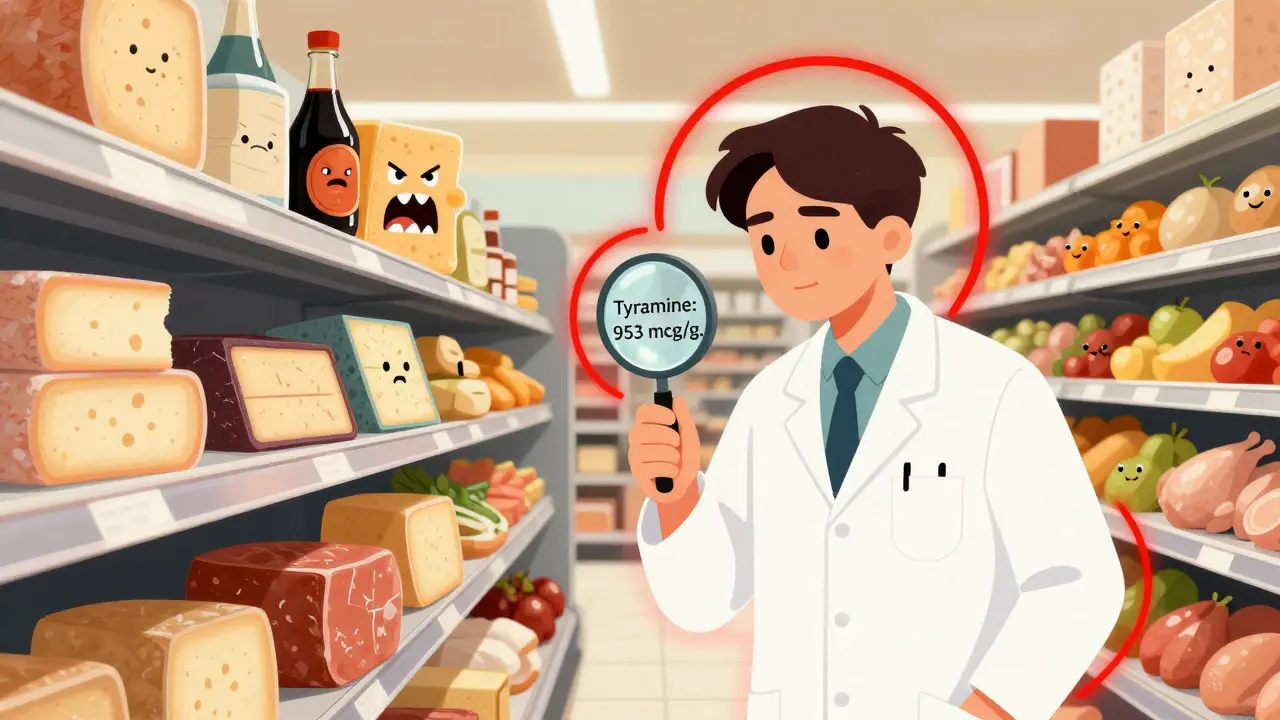
- Aged cheddar (72-953 mcg/g)-a single 30g slice can contain up to 28.6 mg of tyramine
- Blue cheeses like Stilton and Gorgonzola (1,000-3,500 mcg/g)
- Parmesan (610-1,400 mcg/g)
- Swiss cheese (400-1,200 mcg/g)
- Feta in brine (350-800 mcg/g)
Just one serving of Parmesan on a salad can contain enough tyramine to trigger a crisis in sensitive individuals. The threshold? As low as 6 mg for some people. For others, it takes 10-25 mg. There’s no universal safe amount-only personal tolerance.
Processed Meats: The Hidden Danger
It's not just cheese. The deli counter is another minefield. Dry-cured, smoked, or fermented meats are packed with tyramine because they're preserved through aging and fermentation-exactly the process that boosts tyramine levels.High-risk meats include:
- Summer sausage (300-900 mcg/g)
- Pepperoni (200-600 mcg/g)
- Salami (150-500 mcg/g)
Even bacon and corned beef aren’t completely safe-they contain 60-250 mcg/g. But freshly cooked meats? Chicken, beef, pork, or fish grilled or baked right before eating? Those are fine. Tyramine doesn’t form in fresh meat. The problem is in the curing, smoking, and aging.
And don’t forget the condiments. Soy sauce, fish sauce, and miso are tyramine bombs. A tablespoon of soy sauce can have more tyramine than a slice of aged cheddar. Even some protein powders and nutritional supplements contain hidden fermented ingredients.
What About Bananas, Chocolate, and Nuts?
You’ve probably heard rumors that bananas or chocolate are dangerous with MAOIs. That’s outdated. Modern research shows these are low-risk:- Bananas: less than 10 mcg/g
- Chocolate: 50-150 mcg/g
- Peanuts: 75-200 mcg/g
These are safe in normal amounts. The real danger lies in aged and fermented foods-not fresh fruits, vegetables, or plain nuts. The confusion comes from old guidelines that lumped everything together. Today’s standards are much more precise.
How Long Do You Need to Stay on This Diet?
Many people think once they stop taking their MAOI, they can go back to eating whatever they want. That’s a mistake. The enzyme that breaks down tyramine doesn’t bounce back overnight. It takes two to three weeks after your last dose for your body to fully restore monoamine oxidase activity.That means if you stop your medication on a Friday, you still can’t have blue cheese until mid- to late January. Skipping this rule is how people end up in the ER weeks after stopping their pills.
Real Stories, Real Consequences
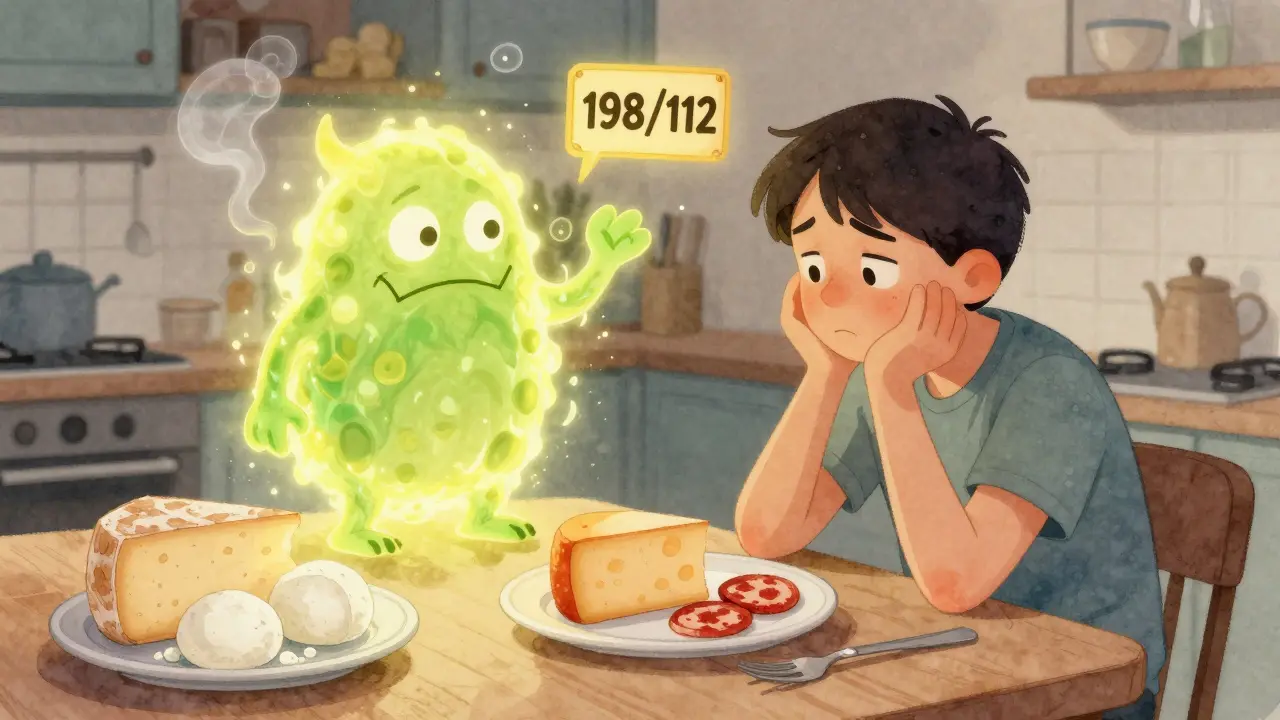
On patient forums, the stories are raw and urgent. One user on Drugs.com described eating a Parmesan salad while on Nardil-then waking up in the ER with a blood pressure reading of 198/112. Another Reddit user, after five years on MAOIs, learned his personal limit: 15 grams of aged cheddar. More than that? Headache, racing heart, nausea.These aren’t rare. The GoodRx database tracks over 1,200 reports of MAOI-food reactions. Nearly 70% involved cheese. Another 22% came from processed meats. The symptoms? 92% had severe headaches. 76% had palpitations. 68% broke out in cold sweats.

How to Manage This Diet in Real Life
This isn’t about perfection. It’s about awareness and smart choices.- Read labels. Look for words like “aged,” “cured,” “fermented,” or “dry-smoked.”
- Buy fresh. Choose refrigerated mozzarella instead of Parmesan. Pick fresh turkey over salami.
- Keep a food diary. Write down what you eat and your blood pressure readings. Many people find their personal threshold this way.
- Use apps. Mayo Clinic’s “MAOI Diet Tracker” scans barcodes and flags high-tyramine foods with 89% accuracy.
- Carry an emergency card. It should say: “I am on an MAOI. Avoid aged cheese, cured meats, soy sauce. If I have a severe headache or high BP, call 911.”
Restaurants are tricky. Ask: “Is this cheese fresh or aged?” “Was this meat cured or smoked?” Most servers won’t know. Be ready to explain. Many now have “MAOI-safe” menu options-especially in larger chains.
What’s Changing in 2025?
The food industry is starting to respond. Companies like Sargento now sell fresh mozzarella cups labeled “MAOI-Safe,” with tyramine under 20 mcg/g. Sales hit $14.7 million in 2022. The FDA requires warning labels on all MAOI packaging. The EU now mandates tyramine content be listed on aged cheese labels.Research is moving fast. A clinical trial (NCT05214387) is testing an enzyme supplement that breaks down tyramine before it enters your bloodstream. Early results look promising. And scientists are even exploring genetically modified cheeses with naturally low tyramine levels-potentially eliminating this interaction entirely within the next five years.
Bottom Line: This Interaction Is Real, Deadly, and Preventable
You don’t have to give up flavor. You just have to know where the danger lies. Fresh cheeses, freshly cooked meats, and plain vegetables? Safe. Aged cheddar, blue cheese, pepperoni, soy sauce? Avoid them. Period.There’s no middle ground. One bite of the wrong cheese can send your blood pressure into a dangerous zone. That’s why doctors still emphasize strict adherence-even in 2025. If you’re on an MAOI, your diet isn’t a suggestion. It’s part of your treatment plan. And when it comes to tyramine, there’s no such thing as “just a little.”
Can I eat a small piece of aged cheese if I’m on an MAOI?
No. Even a small amount of aged cheese can contain enough tyramine to trigger a hypertensive crisis. The threshold for danger is as low as 6 mg for some people, and a single 30g slice of aged cheddar can contain over 25 mg. There’s no safe “small portion” when the risk is life-threatening.
What if I accidentally eat aged cheese while on an MAOI?
Monitor your symptoms closely. If you develop a severe headache, rapid heartbeat, chest pain, sweating, or blurred vision, check your blood pressure immediately. If it’s above 180/120, call 911. Do not wait. Emergency treatment with medications like nifedipine or chlorpromazine can reverse the crisis, but timing is critical.
Are all blue cheeses equally dangerous?
Yes. All blue cheeses-including Stilton, Gorgonzola, Roquefort, and Danish blue-have high tyramine levels, typically between 1,000 and 3,500 mcg/g. The mold used in production accelerates tyramine formation. None are safe on MAOIs.
Can I drink alcohol while on an MAOI?
Avoid most alcohol. Beer, red wine, and liqueurs can contain tyramine or compounds that interact with MAOIs. Even small amounts can raise blood pressure. Clear spirits like vodka or gin in very limited quantities may be acceptable for some, but only after discussing with your doctor. Never mix alcohol with aged cheese or cured meats.
Do I need to avoid tyramine forever?
Only while taking MAOIs and for two to three weeks after stopping. Once your body regenerates monoamine oxidase enzymes, tyramine is safely broken down again. But during that window, strict avoidance is non-negotiable. Many people return to their normal diet after this period without issue.
Is there a blood test to check for tyramine levels?
No. There’s no routine blood test for tyramine. Diagnosis is based on symptoms and recent food intake. That’s why tracking what you eat and your blood pressure is so important. If you suspect a reaction, the best tool is a home blood pressure monitor and a food diary.
Why do some people react worse than others?
Genetics, liver function, and the specific MAOI you’re taking all play a role. Some people’s enzymes are more easily blocked, while others metabolize tyramine differently. That’s why one person can have a reaction to 10 mg of tyramine, while another tolerates 25 mg. There’s no way to predict your threshold-you have to find it through careful observation and monitoring.
Can I eat fermented foods like kimchi or sauerkraut?
Avoid them. Fermented vegetables like kimchi and sauerkraut contain tyramine levels similar to aged cheese. The fermentation process creates the same compound. Even small amounts can trigger a reaction. Stick to fresh, unfermented vegetables instead.
Comments
Thomas Anderson
I was on Nardil for a year and learned the hard way. Ate a slice of cheddar on a burger-thought it was fine since it was just a little. Ended up in the ER with a headache so bad I thought my skull was splitting. Never touch aged cheese again. Fresh mozzarella? Cool. Everything else? No.
December 16, 2025 at 03:30
Edward Stevens
So let me get this straight-my favorite charcuterie board is basically a biological time bomb? Thanks for the heads-up, doc. Guess I’ll be eating baby carrots and regretting my life choices from now on.
December 16, 2025 at 11:37
Daniel Wevik
It’s critical to understand that MAOIs inhibit the mitochondrial isoform of monoamine oxidase A, leading to catecholamine dysregulation. Tyramine acts as a false neurotransmitter substrate, displacing norepinephrine from vesicular stores. The resulting sympathomimetic cascade is not merely hypertensive-it’s catecholaminergic storm. Avoid all biogenic amine precursors. Period.
December 17, 2025 at 17:38
Rich Robertson
As someone who’s lived in both the U.S. and Italy, I’ve seen how cheese culture clashes with modern pharmacology. In Bologna, they’ll hand you a 24-month Parmigiano like it’s candy. Here, we’re told it’s a death sentence. It’s not that the food changed-it’s that our medical understanding caught up. The irony? The Italians who’ve eaten this way for centuries? They’re not dropping dead. But then again, they’re not on Nardil either.
It’s a cultural divide wrapped in a biochemical truth. You don’t have to give up flavor-you just have to know where the line is. And that line? It’s not in the cheese. It’s in your prescription bottle.
December 18, 2025 at 21:35
Natalie Koeber
They say it’s tyramine… but what if it’s the GMO mold they put in the cheese to make it age faster? And soy sauce? That’s definitely laced with fluoride to mess with your thyroid. I read on a forum that the FDA hides the real danger-people on MAOIs are being targeted. I saw a guy on YouTube who got sick after eating ‘fresh’ mozzarella… turns out it was aged in a lab with nanotech. Trust no one. Check your water. Avoid anything with a barcode.
December 19, 2025 at 04:04
Rulich Pretorius
This is one of those rare moments where medicine and lived experience align perfectly. The body doesn’t lie. If your blood pressure spikes after a bite of blue cheese, it’s not your imagination-it’s your enzymes being silenced. I’ve walked people through this for years. It’s not about fear. It’s about respect. Respect for the drug. Respect for your own biology. You’re not being punished-you’re being protected.
And yes, the two-to-three-week window after stopping MAOIs? That’s non-negotiable. Your liver isn’t a light switch. It’s a slow-brewing pot. Don’t rush it.
December 20, 2025 at 07:24
Dwayne hiers
For clarity: tyramine is a monoamine that is not metabolized by MAO-A when inhibited, leading to excessive sympathetic outflow via norepinephrine release from adrenergic nerve terminals. The threshold for hypertensive crisis is typically 6–10 mg of tyramine. Aged cheddar contains 25–30 mg per 30g serving. Therefore, even a 10g portion exceeds the lower threshold in susceptible individuals. There is no safe dose-only risk stratification. This is not dietary advice. This is pharmacological safety.
December 20, 2025 at 18:55
Jonny Moran
Hey, I get it-this stuff sounds scary. But you’re not alone. I’ve been on Parnate for five years. I’ve learned to love fresh mozzarella with basil and tomato. I grill my own chicken. I use coconut aminos instead of soy sauce. It’s not about deprivation-it’s about finding new flavors. And honestly? My skin cleared up. My energy improved. I stopped craving junk. This diet didn’t take flavor away-it gave me back my health.
December 21, 2025 at 03:19
Sarthak Jain
Bro i was on nardil last year and i ate some parmesan on pizza… thought it was fine cuz it was ‘just a sprinkle’… then my head felt like it was gonna explode and my heart was doing the cha-cha. Called my doc at 2am. He said ‘you’re lucky you’re alive.’ Now i read every label like its a secret code. Also, kimchi? yeah, avoid. even if its ‘organic.’
December 21, 2025 at 10:57
Tim Bartik
So some guy in a lab in Boston says I can’t eat my grandma’s pepperoni? Screw that. This is America. We eat what we want. If you’re weak enough to get sick from cheese, maybe you shouldn’t be on meds in the first place. I’ve had 3 slices of salami on my sandwich every day for 12 years-still running marathons. Your ‘science’ is just fearmongering. Let people live.
December 23, 2025 at 06:31
Sinéad Griffin
OMG I JUST ATE BLUE CHEESE 😱 I’M GONNA DIE 😭 BUT LIKE… IS IT TOO LATE?? I JUST ATE IT 20 MIN AGO!! 🤯🆘 #MAOIdanger #CheeseIsMySoul #EmergencyHelp
December 24, 2025 at 07:00
Daniel Thompson
While I appreciate the thoroughness of the original post, I must emphasize that the assumption of universal thresholds for tyramine sensitivity is clinically misleading. Individual pharmacokinetic variability, hepatic enzyme expression, and concurrent medication use significantly modulate risk. The assertion that ‘there is no safe amount’ may be well-intentioned, but it disregards the clinical nuance required for personalized care. A patient with robust MAO-B compensation may tolerate minor exposure. A blanket prohibition, while prudent for public messaging, may unnecessarily restrict quality of life without proportional benefit in low-risk subpopulations.
December 25, 2025 at 17:56
Write a comment