
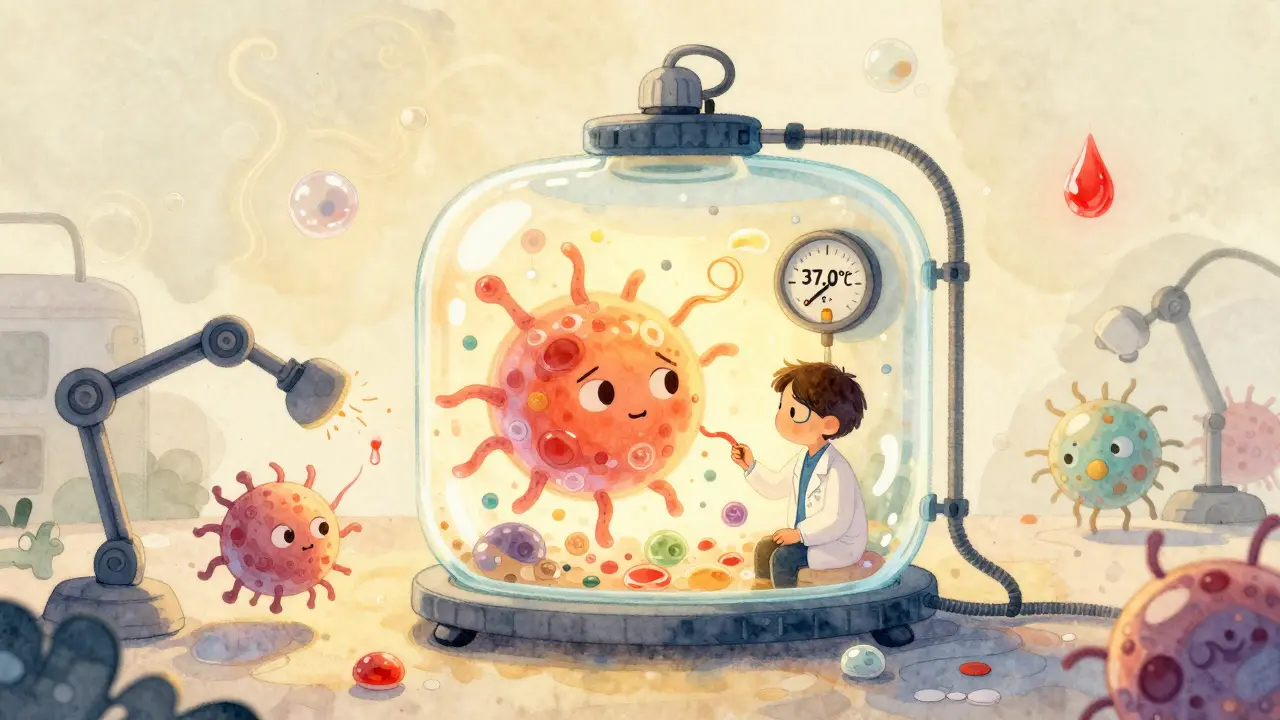
Biologic drugs aren’t like the pills you pick up at the pharmacy. You can’t just reverse-engineer them, mix chemicals in a lab, and get the same result. That’s because they’re made from living cells - not chemistry. A single dose of Humira or Ozempic contains proteins so complex they’re a thousand times bigger than aspirin. And even if two factories try to make the exact same drug, they’ll end up with slightly different versions. That’s not a mistake. It’s how biology works.
How biologics are made - and why it’s so hard
Biologic drugs start with a single living cell, genetically tweaked to produce a specific protein. That cell is then grown in giant stainless-steel tanks called bioreactors, where it multiplies over 10 to 14 days. The environment has to be perfect: temperature within 0.1°C of 37°C, pH exactly at 7.2, nutrients constantly fed in, oxygen levels monitored second by second. One tiny shift - a spike in temperature, a drop in oxygen - and the cells start producing the wrong protein shape. That’s not just a bad batch. It’s a $500,000 loss.After the cells grow, the real work begins. The protein has to be pulled out of the cell soup, cleaned, filtered, and stabilized. This isn’t a one-step process. It’s five or six purification stages - protein A chromatography, viral filtration, ultrafiltration - each one removing impurities but also risking damage to the fragile molecule. By the end, you’ve got a product that’s 95% pure. But even that 5% variation? It matters.
The whole process takes 3 to 6 months. For a regular pill? Two weeks. And the cost? Manufacturing a biologic can cost 10 to 20 times more than making a generic drug. Quality control alone eats up 30-40% of the total budget. For a small molecule, it’s 5-10%. That’s because every batch of a biologic has to be tested for over 100 different characteristics - not just the active ingredient, but the shape of the protein, the sugar chains attached to it, how it folds, how stable it is under heat or light. No two batches are identical. And that’s okay - as long as they’re close enough to work the same way.
Generics vs. biosimilars: the big difference
When a small molecule drug like Lipitor goes off-patent, any company can make a generic version. The active ingredient is a single, simple chemical. You analyze it, replicate it, and you’ve got an exact copy. The FDA doesn’t even require new clinical trials - just proof the generic dissolves the same way in the body.Biologics don’t work like that. You can’t copy them. You can only make something very similar - a biosimilar. And getting approval for a biosimilar isn’t easy. The FDA requires hundreds of lab tests comparing the biosimilar to the original. You need to prove it has the same protein structure, the same binding behavior, the same stability profile. Then you need animal studies. Then you need clinical trials - not to prove it’s better, but to prove it’s not worse. That’s why a biosimilar still costs $50,000 to $100,000 to develop, compared to $1 million for the original biologic. But it’s still cheaper than the brand.
Think of it like a handmade violin. Two master luthiers can build violins that sound nearly identical. But if you take them apart, you’ll find differences in the wood grain, the varnish thickness, the curve of the neck. The sound? Almost the same. But not identical. That’s what a biosimilar is - a near-perfect copy, made by a different artist, with different tools.

Why even small changes matter
A 2022 survey of 158 biopharmaceutical facilities found that 35% of manufacturing failures were due to contamination. A single airborne particle in a cleanroom can ruin a whole batch. Even something as small as a change in the water used to rinse equipment can alter the final product’s behavior in the body. That’s why manufacturers spend years perfecting their processes. One engineer at Amgen said switching from a 2,000-liter to a 15,000-liter bioreactor took 17 months and cost $22 million in lost production time.And it’s not just the equipment. The cells themselves change over time. They drift. After 10 to 14 days of growing, the cells start producing slightly different versions of the protein. That’s why production runs are limited - you can’t let them grow forever. You have to start fresh with a new batch of cells. This is called cell line drift. It’s natural. It’s expected. But it’s also why no two biologics from two different factories are ever truly identical.
Even the packaging matters. The buffer solution used to stabilize the drug - the salt, the sugar, the pH adjusters - can affect how the protein behaves. One study showed that changing the buffer by just 0.1 pH unit altered how quickly the drug was absorbed in the bloodstream. That’s why biosimilars must match the original’s entire formulation, not just the protein.
The regulatory maze
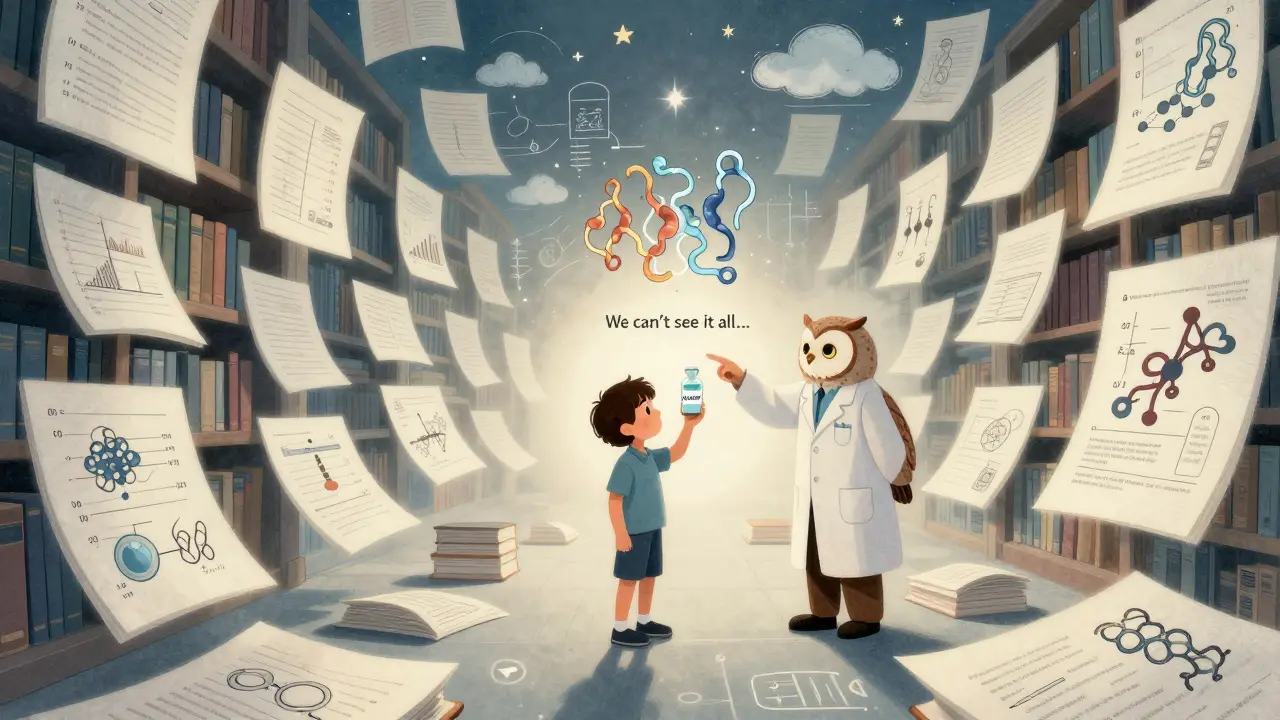
The FDA’s guidelines for biologics run over 200 pages. The European Medicines Agency’s? Over 300. Each batch requires documentation of every single step - from the seed cell to the final vial. That paperwork can run over 10,000 pages per product. Regulators don’t just want to know what was done. They want to know why it was done, how it was monitored, and what happened if something went wrong.For biosimilars, the bar is even higher. You can’t just say, “It’s close enough.” You have to prove it. And that means analyzing the molecule with tools that still can’t see the whole picture. Right now, scientists can only characterize about 60-70% of a monoclonal antibody’s structure. The rest? We infer it. We assume it. But we can’t measure it. That’s why regulators insist on clinical trials - because sometimes, the invisible differences matter.
What’s next for biologics manufacturing
The industry is trying to fix this. New facilities are using single-use plastic bags instead of stainless steel tanks to cut contamination risk by 60%. Artificial intelligence is being used to predict how changes in temperature or nutrient flow will affect protein quality - before the batch even runs. Some companies are moving to continuous manufacturing, where the process runs nonstop instead of in batches. That could cut production time by 30%.But the biggest challenge remains: we still don’t have the tools to fully understand what we’re making. Dr. R. Lou Sherman from the Alliance for Advanced Biologics says we’re flying blind in 30-40% of cases. We know the drug works. But we don’t fully know why.
That’s why biosimilars will never be generics. And why biologics will always be expensive. Not because companies are greedy. But because biology is messy. And we’re still learning how to control it.
What this means for patients
For patients, the good news is that biosimilars are safe and effective. Over 50 have been approved in the U.S. and Europe. Studies show they work just as well as the originals for rheumatoid arthritis, Crohn’s disease, and cancer. Insurance companies are pushing them hard because they save billions.The bad news? Access isn’t automatic. Some doctors still hesitate to switch patients from the original biologic. Some patients fear the “copy” won’t work as well. That fear isn’t irrational - it’s rooted in how complex these drugs really are. But the science says: if the biosimilar passed the FDA’s tests, it’s just as good.
The real issue isn’t safety. It’s trust. And that’s something no lab test can fix. It takes time. Education. And transparency.
Can a biosimilar be exactly the same as the original biologic?
No. Biologics are made from living cells, and even minor changes in temperature, nutrients, or equipment can cause tiny differences in the final protein. These variations are natural and expected. A biosimilar is highly similar - but not identical. That’s why regulators require extensive testing to prove it works the same way in the body.
Why are biologics so much more expensive than generic drugs?
Biologics require living cells, complex manufacturing, months of production, and intense quality control. A single batch can cost over $500,000 to make and takes 3-6 months. Generics are made by mixing chemicals in weeks. The cost difference isn’t about profit - it’s about science. Making a living molecule is just harder than making a small chemical.
Are biosimilars safe to use instead of the original biologic?
Yes. Over 50 biosimilars have been approved in the U.S. and Europe after rigorous testing. Studies show they work just as well as the original drugs for conditions like rheumatoid arthritis, psoriasis, and cancer. The FDA and EMA require clinical trials to prove they’re not less effective or more harmful. Patients switching to biosimilars don’t experience worse outcomes.
Why can’t we just copy biologics like we copy pills?
Pills are made of simple, stable chemicals. You can analyze them, break them down, and rebuild them exactly. Biologics are huge, fragile proteins made by living cells. Even if you know the sequence, you can’t recreate the exact folding, sugar attachments, or impurity profile. The manufacturing process itself becomes part of the drug - and that can’t be copied.
How long does it take to make a biologic drug from start to finish?
From developing the cell line to releasing the final product, it takes 3 to 6 months. But getting there takes years. The full timeline from lab discovery to market is 5 to 7 years and costs $100 million to $500 million. That’s because every step - cell growth, purification, testing, documentation - has to be perfect. One mistake can mean losing an entire batch.
Comments
Prakash Sharma
Man, this is why India needs to stop outsourcing pharma and start building our own bioreactors. We’re buying these drugs at 5x the cost while our scientists sit idle. We can do this - we’ve launched Mars missions, we can grow proteins.
January 7, 2026 at 12:52
Donny Airlangga
I’ve got a friend on Humira. She switched to a biosimilar last year and saved $40k in 18 months. No side effects, no drama. Doctors still act like it’s some kind of gamble, but the data’s solid.
January 9, 2026 at 12:32
swati Thounaojam
so like… biosimilars are like knockoff sneakers? looks same but feels different?
January 10, 2026 at 15:37
Aubrey Mallory
It’s not that we can’t copy them - it’s that the system *wants* us to fail. Big Pharma owns the patents, the regulators, even the doctors’ training. Biosimilars are a threat to their $200B empire. They don’t want you to know this is possible.
January 12, 2026 at 02:06
Dave Old-Wolf
Wait so if the cells change over time… how do they even make sure the next batch works? Do they just guess?
January 13, 2026 at 04:32
Ken Porter
Biologics are expensive because we’re paying for American labor. In China, they’d make this for 1/10th the cost. But nope, let’s keep it ‘cutting edge’ while patients starve.
January 15, 2026 at 01:43
Kristina Felixita
Okay but imagine if your baby’s insulin was made by a robot that got tired after 14 days… and then you had to pray the next one didn’t make them sick?? That’s real life for so many people. We need better tools. Like, NOW.
January 17, 2026 at 01:34
Joanna Brancewicz
Post-translational modifications are the silent killers here. Glycosylation profiles, disulfide bond isomerization - if you miss one, you get immunogenicity. That’s why we need deep characterization. No shortcuts.
January 18, 2026 at 09:35
Evan Smith
So let me get this straight… we spend $500k on a batch of protein that’s basically a snowflake… and we’re mad when someone tries to make a slightly different snowflake? Sounds like we’re just mad we can’t control nature. Cool story.
January 19, 2026 at 15:24
Lois Li
It’s not just about science - it’s about trust. I’ve seen patients cry because they were told their ‘copy’ drug might not work. We need more stories from people who switched and lived better. Not just data sheets.
January 20, 2026 at 20:42
christy lianto
My sister’s on a biosimilar for lupus. She was terrified. We went to the clinic together. The nurse showed her the FDA’s 100+ tests. She cried. Then she hugged the nurse. That’s the real breakthrough - not the molecule. The human moment.
January 22, 2026 at 16:58
Luke Crump
What if the problem isn’t biology… but our arrogance? We think we can control life. We build machines to mimic cells. We measure protein shapes like they’re Lego blocks. But life isn’t engineering. It’s poetry. And we’re trying to write sonnets with a thesaurus. We’ll never ‘solve’ this - we’ll only learn to bow to it.
January 22, 2026 at 21:50
Manish Kumar
Look, I’ve worked in a biotech lab in Hyderabad. We made biosimilars for Africa. The truth? It’s not about technology. It’s about patience. The cells don’t care if you’re in Delhi or Detroit - they just want to live. You give them warmth, food, silence, and they give you life. But we’re too busy trying to optimize, automate, monetize. We forgot to listen. That’s why we’re stuck. Not because we lack science. Because we lack humility.
January 24, 2026 at 18:04
Write a comment