
Bridging Therapy Decision Tool
Is Bridging Therapy Necessary?
Answer these questions to determine if you need bridging therapy before surgery.
Why You Might Need to Switch Blood Thinners
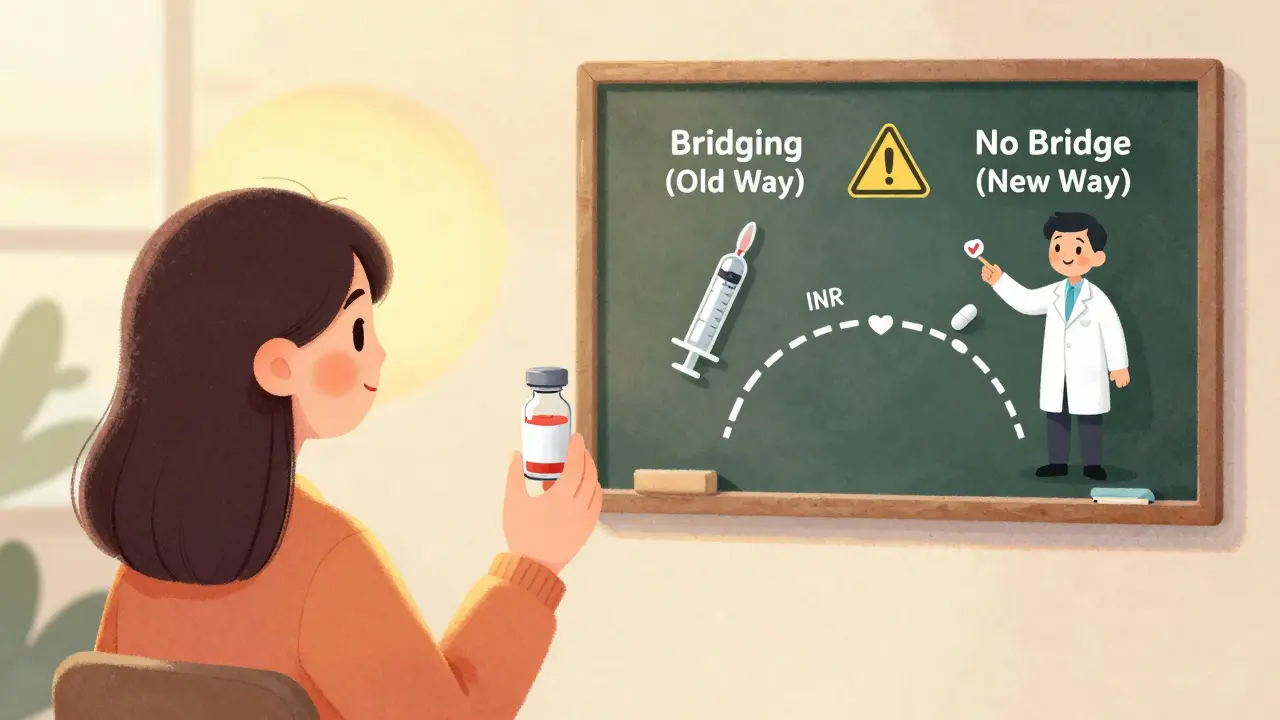
If you’re on a blood thinner, you’ve probably heard the phrase "bridging therapy"-maybe from your doctor, or while preparing for surgery. But what does it really mean? And do you even need it? Bridging therapy is when you temporarily switch from one blood thinner to another-usually from warfarin to a shot like low molecular weight heparin (LMWH)-while you pause your usual medication for a procedure. The idea is simple: keep your blood from clotting too much during the gap, without making you bleed too much. But here’s the twist: for most people today, bridging isn’t needed anymore. The rules changed. A decade ago, doctors almost always bridged. Now, they rarely do. And the reason isn’t just a trend-it’s hard data from large clinical trials.When Bridging Still Makes Sense
Not everyone is the same. Some people have a very high risk of clots. For them, stopping their blood thinner-even for a few days-could be dangerous. The only cases where bridging is still recommended are:- People with a mechanical heart valve in the mitral position
- Those who had a blood clot in their lung or leg within the last 3 months
How Warfarin Works (and Why It’s Complicated)
Warfarin is old. It’s been around for decades. It works by thinning your blood slowly, but it’s messy to manage. You need regular blood tests (INR checks). Your dose changes based on what you eat, what meds you take, even how much you sleep. When you’re getting ready for surgery, doctors stop warfarin 5 to 6 days before. Why? Because it takes that long for the effect to wear off. If you don’t wait, you could bleed too much during the procedure. But now you’re unprotected. So, in the past, they’d start injections-LMWH-3 days before surgery. That’s the classic bridge: stop warfarin → start shots → stop shots 24 hours before surgery → restart warfarin after. The problem? Those shots hurt. You have to inject yourself every day. You need to remember the timing. You need to store the medication properly. And you’re paying $300-$500 for a week’s supply in the U.S. And for most people? It’s unnecessary.Why DOACs Changed Everything
Direct oral anticoagulants (DOACs)-like apixaban (Eliquis), rivaroxaban (Xarelto), and dabigatran (Pradaxa)-don’t need bridging. Not ever. Why? Because they work fast and leave fast. Warfarin sticks around for days. DOACs? They’re gone in 12 to 24 hours. That means:- You stop your DOAC the day before surgery (or even the morning of, depending on the procedure)
- You don’t need shots
- You restart it the day after surgery

The Real Risks of Bridging
Bridging isn’t harmless. It’s risky.- Bleeding: The BRIDGE trial showed a 2.3% major bleeding rate with bridging vs. 1% without. That’s more than double.
- Logistics: You need to learn how to give yourself shots. You need to schedule appointments. You need to remember when to stop and start.
- Cost: LMWH can cost $300-$500 for a week. Insurance doesn’t always cover it fully.
- Adherence: Studies show 15-20% of patients miss at least one injection. That’s not just inconvenient-it’s dangerous.
What to Do If You’re on Warfarin
If you’re still on warfarin and you need surgery or a procedure, here’s what actually works:- Get your INR checked 5-7 days before the procedure. It should be under 2.0.
- Stop warfarin 5-6 days before surgery. No exceptions.
- Ask your doctor: "Am I in the 10-15% who actually need bridging?" If you don’t have a mechanical mitral valve or a recent clot, the answer is no.
- If you do need bridging, start LMWH 3 days before surgery. Stop it 24 hours before.
- After surgery, restart warfarin at 15-20% higher than your usual dose. Check your INR in 3-4 days.
What to Do If You’re on a DOAC
If you’re on Eliquis, Xarelto, or Pradaxa, your plan is way simpler:- Stop the DOAC 1-2 days before surgery (check with your doctor-timing depends on kidney function and procedure type).
- No injections. No bridging. No extra meds.
- Restart the DOAC 12-24 hours after surgery, as long as bleeding is controlled.

What If You’re Switching from Warfarin to a DOAC?
Sometimes, doctors switch patients from warfarin to a DOAC. That’s common. But the transition has rules.- Stop warfarin when your INR is below 2.0.
- Start the DOAC the next day. No overlap. No bridging.
- If your kidney function is low (creatinine clearance under 15 mL/min), you might need a longer gap between stopping warfarin and starting the DOAC.
Why the Guidelines Changed
In 2010, nearly half of patients on warfarin got bridged. By 2021, that number dropped to under 15%. Why? Because the evidence changed. The BRIDGE trial (2015) and the PERIOP2 trial (2020) showed that bridging doesn’t prevent strokes or clots-it just causes more bleeding. The American Heart Association, the American College of Cardiology, and the European Heart Rhythm Association all updated their guidelines to reflect this. Now, the rule is: only bridge if you’re at very high risk of clotting. Everything else? Skip it.What You Should Ask Your Doctor
Don’t assume bridging is standard. Ask these questions:- "Am I at high risk for clots, or just at average risk?"
- "Do I really need a bridge, or is this just how we used to do it?"
- "What’s the bleeding risk if I don’t bridge?"
- "Can we use a DOAC instead of warfarin so I don’t need this at all?"
Final Thought: Less Is Often More
Blood thinners save lives. But more drugs, more shots, more complexity don’t always mean better outcomes. For most people, the safest path is simple: stop the blood thinner, do the procedure, restart the blood thinner. No bridge. No extra risk. If you’re on warfarin and you’re scheduled for surgery, ask your doctor: "Do I really need this?" If they say yes, ask why. If they can’t give you a clear reason based on your specific risk, push back. Because sometimes, the best medical decision isn’t adding something-it’s leaving something out.Do all blood thinners need bridging before surgery?
No. Only warfarin sometimes needs bridging, and even then, only for a small group of high-risk patients-those with mechanical mitral valves or recent blood clots. Direct oral anticoagulants (DOACs) like Eliquis, Xarelto, and Pradaxa do not require bridging because they leave the body quickly. Stopping and restarting them without a bridge is safe and standard practice.
Is bridging therapy still commonly used today?
No. Bridging therapy has dropped sharply since 2015. Before that, nearly half of warfarin patients received it. Now, only about 10-15% of patients qualify for bridging, based on strict guidelines. Most patients with atrial fibrillation or non-mitral mechanical valves are better off without it. DOACs have replaced warfarin in 75% of new prescriptions, and they eliminate the need for bridging entirely.
What are the risks of bridging therapy?
The biggest risk is major bleeding. The BRIDGE trial found a 2.3% chance of major bleeding with bridging versus 1% without. Other risks include pain from daily injections, high cost (up to $500 for a week), missed doses (15-20% of patients skip shots), and confusion over timing. In most cases, these risks aren’t offset by any reduction in clotting events.
How long should I stop warfarin before surgery?
Stop warfarin 5 to 6 days before surgery. This allows your INR (blood clotting measure) to drop below 2.0, reducing bleeding risk. If you need bridging, start low molecular weight heparin (LMWH) 3 days before surgery and stop it 24 hours before the procedure. Always check your INR before stopping warfarin to confirm it’s in a safe range.
Can I switch from warfarin to a DOAC to avoid bridging?
Yes, and it’s often recommended. Switching from warfarin to a DOAC like Eliquis or Xarelto eliminates the need for bridging in most cases. To switch safely, stop warfarin when your INR is below 2.0, then start the DOAC the next day. No overlap, no injections. This approach is simpler, safer, and cheaper long-term. Talk to your doctor if you’re on warfarin and scheduled for surgery-this might be a better option for you.
Comments
Amadi Kenneth
So let me get this straight-you’re telling me the entire medical establishment got it wrong for a decade, and now suddenly we’re all supposed to trust that DOACs are perfect? 🤔 I’ve seen too many patients bleed out after ‘simple’ procedures because doctors were too lazy to bridge. And don’t even get me started on how these new drugs are priced-pharma companies are laughing all the way to the bank while we’re left with no insurance coverage. This isn’t science-it’s profit-driven nonsense. And don’t tell me about ‘clinical trials’-those are funded by the same companies that make the drugs. I’ve got sources. Real ones.
March 16, 2026 at 20:27
Shameer Ahammad
I must respectfully, yet firmly, correct this narrative. The notion that bridging therapy is obsolete is not only scientifically inaccurate-it is dangerously misleading. In my clinical practice in Mumbai, we encounter patients with non-compliant lifestyles, erratic INR monitoring, and comorbidities that render DOACs unpredictable. The BRIDGE trial? A Western-centric study with minimal representation from populations with high thrombotic burdens. We have seen strokes within 48 hours of DOAC discontinuation in patients with atrial fibrillation and prior TIA. Bridging is not outdated-it is context-dependent. And to suggest otherwise is to abandon the Hippocratic oath.
March 18, 2026 at 17:51
Alexander Pitt
The data is clear. The BRIDGE and PERIOP2 trials are among the most rigorously conducted studies in anticoagulation management. Bridging increases bleeding risk without reducing thrombotic events. DOACs have predictable pharmacokinetics, no dietary interactions, and no need for monitoring. For the vast majority of patients, especially those with non-valvular AFib, bridging is an unnecessary burden. The guidelines reflect evidence-not tradition. If your doctor still recommends it without clear high-risk criteria, ask for the trial data they’re relying on.
March 20, 2026 at 11:18
Manish Singh
I’ve been on Xarelto for 3 years now-no bridging, no shots, no drama. Had knee surgery last year. Stopped it the night before, started it back 14 hours after. Done. My doctor didn’t even blink. But I get it-some folks are scared of change. I grew up in a village where people still used turmeric for cuts. Progress isn’t always comfortable, but it’s necessary. We’ve got better tools now. Use them. Don’t cling to needles and $500 injections because ‘that’s how it’s always been.’
March 21, 2026 at 18:20
Nilesh Khedekar
wait so u r saying we dont need the shots anymore?? lol i think ur jk. my uncle got a stent and they gave him like 7 different injections over 2 weeks. he cried every time. and now u say its all fake?? who paid for that trial? big pharma?? i think they just want us to stop buying the expensive stuff. i read on a forum that the gov is pushing DOACs so they can save money on INR tests. dont trust the system. they dont care if u bleed. they just want u to stop using warfarin so they can make more profit off the new pills. #bigpharmalies
March 23, 2026 at 08:19
Laura Gabel
Bridging is a scam. Period. I had to pay $400 for a week of shots I didn’t need. My doctor just went with ‘standard protocol.’ Turned out I was fine without it. Why do we still do this? Because no one wants to admit they were wrong for 10 years. And now they’re just going through the motions. Save the money. Save the pain. Skip the bridge.
March 24, 2026 at 10:26
Melissa Starks
I’ve been a nurse for 18 years, and I’ve seen this shift firsthand. I used to teach patients how to inject LMWH every night-painful, expensive, terrifying for some. Then DOACs came along, and I watched so many people breathe easier. I’ve had patients cry because they finally didn’t have to carry syringes on trips, or worry about forgetting a dose before a date night. This isn’t just about data-it’s about dignity. Letting people live without constant medical intrusion? That’s not just good medicine. It’s human. And if your doctor still pushes bridging without clear high-risk indicators? Find a new one. You deserve better.
March 26, 2026 at 10:22
Kal Lambert
DOACs are the future. No bridge needed. No shots. No INR checks. Just stop and restart. Simple. Safe. Effective. If you’re on warfarin and your doctor says you need bridging-ask if you’re in the 10% who actually need it. If they can’t point to a mechanical mitral valve or a clot in the last 3 months, you don’t. Period.
March 28, 2026 at 01:12
Melissa Stansbury
I had a friend who had a stroke because they didn’t bridge. So I get why people are scared. But here’s the thing-she had a mechanical valve AND a clot last year. She was one of the 10%. Most people aren’t. The problem is, doctors don’t always take the time to explain the difference. They just say ‘we always bridge.’ That’s not care. That’s autopilot. We need to stop normalizing fear-based medicine. Not everyone needs a bridge. And it’s okay to say no.
March 28, 2026 at 02:03
cara s
I am writing this as a former warfarin patient who transitioned to apixaban after a cardiac event. The notion that bridging is universally beneficial is not only outdated but also fundamentally misaligned with the evidence base. The BRIDGE trial, PERIOP2, and subsequent meta-analyses demonstrate unequivocally that the risks of bridging-particularly major hemorrhage-outweigh any theoretical benefit in low- to moderate-risk populations. The persistence of this practice is a testament to institutional inertia and the slow pace of guideline adoption in primary care. I urge all clinicians to re-evaluate their protocols and prioritize patient autonomy, safety, and quality of life over tradition. The science is clear. The time for change is now.
March 28, 2026 at 06:30
Write a comment