
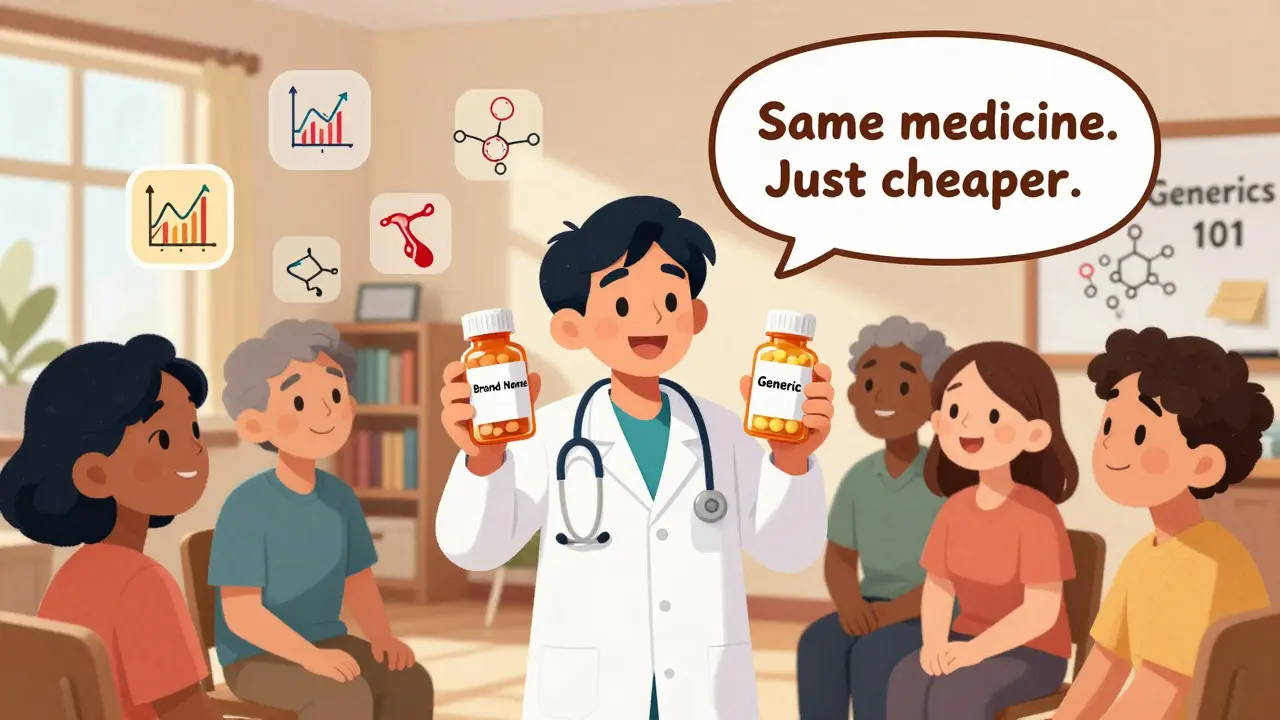
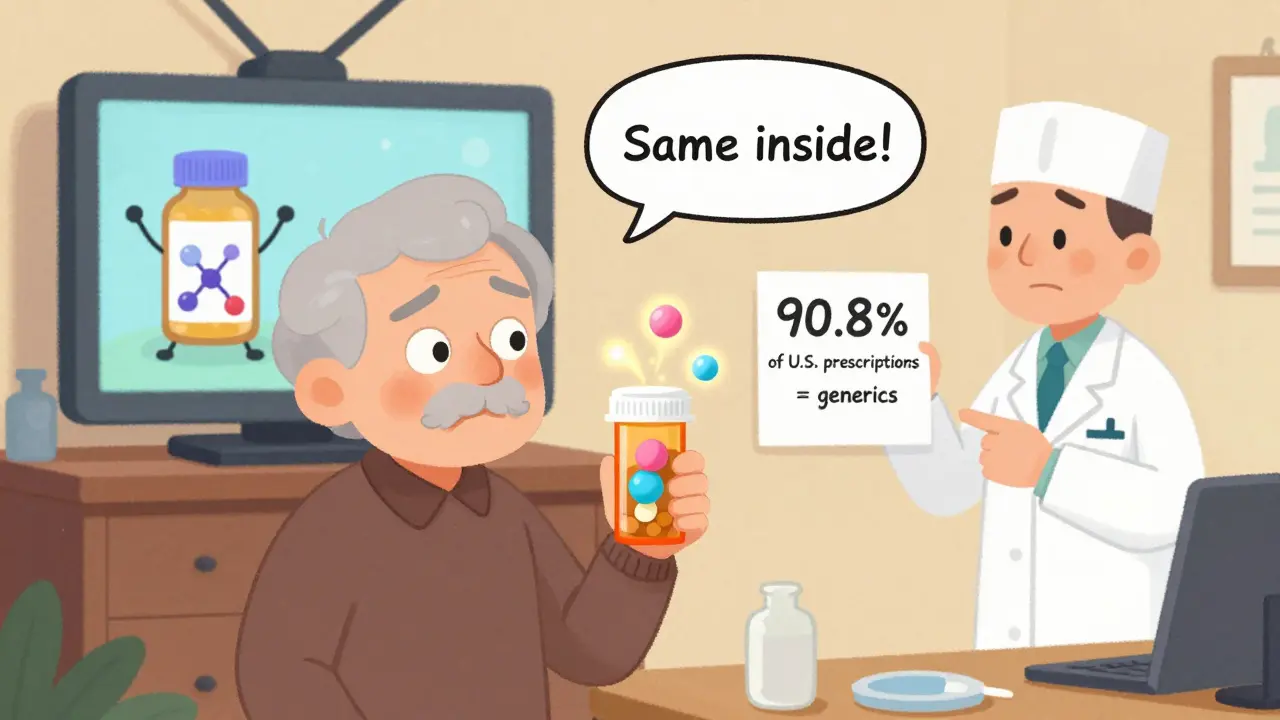
Every year, over 6.8 billion prescriptions are filled in the U.S. - and 90.8% of them are for generic drugs. Yet, many patients still hesitate to take them. Why? Because they’ve been told, or they’ve assumed, that generics are weaker, less safe, or not as good as the brand-name versions. This isn’t true. But misinformation sticks. That’s why community health presentations on generic drugs matter - and why they’re more urgent now than ever.
What Are Generic Drugs, Really?
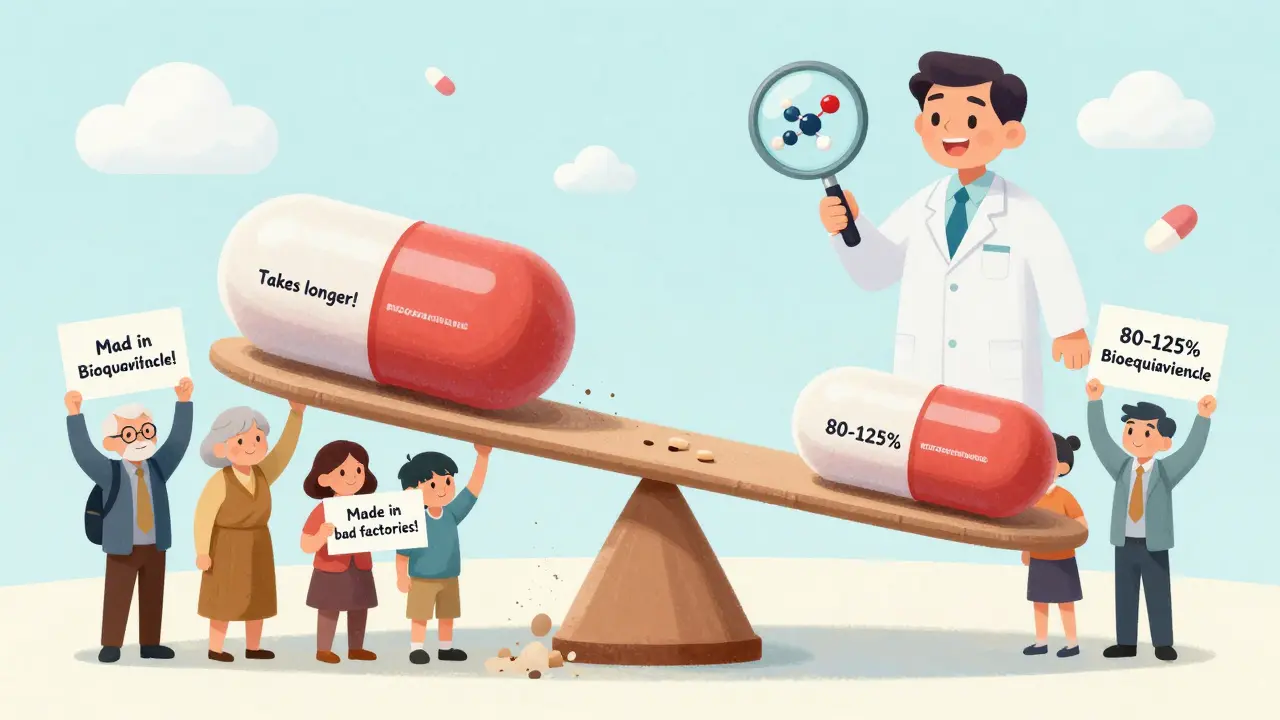
A generic drug isn’t a copy. It’s not a knockoff. It’s the exact same medicine, legally required to have the same active ingredient, strength, dosage form, and route of administration as the brand-name version. The FDA doesn’t approve generics based on trust - it requires hard proof. Every single generic must pass a bioequivalence test: it must deliver 80% to 125% of the active ingredient into the bloodstream compared to the brand-name drug. That’s not a guess. It’s measured using blood tests that track how much of the drug is absorbed (AUC) and how fast it peaks (Cmax). If it doesn’t hit that range, it doesn’t get approved.
Think of it like this: if you take a brand-name blood pressure pill and a generic version, your body absorbs and uses them the same way. The only differences are in the inactive ingredients - things like color, shape, or filler. Those don’t affect how the medicine works. They just make the pill look different.
Why Do People Doubt Generics?
It’s not about science. It’s about perception. A 2016 CVS Health survey found that 87% of patients had at least one misconception about generics. Common ones? "Generics take longer to work." "They’re made in inferior factories." "They cause more side effects."
Here’s the truth: the same factories often make both brand-name and generic drugs. The FDA inspects them all - and they follow the same strict rules. A 2022 FDA report showed that over 70% of generic drug manufacturing sites are the same as those producing brand-name versions. The difference? Price. Generics cost 80-85% less. That’s why they make up 9 out of 10 prescriptions.
But here’s where it gets tricky: appearance. A 2022 University of Michigan survey of 1,247 patients found that 23% stopped taking their generic because it looked different from the last pill they got. They didn’t know the pill’s shape or color could change between manufacturers - even if the drug inside was identical. That’s why community health workers need to show patients the actual pills. A picture, a handout, even holding the bottle side-by-side - it breaks the myth faster than any speech.
What the Data Really Says
Let’s look at real-world outcomes. In cardiovascular drugs - like statins or blood pressure pills - generic use is over 95%. Why? Because doctors prescribe them, and patients see results. No confusion. No side effects. Just lower bills.
But in mental health? Only 68% of prescriptions are filled with generics. Why? Because patients fear change. A 2022 JAMA Internal Medicine study showed that when doctors simply said, "This generic is just as good as the brand," patient acceptance jumped from 52% to 89%. One sentence. That’s all it took.
Even more telling: a 2021 Annals of Internal Medicine study found that when patients were told they were switching to a generic, they reported side effects 18.7% more often - even though they were actually taking the same drug. This is called the "nocebo effect" - when expecting something bad makes you feel it. Education isn’t just about facts. It’s about changing fear into trust.
How Community Health Presentations Work
The FDA’s Generic Drugs Stakeholder Toolkit gives community health workers clear, tested methods. One of the most powerful? The "Teach-Back" method. Instead of saying, "Generics are safe," you ask: "Can you tell me in your own words why this generic is the same as the brand?" If they can explain it back, they’ve learned it. If not, you clarify. Simple. Effective.
One community health center in Burlington started using this method in 2021. Within six months, patient acceptance of generics rose by 37%. Why? Because they didn’t just hand out pamphlets. They talked. They listened. They showed patients their own prescriptions side-by-side.
Another tactic? Use visuals. The FDA’s "Generics 101" video series - launched in 2023 - shows side-by-side comparisons of brand and generic pills, explains bioequivalence with simple animations, and features real patients who switched without issue. It’s designed for older adults, especially Medicare beneficiaries. Preliminary data shows viewers aged 65+ improved their knowledge retention by 31%.
When Generics Aren’t the Same - And When They Are
There’s one area where exceptions are debated: epilepsy. A 2023 study in Epilepsy & Behavior found a 12.7% higher chance of seizure recurrence when patients switched from brand to generic antiepileptic drugs. But here’s the full picture: the American Academy of Neurology reviewed over 100 studies and concluded this is an extremely rare exception - not a rule. They still endorse generics as the standard of care.
Why does this happen? For some complex drugs - like inhalers, topical creams, or injectables - small differences in how the drug is delivered can matter. But even here, the FDA requires extra testing. These aren’t "simple" generics. They’re complex formulations, and they’re still held to the same high bar.
The takeaway? For 98% of medications - pills, tablets, capsules - generics are identical. The exceptions are rare, studied, and tightly regulated. They don’t undermine the rule. They confirm it.
Cost Matters - A Lot
Generics saved the U.S. healthcare system $377 billion in 2022 alone. That’s not a number. That’s thousands of people who didn’t have to choose between medicine and rent. For low-income patients, switching to a generic can mean the difference between taking medication daily or skipping doses. A 2021 study in Health Affairs tracking 3.2 million patients found that switching to generics improved adherence by 22% in low-income groups.
And it’s getting bigger. Between 2023 and 2028, 287 brand-name drugs will lose patent protection. That means more generics will hit the market. More savings. More access. But only if people know to ask for them.
What’s Changing in 2025
Starting January 1, 2025, Medicare Part D plans will be required to give every beneficiary standardized educational materials about generics. That’s not a suggestion. It’s the law. And it’s a big deal. Millions of older adults will get clear, consistent information directly from their insurance.
Meanwhile, the Association for Accessible Medicines has distributed over 2.7 million brochures through community health centers nationwide. The National Association of Community Health Centers now requires all patient counseling sessions to include a generic drug education component - starting January 2024.
This isn’t about pushing generics. It’s about making sure people know what they’re taking - and why it’s safe, effective, and affordable.
What You Can Do
If you’re a patient: Ask your pharmacist. Ask your doctor. "Is there a generic?" Don’t assume it’s not available. Don’t assume it’s inferior. Ask for the facts.
If you’re a community health worker: Use the FDA’s toolkit. Show patients the pills. Use the Teach-Back method. Don’t just tell - explain, then ask them to explain back. Use visuals. Keep it simple.
If you’re a provider: When you prescribe a generic, say so. Say it confidently. Say, "This is just as good as the brand, and it’ll save you money." That one sentence changes behavior.
Generics aren’t a compromise. They’re the standard. And with over 90% of prescriptions already filled with them, the system is already working. The missing piece? Understanding.
Are generic drugs as safe as brand-name drugs?
Yes. The FDA requires generic drugs to have the same active ingredient, strength, dosage form, and route of administration as the brand-name version. They must also meet the same strict manufacturing standards. Every generic must pass a bioequivalence test, proving it delivers the same amount of medicine into the bloodstream as the brand. The FDA inspects all manufacturing sites - whether they make brand or generic drugs - and holds them to identical quality rules.
Why do generic pills look different from brand-name pills?
The difference in shape, color, or size comes from inactive ingredients - like dyes or fillers - which don’t affect how the drug works. By law, generic manufacturers can’t copy the exact appearance of the brand-name pill to avoid trademark issues. But the active ingredient, dosage, and effect are identical. If you notice a change in your pill’s appearance, ask your pharmacist. It’s normal and safe.
Do generics take longer to work?
No. Generics must meet the same bioequivalence standards as brand-name drugs, meaning they are absorbed at the same rate and to the same extent. Clinical studies measure how quickly the drug reaches peak levels in the blood (Cmax) and how much is absorbed over time (AUC). If a generic doesn’t match the brand within the 80-125% range, it’s not approved. There’s no delay in effectiveness.
Can I trust generics made in other countries?
Yes. The FDA inspects all manufacturing facilities - whether they’re in the U.S., India, China, or elsewhere - before approving a generic drug. The same quality standards apply globally. The European Medicines Agency and other international regulators use identical bioequivalence rules. Over 37 countries recognize the same standards. The location doesn’t change the safety or effectiveness - only the cost.
Why do some doctors still prescribe brand-name drugs?
Sometimes, it’s habit. Or they’re unaware of the latest data. In rare cases - like with certain epilepsy or thyroid medications - doctors may prefer to stick with one version to avoid potential variability. But for 98% of drugs, generics are equally effective. The American Medical Association and the Academy of Managed Care Pharmacy both support physician-led education to increase patient trust in generics. If your doctor doesn’t mention generics, ask: "Is there a generic option?"
Do generics cause more side effects?
No. Clinical studies show no increase in side effects with generics compared to brand-name drugs. In fact, a 2021 study found that when patients were told they were switching to a generic, they reported more side effects - even though the drug was identical. This is the "nocebo effect" - a psychological response to belief, not chemistry. The medicine itself hasn’t changed.
How much money can I save with generics?
On average, generics cost 80-85% less than brand-name drugs. For example, a $300 monthly brand-name prescription might drop to $50 as a generic. In 2022, generics saved the U.S. healthcare system $377 billion. For patients on fixed incomes, that can mean the difference between taking medication daily or skipping doses.
Are there any drugs where generics aren’t recommended?
For the vast majority of drugs - including antibiotics, blood pressure pills, diabetes meds, and antidepressants - generics are fully recommended. The only area with occasional debate is epilepsy, where a small number of studies noted slightly higher seizure risk after switching. But major medical groups like the American Academy of Neurology confirm this is extremely rare. The FDA and global regulators still approve generics for these drugs based on strict testing. Always discuss concerns with your doctor, but don’t assume generics are unsafe.
Next Steps
If you’re a patient: Ask your pharmacist or doctor about generic options. Don’t assume you’re being offered the best choice - ask. Request a pill comparison if the appearance changed.
If you’re a community health worker: Download the FDA’s Generic Drugs Stakeholder Toolkit. Use the Teach-Back method. Show visuals. Keep it simple. Track your results - many centers saw patient acceptance rise by over 30% in under six months.
If you’re a provider: Make generics part of your routine counseling. Say, "This generic works the same way and will save you money." That simple phrase changes behavior. And if a patient refuses, don’t push. Ask why. Listen. Then explain again - with facts, not jargon.
Generics aren’t a second choice. They’re the standard. And when people understand that, they take their medicine - and stay healthy.
Comments
Susan Purney Mark
Just wanted to say I showed my mom this last week - she’s 72 and on 5 meds, all generics. She was convinced the blue pill was "weak" because it looked different from the old white one. I printed out the FDA side-by-side pics and showed her the active ingredient names matched. She cried. Said she’d been skipping doses because she thought she was getting "second-rate stuff." Now she takes them all. Thank you for this.
March 7, 2026 at 03:59
Patrick Jackson
Wow. This is one of those posts that makes you pause and think: how did we let marketing hijack medicine? 🤔
Think about it - we accept that a $50 generic insulin works just as well as a $300 brand, but we still flinch when the pill looks different. It’s not science. It’s branding. We’ve been trained to equate price with power, quality with packaging. The real tragedy? People die because they can’t afford the color they’re used to. We need more of this. Not just info - visual, tactile, human proof.
March 8, 2026 at 02:50
Pranay Roy
90.8% generics? LOL. You really believe the FDA? I work in pharma supply chain. The "bioequivalence" tests? They’re rigged. Labs get paid by the manufacturers. The same factories? Yeah, but they switch lines at night. One batch is brand, next batch is generic - no real quality control. And the FDA inspections? They’re scheduled. You think they don’t clean up before inspectors show up? 🤨
Also - most generics are made in China. You really think your blood pressure med is safe if it’s made in a factory with no English-speaking inspectors? Wake up.
March 9, 2026 at 12:57
Andrew Poulin
Generics work. Period. Stop overthinking. Your body doesn’t care if the pill is blue or white. It cares if the molecule is there. If your doctor prescribes it, it’s good. If your pharmacist fills it, it’s safe. Ask for the generic. Save money. Take your meds. Done.
March 10, 2026 at 20:36
Sean Callahan
okay but like… i just got my blood pressure script switched to generic and i swear i felt weird for like 3 days?? like dizzy and kinda panicky?? i thought it was the meds but then i read this and i’m like… wait… is this in my head?? i’m so embarrassed i didn’t trust it. i feel like an idiot. but also… why does this even happen?? why do we think a different color means a different drug?? 😭
March 12, 2026 at 01:16
phyllis bourassa
Ugh. I love how everyone here is acting like this is some groundbreaking revelation. We’ve known this for decades. The real issue? Doctors don’t educate. Pharmacists don’t explain. Insurance companies don’t incentivize. And now we’re acting like a pamphlet and a side-by-side photo is going to fix systemic neglect? 🙄
Also - the 12.7% seizure increase in epilepsy? That’s not "rare." That’s a red flag. And you’re dismissing it because it’s "rare"? That’s not science. That’s wishful thinking.
March 12, 2026 at 19:49
Ferdinand Aton
Wait - so you’re saying generics are just as good… but then you admit there’s a 12.7% higher seizure risk with epilepsy meds? So which is it? Are they identical? Or are they not? Pick a story.
March 14, 2026 at 08:27
William Minks
As someone who grew up in India and now lives in the U.S., I’ve seen both sides. In India, generics are the only option - and they save lives. In the U.S., we treat them like they’re suspect. The truth? The science is global. The FDA, EMA, WHO - they all use the same standards. The only difference? Culture. We’ve been sold a myth. Time to let it go. 💪🌍
March 14, 2026 at 14:39
Jeff Mirisola
My dad had a stroke in 2020. He was on 7 meds. 6 were generics. He’s still here. He didn’t know the difference until I showed him the bottle. He said, "I thought I was cheating myself by taking the cheap one."
He’s alive because he took them. Not because they were expensive. Because he took them.
That’s the real story. Not the science. Not the FDA. The fact that people live when they take their pills. And generics make that possible. So let’s stop overcomplicating it. Just take the damn pill. And thank the system that made it affordable.
March 15, 2026 at 12:57
Write a comment