

Corticosteroids are one of the most powerful tools doctors have to calm down an overactive immune system. If you’ve been diagnosed with an autoimmune disease like rheumatoid arthritis, lupus, or vasculitis, you’ve likely heard about them. They work fast-sometimes within hours-to reduce swelling, pain, and damage caused by your body attacking itself. But they’re not a cure. And using them for months or years comes with serious risks you need to understand.
How Corticosteroids Work
Corticosteroids, like prednisone and methylprednisolone, are synthetic versions of cortisol, the hormone your adrenal glands make naturally. When your body’s under stress, cortisol helps manage inflammation. Doctors use these drugs to mimic that effect, but at much higher levels.
They don’t just mask symptoms. They shut down the inflammation process at the molecular level. Corticosteroids bind to receptors inside cells and turn off genes that produce inflammatory proteins like tumor necrosis factor-alpha and interleukins. They also block enzymes like phospholipase A2, which triggers a chain reaction of swelling and tissue damage. This is why they’re so effective in conditions like severe asthma, skin rashes from lupus, or inflamed joints in rheumatoid arthritis.
Unlike other immunosuppressants-like methotrexate or azathioprine-that take weeks to kick in, corticosteroids work fast. That’s why they’re often the first line of defense when a flare hits. A patient with rapidly progressive kidney damage from vasculitis might get daily IV methylprednisolone pulses to stop the bleeding in their kidneys before adding slower-acting drugs like cyclophosphamide.
When They Work Best
Corticosteroids aren’t equally useful for every autoimmune disease. They’re highly effective for conditions where inflammation is the main driver of symptoms:
- Rheumatoid arthritis: Reduces joint swelling and pain
- Systemic lupus erythematosus (SLE): Controls kidney inflammation and skin rashes
- Inflammatory bowel disease (IBD): Helps manage flare-ups of Crohn’s or ulcerative colitis
- Multiple sclerosis: Used during acute relapses to shorten duration
- Autoimmune hemolytic anemia: Often combined with rituximab for better results
- Granulomatosis with polyangiitis (formerly Wegener’s): Life-saving in early stages
But they don’t work for all. In advanced type 1 diabetes, where most insulin-producing cells are already dead, corticosteroids won’t bring them back. The same goes for Hashimoto’s thyroiditis or advanced primary biliary cholangitis-by the time the damage is complete, suppressing inflammation doesn’t restore function. Early-stage cases, though, where some cells are still alive, may respond better.
Short-Term Benefits: Why Doctors Prescribe Them
For many patients, corticosteroids are a lifeline. A person with severe asthma who can’t breathe might get a short course of prednisone and feel better in 24 hours. Someone with a painful skin rash from lupus might see it fade in days. In emergencies-like sudden vision loss from giant cell arteritis-high-dose steroids can prevent permanent damage.
Doctors aim for specific goals: reducing protein in the urine (a sign of kidney inflammation), improving lung function in vasculitis, lowering muscle enzyme levels in polymyositis, or normalizing blood counts in autoimmune cytopenias. When these markers improve, it means the treatment is working.
Even better, corticosteroids are often used as a bridge. They give doctors time to introduce slower-acting, safer drugs like methotrexate or biologics like rituximab. Once those take over, the steroid dose can be lowered-or stopped entirely.
Long-Term Risks: What No One Tells You
Here’s the hard truth: the longer you take corticosteroids, the more your body pays the price. Even low doses over time can cause serious problems.
Osteoporosis is one of the most common. Steroids interfere with bone-building cells and increase calcium loss. Up to 40% of long-term users develop fractures. That’s why doctors now routinely prescribe calcium, vitamin D, and bisphosphonates alongside steroids-even if you’re young.
Cataracts and glaucoma are also common. Many patients don’t realize their blurry vision or eye pressure is steroid-related until it’s advanced. Regular eye checks are non-negotiable if you’re on steroids for more than three months.
Weight gain and moon face (round, puffy cheeks) happen because steroids change how your body stores fat and retains fluid. Blood sugar can spike, turning prediabetes into full-blown diabetes. Some people gain 10-20 kilograms in a few months.
Adrenal insufficiency is the silent danger. Your body stops making its own cortisol because the pills are doing the job. If you suddenly stop taking steroids, your body can’t respond to stress-like an infection or surgery. That can lead to a life-threatening drop in blood pressure. That’s why you never quit cold turkey. Tapering off slowly, under supervision, is essential.
Other risks include thinning skin that bruises easily, muscle weakness, mood swings, insomnia, and increased infection risk. Even something as simple as a cold can turn into pneumonia.
Minimizing Harm: The Modern Approach
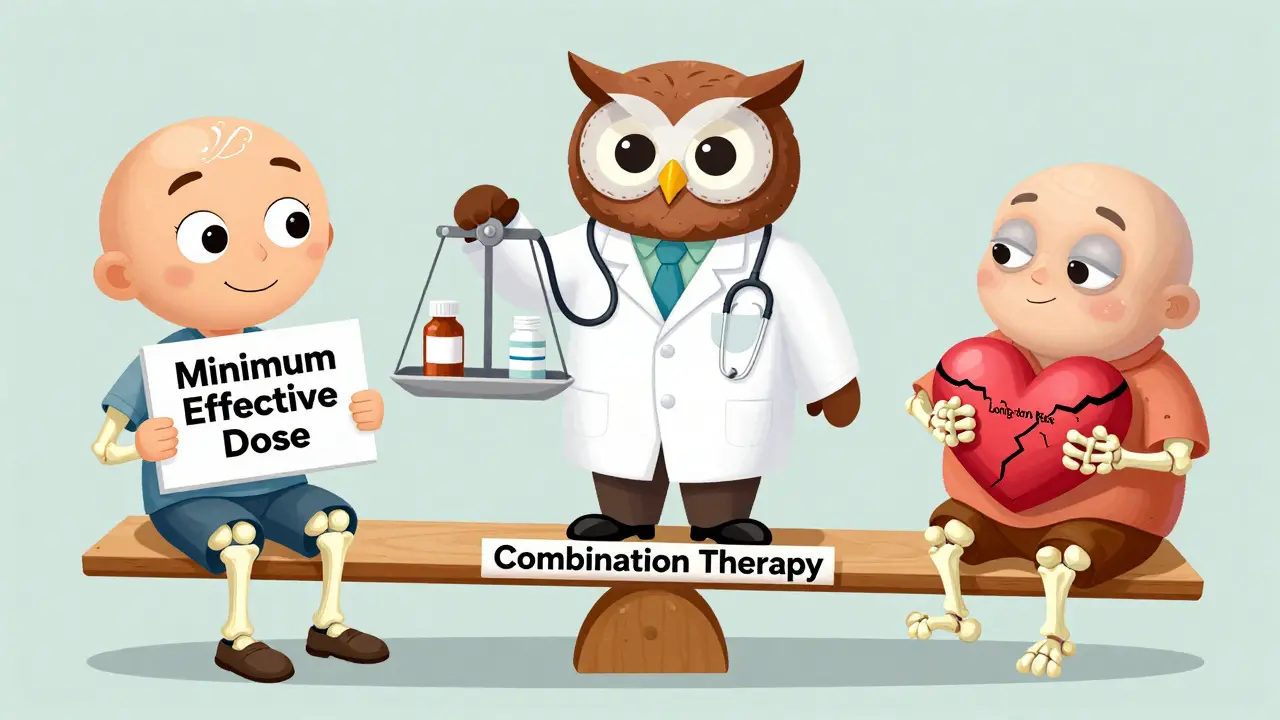
Today’s treatment isn’t about taking steroids for life. It’s about using them as little as possible, for as short as possible.
The goal is called minimum effective dose. That means finding the lowest amount that keeps your disease under control. For some, it’s 5 mg of prednisone every other day. For others, it’s 2.5 mg. Doctors now use blood tests, imaging, and symptom tracking to adjust doses precisely.
Combination therapy is key. Adding drugs like methotrexate, azathioprine, or biologics like rituximab allows doctors to cut steroid doses by half-or more. One study showed that combining prednisone with rituximab doubled the time patients stayed in remission compared to prednisone alone.
Topical versions help too. For skin conditions like psoriasis or eczema, creams and ointments deliver the drug right where it’s needed, avoiding the body-wide effects. Inhalers for asthma do the same for the lungs.
Even the timing matters. Taking steroids in the morning mimics your body’s natural cortisol rhythm and reduces the chance of adrenal suppression. Evening doses? They’re linked to worse side effects.

What to Do If You’re on Long-Term Steroids
If you’ve been on corticosteroids for more than three months, here’s what you need to do:
- Get a bone density scan (DEXA) every year
- See an eye doctor annually for glaucoma and cataract screening
- Monitor your blood sugar and blood pressure regularly
- Take calcium (1,200 mg) and vitamin D (800-1,000 IU) daily
- Avoid NSAIDs like ibuprofen-they increase stomach bleeding risk
- Carry a medical alert card that says you’re on steroids
- Never skip a dose or stop suddenly without your doctor’s plan
Also, protect your skin. Steroids make you more sensitive to sunlight. Use broad-spectrum sunscreen daily, even in winter. Wear hats and long sleeves. Skin changes-like darkening or thinning-are common and preventable.
The Future: Moving Beyond Steroids
Research is shifting away from relying on corticosteroids alone. New drugs like JAK inhibitors and B-cell depleters (e.g., rituximab) are becoming first-line for many conditions. In some cases, they’re replacing steroids entirely.
Scientists are also exploring targeted therapies that mimic the anti-inflammatory effects of steroids without the side effects. One promising target is GILZ, a protein that mediates cortisol’s benefits. If a drug can activate GILZ directly, it might control inflammation without suppressing the whole immune system.
For now, corticosteroids remain unmatched in speed and power. But they’re no longer the endgame. They’re the starter pistol-getting you through the first lap so you can hand off to safer, longer-lasting treatments.
Can corticosteroids cure autoimmune diseases?
No. Corticosteroids suppress inflammation and calm immune attacks, but they don’t fix the underlying cause of autoimmune diseases. They’re used to control symptoms and prevent damage, not to cure. Once you stop taking them, the disease often returns unless another long-term treatment is in place.
How long can you safely take prednisone?
There’s no fixed limit, but the goal is always to use the lowest dose for the shortest time possible. Short courses (under 3 weeks) carry minimal risk. Long-term use (over 3 months) requires close monitoring for bone loss, eye problems, and adrenal suppression. Many patients stay on low doses for years, but only when absolutely necessary and with protective measures in place.
Do corticosteroids cause weight gain even at low doses?
Yes. Even low doses (5 mg or less daily) can cause fluid retention and increased appetite, leading to gradual weight gain over time. The effect is more noticeable with longer use. Managing diet, reducing salt intake, and staying active can help, but the body’s metabolism changes with steroids-so weight gain is common even with careful habits.
Are there alternatives to corticosteroids for autoimmune diseases?
Yes. Many newer drugs are now preferred for long-term use, including methotrexate, azathioprine, mycophenolate, rituximab, and JAK inhibitors. These work slower but have fewer side effects than long-term steroids. The trend is to use steroids only to control flares, then switch to these safer options for maintenance.
Can you stop corticosteroids cold turkey?
Never. Stopping suddenly can trigger adrenal crisis-a life-threatening drop in blood pressure, severe fatigue, vomiting, and confusion. Your body needs time to restart its own cortisol production. Tapering is done slowly, over weeks or months, based on your dose, duration, and health status. Always follow your doctor’s plan.
Do corticosteroids affect mental health?
Yes. Steroids can cause mood swings, anxiety, irritability, insomnia, and even depression or psychosis in some people. These effects are more common at higher doses and usually improve when the dose is lowered. If you notice major changes in mood or sleep, talk to your doctor-they may adjust your dose or add support.
Why do some autoimmune diseases not respond to corticosteroids?
Corticosteroids work by reducing inflammation, but some diseases cause irreversible damage before inflammation becomes the main problem. In advanced type 1 diabetes or end-stage primary biliary cholangitis, the cells that produce insulin or bile are already gone. Suppressing immune attacks won’t bring them back. In these cases, steroids offer no benefit and only add risk.
Can corticosteroids cause diabetes?
Yes. Steroids increase blood sugar by making the liver release more glucose and reducing insulin sensitivity. People with prediabetes or a family history of diabetes are at higher risk. Blood sugar should be checked regularly during treatment. In many cases, blood sugar returns to normal after stopping steroids, but some people develop permanent type 2 diabetes.
Final Thoughts
Corticosteroids are powerful, fast-acting, and often life-saving. But they’re not gentle. Every pill you take chips away at your bones, your eyes, your metabolism, and your natural hormone balance. The best outcome isn’t just controlling your disease-it’s controlling your steroid use. Work with your doctor to get off them as soon as safely possible. Use them as a bridge, not a permanent home. And never underestimate the importance of monitoring, prevention, and alternative treatments. Your future self will thank you.
Comments
Bryan Wolfe
Man, I was on prednisone for 18 months after my vasculitis flare-felt like a different person. Moon face, weight gain, insomnia… but I was alive. I didn’t realize how much my body had shut down until I started tapering. Now I’m on rituximab and down to 2.5mg every other day. It’s a trade-off, but worth it. Don’t let fear stop you from using them when you need them-but don’t get comfy with them either.
January 12, 2026 at 09:18
Sumit Sharma
Let’s be clear: corticosteroids are not therapeutic-they are palliative bandages on a hemorrhaging wound. The molecular suppression of TNF-alpha and IL-6 is pharmacologically elegant, but it’s akin to disabling the fire alarm while the building burns. The real paradigm shift lies in targeted immunomodulation: B-cell depletion, JAK inhibition, and GILZ pathway agonism represent the next generation. Steroids are the 1970s of autoimmune therapy-outdated, toxic, and unnecessarily systemic.
January 13, 2026 at 00:25
Jay Powers
I’ve seen patients on steroids for years and it breaks my heart. But I’ve also seen them come back from the edge because of it. It’s not black and white. The key is awareness. Get your bone scan. See the eye doctor. Watch your sugar. Talk to your rheumatologist about alternatives. You’re not weak for needing them-you’re smart for managing them.
January 14, 2026 at 05:30
Lawrence Jung
Everyone talks about the side effects like they’re some kind of cosmic punishment. But what if the body’s inflammation is the real enemy? What if steroids are just the blunt instrument we’re stuck with because we haven’t figured out how to reprogram the immune system without breaking everything else? We’re still playing whack-a-mole with autoimmunity. Steroids are the hammer. Maybe we need better tools. But until then, don’t romanticize suffering. Sometimes the hammer saves your kidneys.
January 15, 2026 at 18:23
Alice Elanora Shepherd
As a nurse who’s managed steroid patients for over 15 years, I can’t stress enough: the morning dosing is critical. And yes, even 5mg daily causes bone loss. I’ve had 32-year-olds with vertebral fractures because they didn’t get their DEXA scans. Please, if you’re on this long-term-take your calcium, get your eyes checked, and don’t ignore the mood changes. They’re not ‘just stress.’
January 16, 2026 at 22:07
Christina Widodo
Wait, so if I’m on 5mg of prednisone every other day and I’ve been doing it for two years, am I still at risk for cataracts? I thought low dose meant low risk. Also, does taking it with food help with the stomach issues? I’m trying to figure this out without bugging my doctor every week.
January 18, 2026 at 02:33
Prachi Chauhan
My mom took steroids for lupus. She gained 40 pounds. Her face looked like a balloon. She cried every night because she didn’t recognize herself. But she could walk again. So we didn’t complain. Now she’s off them, thanks to methotrexate. It’s not about the drug. It’s about the life you get back. Even if it costs you your reflection.
January 18, 2026 at 17:22
Katherine Carlock
I thought steroids were just for allergies until I needed them for my RA. Now I’m on a 5mg every other day plan and I’m trying to get off. It’s hard. But I’m doing it-for my bones, my eyes, my sanity.
January 19, 2026 at 16:25
Write a comment