
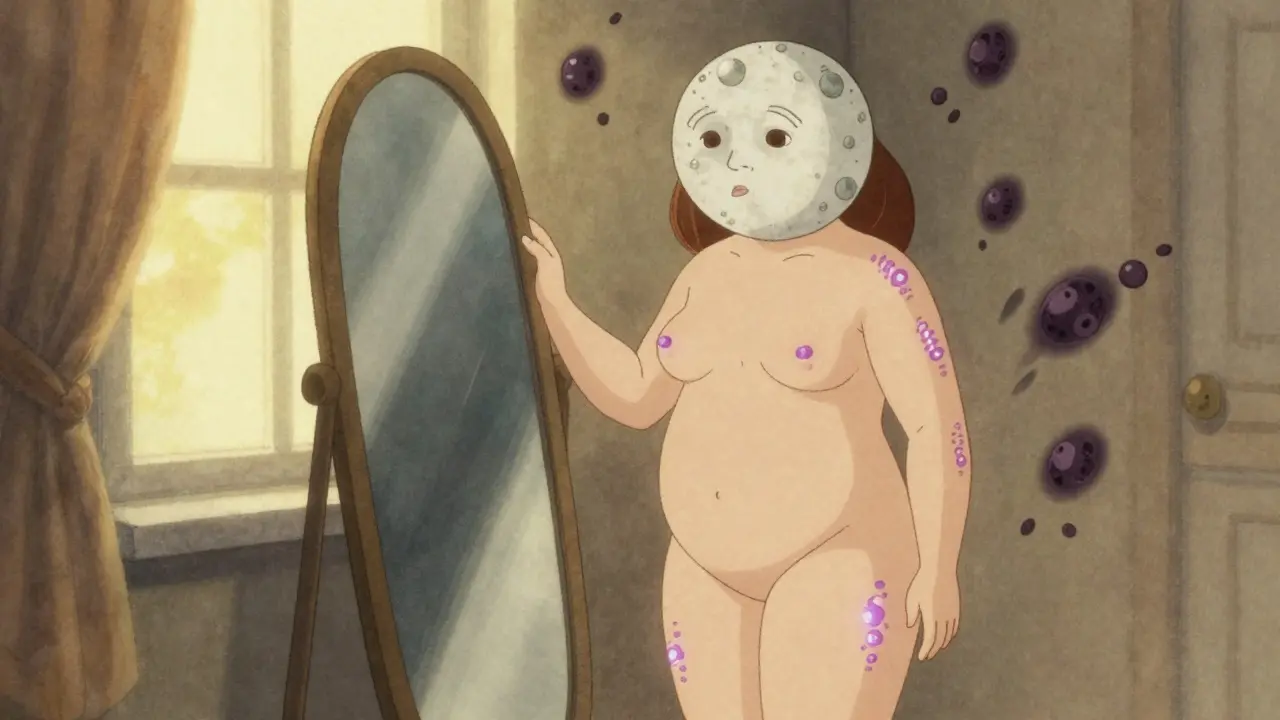
When your body makes too much cortisol - the stress hormone that keeps you alert, regulates blood sugar, and controls inflammation - it doesn’t just make you feel tense. It rewires your body. Your face swells into a round, moon-like shape. Fat piles onto your belly while your arms and legs stay thin. Purple stretch marks appear on your skin like bruises that won’t fade. Your bones weaken. Your blood pressure spikes. You get tired all the time, even after sleeping. This isn’t just being overweight or stressed. This is Cushing’s syndrome.
First identified in 1912 by neurosurgeon Harvey Cushing, this rare condition affects only 10 to 15 people per million each year. But for those who have it, the impact is life-altering. Most cases come from internal overproduction of cortisol - not from taking too many steroid pills. That’s the key difference. When the problem comes from inside your body - from a tumor in your pituitary gland, adrenal gland, or somewhere else - surgery becomes the best shot at a cure.
What Causes Cushing’s Syndrome?
Cushing’s syndrome isn’t one disease. It’s a set of symptoms caused by too much cortisol over a long time. About 80% of cases come from outside the body - people taking high-dose steroids for conditions like asthma, lupus, or after organ transplants. But the other 20%? That’s endogenous Cushing’s. That’s when your body makes too much on its own.
The most common cause - making up 60 to 70% of endogenous cases - is a small, noncancerous tumor in the pituitary gland. This tumor pushes out too much ACTH, the hormone that tells your adrenal glands to produce cortisol. This version is called Cushing’s disease. It’s most common in women between 20 and 50. The second most common cause is a tumor on one adrenal gland (15-20% of cases). These tumors make cortisol directly, ignoring the body’s normal signals. Less than 10% come from tumors in other places - like the lungs or pancreas - that accidentally start pumping out ACTH. These are called ectopic tumors.
What makes this tricky is that cortisol levels can bounce around. One test might look normal. That’s why doctors don’t rely on just one blood test. They use a combo: late-night saliva cortisol (normal is under 0.14 mcg/dL), a 24-hour urine test (normal is 5-25 mcg/24h, but Cushing’s pushes it over 50), and a dexamethasone suppression test. If your cortisol stays high after taking a low dose of dexamethasone, that’s a red flag.
Physical Signs You Can’t Ignore
Doctors don’t just test blood. They look. And they see patterns.
- Moon face: Round, red, puffy cheeks - seen in 70% of patients.
- Buffalo hump: A fatty hump between the shoulders - present in 90% of cases.
- Central obesity: Belly fat grows while arms and legs stay skinny. Weight gain of 20-30% is common.
- Violaceous striae: Purple or red stretch marks wider than 1 cm - found in 75% of people.
- Thinning skin: Bruises easily, cuts take forever to heal.
- High blood pressure: Affects 85% of patients.
- Diabetes or prediabetes: 70% develop glucose intolerance.
- Bone loss: Half of patients have osteoporosis with T-scores below -2.5.
These aren’t random symptoms. They’re the direct result of cortisol flooding your system for months or years. It breaks down muscle, stores fat in the wrong places, weakens bones, and keeps your blood pressure high. Left untreated, the risk of heart attack, stroke, or serious infection climbs sharply.
Why Surgery Is the First-Line Treatment
Medications exist - drugs like pasireotide or mifepristone - but they’re not cures. They’re bandaids. They lower cortisol temporarily, but they don’t remove the tumor. And they cost $5,000 to $10,000 a year. Plus, side effects like liver damage, fatigue, and nausea are common.
Surgery is different. It’s the only way to remove the source. The Endocrine Society, the American Association of Neurological Surgeons, and the Mayo Clinic all agree: if a tumor is found and surgery is possible, that’s the best first step.
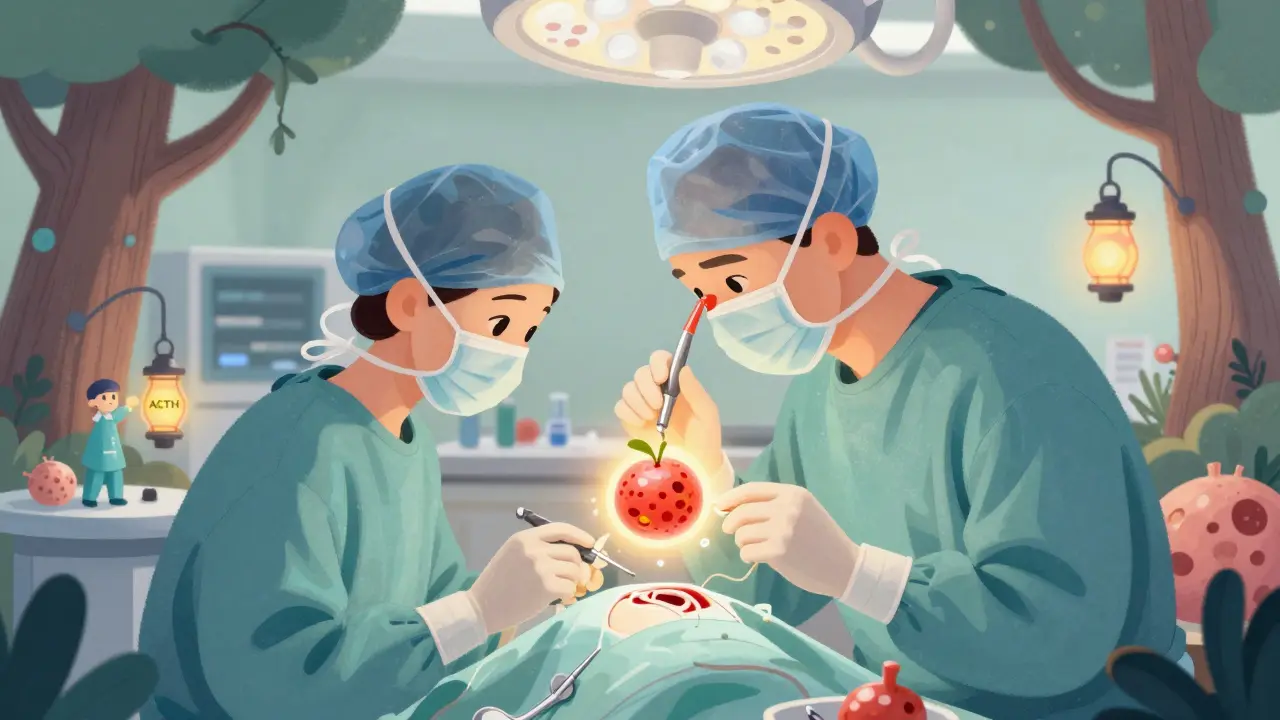
For pituitary tumors (Cushing’s disease), the go-to surgery is transsphenoidal. That means the surgeon goes through the nose or upper lip, not through the skull. It’s minimally invasive. The procedure takes 2 to 4 hours. Most patients are out of the hospital in 2 to 5 days. Success rates? For small tumors under 10 mm, remission hits 80-90%. For larger ones, it drops to 50-60%. But here’s the catch: it matters where you have it done. Surgeons who do fewer than 10 of these a year have remission rates as low as 50%. At high-volume centers - like Barrow Neurological Institute or Mayo Clinic - it’s 80-90%. Volume matters. A lot.
For adrenal tumors, the surgery is laparoscopic adrenalectomy. Small cuts, a camera, and the adrenal gland is removed. It takes 1 to 2 hours. Hospital stay? Often just one night. Success rate? 95%. Complication rates are low - under 5%. But if both adrenal glands are removed (rare, only for severe cases), you’ll need lifelong hormone replacement. And there’s a 40% risk of Nelson’s syndrome - a fast-growing pituitary tumor that can develop after both glands are gone.
What Happens After Surgery?
Surgery isn’t the end. It’s the beginning of a new phase.
When you remove the tumor, your body stops making cortisol. Suddenly. That’s a problem. Your adrenal glands have been sleeping for years. They need time to wake up. So right after surgery, you’ll get steroid replacement - usually hydrocortisone. Most people need it for 3 to 6 months. About 10% will need it forever. This isn’t optional. If you skip a dose during illness, injury, or stress, you can go into adrenal crisis - low blood pressure, vomiting, confusion, even coma.
Patients have to learn to adjust their dose during sickness. If you get the flu, you might need to double or triple your dose. If you have surgery or a broken bone, you need more. Many centers now use nurse coordinators to help patients manage this. Those with support see 95% adherence. Without it? Only 65% stay on track.
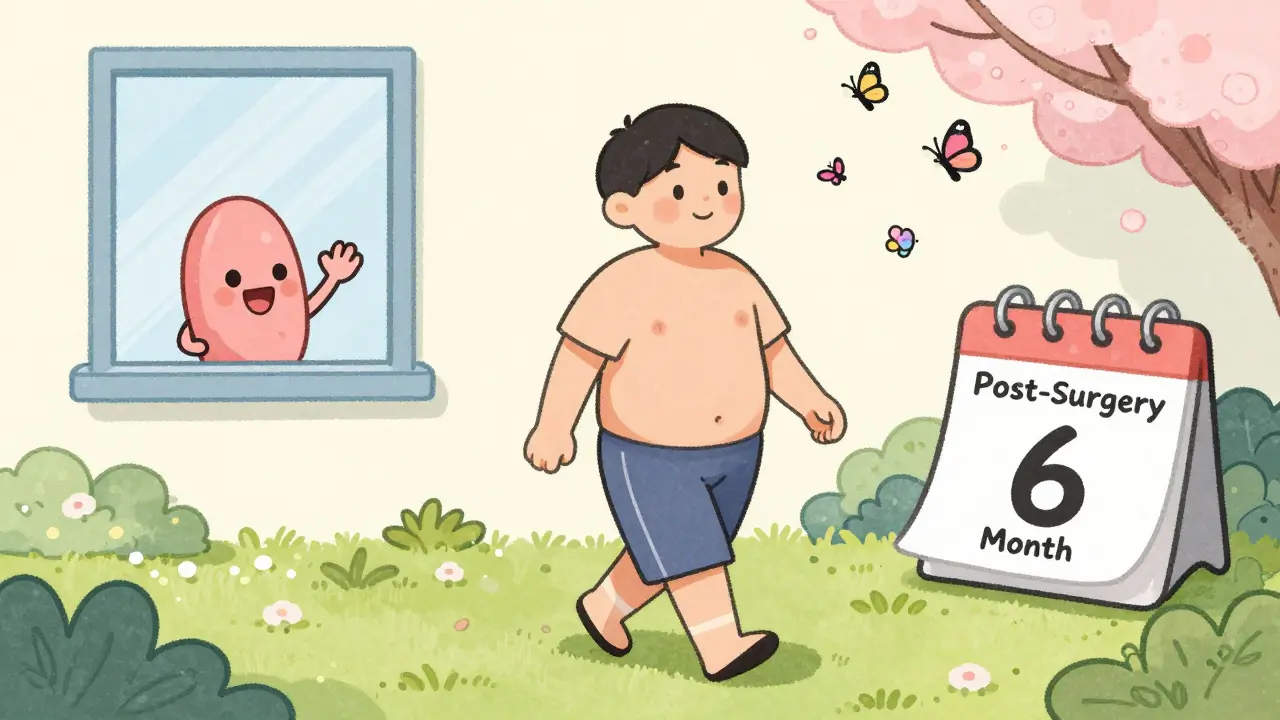
Recovery isn’t fast. It takes 3 to 6 months to feel like yourself again. Weight drops slowly. Skin heals. Blood pressure normalizes. One patient on a Cushing’s support forum wrote, “Two months after surgery, my moon face vanished. My blood pressure dropped without meds. I lost 40 pounds.” But another said, “I still feel exhausted. I need thyroid and testosterone now.” Recovery is different for everyone.
Success Rates and Long-Term Risks
After successful surgery, cortisol levels return to normal in 75-90% of cases. But remission isn’t always permanent. Recurrence happens in 10-25% of patients within 10 years. That’s why follow-up is critical. You need blood tests every few months for at least two years.
Even after successful surgery, your long-term risk of death is still 1.5 to 2 times higher than the average person. Why? Because years of high cortisol damaged your heart, bones, and immune system. That damage doesn’t vanish overnight. That’s why managing blood pressure, bone density, and glucose after surgery is just as important as the surgery itself.
Recent tech is helping. In 2023, the FDA approved a new intraoperative cortisol monitor. It gives surgeons real-time feedback during surgery - cutting down the time to confirm success from 7 days to 24 hours. That means shorter hospital stays. New 3D endoscopic tools are reducing CSF leaks by 40%. And in trials, a special PET scan using 11C-metomidate is finding tumors with 95% accuracy - up from 70%. These aren’t sci-fi. They’re here now.
Who Should Consider Surgery?
If you’ve been diagnosed with endogenous Cushing’s syndrome and a tumor has been found - pituitary, adrenal, or ectopic - surgery should be your first option. Not your last. Not your backup. Your first.
But you need to go to the right place. Don’t settle for a general hospital. Look for a center that does at least 20 pituitary surgeries a year. Ask: “How many Cushing’s cases do you treat annually?” If they don’t know, keep looking. Your odds of cure double at high-volume centers.
Timing matters too. The sooner you operate after diagnosis, the better. Studies show patients who have surgery within 18 months have 85% remission rates. Those who wait beyond 24 months? Only 65%. Delaying surgery doesn’t just mean more symptoms. It means more permanent damage.
And if surgery isn’t possible? Maybe your tumor is too risky, or you’re too sick to handle it? Then medical therapy becomes a bridge - not a destination. But it’s not the end goal. Surgery remains the only path to true recovery.
Living After Cushing’s
Most patients who have successful surgery report a huge improvement in quality of life. By 12 months, 85% say they feel like themselves again. Energy returns. Mood lifts. Skin clears. The weight comes off - slowly, but it does.
But the journey isn’t over. You’ll need to stay in touch with your endocrinologist. You’ll need to monitor your bones with DEXA scans. You’ll need to watch your blood pressure and sugar. You’ll need to carry a medical alert card in case of emergency. And you’ll need to tell every doctor you see - dentist, surgeon, ER staff - that you’re on steroid replacement.
It’s not easy. But for most, it’s worth it. One patient on Reddit wrote: “I’d do it again in a heartbeat. The fatigue was killing me. The osteoporosis was terrifying. Surgery gave me my life back.”
Cushing’s syndrome doesn’t have to be a life sentence. With the right diagnosis, the right surgery, and the right care, you can get back to living - not just surviving.
Can Cushing’s syndrome be cured without surgery?
Medications can lower cortisol levels and manage symptoms, but they don’t remove the tumor causing the problem. For endogenous Cushing’s - where the body makes too much cortisol on its own - surgery is the only treatment with a chance of cure. Drugs like pasireotide or mifepristone are used when surgery isn’t possible, or as a bridge before or after surgery. But long-term, they’re less effective and more expensive than removing the source.
How long does recovery take after Cushing’s surgery?
Recovery varies. Most people feel better in 3 to 6 months, but full recovery can take up to a year. Fatigue, mood swings, and weight changes linger as your body adjusts to normal cortisol levels. Adrenal glands need time to wake up after being suppressed for years. You’ll need steroid replacement during this time, and it’s common to taper off slowly over 3 to 6 months. Returning to work often takes 4 to 8 weeks for pituitary surgery and 2 to 4 weeks for adrenal surgery.
What are the risks of transsphenoidal pituitary surgery?
Transsphenoidal surgery is generally safe, but risks include cerebrospinal fluid (CSF) leak (2-5%), temporary or permanent adrenal insufficiency (30-40% temporary, 5-10% permanent), infection (1-3%), and damage to the pituitary gland leading to hormone deficiencies. In rare cases, there’s bleeding or vision changes. The risk of serious complications drops significantly when the surgery is done by a high-volume pituitary team - those performing 10+ cases per year.
Will I need to take hormones for the rest of my life after surgery?
It depends on the surgery. After pituitary surgery, most people need temporary steroid replacement for 3 to 6 months while their adrenal glands recover. About 10% need lifelong replacement. After bilateral adrenalectomy (removal of both adrenal glands), lifelong replacement of cortisol and aldosterone is required. After unilateral adrenal surgery, most people stop replacement within months, but some need it longer if the remaining gland is weak.
How do I know if my surgery was successful?
Success is measured by normal cortisol levels after surgery. Blood and urine tests are done 6 to 8 weeks post-op. If cortisol is low and ACTH is low (for pituitary cases), it’s a good sign. Imaging may be repeated to confirm tumor removal. Many centers now use intraoperative cortisol monitoring to check levels during surgery. Long-term success means cortisol stays normal for at least 6 months without medication. Recurrence is checked with yearly testing for up to 10 years.
Why is the hospital where I have surgery so important?
Surgeons who do more Cushing’s surgeries get better results. Centers performing fewer than 10 pituitary surgeries a year have remission rates as low as 50-60%. High-volume centers - those doing 20+ per year - achieve 80-90% remission. Experience matters. These centers have better imaging, more skilled anesthesiologists, specialized nursing teams, and protocols for managing post-op hormone shifts. Choosing the wrong hospital can mean a failed surgery, longer recovery, or needing repeat operations.
Comments
Aditya Kumar
This is way too much info. I skimmed it and my brain hurt. Just tell me if surgery works or not.
December 16, 2025 at 22:49
James Rayner
I read this whole thing... and I just want to hug everyone who's been through this. 🥺 The way cortisol rewires your body-it’s like your own cells turn against you. And then you have to relearn how to be human again after surgery. It’s not just medical. It’s existential.
December 17, 2025 at 16:14
Josias Ariel Mahlangu
People think medicine is magic. It’s not. This is the result of decades of neglect. If you’re not eating clean, sleeping right, and avoiding stress-you’re asking for this. Surgery won’t fix laziness.
December 18, 2025 at 14:26
Dave Alponvyr
Surgery? Yeah. But only if you’re going to a place that does 20+ a year. Otherwise you’re just paying to get poked with a needle and told to come back next week.
December 19, 2025 at 17:35
Cassandra Collins
Wait… so this is all caused by GMOs and 5G? That’s what my cousin’s acupuncturist said. Also, the government hides the cure because Big Pharma makes more money selling pills. I’ve been researching this for 3 years. I’m not crazy. I’m just informed.
December 19, 2025 at 21:21
Joanna Ebizie
Ugh. People still don’t know how to take care of themselves. You think this is hard? Try living with a thyroid issue AND diabetes AND depression. At least this one has a fix. Most of us are stuck with meds forever.
December 20, 2025 at 15:00
Elizabeth Bauman
America leads the world in medical innovation. No other country has this level of precision surgery or access to 11C-metomidate PET scans. If you’re not getting treated here, you’re choosing to suffer. And frankly, that’s un-American.
December 20, 2025 at 17:07
Dylan Smith
I’m curious how many people actually get diagnosed before they’re at the moon face stage. I feel like most people just think they’re gaining weight from stress or aging and never get tested. Is there a screening protocol? Or are we just waiting for people to look like they’ve been inflated by a balloon?
December 22, 2025 at 11:12
Mike Smith
Thank you for this comprehensive and meticulously researched overview. The clinical accuracy, coupled with the emphasis on institutional expertise and postoperative care, represents the gold standard in patient education. It is imperative that individuals diagnosed with endogenous Cushing’s syndrome pursue treatment at high-volume centers without delay. The data are unequivocal: early intervention by experienced teams significantly improves long-term outcomes and reduces the risk of irreversible morbidity. Your advocacy for timely surgical intervention is both clinically sound and profoundly compassionate.
December 22, 2025 at 15:08
Write a comment