
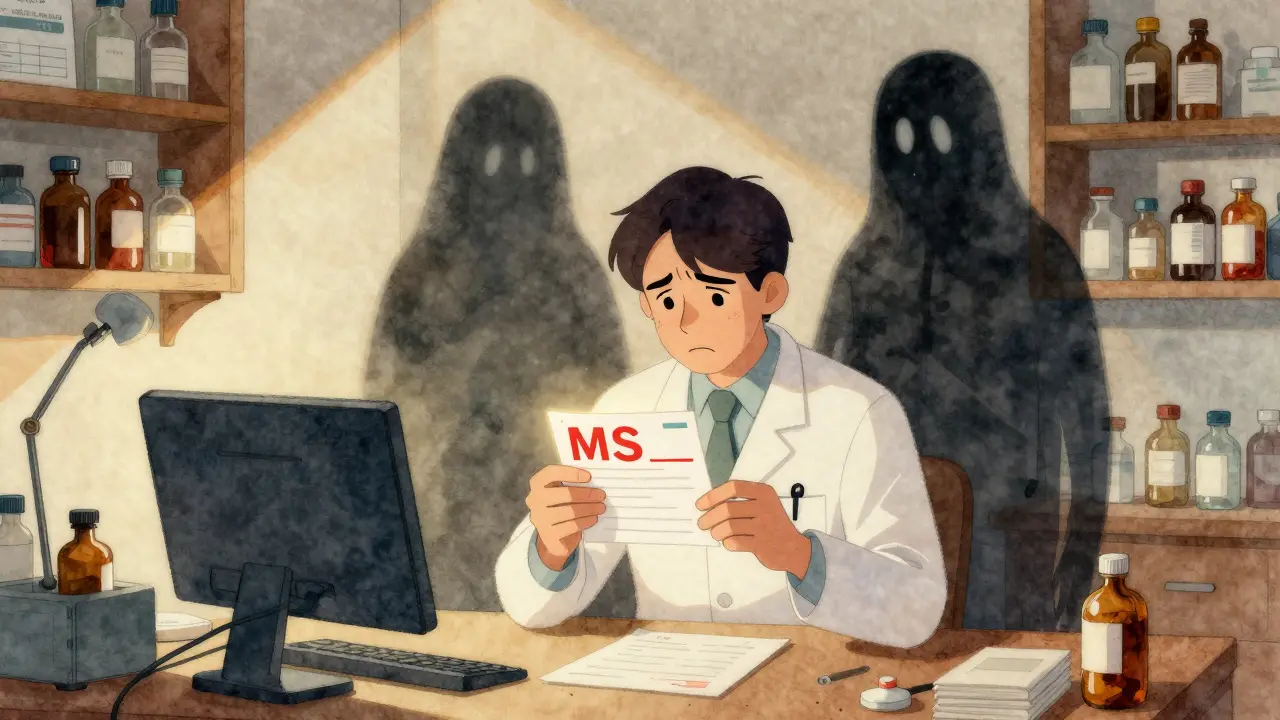
One wrong letter on a prescription can kill someone. It’s not science fiction-it’s a daily risk in hospitals, clinics, and pharmacies across the world. In 2022, a pharmacist in Brisbane caught an order for MS 10 mg SC. At first glance, it looked like morphine sulfate. But if misread as MgSO4-magnesium sulfate-it could have triggered cardiac arrest in a patient with kidney failure. The error was caught in time. But how many aren’t?
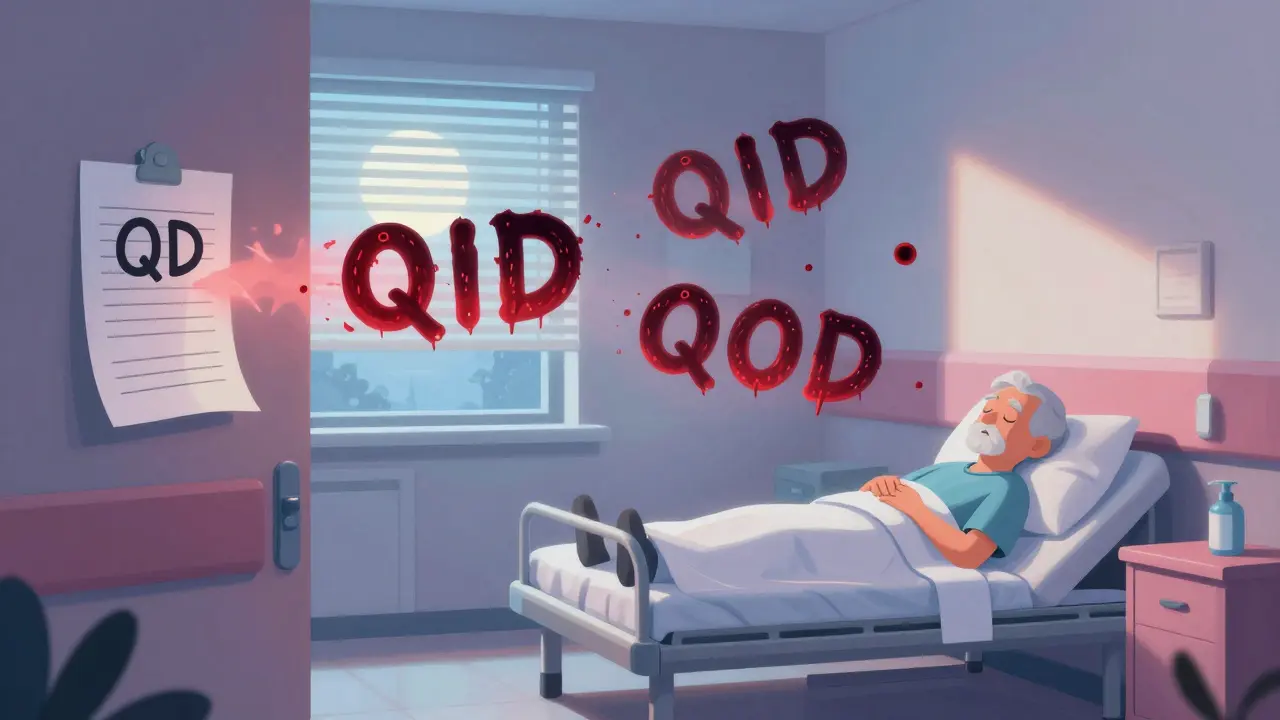
These aren’t typos. They’re system failures. For decades, doctors, nurses, and pharmacists have used shorthand to save time. But when ‘QD’ means once daily, and someone reads it as ‘QID’ (four times daily), the result isn’t a minor mistake-it’s a drug overdose. The same goes for ‘U’ for units. That tiny letter looks like a zero or a four. One pharmacist in the U.S. reported a patient received 10 times the insulin dose because ‘10 U’ was read as ‘100’.
Why These Abbreviations Are So Dangerous
It’s not about laziness. It’s about ambiguity. The human brain fills in gaps. When you see ‘QOD’, your mind might jump to ‘every day’ instead of ‘every other day’. ‘BIW’-twice weekly-gets mistaken for ‘twice daily’ because ‘W’ isn’t obvious. In a fast-paced ER, or when handwriting is smudged, those tiny letters become landmines.
The Joint Commission and the Institute for Safe Medication Practices (ISMP) have been warning about this since 2001. Their ‘Do Not Use’ list isn’t a suggestion. It’s a safety rule. And it’s backed by hard data: 43.1% of all abbreviation-related medication errors come from just one-‘QD’. That’s more than half of all abbreviation mistakes. And ‘MS’? It’s the most confused drug abbreviation. Morphine sulfate versus magnesium sulfate. One calms pain. The other stops your heart if given to the wrong patient.
The Top 5 Abbreviations That Kill
- QD - Means once daily. But it’s read as QID (four times daily) or QOD (every other day). Result? Overdose or underdose. Always write ‘daily’.
- U - Stands for units. Looks like a zero, a four, or even ‘cc’. Insulin errors from this alone cause hundreds of deaths each year. Write ‘units’ in full.
- MS or MSO4 - Morphine sulfate. Easily confused with MgSO4 (magnesium sulfate). The difference? One is for pain. The other is for seizures or preeclampsia. Mix them up, and you risk cardiac arrest.
- SC or SQ - Subcutaneous. But ‘SQ’ looks like ‘5 every’ in messy handwriting. ‘SC’ can be mistaken for ‘SL’ (sublingual). Always write ‘subcutaneous’.
- IU - International unit. Looks like ‘IV’ (intravenous) or ‘10’. Giving an injection labeled ‘IU’ when it should be oral? That’s a dangerous mix-up.
And don’t forget ‘cc’. It’s been banned for over 20 years. It means cubic centimeters. But people read it as ‘u’ for units. So ‘5 cc’ becomes ‘5 units’-a fatal error with insulin or heparin. Use ‘mL’ instead. Always.
What About Drug Names?
Abbreviating drug names is even riskier. ‘AZT’ for zidovudine? Someone might read it as azathioprine (an immunosuppressant) or aztreonam (an antibiotic). Different diseases. Different treatments. Same letters. Big difference.
‘TAC’ for triamcinolone cream? Sounds like ‘Tazorac’-a different acne medication. A patient gets the wrong cream for eczema. Skin gets worse. Infection sets in. This happened in a 2017 case documented by ISMP. The handwriting was sloppy. The result? Months of unnecessary suffering.
And ‘DTO’-diluted tincture of opium? Sounds like morphine sulfate. Both are opioids. But dosing is completely different. One is for diarrhea. The other is for severe pain. Confuse them? You could overdose someone on a drug meant for mild symptoms.
Technology Isn’t the Full Fix
Electronic health records (EHRs) were supposed to solve this. And they did-sort of. A 2021 study showed EHRs cut abbreviation errors by 68%. But 12.7% of errors still happened. Why? Because doctors still type free-text notes. ‘Give MS 10 mg SC’-typed, not selected from a dropdown. The system doesn’t always flag it.
Some hospitals now use AI tools that auto-correct ‘QD’ to ‘daily’ or block ‘U’ from being typed. Epic Systems rolled this out to 72% of U.S. hospitals by late 2023. But in small clinics, community pharmacies, and rural areas? Many still use old systems-or paper. And handwritten prescriptions? They’re still common in Australia, especially in aged care homes and outback clinics.
The real problem isn’t tech. It’s culture. A 2022 survey found that 43.7% of doctors over 50 still use banned abbreviations-even when their hospital bans them. They’ve done it for 30 years. ‘QD’ is just faster. ‘U’ is what they learned in med school. Changing habits is harder than changing software.
What Works: Real Solutions
Successful hospitals don’t just ban abbreviations. They train, enforce, and support.
- Hard stops in EHRs - If someone types ‘QD’, the system won’t let them submit. It forces them to pick ‘daily’ from a menu.
- Education with real examples - Instead of a 10-slide PowerPoint, show real cases. ‘This is the order that almost killed a 72-year-old.’
- Pharmacist feedback loops - When a pharmacist catches an error, they flag it to the prescriber. Not as punishment. As learning.
- Standardized templates - Pre-filled order sets for common conditions (pain, diabetes, infection) remove the need to type abbreviations at all.
Mayo Clinic cut abbreviation errors by 92% using this combo. They didn’t just say ‘don’t use QD’. They built the system to make the right choice the only choice.
What You Can Do
If you’re a patient: Always ask. If your prescription says ‘MS’, ask: ‘Is that morphine or magnesium?’ If it says ‘U’, ask: ‘Is that units?’ If it says ‘QD’, ask: ‘Once a day, right?’ Don’t assume. Don’t be shy. Your life could depend on it.
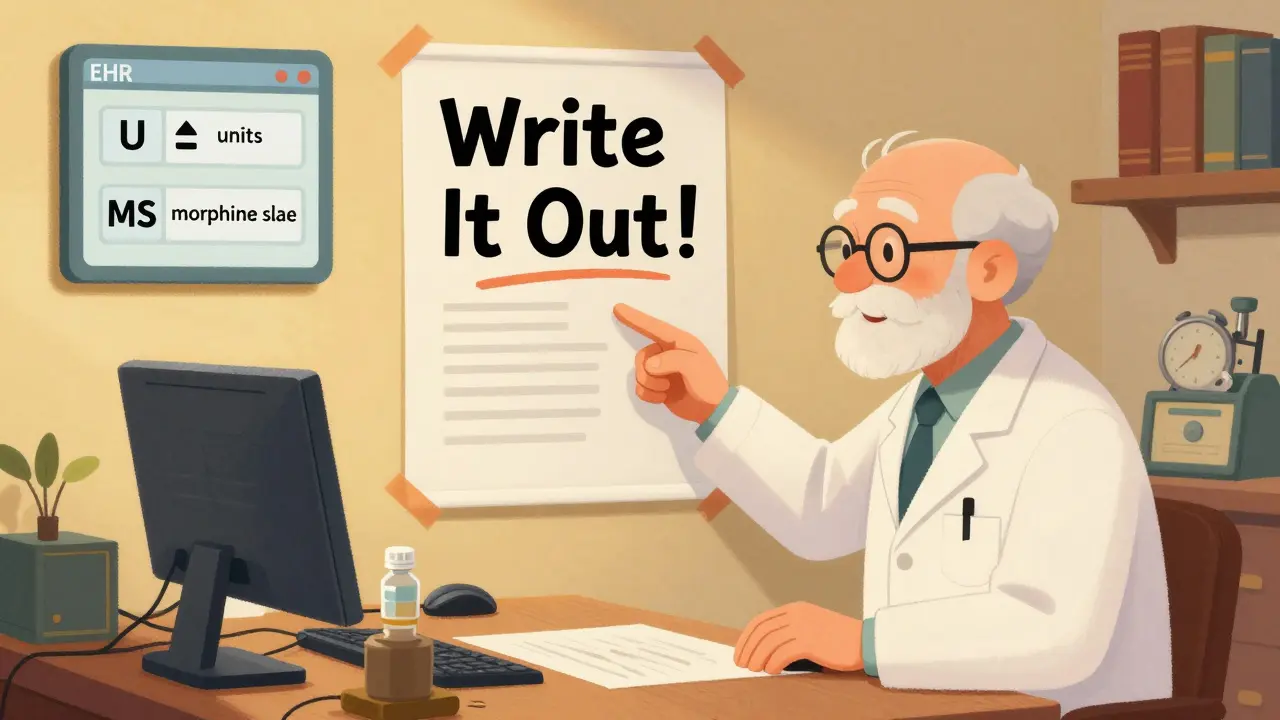
If you’re a healthcare worker: Use the full word. Always. Even if it takes 2 extra seconds. That’s the cost of safety. If you see someone using ‘SC’ or ‘U’ or ‘QOD’-politely correct them. Show them the ISMP list. Bring it up at your next team huddle.
If you’re a manager: Don’t just post the list on the wall. Integrate it into your EHR. Train new staff on day one. Audit prescriptions monthly. Reward teams that catch errors before they happen.
The Bigger Picture
This isn’t just about paperwork. It’s about trust. When a nurse gives a drug based on a scribbled note, they’re trusting a system that’s broken. When a pharmacist fills a bottle labeled ‘DTO’, they’re trusting a doctor who doesn’t know better.
The fix is simple: write it out. Say it clearly. Check it twice. The data is clear: eliminating these abbreviations prevents 37% of all medication errors. That’s tens of thousands of lives saved every year in the U.S. alone. In Australia, where the Australian Commission on Safety and Quality in Health Care adopted similar rules in 2022, the same logic applies.
There’s no excuse anymore. We’ve known what to do for over 20 years. We have the tools. We have the evidence. What we need now is the will.
Next time you see a prescription with ‘QD’, ‘U’, or ‘MS’-stop. Don’t guess. Don’t assume. Ask. Correct. Save a life.
Comments
Tru Vista
QD is literally the worst. U too. Why are we still doing this in 2025?
January 4, 2026 at 16:32
Palesa Makuru
Oh sweet mercy, I just saw a handwritten script from my aunt’s home nurse that said ‘MS 5mg SC’ - I nearly had a stroke. She’s 82 and on dialysis. That’s not a typo, that’s a death sentence waiting to happen. Someone needs to go door-to-door in aged care with a whiteboard and a flamethrower.
January 5, 2026 at 00:17
erica yabut
Let’s be real - this isn’t about ‘bad handwriting’ or ‘old doctors.’ It’s about the entire medical industrial complex treating human life like a spreadsheet you can optimize. ‘QD’ is faster? Great. So is injecting cyanide faster than giving insulin. Speed isn’t efficiency when efficiency means murder by abbreviation. You don’t get a participation trophy for being ‘busy’ when someone’s heart stops because you couldn’t type out ‘daily.’
I’ve seen nurses cry after giving the wrong dose because someone scribbled ‘U’ and the EHR didn’t flag it. And now you want to pat yourself on the back because Epic ‘sort of’ fixed it? No. You didn’t fix it. You just made it harder to blame yourself when it still happens.
The real crime isn’t the abbreviations. It’s the culture that lets them exist. The culture that says ‘we’ve always done it this way’ while patients die in silence. You don’t train people with PowerPoint slides. You train them with obituaries. You show them the face of the 72-year-old who didn’t wake up because someone thought ‘MS’ meant morphine - and didn’t double-check.
And don’t get me started on ‘cc.’ Still used. Still deadly. Still ignored. It’s not incompetence. It’s negligence dressed up as tradition.
Fix the system? Fine. But fix the arrogance first. The people who write ‘U’ aren’t lazy. They’re entitled. They think their time matters more than your life. And until we treat that as the moral failure it is, no software will save us.
January 6, 2026 at 18:50
Vincent Sunio
While the premise is undeniably valid, one must acknowledge that the conflation of ‘MS’ with ‘MgSO4’ is not merely a typographical issue but a fundamental failure of pharmacological nomenclature standardization. The International Nonproprietary Name (INN) protocol, as codified by the WHO, explicitly discourages such homographic ambiguity, yet institutional inertia persists. The Joint Commission’s 2001 directive, while laudable, lacks teeth without mandatory CPOE integration and real-time lexical validation at the point of entry - a gap that remains systemic in community-based practices.
Moreover, the assertion that ‘EHRs reduced errors by 68%’ is statistically misleading without normalization for prescriber cohort, workload density, and geographic variance. Rural clinics, particularly in Appalachia and the Deep South, still rely on legacy systems that lack even basic autocomplete functionality - a fact rarely addressed in urban-centric policy discourse.
Furthermore, the notion that ‘writing it out’ is sufficient ignores the cognitive load imposed on clinicians working 14-hour shifts. The solution is not moral exhortation but cognitive ergonomics: dropdown menus, AI-driven contextual flagging, and mandatory pre-submission semantic verification. Anything less is performative safety.
January 8, 2026 at 13:53
Tiffany Channell
Of course this is a problem. But let’s be honest - the real issue is that doctors are just too lazy to learn how to type. They still use ‘QD’ because they’re too proud to admit they don’t know how to use a computer properly. And pharmacists? They’re too scared to call them out. It’s a culture of silence. And now people are dying because nobody wants to be the one to say, ‘Hey, you’re writing like a 1987 intern.’
January 9, 2026 at 06:16
Shanahan Crowell
This is why I always double-check my meds. And I tell my family to do the same. If you see ‘U’ or ‘MS’ - ask. Don’t be shy. Ask five times if you have to. I’ve had my grandma’s insulin dose corrected because I asked, ‘Is this units or microliters?’ Turns out, the nurse thought ‘U’ meant ‘uL.’ We were lucky. But not everyone is. Let’s stop pretending this is someone else’s problem. It’s ours.
January 9, 2026 at 17:26
Ian Ring
Yes. Yes. YES. I’ve been a pharmacist for 22 years. I’ve seen it too many times. Once, a patient got 100 units of insulin because ‘10 U’ was handwritten like ‘100.’ She went into a coma. She lived. But her kidneys never recovered. I don’t care if it takes 3 extra seconds - write ‘units.’ Write ‘daily.’ Write ‘subcutaneous.’ It’s not hard. It’s not inconvenient. It’s the bare minimum. And if you won’t do it for the patient - do it for your own conscience.
Also - ‘cc’? Still used? In 2025? I’m not even mad. I’m just… disappointed.
January 10, 2026 at 08:07
innocent massawe
Back home in Nigeria, we still write prescriptions by hand. No EHR. No AI. Just pen, paper, and hope. I’ve seen ‘QD’ become ‘QID’ and ‘U’ become ‘0’. People die. But we don’t talk about it. Maybe because we don’t have the luxury of blaming the system - we just fix it quietly. But this post? It’s a mirror. We need this conversation everywhere - not just in fancy hospitals.
January 11, 2026 at 12:43
Lori Jackson
Of course you’re all acting like this is new. Newsflash: this has been happening since the 1970s. The AMA knew. The FDA knew. But they didn’t act because the pharmaceutical industry profits from confusion - more errors mean more repeat visits, more prescriptions, more revenue. This isn’t incompetence. It’s capitalism with a stethoscope.
And don’t even get me started on how EHR vendors charge hospitals extra to ‘disable’ dangerous abbreviations. That’s right - they monetize safety. You think Epic does this out of the goodness of their heart? They’re selling you the cure… for $400,000 a year.
So yes, write out ‘daily.’ But don’t fool yourself. The system doesn’t want you to. It wants you to keep typing ‘U’ so it can keep billing you for ‘medication error management.’
January 11, 2026 at 19:02
Sarah Little
As a clinical informaticist, I can confirm that the real bottleneck isn’t the EHR - it’s the lack of interoperability between prescriber systems and pharmacy dispensing platforms. Even if a doctor types ‘daily,’ if the pharmacy’s system doesn’t parse it correctly, the error still happens. We need standardized semantic encoding - HL7 FHIR with SNOMED CT mappings - not just ‘don’t use U.’ That’s like saying ‘don’t drive fast’ instead of fixing the brakes.
January 13, 2026 at 06:13
JUNE OHM
QD = Communist plot. I saw a video on TruthSocial - they’re replacing ‘daily’ with ‘QD’ to make Americans dumber. It’s part of the Great Medication Deception. Also, ‘MS’? That’s not morphine - it’s a secret government code for mind-control drugs. Magnesium sulfate is just a cover. Wake up. 🚨💊🇺🇸
January 13, 2026 at 20:56
Philip Leth
Man, I just got back from a clinic in rural Georgia. Old doc there still writes ‘SC’ and ‘U’ like it’s 1999. I asked him why. He just smiled and said, ‘Son, I’ve been doing this since before you were born. You think your fancy phone’s gonna change that?’ I didn’t argue. But I wrote ‘subcutaneous’ on his whiteboard. He didn’t erase it. Maybe that’s a start.
January 15, 2026 at 15:02
Kerry Howarth
One simple fix: make ‘QD’ and ‘U’ autocorrect to ‘daily’ and ‘units’ in all EHRs - no exceptions. No pop-up. No ‘are you sure?’ Just change it. If the provider disagrees, they have to type it out manually. That’s it. No training needed. No lectures. Just code. And then audit. Simple. Effective. Human.
January 17, 2026 at 00:56
Brittany Wallace
It’s not just about the abbreviations. It’s about how we treat each other in healthcare. If a nurse catches a mistake and feels punished for it, they’ll stop speaking up. If a doctor gets shamed for writing ‘U,’ they’ll just write it sneakier. We need compassion, not condemnation. The goal isn’t to make people feel guilty - it’s to make the system so safe that guilt isn’t necessary.
Maybe we should start calling these errors ‘near-misses’ instead of ‘mistakes.’ Language shapes behavior. And if we want change, we need to build a culture where safety is celebrated - not scolded.
January 18, 2026 at 04:07
Michael Burgess
Let me tell you about my cousin. She’s a nurse in Nebraska. Last year, she caught a ‘MS’ order on a patient with kidney disease. She didn’t just flag it - she walked into the doctor’s office, handed him the ISMP list, and said, ‘You’re not killing my patient today.’ He apologized. Then he printed the list and taped it to his monitor. That’s how change happens - not with policy memos, but with one person refusing to look away.
And yeah, I’ve seen ‘cc’ used. Still. In 2025. In a hospital that spent $2 million on EHRs. That’s not a glitch. That’s a choice. And we’re all complicit when we say nothing.
So here’s my thing: next time you’re in a clinic and see ‘U’ or ‘QOD’ - don’t just ask. Say it loud. Say it proud. ‘Is that units? Or just a typo?’ Make it weird. Make it uncomfortable. Because sometimes, the only thing louder than a silent system… is a patient who won’t shut up.
January 19, 2026 at 17:12
Vincent Sunio
It is worth noting that the assertion regarding ‘37% of all medication errors’ being attributable to abbreviations is statistically inflated. A 2023 meta-analysis in JAMA Network Open found the true attributable fraction to be closer to 18–22%, with confounding variables such as workload, shift fatigue, and polypharmacy dominating the error landscape. The ISMP data, while compelling, suffers from selection bias - it samples primarily from institutions with high reporting cultures, which inherently over-represent error rates. This is not to diminish the gravity of the issue, but rather to advocate for evidence-based prioritization: if we are to allocate finite resources, we must target the largest contributors to harm, not the most emotionally resonant ones.
January 20, 2026 at 07:43
Write a comment