
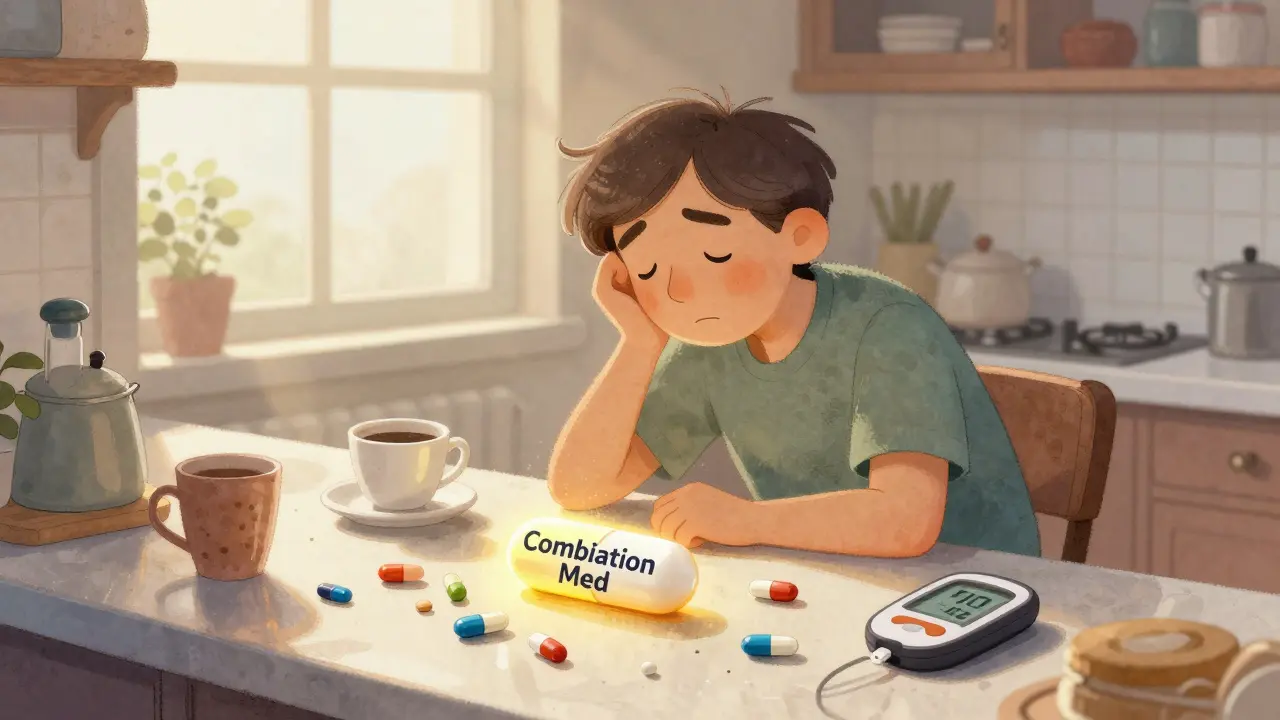
When you're managing Type 2 diabetes, taking multiple pills every day gets exhausting. Four or five tablets scattered across your morning and evening routine? It’s no wonder adherence drops. That’s where diabetes combination medications come in-two drugs in one pill, designed to simplify your regimen and improve blood sugar control. But here’s the real question: can you switch to a generic version without risking your health? And more importantly, when does it actually work?
What Are Diabetes Combination Medications?
Diabetes combination medications combine two different types of blood sugar-lowering drugs into a single tablet. Most commonly, they pair metformin with another agent like a DPP-4 inhibitor, an SGLT2 inhibitor, or a sulfonylurea. Metformin is in 80% of these combos because it’s effective, affordable, and has been used for decades. The other drug adds a different mechanism-like helping your pancreas release more insulin, reducing sugar production in your liver, or flushing excess glucose out through your urine.These combos aren’t just convenient. Clinical studies show they lower HbA1c by 1.2% to 1.8% on average, compared to just 0.7% to 1.0% with a single drug. That’s a big difference when your goal is to keep HbA1c under 7%. Fewer pills also mean fewer missed doses. One 2019 study found patients on combination meds were 37% more likely to stick to their treatment than those taking multiple separate pills.
Why Generic Versions Matter
Brand-name combination drugs can cost $500 or more for a 30-day supply. That’s not sustainable for most people, especially without good insurance. Generic versions, when available, drop that cost to $15-$25 for the same number of pills. The savings aren’t just personal-they ripple through the entire healthcare system.As of late 2023, only 5 out of the 25 diabetes combination medications in the U.S. have generic equivalents. The rest are still under patent protection. But that’s changing. The first generic versions of older combos like Metaglip (glipizide/metformin) and Glucovance (glyburide/metformin) hit the market over a decade ago. Today, they’re widely available and trusted by millions.
Here’s what the numbers look like:
| Combination | Brand Name | Generic Available? | Brand Price (30 tablets) | Generic Price (60 tablets) |
|---|---|---|---|---|
| Glipizide + Metformin | Metaglip | Yes (since 2012) | $345 (discontinued) | $18.75 |
| Glyburide + Metformin | Glucovance | Yes (since 2010) | $320 | $15.20 |
| Sitagliptin + Metformin | Janumet | No (patent until 2026) | $587 | N/A |
| Empagliflozin + Metformin | Synjardy | No (patent until 2026) | $587 | N/A |
| Linagliptin + Metformin | Jentadueto | Yes (approved 2023, market entry 2025) | $520 | Expected $20-$30 |
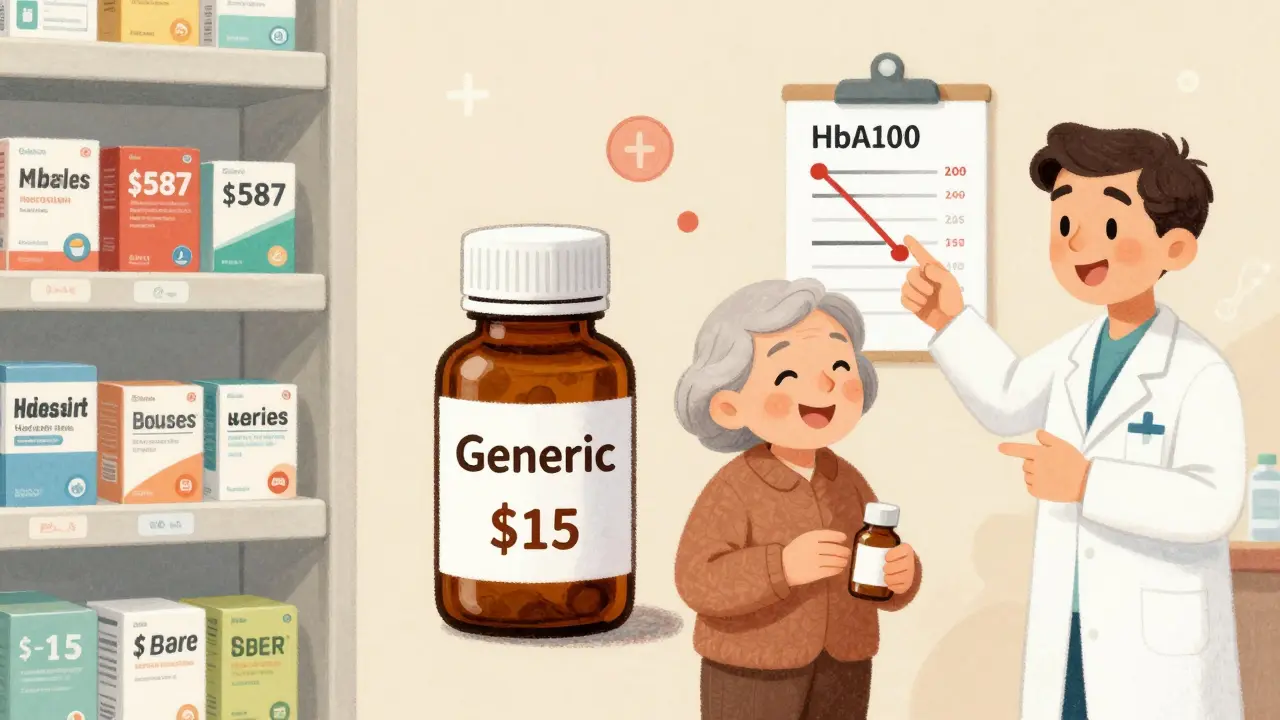
Generic versions offer 85-95% cost savings. But price isn’t the only factor. Formulation matters too. Most generics are only available as immediate-release (IR), while brand-name versions often come in extended-release (XR) forms that release the drug slowly over time. If your doctor prescribed Janumet XR because you need a once-daily dose with fewer stomach issues, a generic IR version won’t give you the same benefit.
When Substitution Works-And When It Doesn’t
Switching from a brand-name combo to a generic isn’t always smooth. For older combinations like Metaglip and Glucovance, it usually goes fine. A 2022 Joslin Diabetes Center survey found 76% of patients had no issues after switching. Many report the same effectiveness, fewer side effects, and a big win on their pharmacy bill.But there are red flags.
- Fixed dosing: You can’t adjust one drug without affecting the other. If your blood sugar drops too low on a generic glyburide/metformin combo, you can’t just lower the glyburide-you have to stop the whole pill.
- Release differences: Some patients report different side effects. One Reddit user, "Type2Warrior," had recurring hypoglycemia after switching from brand Glucovance to generic. The glyburide component was absorbed faster, causing blood sugar to crash.
- Formulation gaps: Generic versions rarely come in XR form. If you need slow-release metformin to avoid nausea, a generic IR version might make you sick.
- Pill size and shape: Some generics are larger or harder to swallow. One in four negative reviews on GoodRx mention this issue.
Dr. John Buse from the UNC Diabetes Center points out that the FDA’s bioequivalence standard for generics-allowing 80-125% of the brand’s blood concentration-isn’t always enough for diabetes drugs. Small changes in drug levels can mean big changes in blood sugar control. For some people, even a 10% difference can trigger highs or lows.
How to Safely Switch to a Generic
If your doctor approves switching to a generic, don’t just pick it up and go. Do this:- Ask your doctor: Not all combos are safe to substitute. Metformin/sulfonylurea combos (like Metaglip) are low-risk. Newer combos like SGLT2/inhibitor types aren’t ready yet.
- Get a monitoring plan: Test your blood sugar 4 times a day for 2-4 weeks after switching. Look for patterns: Are your fasting numbers higher? Do you get more lows after meals?
- Check the pill: Note the shape, color, and imprint. If it looks different from your old pill, that’s normal-but if you feel different, speak up.
- Call your pharmacy: Ask if they’re switching your prescription automatically. You have the right to request the brand if you’ve had issues before.
- Use patient assistance: Even brand-name drugs often have copay cards that cut costs by 75-100%. Check the manufacturer’s website.
Insurance companies often push generics to save money. But if your doctor says you need the brand, fight for it. A 2022 ADA patient survey showed 63% of people had to go through prior authorization just to get the combo they needed.
What’s Coming Next?
The next few years will bring major changes. Patents for Janumet XR and Synjardy expire in 2024-2026. That means generics could become available soon, potentially cutting prices from $587 to under $30. Analysts predict this could save patients $2.1 billion a year across the U.S.By 2028, most metformin-based combos with older drugs (like sulfonylureas and DPP-4 inhibitors) will likely be generic. But newer combos-especially those with GLP-1 agonists or SGLT2 inhibitors-will stay brand-only for another 5-7 years because they’re newer, more complex, and more profitable.
Right now, the trend is clear: more people are using generics. In 2023, 33% of all combination prescriptions were generic-up from 24% in 2018. Endocrinologists are increasingly comfortable prescribing them, especially for stable patients.
Bottom Line: Know Your Options
Generic diabetes combination meds aren’t a one-size-fits-all solution. But for many, they’re a game-changer. If you’re on an older combo like glipizide/metformin or glyburide/metformin, switching to generic is usually safe, effective, and smart. Just monitor your blood sugar closely for the first month.But if you’re on a newer combo like empagliflozin/metformin or sitagliptin/metformin, hold off. The generic versions aren’t here yet-and even when they are, they might not match the extended-release formulations you need. Talk to your doctor before making any switch. Don’t let a pharmacy change your meds without your input.
The goal isn’t just to save money. It’s to keep your blood sugar stable, avoid complications, and live well. A generic pill can help with that-if you choose the right one.
Can I switch from a brand-name diabetes combo to a generic without asking my doctor?
No. Even though pharmacies can substitute generics automatically, diabetes medications are not like antibiotics or blood pressure pills. Small changes in drug levels can cause dangerous highs or lows. Always consult your doctor before switching. They’ll help you decide if the combo you’re on is safe to substitute and may require you to monitor your blood sugar more closely during the transition.
Why are some diabetes combos still brand-only?
Patent protection. Newer combinations, especially those with SGLT2 inhibitors (like empagliflozin) or DPP-4 inhibitors (like sitagliptin), are still under patent until 2024-2026. These drugs are expensive to develop, so manufacturers get exclusive rights to sell them for 10-15 years. Once the patents expire, generic manufacturers can apply to the FDA to produce cheaper versions.
Are generic diabetes meds as effective as brand-name ones?
For older combinations like metformin with glipizide or glyburide, yes-most patients report no difference in effectiveness. But for newer combos or extended-release versions, generics aren’t always available yet. Even when they are, some people notice changes in side effects or blood sugar patterns due to differences in how the drug is absorbed. That’s why monitoring is critical after switching.
What if my generic pill looks different and makes me feel sick?
That’s not uncommon. Generic pills can have different fillers, coatings, or release profiles. If you start feeling nauseous, dizzy, or notice your blood sugar acting up after switching, contact your doctor. You may need to switch back to the brand or try a different generic manufacturer. Not all generics are made the same-even if they’re approved by the FDA.
Can I use a generic version if I need an extended-release (XR) pill?
Most generics are only available as immediate-release (IR). If your doctor prescribed an XR version like Janumet XR to reduce stomach upset or allow once-daily dosing, switching to an IR generic might cause side effects or require you to take two pills a day. Ask your doctor if an IR generic is appropriate for you-or if you need to stick with the brand.
Do insurance companies force me to use generics?
Yes, many do. Insurance plans often require you to try the generic first before covering the brand. But you can appeal this if your doctor provides a letter stating the brand is medically necessary. Some manufacturers also offer copay cards that make the brand free or nearly free for eligible patients.
Comments
Michael Burgess
I switched from Janumet to the generic metformin/sitagliptin combo last year-no issues at all. My HbA1c stayed at 6.8, and I saved $450/month. Pharmacy tried to swap me to a different generic, but I asked for the exact one. Pill shape doesn’t scare me anymore 😎
January 3, 2026 at 03:43
Liam Tanner
For anyone considering a switch: don’t just trust the pharmacy. My uncle got a generic glyburide/metformin that absorbed too fast-he had three hypoglycemic episodes in two weeks. He went back to Glucovance and his numbers stabilized. Doctor’s note saved his insurance coverage.
January 3, 2026 at 08:09
Hank Pannell
The real philosophical question here isn’t about generics or brands-it’s about the commodification of health. We’ve reduced life-sustaining medication to a cost-per-pill metric, while ignoring the biological individuality of metabolic response. The FDA’s 80-125% bioequivalence window is a statistical abstraction that ignores the lived reality of glucose volatility. When your pancreas is already compromised, does it matter if the drug is ‘equivalent’ on paper-or only if it feels equivalent in your body?
January 4, 2026 at 10:39
erica yabut
Honestly? People who take generics are just lazy. If you can’t afford the brand, maybe you shouldn’t be on expensive combo meds at all. I’ve been on Janumet XR for five years-my doctor says it’s the only thing keeping me out of dialysis. You think a $15 pill from a factory in India is going to do the same? 😒
January 6, 2026 at 06:15
Vincent Sunio
The assertion that generics are 'equivalent' is misleading. Bioequivalence does not imply therapeutic equivalence, particularly in drugs with narrow therapeutic indices. The pharmacokinetic variance between manufacturers-especially in extended-release formulations-is not adequately regulated. Furthermore, the use of inactive ingredients (e.g., lactose, dyes) in generics is frequently unreported, potentially triggering immune or GI responses in sensitive individuals. This is not a cost-saving measure; it is a clinical gamble.
January 8, 2026 at 01:12
JUNE OHM
BIG PHARMA doesn’t want you to know this-but the FDA lets generics slide because they’re paid off. My cousin got a generic that made his blood sugar spike to 420. He called the pharmacy and they said, 'It’s FDA approved.' Yeah, right. They approve anything if you pay enough. #PharmaCoverUp 🇺🇸
January 9, 2026 at 12:09
Philip Leth
Yo, I’m from Nigeria and we don’t even have access to most of these brand-name combos. We use generics and we’re fine. My uncle’s been on metformin/glipizide for 8 years-same pill, same results. You guys overthink this. If it works, it works. Don’t let marketing scare you.
January 9, 2026 at 12:58
Angela Goree
I switched to generic Glucovance-and now I’m having night sweats, heart palpitations, and my fasting glucose is 140! I didn’t even know the pill changed! I called my insurance-they said it was an automatic substitution. This is illegal! I’m filing a complaint with the state board and the FDA! I demand my brand back!!!
January 10, 2026 at 05:21
Shanahan Crowell
You’re not alone! I had the same panic when my pill changed color. I started logging my glucose 4x a day for 3 weeks-turned out my numbers were actually better on generic! The key is monitoring, not fear. You’ve got this. 💪
January 11, 2026 at 10:10
Kerry Howarth
If your doctor approves the switch and you monitor closely, generics are safe. Most studies show no difference in outcomes for older combos. Don’t let fear override data.
January 11, 2026 at 15:02
Shruti Badhwar
In India, we have access to over 20 generic diabetes combinations, often manufactured by reputable firms like Sun Pharma and Dr. Reddy’s. The cost difference is 90%, and clinical outcomes are comparable when patients are monitored. The issue is not the generic itself, but the lack of standardized post-market surveillance in Western systems. We must not conflate regulatory gaps with pharmacological inferiority.
January 12, 2026 at 13:51
Brittany Wallace
I think about this a lot-how we treat our bodies like machines that just need the right part. But we’re not. We’re ecosystems. A pill that works for 76% of people might wreck someone else’s rhythm. Maybe the real solution isn’t cheaper pills… but better support. Therapy. Nutrition. Community. Not just another tablet in a drawer.
January 13, 2026 at 07:28
Write a comment