
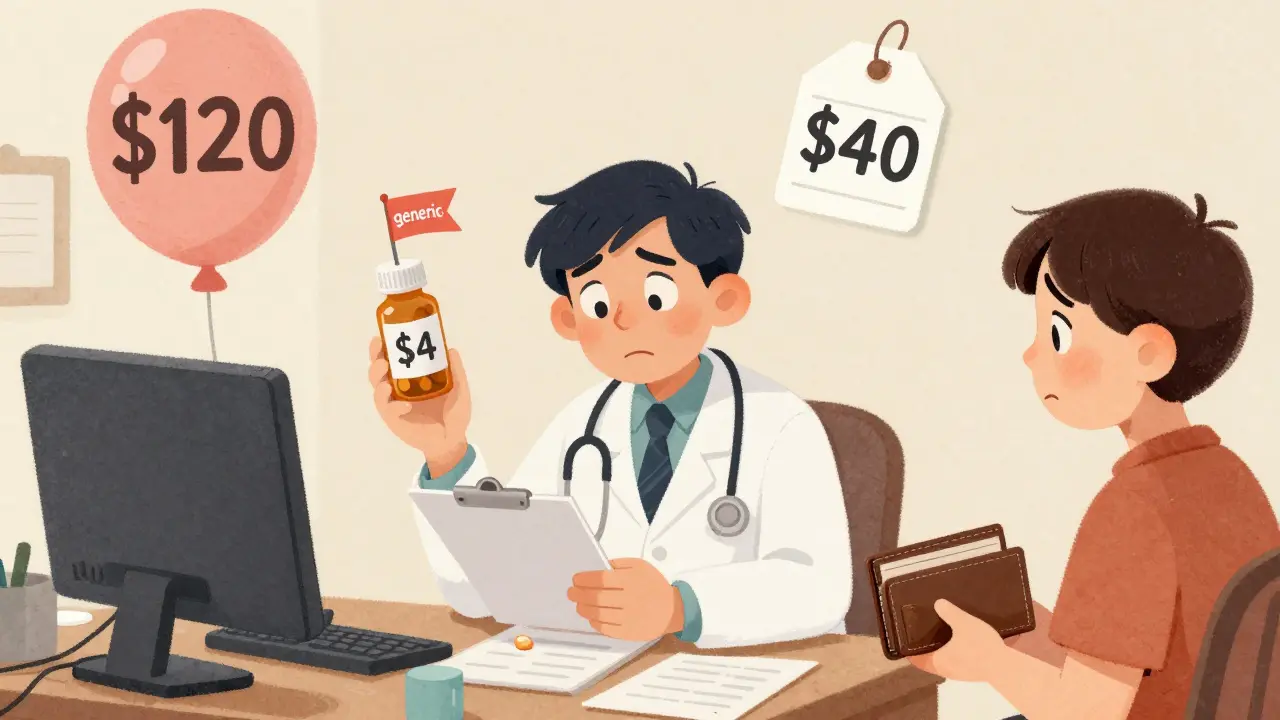
Imagine you’re a doctor. Your patient walks in with high blood pressure. You write a prescription for lisinopril - a generic, $4-a-month pill. But you think it costs $40. So you switch to a brand-name alternative you believe is cheaper, even though it’s actually $120 a month. This isn’t hypothetical. It happens more often than you think.
Doctors are bad at guessing drug prices
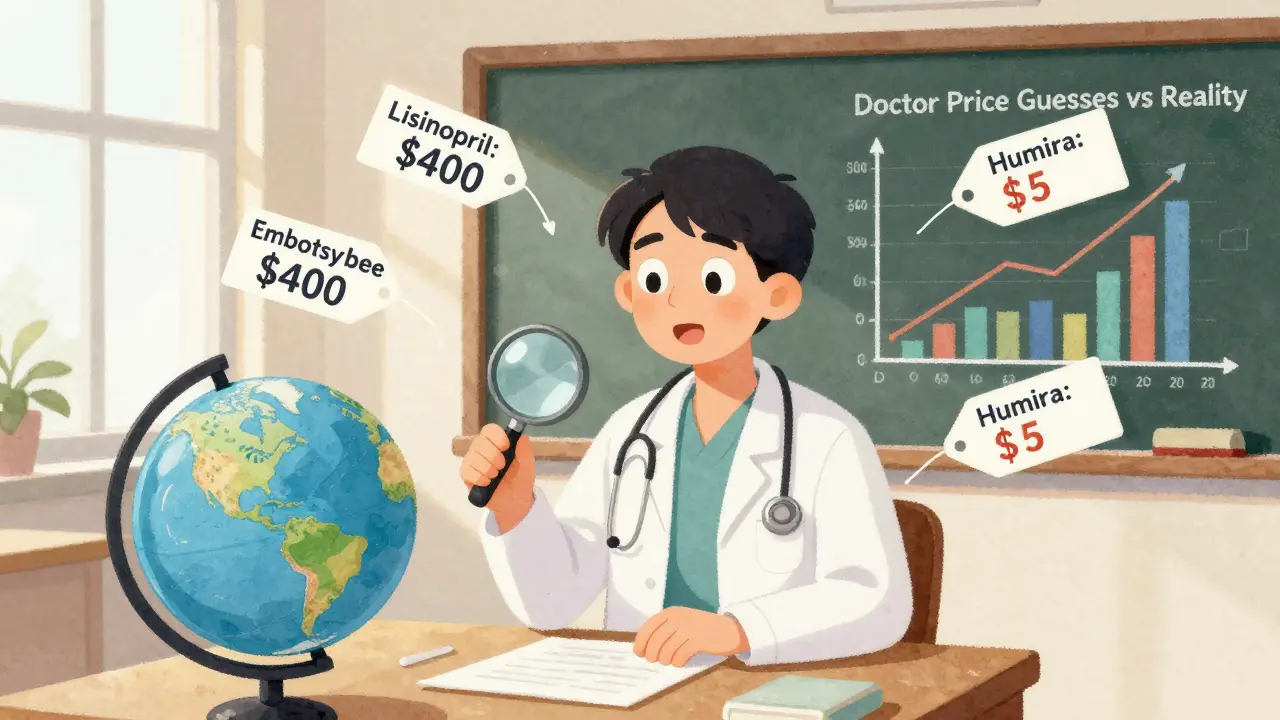
A 2007 review of 29 studies found that physicians consistently misjudge medication costs. They overestimate the price of cheap drugs by 31% and underestimate expensive ones by 74%. In one study, only 31% of doctors correctly estimated the cost of low-price generics, while 74% got high-cost drugs right. That’s not a fluke - it’s a pattern. And it’s not just older doctors. Medical students do even worse. One 2016 study showed only 5.4% of generic drug prices were estimated within 25% of the actual cost. For brand-name drugs, the error rate was even higher.Why does this matter? Because when doctors don’t know what a drug costs, they can’t make cost-effective choices. And patients pay the price - literally. Eighty-two percent of U.S. adults say drug prices are unreasonable. Nearly 3 in 10 skip doses or skip pills entirely because they can’t afford them.
The system is broken - and it’s not the doctors’ fault
Most clinicians didn’t learn drug pricing in med school. Only 44% of medical students understand that drug prices have almost nothing to do with research and development costs. The public thinks high prices reflect innovation. Clinicians often think the same. But the truth? A drug like Humira saw a 4.7% price hike in 2023 - with no new benefits, no new data. Just a price tag that climbed.Doctors aren’t trained to navigate a system where the same drug costs $15 at one pharmacy and $320 at another. Insurance networks, pharmacy benefit managers, copay coupons, and manufacturer discounts create a pricing maze no one can map without a computer. One primary care physician on Reddit said checking a single drug’s cost takes 3 to 5 minutes. Multiply that by 20 prescriptions a day - that’s 100 minutes of extra work. No one has that time.
Technology can fix this - if it’s done right
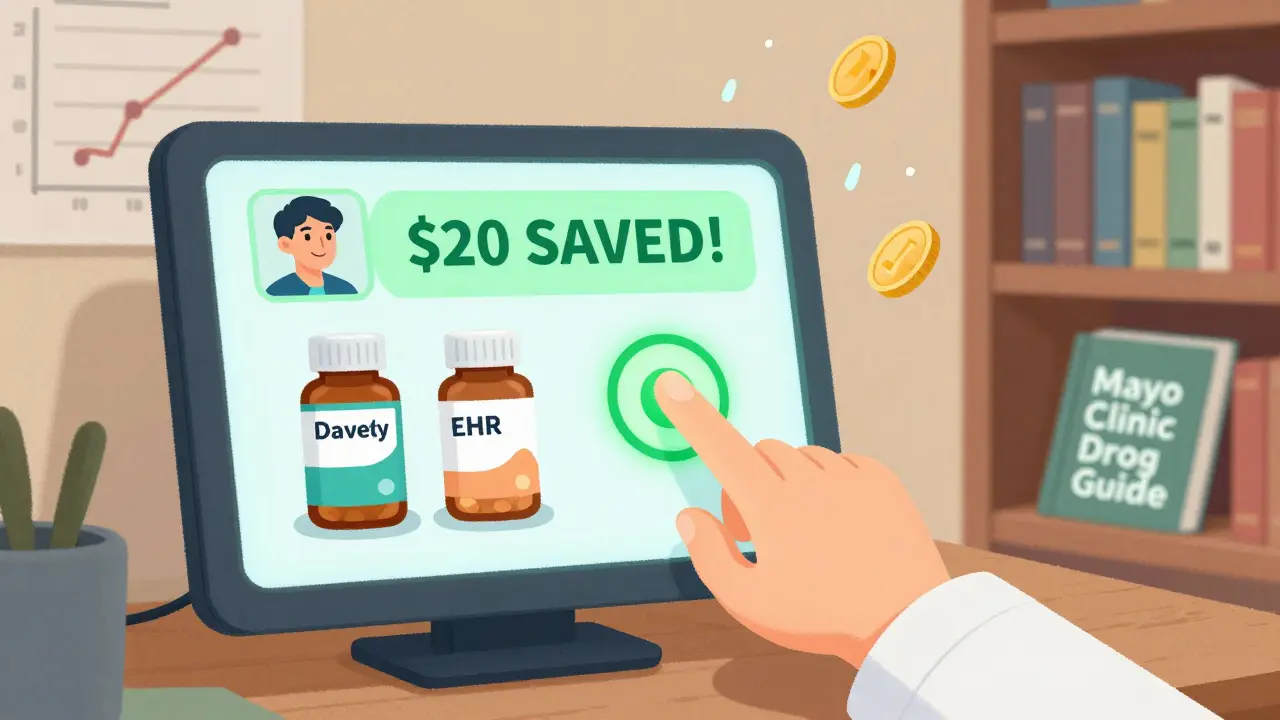
The biggest breakthrough in cost awareness isn’t education. It’s technology. Electronic health records (EHRs) that show real-time out-of-pocket costs at the point of care are changing prescribing habits. A 2021 JAMA Network Open study found doctors with access to cost data in their EHRs made significantly better estimates. But it’s not just about accuracy - it’s about action.At UCHealth, when doctors saw alerts showing a cheaper alternative could save a patient $20 or more, one in six changed the prescription. That’s not a small number. That’s 16% of prescriptions potentially saving patients hundreds of dollars a year. And those savings add up: patients using these tools saved $187 annually on average.
But the tools aren’t perfect. One resident on Reddit complained that their Epic system shows insurer pricing - not what the patient actually pays. If a patient has a $500 deductible, the $10 copay shown on screen is meaningless. The system doesn’t know if the patient’s pharmacy is in-network. It doesn’t know if they’re on Medicare Part D or a private plan. So the alerts are often wrong. And when tools are wrong, doctors stop trusting them.
Who’s getting it right?
Some institutions are building smarter systems. Mayo Clinic’s Drug Cost Resource Guide, updated quarterly, is rated 4.7 out of 5 by physicians. It doesn’t just list prices - it compares alternatives, shows patient assistance programs, and flags when a generic is available. Meanwhile, Medicare’s Part D formulary, used by 850 doctors on Doximity, scores a measly 2.8. Why? Because it’s static. It doesn’t reflect real-time copays. It doesn’t update for patient-specific coverage.Younger doctors are more likely to use these tools. Among physicians under 40, 78% regularly check drug costs. Among those over 55, it’s just 52%. Why? Because they grew up with smartphones, apps, and instant data. They expect information to be available - and they’re not afraid to use it.
The gap in training is widening
Despite all this, 56% of U.S. medical schools still don’t teach drug pricing. Residents learn about pharmacodynamics, side effects, drug interactions - but rarely about cost. One study showed medical students’ knowledge improved slightly with each year of training, but their accuracy still hovered around 6 out of 10 on basic pricing questions. That’s barely better than guessing.And it’s not just students. Even experienced clinicians don’t know where to look. In a 2007 survey, 92% of doctors said they wanted cost information - but didn’t know where to find it. That hasn’t changed much. The tools exist. But they’re scattered, inconsistent, and often hidden inside clunky EHRs.
Policy is catching up - slowly
The 2022 Inflation Reduction Act gave Medicare the power to negotiate drug prices for the first time. That’s historic. And it’s popular - 83% of Democrats and 76% of Republicans support it. But negotiation takes years. Meanwhile, the CMS now requires drugmakers to report out-of-pocket costs on ads. That’s a start. But it doesn’t help a doctor in a 10-minute appointment.What’s more urgent is making cost data visible at the moment of prescribing. The Institute for Clinical and Economic Review predicts 75% of U.S. health systems will have advanced real-time benefit tools by 2027. That’s good news. But only if those tools are accurate, easy to use, and integrated into the workflow - not tacked on like an afterthought.
What needs to change
Three things need to happen now:- Make cost data visible in EHRs. Not as a pop-up. Not as a tab. But as a default field - right next to the drug name. If a doctor can see the side effect profile instantly, they should see the cost too.
- Fix the data. Alerts must reflect the patient’s actual out-of-pocket cost, not just the list price or insurer rate. That means integrating with pharmacy networks, Medicare Part D, and copay assistance programs in real time.
- Teach it in med school. Drug pricing isn’t a business topic - it’s a clinical one. Students need to learn how to compare alternatives, understand formularies, and talk to patients about cost. It’s part of being a good doctor.
Doctors want to help patients. But they’re being asked to make complex financial decisions with incomplete information. When a patient says, ‘I can’t afford this,’ the doctor should be able to say, ‘Here’s a cheaper option that works just as well.’ Right now, too often, they can’t.
The solution isn’t more training sessions. It’s better technology. Smarter systems. And a simple shift: treat cost like a vital sign. Not optional. Not secondary. Essential.
Do doctors know how much prescription drugs cost?
Most doctors don’t. Studies show they overestimate the cost of cheap generics by 31% and underestimate expensive brand-name drugs by 74%. Only 5.4% of generic drug prices are estimated accurately within 25% of the actual cost. This isn’t due to ignorance - it’s because pricing systems are too complex and fragmented to be memorized.
Why does it matter if doctors don’t know drug prices?
When doctors don’t know the cost, they may prescribe more expensive drugs unnecessarily. This leads to patients skipping doses, delaying refills, or abandoning treatment entirely. Nearly 30% of U.S. adults report not taking their medication because of cost. Cost-aware prescribing reduces this harm and improves health outcomes.
Can electronic health records (EHRs) help doctors know drug prices?
Yes - but only if they’re built right. EHRs that show real-time out-of-pocket costs at the point of care have been shown to change prescribing habits. One study found one in six doctors changed a prescription when the system flagged a $20+ savings. But many current tools show list prices or insurer rates, not what the patient actually pays - making them unreliable.
Are medical students learning about drug pricing?
Only a little. 56% of U.S. medical schools don’t include drug pricing in their curriculum. Even among those that do, students often learn only basic facts - not how to compare alternatives or navigate insurance complexities. Knowledge improves slightly with each year of training, but accuracy remains low.
What’s being done to fix this problem?
The Inflation Reduction Act lets Medicare negotiate drug prices, and new rules require drugmakers to disclose out-of-pocket costs in ads. Health systems like UCHealth and Mayo Clinic are building real-time cost tools that help doctors choose affordable options. But adoption is slow - only 37% of U.S. hospitals have these tools as of late 2024. The biggest barrier isn’t technology - it’s integration and accuracy.
Comments
Crystal August
Doctors are just lazy. If they can’t be bothered to look up drug prices, they shouldn’t be prescribing. Patients are suffering because of their incompetence. This isn’t rocket science - it’s basic responsibility.
January 20, 2026 at 00:02
Nadia Watson
I’ve worked in primary care for 18 years, and this article nails it. We’re not trained to be pharmacoeconomists - we’re trained to treat disease. But the system forces us to play accountant without tools, without time, and without reliable data. It’s like asking a chef to guess the cost of every spice in the pantry while blindfolded. The real failure isn’t the doctor - it’s the EHR vendors and insurers who refuse to integrate real patient-specific pricing. I’ve seen patients skip insulin because the system showed $12 when their deductible meant $480. That’s not a prescribing error. That’s a systemic betrayal.
January 21, 2026 at 02:52
Shane McGriff
Let’s be real - this isn’t about doctors being dumb. It’s about the system being designed to confuse. I’m a resident, and I spend 20 minutes a day just trying to figure out if a $5 generic is actually $5 for this one patient. The EHR shows one price. The pharmacy says another. The copay card says a third. And the patient’s insurance portal? Totally different. I’m not supposed to be a data analyst - I’m supposed to heal people. If you want better prescribing, give us a single, accurate, real-time feed that works across every insurer, every pharmacy, every deductible tier. Not a pop-up. Not a tab. A field. Right next to the drug name. Like blood pressure. Like heart rate. Because cost is a vital sign too.
January 21, 2026 at 20:44
Jacob Cathro
Big Pharma’s been laughing all the way to the bank. These ‘cost alerts’ are just PR theater. Epic and Cerner are owned by the same VCs that profit off drug markups. The system’s rigged. They give us fake numbers so we think we’re helping - but we’re just the patsies in their profit game. And don’t get me started on Medicare Part D - that’s a maze designed by lobbyists to make seniors cry. This isn’t a medical problem. It’s a criminal enterprise.
January 23, 2026 at 13:20
Paul Barnes
The data is clear: physicians misestimate drug costs consistently, and the error direction is predictable - overestimating generics, underestimating brands. This pattern is replicated across multiple peer-reviewed studies, including those published in JAMA and Annals of Internal Medicine. The root cause is structural: lack of standardized, real-time pricing integration into clinical workflows. Solutions must be technical, not educational.
January 24, 2026 at 21:05
pragya mishra
Why should American doctors care about drug prices? In India, we get generics for $0.10 a pill. You guys have a $120 problem because you let corporations run your health system. Fix your capitalism first.
January 26, 2026 at 18:50
Andy Thompson
They’re lying. This whole thing is a psyop. The government wants you to think doctors are clueless so you’ll blame them - not the real villains: the CDC, the AMA, and the shadowy Pharma-Congress cabal. They want you to trust their ‘EHR alerts’ so they can track your meds and control your body. Next thing you know, they’ll be forcing you to take the $4 pill because it’s ‘better for the system.’ Wake up!
January 27, 2026 at 11:24
sagar sanadi
Doctors don’t know prices? Bro, I paid $300 for metformin last month. My cousin in Mumbai paid $2. So maybe the problem isn’t doctors… maybe it’s you guys thinking $4 is cheap when it’s actually a scam.
January 27, 2026 at 20:24
kumar kc
Doctors should know costs. It’s basic ethics. No excuses.
January 29, 2026 at 15:18
Thomas Varner
Look, I get it - the system’s broken. But here’s the thing: I’m a 58-year-old doc, and I’ve been using UpToDate, Medscape, and my pharmacy’s app for years. I don’t wait for the EHR to tell me what’s cheap - I ask the pharmacist. I check GoodRx. I’ve saved patients hundreds, sometimes thousands. So don’t tell me we’re all helpless. We’re not. We just have to do the work - even if the system doesn’t help. And yes - I’ve told my med students to do the same. It’s not glamorous. But it’s patient care.
January 30, 2026 at 23:39
Write a comment