
When your doctor hands you a prescription, you might not notice the small black rectangle on the label or the thick warning in the patient leaflet. But that box? It’s the FDA’s strongest possible alert. A boxed warning, often called a black box warning, means the drug carries a serious, sometimes life-threatening risk. It’s not a suggestion. It’s a legal requirement. And if you’re taking one of these medications, you need to understand exactly what it means - and what to do next.
What Exactly Is a Boxed Warning?
A boxed warning is the most serious safety alert the U.S. Food and Drug Administration (FDA) can require for a medication. It appears at the very top of the drug’s prescribing information, printed in a bold black border with large, clear text. This isn’t just for show - the FDA has strict rules about how it must look: 8-10 point font, 1.5 line spacing, and always in a box. It’s designed to grab attention, because the risks inside are real. These warnings aren’t added lightly. They’re only used when a drug has been linked to serious side effects like organ failure, severe allergic reactions, suicidal behavior, or death. As of 2022, more than 400 prescription drugs carry one. That’s about 1 in 10 of all medications on the market. Some common ones include antidepressants, antipsychotics, diabetes drugs like metformin with lactic acidosis risk, cancer treatments, and even birth control pills with high clotting risks. The system started after the thalidomide disaster in the 1960s, when thousands of babies were born with severe birth defects because the drug wasn’t properly tested in pregnant women. The FDA didn’t have strong enough rules back then. The Kefauver-Harris Amendments of 1962 changed that. But the black box format itself didn’t become standard until the 1970s, after more cases of dangerous side effects slipped through the cracks.Why Do These Warnings Exist - And Why Are They So Scary?
The goal isn’t to scare you away from medicine. It’s to make sure you and your doctor weigh the risks against the benefits. Some drugs with boxed warnings are lifesavers - but only if used correctly. For example, isotretinoin (Accutane) carries a boxed warning for severe birth defects. That’s why women taking it must enroll in the iPLEDGE program, get monthly pregnancy tests, and use two forms of birth control. Without that system, the risk would be too high. But for someone with severe, treatment-resistant acne, isotretinoin can be life-changing. Another example: antidepressants like fluoxetine (Prozac) or sertraline (Zoloft) carry a warning about increased suicide risk in children and young adults under 25. That doesn’t mean you shouldn’t take them. It means you need close monitoring in the first few weeks, especially if you’re starting the drug or changing doses. Studies show that when patients and doctors talk through this risk, most people continue treatment safely. The problem? Many people misunderstand these warnings. A 2022 survey found that 41% of patients thought a boxed warning meant they shouldn’t take the drug at all. That’s not true. It means: talk to your doctor. Know the signs. Get checked regularly.How Are Boxed Warnings Different From Other Warnings?
Not all drug warnings are the same. The FDA uses a hierarchy:- Boxed warnings - the highest level. Legally required, printed on labels, and must be discussed before prescribing.
- Drug Safety Communications - public alerts issued after a drug is on the market. These are updates, not part of the official label.
- Label changes - updates to the prescribing info that don’t require a black box.
- Medication Guides - patient-friendly handouts you get at the pharmacy. They’re helpful, but not as strict as boxed warnings.
Who Decides When a Drug Gets a Boxed Warning?
Most boxed warnings aren’t added before a drug hits the market. In fact, about 70% are added after the drug has been used by millions of people. Clinical trials usually involve only 1,000 to 5,000 patients. That’s not enough to catch rare but deadly side effects. Take rofecoxib (Vioxx), a painkiller pulled from the market in 2004. It had no boxed warning at launch. After thousands of heart attacks and strokes were reported, the FDA added a warning - but too late. The drug was withdrawn. That’s why post-market monitoring is so critical. The FDA now uses its Sentinel Initiative, a real-time system that tracks health records from over 300 million Americans. It can spot patterns - like a spike in liver damage linked to a certain drug - much faster than before. In September 2023, the FDA added a new boxed warning for SGLT2 inhibitors (like empagliflozin) after reports of serious urinary tract infections leading to hospitalization. But delays still happen. A 2019 study found that 44% of boxed warnings were issued more than five years after the drug was approved. That’s a long time for patients to be at risk.
What Should You Do If Your Medication Has a Boxed Warning?
Don’t panic. Don’t stop taking it. Do this instead:- Ask your doctor to explain the warning in plain language. Don’t settle for jargon. Ask: “What exactly could go wrong? How likely is it? What are the signs I should watch for?”
- Know your personal risk. Are you older? Do you have kidney disease? Are you pregnant or planning to be? Some risks only apply to certain groups. For example, the boxed warning for methotrexate (used for rheumatoid arthritis and cancer) says you need monthly liver tests. If you don’t get them, you could develop liver damage.
- Ask about monitoring. Will you need blood tests? EKGs? Regular check-ins? Write down when and how often.
- Use the teach-back method. After your doctor explains, say it back in your own words. “So if I get sudden nausea, yellow skin, or dark urine, I need to call you right away?” If you can’t explain it, they didn’t explain it well enough.
- Report side effects. Use the FDA’s MedWatch system (form 3500) to report any unusual symptoms. Over 2 million reports come in each year. Your report could help save someone else’s life.
Are Boxed Warnings Effective - Or Do They Do More Harm?
The system works - but not perfectly. Studies show boxed warnings reduce inappropriate prescribing by 15-25%. That’s good. But they also cause 10-20% of doctors to avoid prescribing even when the drug is the best option. Why? Fear of liability. A 2021 report from the Institute for Clinical and Economic Review found that some doctors won’t prescribe certain diabetes drugs with boxed warnings, even to patients who would benefit most. Some experts argue the warnings are too vague. For example, a warning might say “increased risk of death in elderly patients with dementia.” But it doesn’t say how much higher the risk is, or which elderly patients are most at risk. That makes it hard to use in real life. The FDA is trying to fix this. In 2023, they launched a pilot program to rewrite boxed warnings in plain language - no legalese, no vague phrases. They’re also testing patient summaries that explain the risk in everyday terms.What Are the Most Common Drugs With Boxed Warnings?
Some therapeutic areas have more than others:- Antipsychotics (27 drugs) - risk of death in elderly patients with dementia
- Antidepressants (22 drugs) - increased suicide risk in young people
- Cancer therapies (45 drugs) - severe organ damage, immune reactions
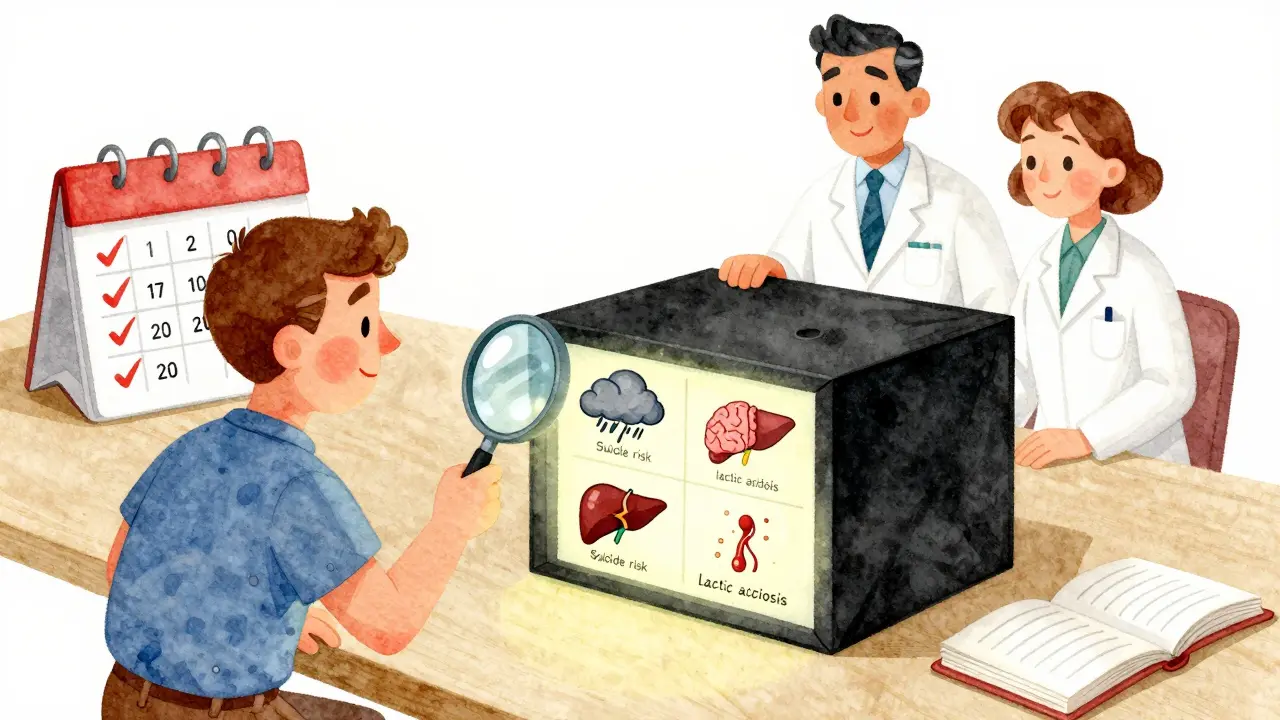
- Diabetes medications (18 drugs) - lactic acidosis, heart failure, infections
- Birth control pills - blood clots, stroke, heart attack
Where Can You Get Trusted Information?
Don’t rely on Google or social media. Use these trusted sources:- Consumer Reports Best Buy Drugs - compares drugs side by side, including risks and costs. Updated quarterly.
- Drug Effectiveness Review Project (DERP) - independent, evidence-based analysis of drug safety and value.
- FDA’s website - search for your drug’s label under “Drugs@FDA.” You’ll see the full boxed warning and all safety updates.
Frequently Asked Questions
Does a boxed warning mean I can’t take the medication?
No. A boxed warning means the drug has serious risks that require careful use. Many patients take these medications safely for years. The key is understanding the risks, getting proper monitoring, and working with your doctor to make sure the benefits outweigh the dangers.
Can a drug have a boxed warning added after I’ve been taking it for years?
Yes. Most boxed warnings - about 70% - are added after a drug has been on the market for years. If a new risk is found through real-world use, the FDA can require the warning. Your pharmacist will update the label, and your doctor should discuss it with you. Don’t assume your medication is safe just because you’ve been taking it for a long time.
Why don’t all drugs with serious side effects have a boxed warning?
The FDA only adds boxed warnings when the risk is severe, well-documented, and occurs frequently enough to warrant a legal requirement. Some drugs have serious side effects, but they’re rare or only happen under very specific conditions. Those may be listed in the standard warnings instead. Boxed warnings are reserved for the most critical, life-threatening risks.
What should I do if my doctor doesn’t mention the boxed warning?
Ask. Say: “I noticed this medication has a boxed warning. Can you explain what that means for me specifically?” Your doctor is required to discuss these risks with you before prescribing. If they don’t bring it up, it’s your right to ask. Don’t be afraid - you’re not being difficult. You’re being responsible.
Can I report a side effect from a drug with a boxed warning?
Yes, and you should. The FDA’s MedWatch program lets patients report adverse events directly. You can file a report online or by phone. Your report helps the FDA spot patterns and update warnings. Even if you’re not sure the drug caused the problem, report it. Thousands of reports are filed each year - and they’ve led to new safety rules.
Next Steps
If you’re on a medication with a boxed warning:- Write down the exact risk and what symptoms to watch for.
- Set calendar reminders for blood tests or checkups.
- Keep a journal of any unusual symptoms - even small ones.
- Ask your pharmacist for the Medication Guide - it’s often easier to read than the full label.
- Don’t skip doses because you’re scared. Talk to your doctor first.
Comments
SWAPNIL SIDAM
Man, I never knew those black boxes meant life or death stuff. My uncle took that diabetes med and just stopped cold because he saw the box. Died of a stroke. Shoulda talked to his doctor first.
January 24, 2026 at 20:53
Aishah Bango
People treat these warnings like horror movie posters. You don't just quit meds because of a black box-you educate yourself or you deserve what happens. This isn't a suggestion, it's a covenant between you and your health.
January 25, 2026 at 23:18
Simran Kaur
I'm from India and we don't get these warnings half the time. My cousin got prescribed an antidepressant with a black box and no one told her about the suicide risk. She almost didn't make it. Please, if you're reading this-ask questions. Even if your doctor seems busy. Your life matters more than their schedule.
January 26, 2026 at 08:13
bella nash
The institutionalization of risk communication through the FDA's black box paradigm reflects a broader epistemological shift in pharmaceutical governance wherein post-marketing surveillance supersedes preclinical certainty as the primary locus of epistemic authority. This is not merely regulatory evolution but a structural reconfiguration of the patient-provider-power triad.
January 27, 2026 at 18:38
Curtis Younker
Listen up everyone-this is the kind of info that saves lives. I got prescribed a drug with a black box last year and I was terrified. But I sat down with my doctor, wrote down every symptom to watch for, set phone reminders for bloodwork, and now I’m doing better than ever. You don’t have to be scared-you have to be smart. This isn’t a stop sign, it’s a speed bump with a checklist. Go read the FDA label. Talk to your pharmacist. Don’t just trust the pill bottle. You got this.
January 29, 2026 at 16:44
Henry Jenkins
I’ve been on a boxed warning med for 8 years. No issues. But I also do monthly labs, track my symptoms in a journal, and bring my report to every appointment. The system works if you engage with it. The real problem isn’t the warning-it’s the assumption that the doctor will do all the work. Medicine isn’t a vending machine. You’re not passive. You’re a partner. If you’re not treating your health like a partnership, you’re gambling with your body.
January 29, 2026 at 19:06
TONY ADAMS
bro why are you all stressing so much i got a black box drug and i just take it and forget about it like its a cereal box
January 30, 2026 at 02:15
Ashley Karanja
It’s fascinating how the black box functions as both a diagnostic tool and a psychological trigger-triggering compliance, fear, and sometimes therapeutic nihilism. The FDA’s framing, while legally necessary, inadvertently pathologizes patient agency. We’re being told to ‘be vigilant,’ but not given the emotional scaffolding to sustain it. I’ve seen patients abandon life-saving meds because the warning felt like a death sentence. We need plain-language summaries, yes-but also empathetic counseling frameworks built into the prescribing workflow. Maybe even a ‘boxed warning’ video explainer from the pharmacist. We’re humans, not data points.
January 30, 2026 at 07:02
Napoleon Huere
What if the real danger isn’t the drug-but the silence around it? We live in a world where information is abundant but understanding is scarce. The black box is a mirror. It doesn’t show you the risk-it shows you how much you’re willing to learn. The system isn’t broken. We are. We’ve outsourced our health to algorithms and doctors and pills, and forgotten that the most powerful medicine is awareness.
January 31, 2026 at 09:12
Josh josh
so i just found out my blood pressure med has a black box and now im paranoid af but like... my doc never mentioned it so is that illegal or what
February 2, 2026 at 03:11
Allie Lehto
People need to stop treating meds like magic beans. If your doctor didn't explain the black box, you need to ask again. And if they get annoyed? Good. They're not doing their job. I had a friend who lost her kidney because she didn't know to check her creatinine levels on her diabetes med. She didn't even know the warning existed. This isn't about fear-it's about responsibility. And if you're too lazy to read the label? You're not a patient-you're a liability.
February 3, 2026 at 07:37
Write a comment