
H2 Blocker & Medication Interaction Checker
Check if your H2 blocker medication may dangerously interact with antivirals or antifungals. Based on the latest FDA guidelines and clinical studies.
Many people take H2 blockers like famotidine or cimetidine for heartburn or acid reflux without realizing they could be quietly sabotaging their antiviral or antifungal treatment. These medications reduce stomach acid, which sounds helpful-until you learn that some life-saving drugs need that acid to work at all.
How H2 Blockers Really Work
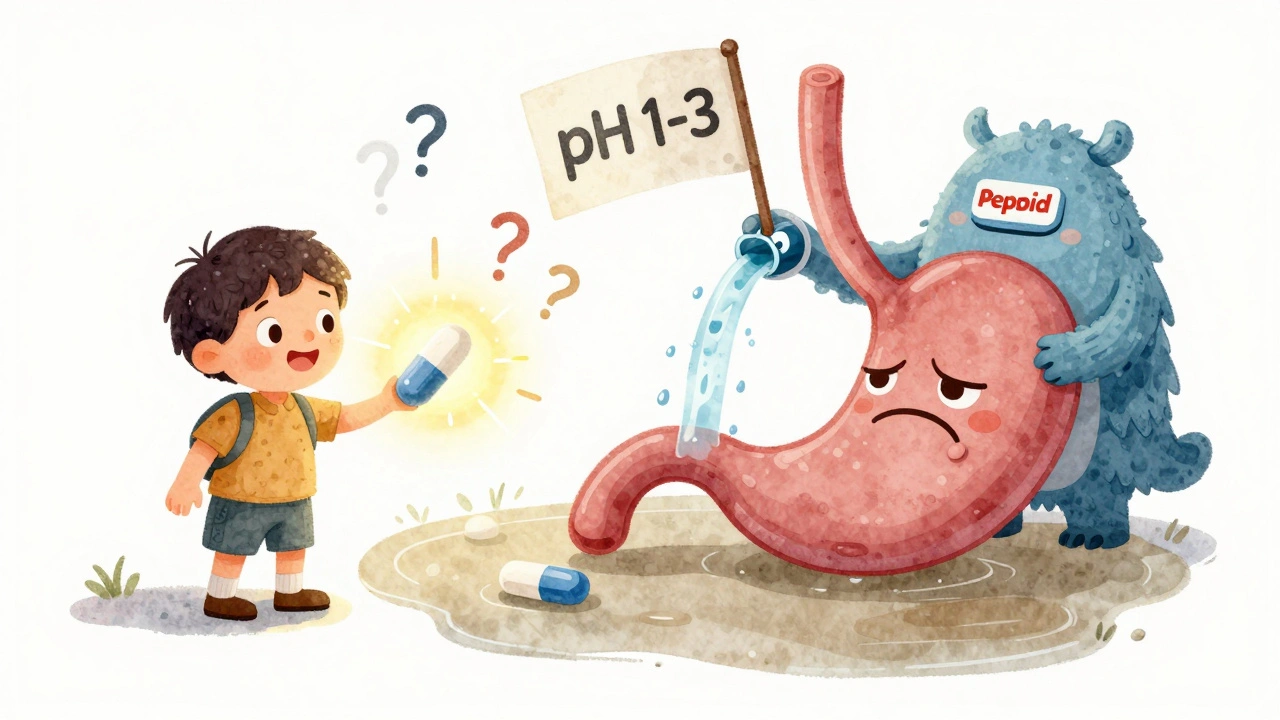
H2 blockers, or histamine H2-receptor antagonists, stop your stomach from making too much acid. They do this by blocking histamine from telling your stomach cells to produce acid. The result? Your stomach pH rises from a harsh 1-3 to a much milder 4-6. That’s great for easing heartburn, but it’s a problem for drugs that need acidity to dissolve and get absorbed. There are three H2 blockers still available in the U.S.: famotidine (Pepcid), cimetidine (Tagamet), and nizatidine (Axid). Ranitidine (Zantac) was pulled in 2020 because of cancer-causing contaminants. Famotidine is now the most common choice because it’s safer than cimetidine-but that doesn’t mean it’s risk-free.The Acid Problem: Why Some Drugs Fail
Not all drugs are created equal when it comes to stomach acid. Some need it. Others don’t care. The difference can mean the difference between healing and worsening infection. Take itraconazole, a powerful antifungal used for serious fungal infections like aspergillosis. It’s poorly soluble in water. Without enough acid, it just sits in your stomach and passes through your body unused. Studies show H2 blockers can slash itraconazole absorption by 40-60%. That’s not a small drop-it’s treatment failure waiting to happen. Fluconazole, on the other hand, doesn’t care. It dissolves easily in water, no matter the pH. So if you’re on fluconazole, you’re probably fine with an H2 blocker. But you can’t assume that’s true for every antifungal. Voriconazole, posaconazole, and isavuconazole? They’re mixed. Some are pH-sensitive. Others aren’t. And then there’s the enzyme problem.Cimetidine: The Hidden Danger
Cimetidine isn’t just an acid reducer. It’s also a powerful inhibitor of liver enzymes-specifically the CYP450 system that breaks down about 70% of all medications. This means cimetidine doesn’t just mess with stomach pH-it can make other drugs build up to toxic levels in your blood. For example, when cimetidine is taken with voriconazole, it can raise voriconazole levels by up to 40%. That might sound good, but too much voriconazole causes hallucinations, liver damage, and heart rhythm problems. The same thing happens with some antivirals like atazanavir, used to treat HIV. Cimetidine can double its concentration, increasing side effects like jaundice and kidney stones. Famotidine doesn’t do this. It barely touches CYP450 enzymes. So if you need an H2 blocker and you’re on antivirals or antifungals, famotidine is the only safe choice. Cimetidine? Avoid it completely.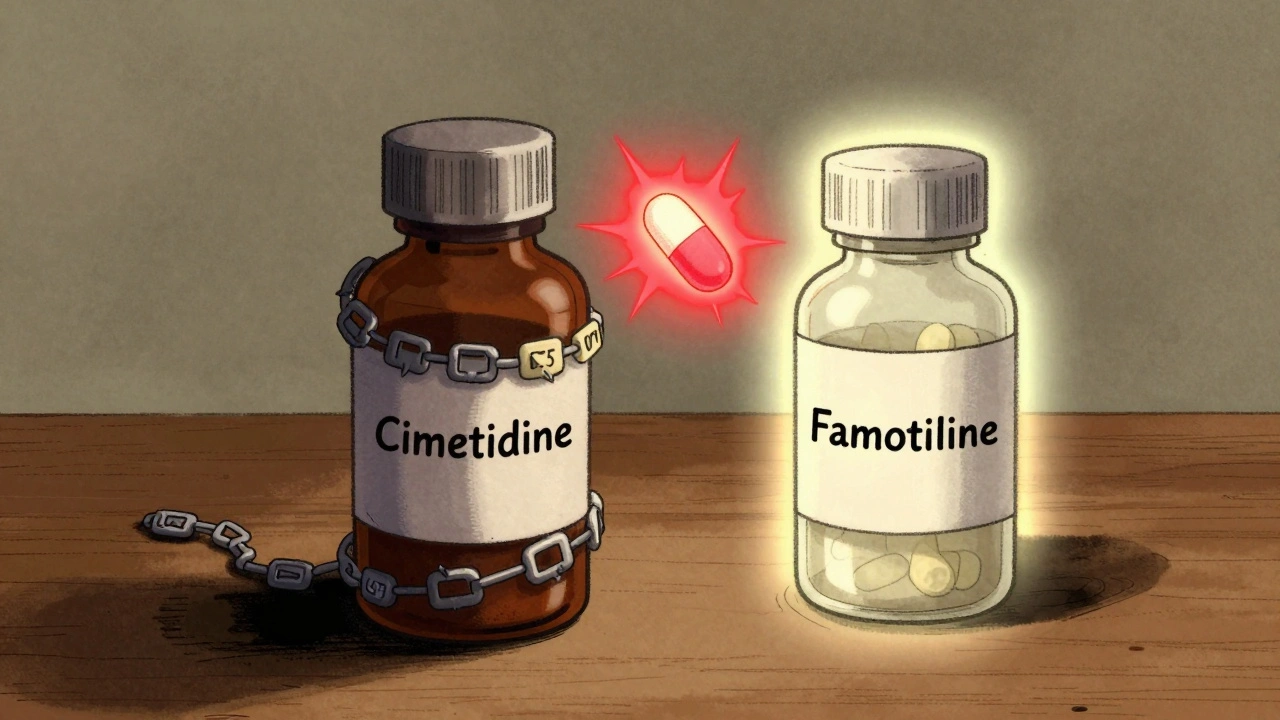
Antivirals That Hate Low Acid
The FDA reviewed 42 antiviral labels in 2022 and found that nearly 7 out of 10 had warnings about acid-reducing drugs. Atazanavir is the worst offender. When taken with famotidine, its absorption drops by up to 77%. That’s not theoretical-it’s been measured in clinical trials. Patients on this combo had viral loads that spiked because the drug just wasn’t getting in. Dasatinib, used for certain leukemias and sometimes considered an antiviral due to its effects on viral proteins, also needs acid. So do some hepatitis C drugs and even certain HIV pre-exposure prophylaxis (PrEP) regimens. The fix? Timing. The FDA says take atazanavir at least two hours before your H2 blocker. That gives your stomach time to be acidic again before the antiviral arrives. Don’t just take them together because it’s convenient. That’s how treatment fails.What About Proton Pump Inhibitors (PPIs)?
People often switch from H2 blockers to PPIs like omeprazole because they’re stronger. But here’s the catch: PPIs suppress acid for over 24 hours. H2 blockers only last 6-12 hours. That means with an H2 blocker, you can time your antifungal to be taken when acid levels are naturally higher-like right before breakfast. With a PPI, your stomach is basically neutral all day, every day. No timing trick works. That’s why experts like the American Society of Health-System Pharmacists recommend H2 blockers over PPIs when acid suppression is needed alongside antifungals. Just make sure you use famotidine, not cimetidine, and separate doses by at least two hours.Real-World Consequences
A 2022 survey of 1,200 hospital pharmacists found that only 43% consistently told patients how to time their antifungal and H2 blocker doses. That means more than half of patients are probably taking them together-risking treatment failure. There are documented cases of fungal infections worsening because patients took itraconazole with their daily heartburn pill. Some ended up in the hospital. Others needed IV antifungals, which cost thousands more and require daily infusions. And it’s not just antifungals. HIV patients who didn’t know about the atazanavir-H2 blocker interaction saw their viral load climb. Some developed drug resistance because the virus wasn’t fully suppressed.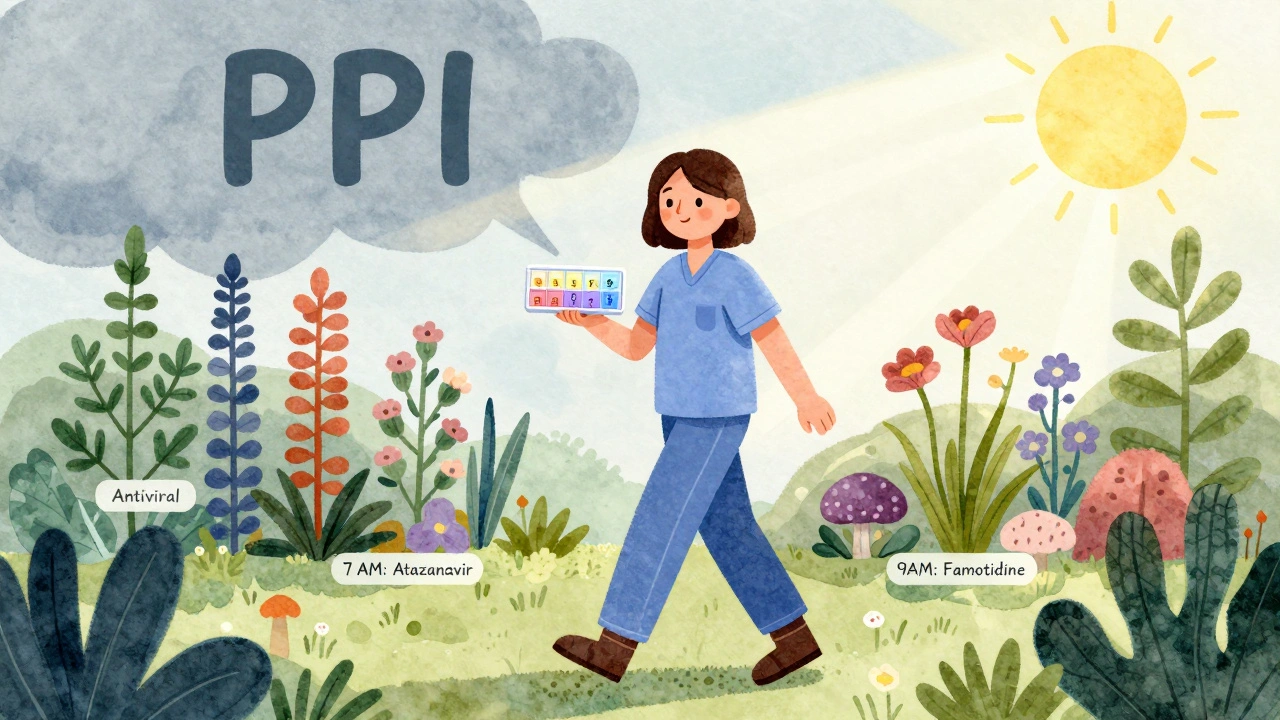
What Should You Do?
If you’re on an antiviral or antifungal and you take an H2 blocker, here’s what to do:- Check the name of your H2 blocker. If it’s cimetidine, talk to your doctor about switching to famotidine.
- For itraconazole tablets: Avoid H2 blockers entirely. Use the oral solution instead-it’s designed to work without acid.
- For atazanavir: Take it at least two hours before your H2 blocker.
- For voriconazole: Ask your doctor about therapeutic drug monitoring. Blood tests can tell if levels are too high or too low.
- For fluconazole or isavuconazole: You’re likely safe, but still confirm with your pharmacist.
Future Solutions
New antifungal formulations are being tested to solve this problem. One trial (NCT04821542) is looking at lipid-based itraconazole that absorbs even in neutral pH. If it works, we might finally be able to take it with heartburn meds without worry. The FDA is also pushing for clearer labeling. By late 2025, all drugs affected by stomach acid will be required to include exact timing instructions on their labels. That should cut down on mistakes. For now, though, the responsibility falls on you and your care team. Don’t assume your pharmacist or doctor knows every interaction. Ask. Double-check. Keep a list of everything you take-including over-the-counter antacids and heartburn pills.When to Call Your Doctor
Call immediately if you notice:- Your fungal infection isn’t improving after a week of treatment
- You develop new symptoms like confusion, yellowing skin, or irregular heartbeat while on voriconazole or itraconazole
- Your HIV viral load suddenly increases
Can I take famotidine with fluconazole?
Yes, you can safely take famotidine with fluconazole. Fluconazole dissolves easily in water and doesn’t need stomach acid to be absorbed. Unlike itraconazole or voriconazole, fluconazole isn’t affected by changes in pH. There’s also no significant CYP450 interaction between the two. Still, always confirm with your pharmacist or doctor before combining medications.
Is cimetidine ever safe to use with antivirals?
No, cimetidine is not safe to use with most antivirals or antifungals. It strongly inhibits liver enzymes (CYP450), which can cause dangerous drug buildup. For example, it can raise atazanavir and voriconazole levels by 40% or more, increasing the risk of toxicity. Even if your doctor says it’s okay, there are safer alternatives like famotidine. Avoid cimetidine entirely if you’re on these medications.
Why does itraconazole fail with H2 blockers but fluconazole doesn’t?
Itraconazole is poorly soluble in water and needs an acidic environment to dissolve and be absorbed. When H2 blockers raise stomach pH above 3, itraconazole stays in tablet form and passes through your gut unused. Fluconazole, however, is highly water-soluble and dissolves regardless of pH. That’s why fluconazole works fine with acid reducers, but itraconazole doesn’t.
Can I take an antacid instead of an H2 blocker?
Antacids like Tums or Maalox can cause even more dramatic pH spikes than H2 blockers-and they work immediately. For drugs like itraconazole or atazanavir, antacids are riskier because they neutralize acid fast and hard. If you must use one, take it at least 2 hours after your antiviral or antifungal. But H2 blockers are often preferred because their effect is shorter and more predictable.
What should I do if I accidentally took my antifungal and H2 blocker together?
If you took them together once, don’t panic. One mistake won’t ruin your treatment. But don’t do it again. For drugs like itraconazole or atazanavir, repeated mistakes can lead to treatment failure. Contact your pharmacist or doctor to discuss whether you need a blood test or dose adjustment. Going forward, use a pill organizer with time labels or set phone reminders to space them out properly.
Comments
Robert Webb
Man, I had no idea H2 blockers could mess with antivirals like that. I’ve been taking famotidine for years for my acid reflux and just assumed it was harmless. This post broke my brain a little. I’m going to pull up my meds list tonight and cross-check everything with my pharmacist. Seriously, if you’re on any kind of antifungal or HIV med, don’t just rely on your doctor to know every interaction - they’re swamped. I’m glad someone laid this out so clearly. I’ll be sharing this with my dad who’s on itraconazole. He’s been complaining his rash isn’t clearing up. Could be this whole time.
December 12, 2025 at 18:32
Stacy Foster
THIS IS WHY THEY WANT YOU TO TAKE PPIs. Big Pharma doesn’t want you to know that H2 blockers are the *only* safe option - they make billions off PPIs and don’t care if you get fungal infections or drug toxicity. Cimetidine was pulled not because it’s dangerous - but because it’s CHEAP and they couldn’t patent it. Famotidine? Same thing. They’re trying to scare you into switching to omeprazole so you keep buying it forever. I’ve seen the FDA documents - they’re hiding the truth. You think this is about safety? No. It’s about profit. Wake up.
December 13, 2025 at 12:27
Ashley Skipp
So basically if you take heartburn meds you’re basically just letting your infection grow? Wow. I thought famotidine was just for comfort. Guess I’m one of those people who didn’t read the fine print. My cousin had a fungal lung thing last year and it got worse. Maybe this was why. I’m gonna tell her. She’s still on itraconazole and takes Pepcid every morning. She’s gonna flip.
December 14, 2025 at 21:59
Audrey Crothers
OMG I just realized I’ve been taking famotidine with my fluconazole for months and didn’t even think twice 😳 I’m so relieved to hear it’s safe! Thank you so much for this post - I was about to panic because my rash is finally clearing up. I’ve been stressing over every little thing. Now I can breathe. 💕 Also, if you’re on antivirals, PLEASE talk to your pharmacist. They’re the real MVPs here. I always ask mine before combining anything - saved me from a disaster last year. You’re not being annoying, you’re being smart.
December 15, 2025 at 14:29
Lawrence Armstrong
Just a heads-up - if you’re using the itraconazole solution instead of the pill, you’re golden. The solution bypasses the acid issue entirely. My oncologist switched me to it after my fungal infection didn’t respond. No more timing games. Just take it on an empty stomach and you’re good. Also, don’t forget to shake the bottle well - it separates like salad dressing. 🤓
December 16, 2025 at 17:56
Levi Cooper
Interesting how Americans are so obsessed with popping pills for everything. In my country, we just eat ginger, drink warm water, and avoid spicy food. No need for fancy meds. You people are so dependent on pharmaceuticals. This whole post reads like a warning from Big Pharma to keep you buying their products. Why not just fix your diet? Acid reflux is caused by stress and poor eating. Not magic pills.
December 18, 2025 at 15:50
Nathan Fatal
This is a perfect example of how medicine has become a system of isolated facts instead of integrated understanding. We treat stomach acid like a switch - on or off - when it’s actually part of a complex ecosystem. The real issue isn’t just drug absorption - it’s how we’ve disconnected physiology from pharmacology. We reduce everything to molecules and interactions, forgetting that the body isn’t a machine. We need systems thinking, not just pharmacokinetics. The fact that we’re still surprised by these interactions says more about our medical education than the drugs themselves.
December 19, 2025 at 05:07
Rob Purvis
Wait - so if I take famotidine at 10 PM, and my atazanavir at 8 AM, is that enough? I mean, the H2 blocker wears off in 12 hours, right? So 10 PM to 8 AM is 10 hours… should I push it back to 6 AM? Or is 8 AM fine? I’ve been doing it this way for months and my viral load’s been undetectable… but now I’m paranoid. Does anyone have a chart or timeline they use? I’d love to see a visual. I’ll even make one if someone can confirm the half-life of famotidine in this context.
December 20, 2025 at 07:46
Laura Weemering
It’s fascinating how the body’s pH equilibrium is so easily disrupted by pharmaceutical interventions - a microcosm of the larger anthropogenic disruption of ecological homeostasis. The pharmacokinetic interference here mirrors the systemic collapse of biological resilience in late-stage capitalism, where convenience is prioritized over physiological integrity. The H2 blocker, as a symbol of symptomatic management, reflects our collective refusal to engage with root causes - whether of acid reflux or of viral persistence. We pharmacologize discomfort instead of interrogating the structures that produce it.
December 20, 2025 at 08:03
Reshma Sinha
Wow this is so important! I work in a hospital pharmacy and we get this question ALL the time. I always tell patients to write down their meds and bring them to every appointment. Even if they think it’s just an OTC pill - it’s not just a pill, it’s a player in your whole treatment. I’ve seen patients end up in ICU because they didn’t know. Please don’t assume. Ask. Always. You’re worth it.
December 20, 2025 at 16:11
Donna Anderson
so like… if i take pepcid in the morning and my antifungal at night… is that okay? or do i need to wait 2 hours before the pepcid? i always take it before bed cause i get heartburn after dinner. help lol
December 22, 2025 at 10:01
Adam Everitt
just read this and my head is spinning. i take famotidine and a hepatitis c med. i thought i was being careful. turns out i might’ve been lucky. i’ll call my dr tomorrow. also, i think i spelled 'famotidine' wrong in my notes. i’ve been writing 'famotadine'. oops.
December 22, 2025 at 13:52
wendy b
It is imperative to underscore the necessity of meticulous pharmacological compliance when utilizing histamine H2 receptor antagonists in conjunction with antiviral or antifungal agents. The clinical implications are non-trivial and demand a rigorous adherence to temporal separation protocols as delineated by the FDA. One must not conflate anecdotal experience with evidence-based practice.
December 22, 2025 at 21:54
sandeep sanigarapu
Good post. Take famotidine before bed. Take antifungal in morning. Two hours apart. Simple. No drama. Your body will thank you.
December 23, 2025 at 02:47
Write a comment