
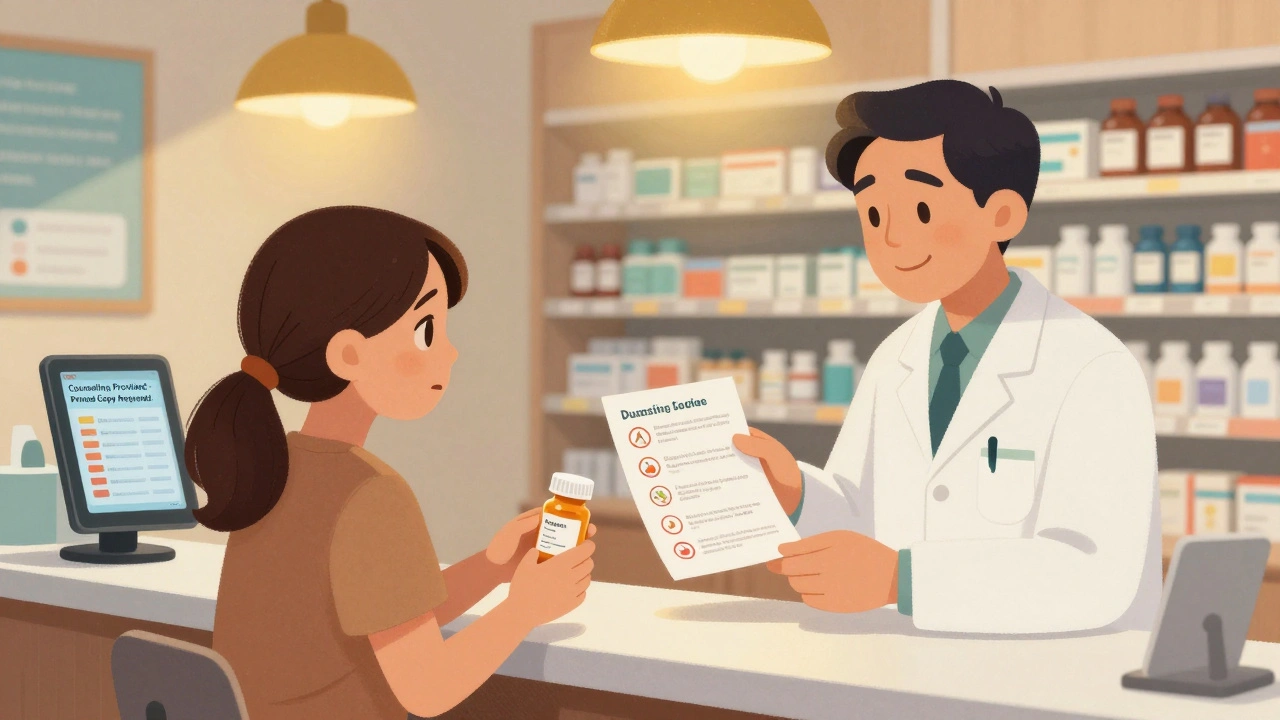
After you pick up your prescription, the work isn’t done. Many people assume the pharmacist’s job ends when they hand over the bottle. But the real safety moment comes after you leave the pharmacy - when you actually start taking the medicine. That’s why confirming pharmacist notes and counseling points is one of the most important steps you can take to avoid dangerous mistakes.
Studies show that half of all medication errors happen not because the wrong drug was dispensed, but because the patient didn’t understand how or when to take it. You might have been told to take your blood pressure pill with food, avoid alcohol with your antibiotic, or watch for dizziness with your new pain med. But if you don’t remember exactly what was said - or worse, if the pharmacist never wrote it down - you’re flying blind.
Why Pharmacist Counseling Notes Matter
Pharmacists are trained to catch drug interactions, explain side effects, and spot red flags like duplicate therapies or dangerous dosages. Under OBRA-90, they’re legally required to offer counseling on all new prescriptions. But offering isn’t the same as documenting. And documenting isn’t the same as making it easy for you to access later.
In 2023, only 37% of community pharmacies consistently provided written counseling documentation. That means in most cases, what you heard at the counter was spoken, not saved. If you forget a detail - like whether to take your medication before or after meals - you can’t go back and check. And that’s when mistakes happen.
The Joint Commission and CMS now track counseling documentation as part of pharmacy quality ratings. But the system isn’t uniform. Some pharmacies store notes in digital portals. Others keep paper copies you have to ask for. Many don’t store them at all.
How to Get Your Counseling Notes - Step by Step
You can’t rely on memory. You can’t assume the notes are automatically available. You need to act - and act fast. Here’s how to make sure you have access to your counseling points after pickup.
- Ask for written documentation at pickup. This is the most reliable method. Say clearly: “Can you please give me a printed copy of the counseling points?” Pharmacists are legally required to provide this upon request. A 2024 ISMP field test showed a 78% success rate when patients asked this directly. Don’t be shy - this is your safety.
- Check your pharmacy’s mobile app immediately after pickup. CVS, Walgreens, and Rite Aid all have patient portals, but access isn’t automatic. For CVS, you need to log in through their app using biometric authentication. For Walgreens, you need your phone number and an 8-digit code. Rite Aid requires you to have filled a prescription in the last 12 months. Don’t wait. Verify your identity the same day you pick up. Walgreens data shows notes appear within 4 hours if you verify on-site.
- Look for the right section. Don’t just check your prescription status. Look for tabs labeled “Pharmacy Notes,” “Counseling Summary,” or “Medication Details.” CVS hides it under “Prescription Details,” while Walgreens puts it under “Prescription Verification.” If you can’t find it, call the pharmacy and ask where to locate it.
- Request an email summary. This is the most underused trick. Ask the pharmacist: “Can you email me a summary of what we discussed?” A Pharmacy Times survey found 89% of patients who asked for this received it. Even if the pharmacy doesn’t store notes digitally, many will still email you a quick bullet list.
- For controlled substances, bring ID. If you’re picking up opioids, benzodiazepines, or other DEA-regulated drugs, you must show photo ID at pickup. Without it, you won’t be able to access counseling notes later - even if they’re stored. DEA data shows this creates a 34% higher barrier to access.
What You Should See in the Notes
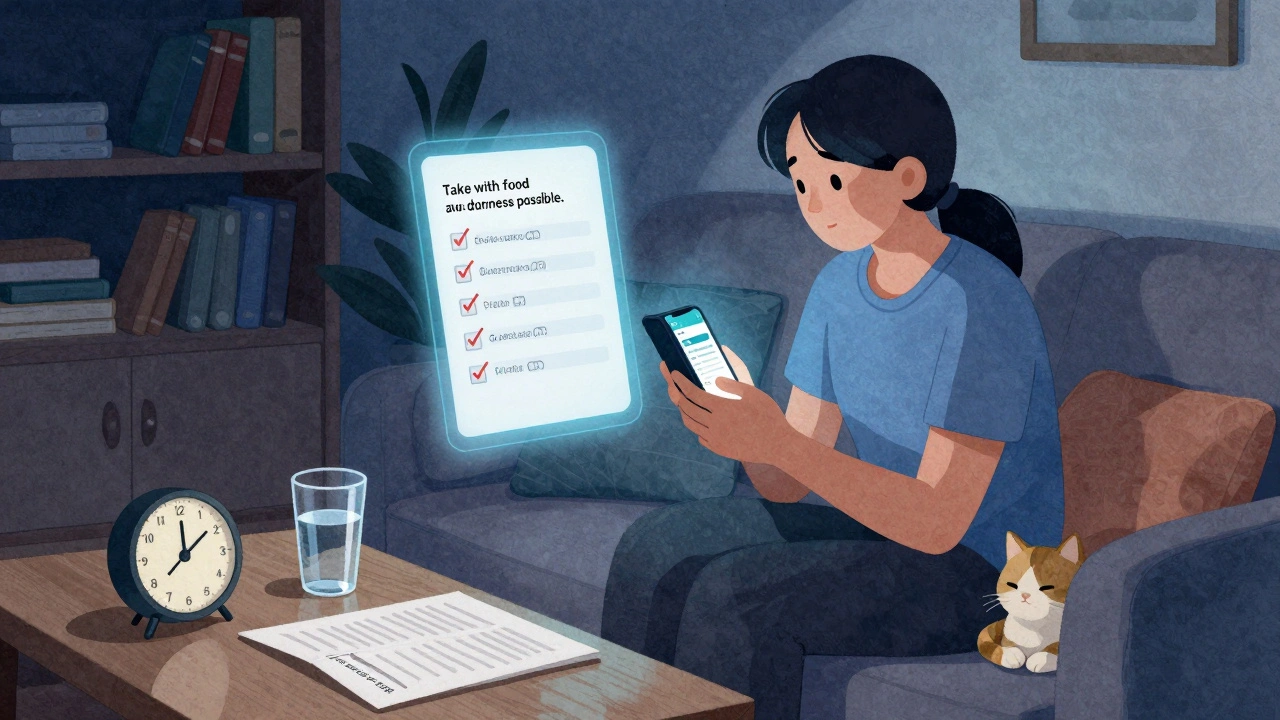
Not all counseling notes are created equal. Some are vague. Others are detailed. Here’s what a complete, useful note should include:
- Exact dosage and timing (e.g., “Take 1 tablet by mouth at bedtime,” not just “Take once daily”)
- Food interactions (“Take with food,” “Avoid grapefruit juice”)
- Side effects to watch for (e.g., “Dizziness may occur - avoid driving until you know how you react”)
- Drug interactions (e.g., “Do not take with ibuprofen or alcohol”)
- Storage instructions (“Keep refrigerated,” “Store at room temperature”)
- When to call your doctor (e.g., “Call if rash develops or if you feel faint”)
- Duration of therapy (“Take for 10 days,” “Refill not available until 2/15/2025”)
If your note says only “Patient counseled on proper use,” that’s not enough. Push back. Ask the pharmacist to expand it. You have the right to clear, specific information.
Why Delays Are Dangerous
The biggest problem across all pharmacy systems? Delayed access. Most notes take 24 to 72 hours to appear online. But the most critical time to confirm counseling is within the first 24 hours - when you’re starting the medication and your body is reacting to it.
Research from SUNY Upstate Medical University found a 22.3% drop in medication errors when patients reviewed counseling points within 24 hours of pickup. That’s why Kaiser Permanente’s system - which delivers notes within minutes - is the gold standard. But Kaiser only serves 12.6 million people. For everyone else, the gap is real.
Waiting 48 hours to check if you’re supposed to take your insulin before or after breakfast isn’t just inconvenient - it’s risky. If you take it wrong, your blood sugar could crash. That’s not a hypothetical. It’s a documented cause of ER visits.
What’s Changing - And What’s Not
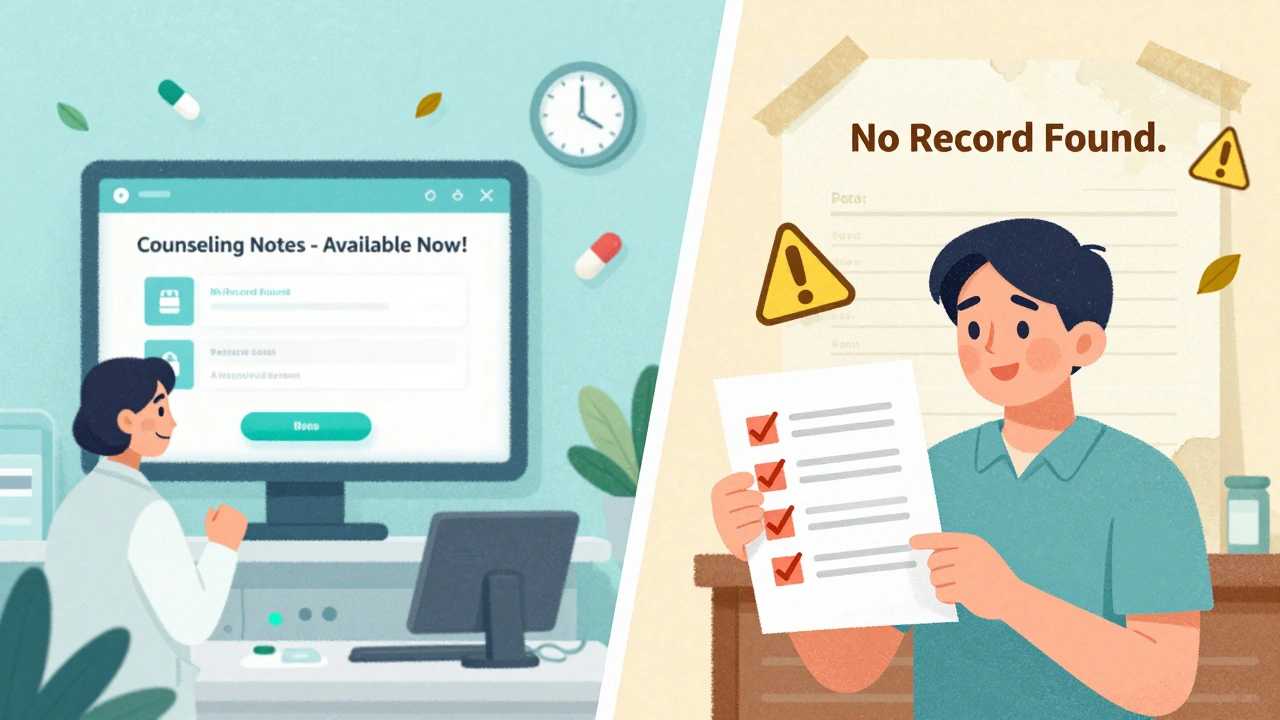
The industry is starting to wake up. In 2024, the National Association of Boards of Pharmacy announced a new rule: by December 2025, all accredited pharmacies must make counseling notes available within 2 hours of pickup. CVS is testing AI-generated summaries that auto-create notes at the counter. Walgreens is partnering with Microsoft to integrate counseling into their health platform. ScriptPath’s MedConfirm platform now sends SMS summaries to patients in pilot programs.
But adoption is slow. Only 18% of community pharmacies have any kind of automated post-pickup verification system. Independent pharmacies - where many people get personalized care - are the least likely to have digital systems. Only 33% offer online access to notes.
And here’s the catch: even within the same chain, practices vary. One Walgreens might email you a summary. The next one might say, “It’s in the app.” You might get a printed sheet at one CVS, and nothing at another. That inconsistency is the biggest barrier to safety.
Your Action Plan: 3 Rules to Stay Safe
Don’t wait for the system to fix itself. Take control. Use these three rules every time you pick up a new prescription:
- Ask for a printed copy. Always. Even if you plan to check the app. Paper is your backup.
- Verify digital access the same day. Log into your pharmacy app right after pickup. Confirm the notes are there and readable.
- Call if something’s missing. If you don’t see your counseling points within 24 hours, call the pharmacy. Ask: “Can you confirm what was discussed about my new medication?” Don’t assume it’s there. Check.
Medication safety doesn’t end at the counter. It ends when you understand what you’re taking - and you have proof you were told how to take it. Don’t let a 72-hour delay or a confusing app stand between you and your health. Be the one who asks. Be the one who checks. Be the one who remembers.
Can I get my pharmacist’s counseling notes if I didn’t ask for them at pickup?
Yes, but it’s harder. You can still request them by calling the pharmacy and asking for a copy of the counseling documentation for your prescription. Pharmacies are required to keep records for at least 2 years. However, if they didn’t document the counseling in the first place - which happens in over 60% of cases - there may be nothing to retrieve. That’s why asking at pickup is critical.
Why do some pharmacies have counseling notes and others don’t?
It comes down to technology and policy. Chain pharmacies like CVS and Walgreens have digital systems that can store notes, but they’re not required to make them available to patients. Independent pharmacies often rely on handwritten notes or no documentation at all. Even within chains, individual stores may have different practices. A 2023 survey found 61% of patients reported inconsistent documentation - even at the same pharmacy chain.
Are pharmacists legally required to document counseling?
They are required to offer counseling under OBRA-90, but not to document it. Documentation is a best practice, not a federal mandate. Some states require it, but most don’t. That’s why you can’t rely on it being there. Always ask for a written copy - that’s your legal right.
What if I’m on Medicare and my pharmacy doesn’t provide notes?
Medicare Part D now includes counseling documentation accessibility in its Star Ratings. Pharmacies with poor scores lose money. That means they’re under pressure to improve. If your pharmacy consistently fails to provide notes, you can file a complaint with Medicare or switch to a pharmacy with better ratings. Check your plan’s pharmacy directory for providers with higher Star Ratings.
Can I ask for counseling notes for over-the-counter meds?
Pharmacists aren’t legally required to counsel on over-the-counter drugs, but many will if you ask - especially for medications that interact with prescriptions or affect chronic conditions like diabetes or high blood pressure. Don’t assume OTC means “safe without advice.” Always ask: “Is this okay to take with my other meds?” and request a note if it’s important.
Comments
Dematteo Lasonya
I always ask for a printed copy. Simple. No app glitches, no login issues. Just paper in my wallet. Done.
December 5, 2025 at 07:14
Jessica Baydowicz
This is the kind of post that makes me want to hug a pharmacist. Seriously, y’all need to stop assuming the system has your back. You gotta be your own advocate. Print it. Save it. Share it. Your life might depend on it.
December 5, 2025 at 12:55
Michael Feldstein
I’ve been a pharmacy tech for 12 years. The biggest thing I see? Patients don’t ask because they think it’s rude. But here’s the truth: we *want* you to ask. We’ve got a hundred things going on, and if you don’t say something, we assume you got it. Don’t assume. Ask. Always.
December 6, 2025 at 17:43
Libby Rees
The legal requirement to offer counseling is clear. The lack of documentation is not a technical failure-it’s a cultural one. Pharmacies treat counseling as a checkbox, not a commitment. Until that changes, patients must carry the burden of accountability.
December 8, 2025 at 06:50
Scott van Haastrecht
Let’s be real. The entire healthcare system is designed to make you fail. They don’t want you to understand your meds. They want you to take them, show up for the next appointment, and pay for the next script. Documentation? That’s a liability. Don’t be fooled.
December 10, 2025 at 02:09
Pavan Kankala
AI-generated summaries? Microsoft integration? Please. This is all just corporate theater. They’re not fixing the system-they’re monetizing the panic. Your data is being harvested. The notes you get? They’re not for you. They’re for the algorithm.
December 11, 2025 at 11:28
Joe Lam
I’m shocked anyone still uses CVS or Walgreens. The app is a dumpster fire. I’ve spent 45 minutes trying to find counseling notes on Walgreens’ portal. It’s like they designed it to frustrate elderly patients. If you’re not tech-savvy, you’re screwed.
December 12, 2025 at 05:58
Rachel Bonaparte
Did you know that in some states, pharmacists are allowed to refuse to document counseling if they think the patient is ‘non-compliant’? That’s not in the article. That’s the real story. They’re not just negligent-they’re gatekeeping. And they call it ‘risk management.’
December 12, 2025 at 13:31
zac grant
The real win here is the 22.3% drop in errors when reviewed within 24 hours. That’s not just a stat-it’s a clinical imperative. We’re talking about preventable hypoglycemia, arrhythmias, renal failure. This isn’t about convenience. It’s about survival metrics. If your pharmacy doesn’t prioritize this, you need a new one.
December 12, 2025 at 14:00
Gareth Storer
So what you’re saying is, we’re supposed to treat pharmacists like our personal medical assistants? And if they don’t hand us a 12-point bullet list like we’re a CEO on a board call, we’re supposed to call them? Wow. What a revolution. Next, we’ll demand handwritten prescriptions with ink signatures.
December 13, 2025 at 08:02
val kendra
I used to think this was overkill until my mom had a bad reaction to a new statin because she forgot the ‘take with food’ part. She’s 74. Didn’t even realize she was supposed to. Now I print every note. I scan it. I email it to her kids. I put it in her pill organizer. It’s not extra work-it’s essential infrastructure.
December 14, 2025 at 16:48
Isabelle Bujold
I work in a community pharmacy in Toronto. We’ve had a policy since 2022: every new script gets a printed summary, emailed, and added to the patient portal-no questions asked. We lost 12% of our patients to big chains because we didn’t push apps hard enough. But our error rate dropped by 68%. Sometimes doing the right thing costs you customers. But it saves lives. And that’s the only metric that matters.
December 15, 2025 at 09:11
jagdish kumar
The system is broken. But the solution isn’t in apps or paper. It’s in trust. When you stop seeing the pharmacist as a clerk and start seeing them as a partner, you stop asking for notes. You just ask questions. And they answer. That’s all you need.
December 16, 2025 at 05:27
Write a comment