
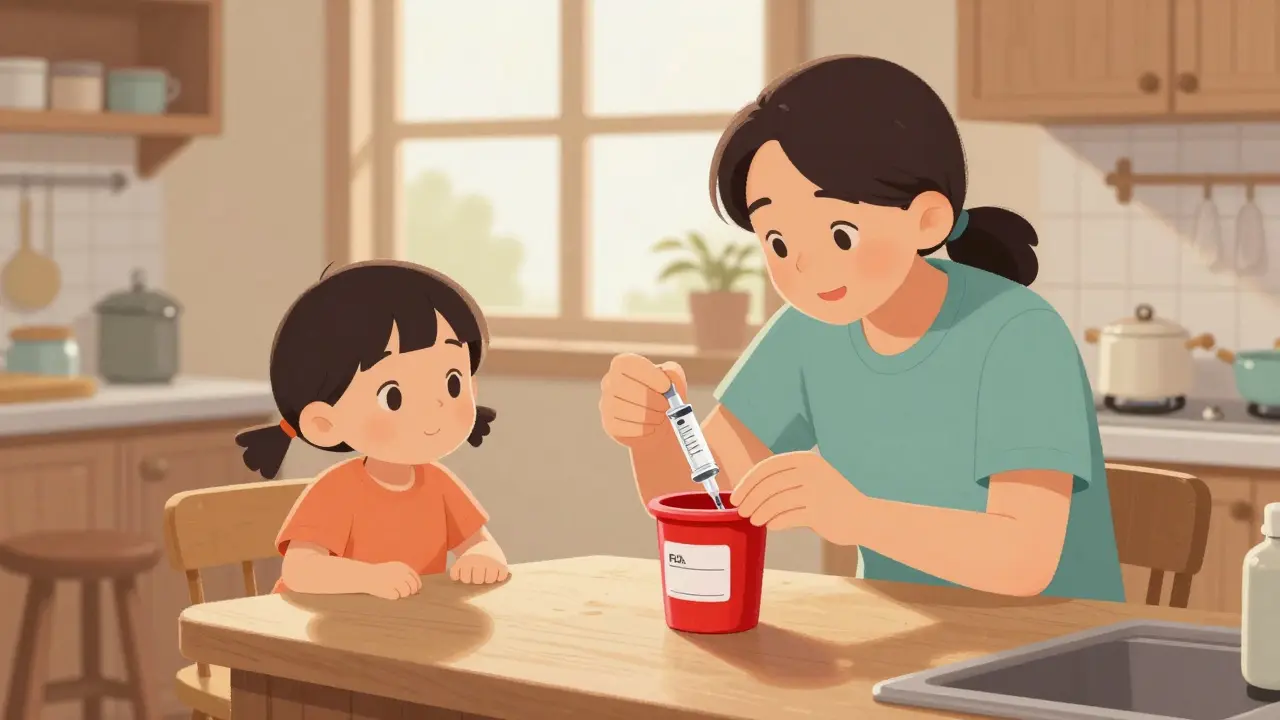
When you or a loved one uses needles or syringes for insulin, blood thinners, or other injected medications, the biggest question isn't how to use them-it's what to do with them after. Throwing them in the trash, tossing them in a soda bottle, or trying to bend the needle might seem harmless, but it's dangerous. Every year, over 385,000 needlestick injuries happen to healthcare workers, and thousands more happen to family members, sanitation workers, and even kids who find improperly discarded sharps. The good news? Safe disposal is simple-if you know how.
What Counts as a Sharp?
A sharp isn’t just a needle. It includes any device that can cut or puncture skin after being used for medication. That means syringes, auto-injectors like EpiPens, lancets for blood glucose tests, and even insulin pen needles. Even if the needle is removed, the syringe barrel can still have sharp edges. If it came into contact with blood or body fluids, it’s regulated medical waste. Don’t assume something is safe just because it looks small or old.
Why You Can’t Just Toss Them in the Trash
Many people think, “It’s just a needle-I’ll wrap it in paper and throw it out.” But according to the FDA, 68% of sharps-related injuries in homes happen because people tried exactly that. Sanitation workers don’t expect to find needles in regular trash. Kids, pets, and even recycling sorters can get stuck. In Australia, over 2,000 public needlestick incidents were reported in 2023 alone, mostly from improperly discarded sharps. You’re not just risking yourself-you’re risking your whole community.
What You Need: FDA-Cleared Sharps Containers
The safest way to store sharps is in a container designed for it. These aren’t just plastic bins-they’re engineered safety devices. FDA-cleared containers must meet strict standards:
- Thick, puncture-resistant plastic (at least 1 mm thick)
- A tight, one-way lid that stops your hand from going in
- A stable base so it doesn’t tip over
- A clear fill line (never fill past 3/4 full)
- A biohazard label with the universal symbol
Brands like BD Redi-Sharp, Sharps Compliance, and Stericycle are common. You’ll see them at pharmacies, medical supply stores, or online. A basic 1.5-gallon container costs between $9 and $13. That’s less than a weekly coffee run, but it could prevent a lifetime of medical bills.
How to Use the Container Correctly
Using the container right matters just as much as having one.
- Keep it within arm’s reach while injecting-no walking across the room.
- Never recap, bend, or break the needle after use. That’s the #1 cause of injuries.
- Drop the sharp straight in. Don’t try to force it or pile it up.
- Stop when the sharps reach the fill line. Even if it looks like there’s space, don’t overfill.
- Keep the lid closed and locked at all times.
One common mistake? Waiting until the container is full before sealing it. If you can see the sharps through the container window, it’s time to seal and dispose. A 2022 study found that 28% of injuries happened because people waited too long to replace containers.
Where to Dispose of Full Containers
Once full, you can’t just leave it by the curb. Here’s how to handle it:
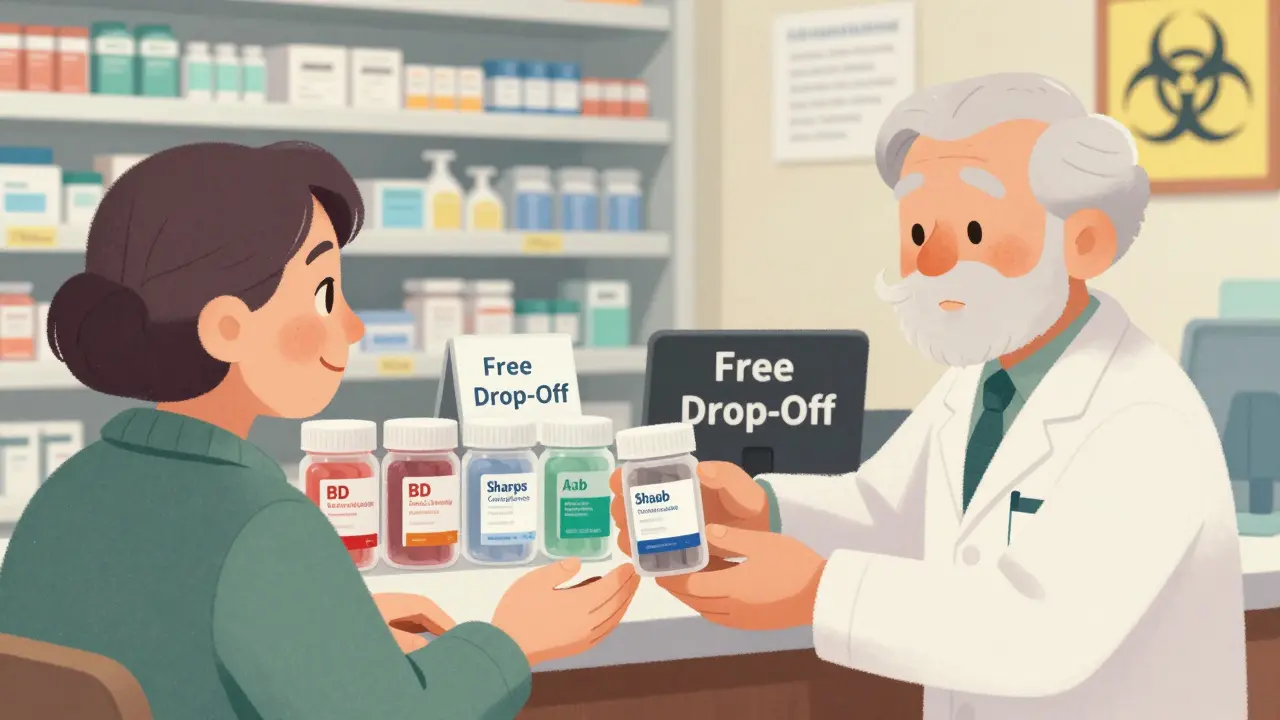
- Pharmacies: Many pharmacies like Chemist Warehouse, Priceline, and local independents have free drop-off boxes. Just bring your sealed container and swap it for a new one-no appointment needed.
- Hospital or clinic drop-off: If you get your medication from a clinic, ask if they accept used sharps. Most do, even if you didn’t get the script there.
- Local council programs: In Brisbane, the City Council runs free sharps disposal bins at 14 locations, including libraries and community centers. Check brisbane.qld.gov.au/sharps for the nearest one.
- Mail-back programs: If you live far from a drop-off point, services like Sharps Compliance offer prepaid mailers. You seal your container, stick on the label, and drop it in the mailbox. Cost is usually $15-$25 per box.
Don’t rely on household waste. Even if your bin says “medical waste,” it’s not designed for sharps. Only use official collection points.
What to Do If You Don’t Have a Container
If you’re out of supplies and can’t get to a pharmacy right away, use a hard plastic bottle with a screw-top lid-like a laundry detergent bottle or a bleach bottle. Never use glass, thin plastic, or anything that can break. Label it clearly: “SHARPS-DO NOT RECYCLE.” Keep it out of reach of children and pets. As soon as you can, transfer it to a proper container. This is a temporary fix, not a long-term solution.
Costs and Financial Help
Yes, containers cost money. But so do injuries. The average cost of treating a needlestick injury is over $3,200-for testing, meds, and follow-ups. Many people on Medicare or private insurance can get sharps containers covered. In Australia, the National Diabetes Services Scheme (NDSS) provides free or low-cost sharps containers and disposal services to registered users. If you’re on a pension or have a healthcare card, ask your GP or pharmacist about subsidies. You’re not alone-thousands get help every year.
What’s Changing in 2026
Starting January 1, 2026, Australia will require all sharps containers to have standardized labeling nationwide. That means clearer symbols and uniform instructions. Also, more pharmacies are rolling out 24/7 drop boxes. In Brisbane, three new locations opened last month, including one at the Queen Street Mall pharmacy. Keep an eye out for these upgrades-they’re making disposal easier than ever.
Common Mistakes (And How to Avoid Them)
- Mistake: Recapping needles to “save” them. Solution: Never do it. Use one-handed scoop technique if absolutely necessary (but avoid it).
- Mistake: Using a yogurt cup or milk bottle. Solution: Only use FDA-approved containers or heavy-duty plastic bottles.
- Mistake: Waiting until the container is overflowing. Solution: Seal it at the fill line-even if it’s not full yet.
- Mistake: Not telling your doctor you’re struggling to dispose. Solution: They have resources. Ask.
What Happens to Used Sharps?
Once collected, sharps go to licensed medical waste facilities. They’re sterilized using high-temperature incineration or autoclaving, then crushed and recycled into non-medical plastic products. The goal? Zero needles in landfills. The system works-but only if you use it right.
Can I recycle a sharps container after it’s empty?
No. Even if the container is empty, it’s classified as contaminated medical waste. Do not put it in your recycling bin. Return the full container to a drop-off point, and they’ll handle the disposal. If you’re using a mail-back system, the entire container is returned for destruction.
What if I accidentally drop a needle on the floor?
Don’t pick it up with your fingers. Use tongs or pliers, and place it directly into a sharps container. If you don’t have one, use a thick plastic bottle. Wash your hands thoroughly afterward. If you get pricked, wash the area with soap and water, then contact your doctor immediately. Report the incident-even if you think you’re fine. Some infections take weeks to show symptoms.
Can I use the same container for different types of sharps?
Yes. As long as the container is FDA-cleared and designed for sharps, it’s safe to use for needles, lancets, auto-injectors, and insulin pen tips. The material and design are built to handle all of them. Just don’t mix in non-sharp medical waste like gauze or pill bottles.
Is it legal to dispose of sharps in the regular trash in Australia?
It’s not illegal for individuals to throw sharps in the trash-but it’s strongly discouraged and violates public health guidelines. Local councils can issue fines if improperly disposed sharps are found in public areas. More importantly, it puts others at risk. Always use a designated drop-off point.
How often should I replace my sharps container?
Replace it when it reaches the fill line, which is usually about 3/4 full. For most people on daily injections, that’s every 2-4 weeks. Don’t wait until it’s full. If you notice the lid is hard to close or the container is bulging, replace it immediately. If you’re unsure, contact your pharmacy-they’ll tell you what’s normal for your usage.
Disposing of sharps isn’t about following rules-it’s about protecting people. You, your family, your neighbors, and the people who collect your trash. It’s simple: use the right container, fill it right, drop it off. That’s all. And if you forget, ask your pharmacist. They’ve seen it all-and they’re there to help.
Comments
Khaya Street
Look, I get it-sharps are dangerous. But let’s be real: most people aren’t going to buy a $12 container just because some pamphlet says so. I’ve been doing insulin for 12 years. I use an old laundry bottle. Label it. Screw the lid tight. Keep it on the shelf. Done. No one’s getting stabbed. Stop making this feel like a military operation.
And don’t even get me started on mail-back programs. $25 to send a bottle? That’s a joke. If you’re on a fixed income, you’re choosing between insulin and a disposal box. That’s not safety-that’s profit.
Pharmacies should provide free containers. Period. It’s not a luxury. It’s a public health necessity. If they’re making money off the meds, they damn well should cover the disposal.
February 22, 2026 at 18:33
Christina VanOsdol
OMG YES 😭 I JUST HAD TO DO THIS LAST WEEK AND IT WAS A NIGHTMARE!!! So I bought the BD Redi-Sharp... it’s like a tiny fortress for needles 🛡️💉 and I swear I almost cried when I sealed it because I felt like a responsible adult for once??
Also-did you know that in 2023, a toddler in Ohio got stuck with a needle from a neighbor’s trash?? 🤯 I’m not even joking. I now keep mine in the garage in a locked toolbox. No kids. No pets. No drama.
PS: If you’re using a yogurt cup, you’re basically playing Russian roulette with sanitation workers. Just… no. 😇
February 22, 2026 at 22:22
Brooke Exley
You’re not alone. Seriously. I’ve been there-scared, overwhelmed, thinking I’m doing something wrong just because I’m tired. But guess what? You’re doing better than you think.
Using a sharps container isn’t about perfection-it’s about progress. One step. One bottle. One safe moment. That’s victory.
And if you’re struggling? Talk to your pharmacist. They’ve got stacks of free containers and a heart bigger than their inventory. You’re not a burden. You’re a warrior. And warriors don’t give up-they just switch to a better container.
Go get that drop-off bin. You’ve got this. 💪❤️
February 23, 2026 at 19:33
Alfred Noble
So I’ve been using the same container for like 6 months because I’m lazy and also kinda broke. I mean, it’s not even full, just kinda bulgy. I read the fill line thing but honestly? I just kinda… ignore it.
But then I dropped a needle on the floor last week and I had to use tongs. That was weird. Like, why do I own tongs? I don’t even cook.
Anyway, I finally sealed it and took it to the CVS drop box. No one asked me anything. Just nodded. Felt kinda proud. Maybe I’ll get one of those fancy ones next time. Or maybe I’ll just keep winging it. 🤷♂️
February 24, 2026 at 04:48
Matthew Brooker
Let’s stop pretending this is complicated. You need a container. You fill it. You drop it. That’s it.
It’s not about being perfect. It’s about being safe. And if you’re worried about cost, talk to your doctor. There are programs. There are free boxes. There are people who want to help you.
Don’t let fear or shame keep you from doing the right thing. You’re not just protecting yourself-you’re protecting the person who empties your trash. The kid who walks the neighborhood. The dog who sniffs around the bin.
Be part of the solution. Not the problem. Simple.
And if you forget? Ask. Always ask.
February 24, 2026 at 07:52
Emily Wolff
If you’re using anything other than an FDA-cleared container, you’re a hazard. Period. No exceptions. No excuses. Your laziness is someone else’s nightmare.
And yes, I’m talking to you, yogurt cup user. You’re not clever. You’re reckless.
Stop making this about convenience. This is about preventing bloodborne pathogens in public spaces. If you can’t handle that, maybe you shouldn’t be injecting at all.
February 24, 2026 at 19:03
Jacob Carthy
Who the hell are these people to tell me how to dispose of my needles? I’m not some government lab rat. I live in America. I do what I want.
I wrap mine in duct tape. Throw ‘em in the trash. If some环卫工 gets stuck? That’s their problem. I’m not paying $15 for a mailer. I’m not driving 20 miles to a pharmacy.
Stop the guilt trip. You want safety? Get your own damn container. Don’t make me pay for your paranoia.
February 24, 2026 at 23:17
Anil bhardwaj
I live in India. We don’t have these fancy containers. My sister uses a small tin box from her tea. She cleans it with bleach and keeps it under the bed. We don’t have drop-off points. So we give it to the local clinic every few months.
It’s not perfect. But it’s what we have. I think the real issue is access-not ignorance. People in rural areas can’t afford $12 boxes. They need support, not lectures.
Maybe instead of pushing containers, we should push free distribution? Just a thought.
February 26, 2026 at 08:25
lela izzani
I just want to say thank you for writing this. I’ve been using insulin for 8 years and never knew about the 3/4 fill rule. I was filling mine to the brim. I felt awful realizing I’d been risking sanitation workers.
I went to my pharmacy yesterday and asked for a container. They gave me one free with my prescription. No questions. Just kindness.
It’s not just about disposal. It’s about dignity. And you reminded me I deserve that.
February 27, 2026 at 01:01
Stephen Archbold
Just dropped off my first full container today. Took me 3 weeks. I thought I’d be doing it monthly. Turns out, daily injections add up faster than you think.
Went to the library drop box. The lady behind the counter smiled and said, ‘You’re doing great.’ I almost cried. Not because it was hard-but because someone noticed.
And yeah, I typo’d ‘container’ as ‘contaier’ on the form. But she didn’t care. Just handed me a new one. That’s the kind of community we need.
Thanks for the guide. Made me feel less alone.
February 28, 2026 at 08:47
Nerina Devi
In rural India, we don’t have drop-off points. We don’t have mailers. We don’t have $12 containers. But we have mothers who save empty insulin bottles, wash them with soap and sunlight, and store them under the floorboards until they can walk 12 kilometers to the nearest clinic.
This isn’t about American standards. It’s about human dignity. We need global solutions-not just pamphlets written for people with Wi-Fi and credit cards.
If you’re reading this and you’re in a position to help, please don’t just share this post. Donate to a program that delivers sharps containers to villages. Let’s make safety universal.
March 1, 2026 at 11:43
Write a comment