
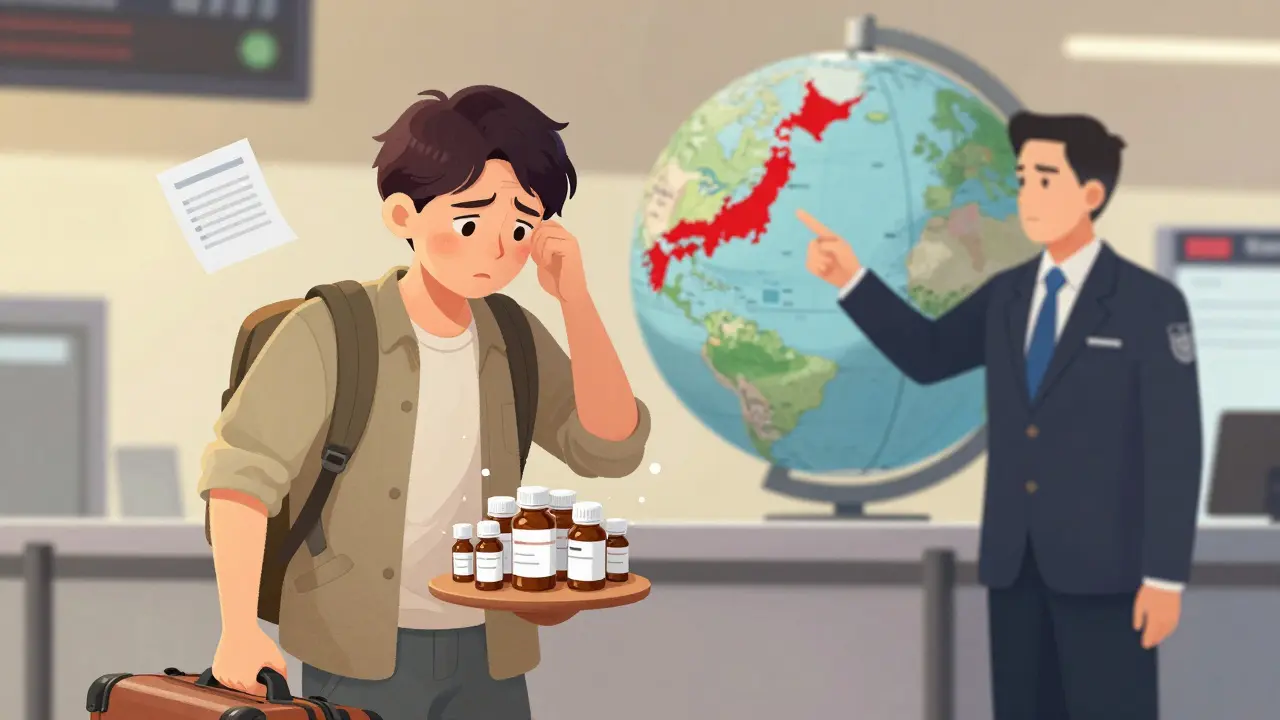
Running out of your medication halfway through your trip isn’t just inconvenient-it can be dangerous. Imagine needing your blood pressure pills and realizing you packed only enough for two weeks, but your trip lasts six. Or worse, getting stopped at customs in Thailand because your anxiety medication is illegal there. These aren’t rare stories. In 2023, over 90 million Americans traveled abroad, and 12-15% of them ran into medication problems. The good news? Almost all of these issues can be avoided with simple, early planning.
Know What’s Allowed Where
Not every drug legal in the U.S. is legal everywhere else. Some countries treat common medications like controlled substances-even if your doctor prescribed them. Japan bans over 1,400 medications, including common decongestants like pseudoephedrine and certain antibiotics. The UAE considers codeine a Class A drug; carrying it without approval can lead to a five-year prison sentence. Thailand detains travelers for days over sleeping pills like zolpidem. And in Saudi Arabia, even your insulin might need a special government permit.Don’t guess. Check the International Narcotics Control Board (INCB) Country Regulations database. It’s updated regularly and lists exactly what’s banned, restricted, or requires paperwork in over 180 countries. If the country isn’t listed, contact their embassy directly. Don’t rely on Google searches or forum advice-rules change fast. In 2024, 19 countries banned CBD products outright, even though they’re legal federally in the U.S. That includes South Korea and Malaysia. If you use CBD oil, assume it’s illegal unless you’ve confirmed otherwise with official sources.
Start Planning 8 to 12 Weeks Ahead
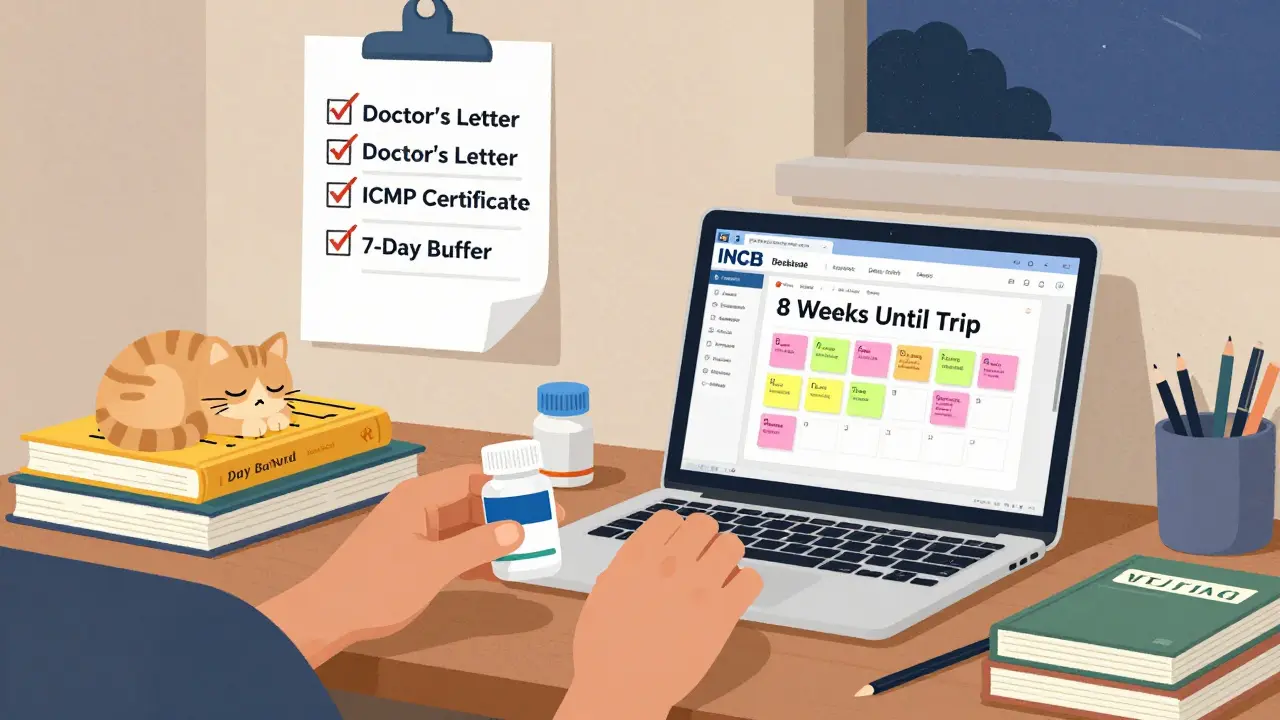
Waiting until the week before your trip is a recipe for disaster. Some countries require letters from your doctor, notarized copies, or even government permits. Getting those takes time. The CDC and the International Society of Travel Medicine both recommend starting at least two months before departure.Here’s what to do in order:
- Make a full list of every medication you take-brand name, generic name, dosage, and frequency.
- Check each one against the INCB database or embassy guidelines.
- Call your doctor. Ask them to write a letter on letterhead explaining why you need each medication. Include your diagnosis, dosage, and duration of treatment. Some countries require this letter to be notarized.
- If you’re taking controlled substances (like opioids, ADHD meds, or benzodiazepines), ask your doctor if they can provide an International Certificate for Medicinal Products (ICMP). About 68% of U.S. pharmacies can issue this, but it costs $25-$40 per certificate.
- Contact the embassy of your destination country. Ask: “What documentation is required for [medication name] to enter your country?” Get their response in writing.
Pro tip: If you’re flying through multiple countries, check transit rules too. A medication allowed in your final destination might be banned in the country you’re connecting through. In 2024, the International Air Transport Association found that 37% of medication incidents happened during layovers, not at the final destination.
Bring Enough-Plus a Buffer
The U.S. Customs and Border Protection says you can bring no more than a 90-day supply of medication for personal use. That’s a good rule of thumb. But don’t stop there. Add at least seven extra days to cover delays, lost luggage, or flight cancellations. If you’re going on a 14-day trip, pack 21 days’ worth. If you’re gone for three months, bring 100 days’ supply.Why? Because refilling prescriptions overseas is often impossible. Pharmacies in many countries don’t accept U.S. prescriptions. Even in Europe, where rules are looser, you might need a local doctor’s note to get a refill. And if your medication is banned? Forget it. You won’t find it anywhere.
Also, don’t assume your insurance will cover refills abroad. Medicare doesn’t. Most private plans don’t either. You’re on your own for supply.
Pack Smart-And Always in Your Carry-On
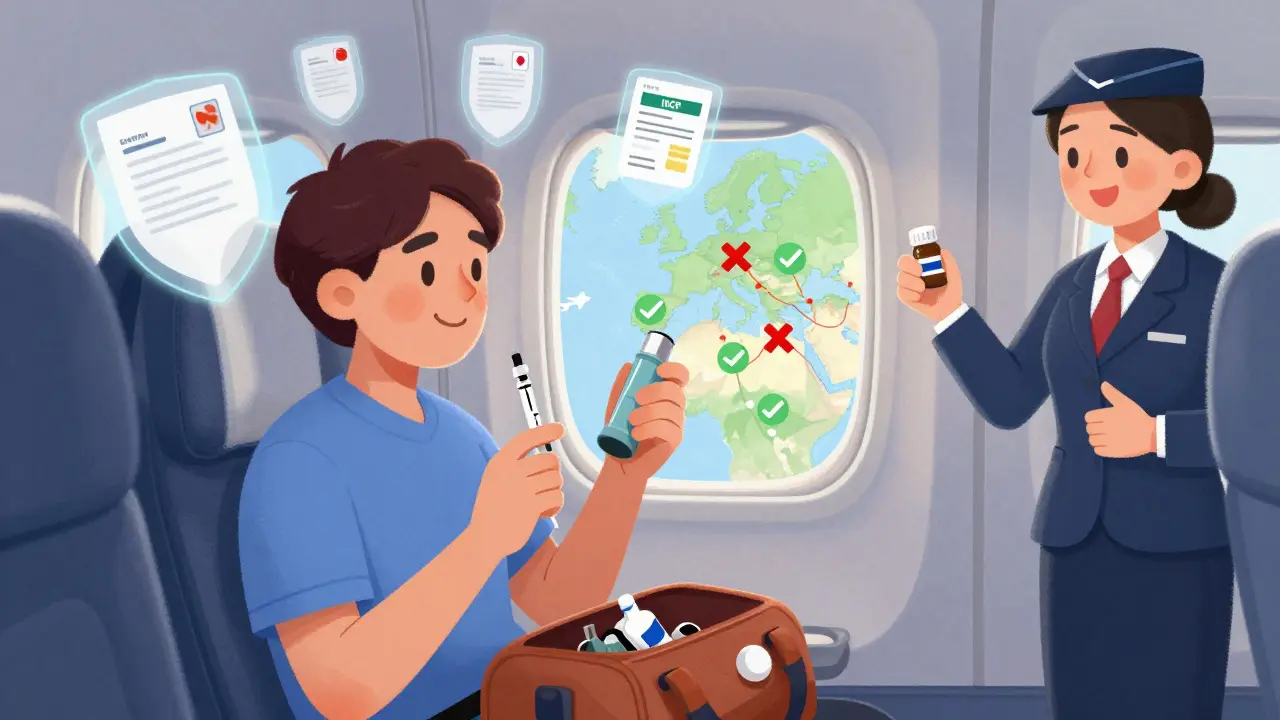
Never check your medication. Bags get lost. Bags get delayed. Bags get stolen. If you need daily insulin, asthma inhalers, or heart medication, keep them with you at all times.Here’s how to pack:
- Keep all medications in their original bottles with prescription labels attached. This is the single most important step. Even if you’re carrying pills in a pill organizer, bring the original bottles too.
- Don’t remove labels. Customs agents need to see the pharmacy name, your name, the drug name, and dosage.
- If you need liquids (like insulin or liquid antibiotics), they’re exempt from the 3.4-ounce rule-but you must declare them at security. TSA says they’re allowed if they’re medically necessary. Delta Air Lines and other major carriers confirm this policy as of January 2025.
- If you use needles or syringes, bring them with you in your carry-on. You may need a doctor’s note explaining why you need them. Some countries require special permits for syringes too.
Pro tip: If you’re flying from a U.S. state like California, New York, or Texas, state law requires controlled substances to remain in original containers. Even if you’re just connecting through one of these states, you still need to follow their rules.
Document Everything
Paperwork isn’t optional-it’s your legal shield. At a minimum, carry:- Original prescription bottles with labels
- A signed letter from your doctor (on letterhead)
- A copy of your prescription
- Proof of your diagnosis (if applicable)
- For controlled substances: the ICMP certificate, if you got one
Scan all these documents and email them to yourself. Save them on your phone. Give a copy to a travel companion. You never know when you’ll need to show them quickly.
And don’t rely on digital copies alone. Some countries require physical originals. Thailand, for example, demands notarized doctor’s letters for any prescription medication-even if it’s not a controlled substance. If you’re going there, get the letter notarized before you leave.
Watch Out for These High-Risk Medications
Some medications are red flags everywhere. Here’s the short list of what to double-check:- ADHD meds (Adderall, Ritalin): Banned in Japan, Singapore, and the UAE. Even in Europe, they’re tightly controlled.
- Anti-anxiety drugs (Xanax, Valium): Illegal in Thailand, South Korea, and parts of the Middle East.
- Sleep aids (Ambien): Forbidden in Japan and Thailand. Carrying them without paperwork can mean detention.
- Painkillers (hydrocodone, oxycodone, codeine): Illegal in the UAE, Saudi Arabia, and Singapore. Codeine is especially risky-it’s in many cough syrups too.
- Decongestants (pseudoephedrine): Banned in Japan and several Asian countries. Even Sudafed can get you in trouble.
- CBD and cannabis products: Legal in some U.S. states, illegal in 19 countries including Malaysia and South Korea. Don’t assume it’s okay.
If you take any of these, start planning early. Some countries allow them with a permit. Others don’t allow them at all. There’s no middle ground.
What If You Can’t Get Your Medication?
If your medication is banned or you can’t get the paperwork in time, talk to your doctor. Ask if there’s an alternative drug that’s legal in your destination. For example, if you take Adderall and can’t bring it to Japan, your doctor might switch you to a non-stimulant like atomoxetine (Strattera), which is allowed there.Or, if you’re traveling to a country with good healthcare (like Germany or Australia), ask your doctor to write a letter explaining your condition and treatment. Some foreign doctors will refill your prescription if you have proper documentation. But don’t count on it. Always bring enough with you.
Need Help? Use These Resources
You don’t have to figure this out alone. Here are trusted sources:- INCB Country Regulations Database - Free, official, updated monthly
- CDC Yellow Book - The gold standard for travel health info
- U.S. State Department Travel Advisories - Look for the “Medical Information” section
- MedPassport - A digital tool that helps organize your meds and documents ($49/year)
- Delta Air Lines Accessibility Line - (404-209-3434) - They help with medication questions, especially for liquids and needles
- INCB Emergency Line - +41 22 917 92 92 - Available 24/7 for urgent questions
Don’t waste money on unaccredited services. The U.S. Government Accountability Office found that 78% of “medication travel assistance” companies aren’t officially recognized. Stick to government and medical sources.
Final Checklist
Before you leave, verify these five things:- Every medication is legal in every country you’re visiting (including layovers).
- You have enough for your entire trip plus seven extra days.
- All meds are in original bottles with labels.
- You have a doctor’s letter and/or ICMP certificate for controlled substances.
- You’ve emailed copies of all documents to yourself and a travel companion.
If you check all five, you’ve done more than 90% of travelers. You’re not just prepared-you’re protected.
Can I mail my medication to another country?
No. It’s illegal to mail prescription medications to most countries. Even if the destination allows the drug, postal services like USPS, FedEx, or DHL are prohibited from shipping controlled substances across borders. Many travelers have had their packages seized, fined, or even faced criminal charges. Always carry your medication with you in your carry-on.
What if my medication is in a pill organizer?
It’s risky. While some travelers get away with it, customs agents in many countries require original prescription bottles. Always bring your original bottles with labels, even if you use a pill organizer for convenience. Keep the organizer as a backup, not your primary carry.
Do I need a doctor’s letter for over-the-counter meds?
Usually not-but check anyway. Some countries, like Thailand, require documentation for any prescription medication, even if it’s available over the counter in the U.S. If your OTC drug contains pseudoephedrine (like Sudafed), it’s banned in Japan and Singapore. Always verify.
Can I refill my prescription overseas?
It’s rare. Most countries don’t recognize U.S. prescriptions. Even in places like Canada or the UK, you’ll need to see a local doctor. Don’t plan on refilling. Bring enough for your entire trip plus a buffer.
Are there any countries that are easier for travelers with medications?
Yes. Most European Union countries, Canada, Australia, and New Zealand have relatively clear rules and accept U.S. prescriptions with a doctor’s note. The Schengen Area has harmonized some rules, making travel between member countries easier. Still, always check-especially if you’re taking ADHD meds or opioids. Even in these countries, restrictions apply.
Comments
Samar Khan
I just got back from Thailand and forgot my anxiety meds were illegal there. 😭 They held me for 3 days while they called my embassy. Don't be me. Bring the letter. Bring the bottles. Bring your sanity.
December 30, 2025 at 19:19
Russell Thomas
Wow. So what you're saying is... don't be an idiot? Thanks for the 2000-word essay on not getting arrested abroad. I'm sure the 12% of people who didn't read this are now sobbing into their Sudafed bottles.
December 30, 2025 at 23:07
Joe Kwon
This is a masterclass in risk mitigation. The INCB database is underutilized-most travelers rely on anecdotal Reddit threads or Google Translate. The ICMP certificate is a game-changer for controlled substances; it's essentially a diplomatic passcode. Also, carry physical copies-digital backups fail at customs checkpoints. Pro tip: laminate your doctor’s letter. Water damage = detention risk.
December 31, 2025 at 21:08
Fabian Riewe
I used to just toss my meds in a pill organizer and pray. Then I got stopped in Dubai with my Adderall. Let me tell you, being questioned by a guy in a white robe while your pills are being scanned under a UV light changes your life. Now I bring the bottles, the letter, the certificate, and a printed copy of the INCB page for my meds. It’s overkill? Maybe. But I’m alive and not in a jail cell. 🙏
January 1, 2026 at 23:41
Jasmine Yule
I can't believe how many people treat this like a chore. Your medication isn't a suggestion-it's your lifeline. If you're taking insulin, heart meds, or anything that keeps you breathing, treat it like your passport. No compromises. No shortcuts. No 'I'll just buy some there.' You won't. And if you do, it might kill you. This guide is life-saving. Share it with everyone you know.
January 3, 2026 at 17:11
Lisa Dore
I love how this guide doesn’t just scare people-it empowers them. So many of us travel with chronic conditions and feel invisible. This is the kind of resource we need: clear, compassionate, and practical. I’m sending this to my entire travel group. And yes, I’m laminating my doctor’s letter. 😊
January 5, 2026 at 03:48
Sharleen Luciano
It's frankly embarrassing that this level of diligence is even necessary. If you're too lazy to check if your ADHD meds are illegal in Japan, maybe you shouldn't be traveling. The fact that people still think they can 'wing it' with prescription drugs abroad is a public health failure. This isn't advice-it's basic adulting.
January 6, 2026 at 18:10
Marie-Pierre Gonzalez
I just returned from a 6-week trip across Europe and Canada. I brought my insulin in original bottles, with a doctor’s letter, and declared it at every security checkpoint. I even had a backup vial in my checked luggage-just in case. (It wasn’t needed, thank goodness.) I’m so glad this guide exists. I’ve shared it with my diabetes support group. 🇨🇦❤️
January 7, 2026 at 01:56
Manan Pandya
I'm from India and have traveled to the US with my epilepsy meds. The key is the doctor’s letter on letterhead with your diagnosis and dosage. US customs rarely questioned me because I had it. But in Singapore, they asked for the original prescription too. Always carry both. And never, ever pack in checked luggage. I’ve seen friends lose their meds to lost bags. It’s terrifying.
January 8, 2026 at 21:53
Nisha Marwaha
The INCB database is the only authoritative source. I’ve seen too many people rely on ‘Reddit said’ or ‘my cousin went there and it was fine.’ That’s how you end up in a Thai prison. Also, CBD is a minefield-even if it’s hemp-derived and legal in your state, 19 countries treat it like heroin. If you’re using it for anxiety, consider switching to non-cannabis alternatives before you go. It’s safer, and honestly, less risky.
January 10, 2026 at 02:57
Paige Shipe
I dont even know why people make this so hard. Just bring your meds. If they ask, say its for your depression. Everyone gets depression now. Its fine. I did it in Japan with my Xanax and no one cared. Maybe you just need to be more chill. Why are we all so scared of borders? Its just a desk with a person.
January 11, 2026 at 12:59
Tamar Dunlop
As someone who has lived in five countries and managed a chronic autoimmune condition, I can say with absolute certainty: this guide is not just helpful-it is essential. The emotional toll of being detained for medication is profound. I once spent 48 hours in a Canadian airport holding cell because my Canadian prescription didn’t match my U.S. bottle label. Please, for your own peace of mind, do not underestimate the bureaucracy. The letter, the bottles, the scans-it is not excessive. It is sacred.
January 12, 2026 at 11:13
David Chase
Let me get this straight-you're telling Americans to beg for permission to bring their own pills to other countries? What's next? Asking the Chinese government if we can bring our guns? This is why the world hates us. We treat every country like a buffet where we can just take whatever we want. If your meds are banned, maybe your body's just not welcome. Get a new one. Or stay home.
January 13, 2026 at 19:17
Write a comment