
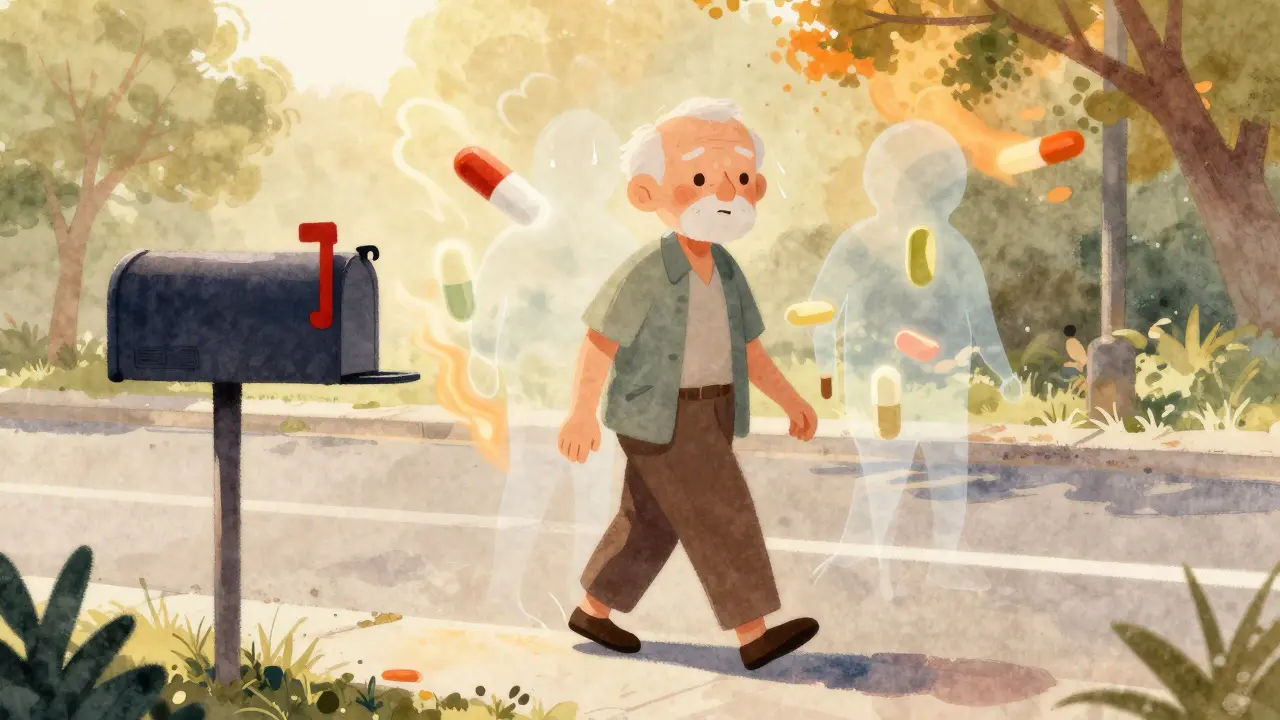
When the temperature climbs above 90°F, many seniors don’t realize their medications could be turning a hot day into a life-threatening situation. It’s not just about sweating more or feeling tired-it’s about how certain drugs quietly sabotage the body’s ability to cool down. For older adults, especially those on multiple prescriptions, heat isn’t just uncomfortable. It’s dangerous. And the risk is rising fast.
Why Seniors Are at Higher Risk
As we age, our bodies change. Sweat glands don’t work as well. Thirst signals weaken. Blood volume drops. These natural changes make it harder to stay cool. But when you add medications into the mix, the problem gets worse-fast.More than 87% of seniors over 65 take two or more prescription drugs, according to the National Center for Health Statistics. Many of these medications interfere with the body’s natural cooling system. The result? A silent, invisible danger that can turn a walk to the mailbox or a trip to the grocery store into an emergency.
Medications That Raise Heat Risk
Not all drugs are created equal when it comes to heat. Some are quietly putting seniors at risk. Here are the top offenders:- Diuretics (like hydrochlorothiazide and furosemide): These pills make you pee more to lower blood pressure-but they also make you lose fluids faster and dull your thirst by 30-40%. You won’t feel thirsty, so you don’t drink. That’s how dehydration starts.
- ACE inhibitors and ARBs (like benazepril, losartan): These blood pressure meds reduce thirst by about 25%. They also lower blood volume, making it harder for your heart to pump blood to your skin to release heat.
- Antipsychotics (like quetiapine, clozapine): Used for dementia or psychosis, these drugs mess with the brain’s thermostat. Studies show they can raise core body temperature by 1.5-2.0°F even without physical activity.
- Anticholinergics (like diphenhydramine in Benadryl or Tylenol PM): These reduce sweating by 35-50%. No sweat? No cooling. That’s how heat stroke sneaks up.
- Certain antibiotics and antifungals: Some make skin ultra-sensitive to the sun. Sunburn risk can jump 4-6 times higher. One dose can mean blistering skin after just 15 minutes outside.
Here’s the worst part: combining these drugs multiplies the danger. Taking a diuretic with an ACE inhibitor? That’s a double hit-less fluid, less thirst, lower blood pressure, and electrolytes crashing. The CDC reports that 22% of heat-related falls in seniors happen because of this exact combo.
What to Do: A Practical Prevention Plan
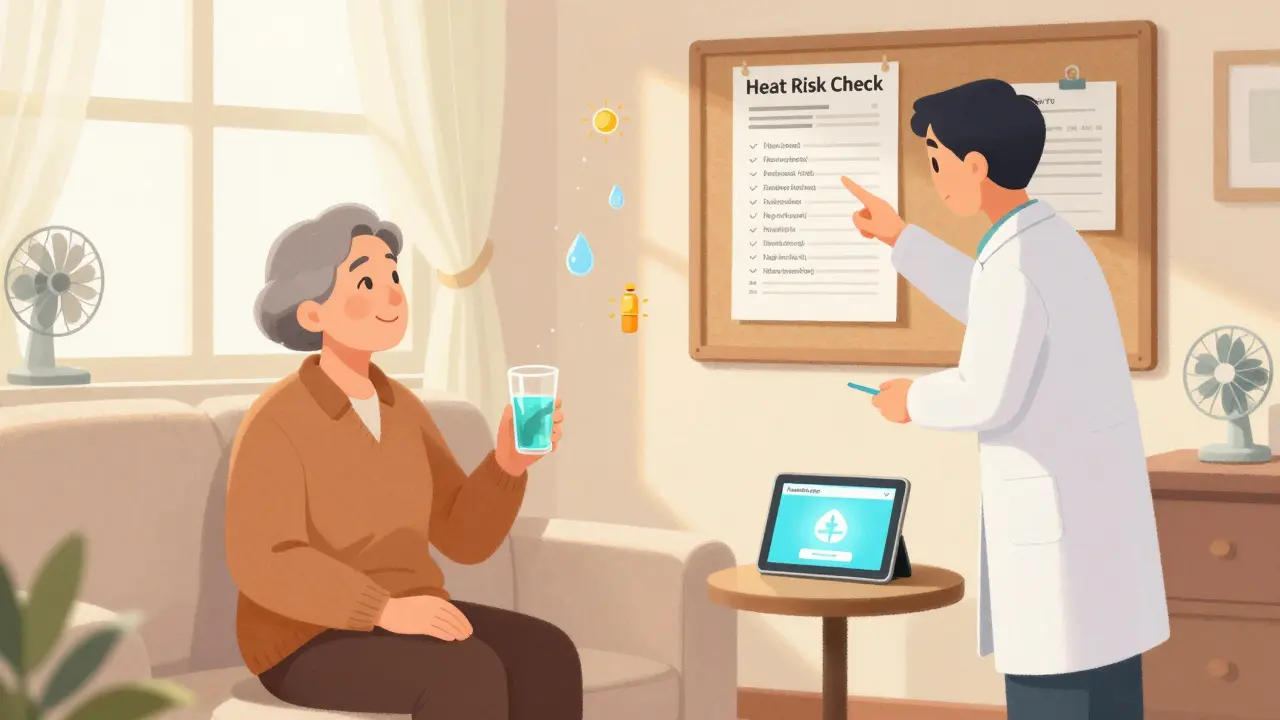
Preventing heat-related problems isn’t about guessing. It’s about action. Here’s what actually works:- Review meds before summer. Don’t wait for a heat wave. Talk to your doctor or pharmacist every spring. Ask: “Which of my meds make me more sensitive to heat?” Get a written list. Keep it in your wallet.
- Adjust fluid intake. Most seniors should drink 8-10 glasses of water a day in hot weather-even if you’re not thirsty. But if you’re on fluid restrictions for heart failure, don’t change this alone. Ask your doctor if you can temporarily increase fluids during heat alerts. About 43% of heart patients on restrictions develop dangerous electrolyte drops in heat waves.
- Choose the right drinks. Skip coffee, tea, soda, and alcohol. These make you lose even more water. For those on diuretics, drink electrolyte beverages with 120-150 mg of sodium per 8 oz. That helps replace what you lose.
- Stay cool indoors. Keep your home below 78°F (25.6°C). If you don’t have AC, go to a library, mall, or community center. Air-conditioned spaces save lives. One study in Arizona showed assisted living facilities cut heat incidents by 29% just by moving residents to cool public spaces during peak heat hours.
- Dress smart. Wear loose, light-colored cotton clothes. They let heat escape and reflect sunlight. Synthetic fabrics trap heat and can raise your perceived temperature by 5-7°F.
- Use sunscreen daily. Apply broad-spectrum SPF 15+ every 2 hours-even on cloudy days. Some meds make you burn in minutes. The FDA says sunburn risk can spike 400-600% with certain antibiotics.
Watch for Warning Signs-Before It’s Too Late
Seniors don’t always show the textbook signs of heat stress. That’s the trap.Heat exhaustion looks like: heavy sweating, muscle cramps, dizziness, nausea, headache, weakness. But with meds, these symptoms can be hidden. One in two seniors won’t feel thirsty or notice they’re overheating until it’s serious.
Heat stroke is a medical emergency. Signs include:
- Body temperature above 103°F (39.4°C)
- Hot, red, dry, or damp skin (no sweating)
- Rapid, strong pulse
- Confusion, slurred speech, or loss of consciousness
The CDC says 65% of heat exhaustion cases turn into heat stroke within 2-4 hours if untreated. And once heat stroke hits, 1 in 3 seniors don’t survive without fast treatment.
What Caregivers and Family Should Do
If you care for an older adult, your role is critical.- Check in twice a day during heat waves-morning and evening. Ask: “How are you feeling?” Don’t wait for them to say something’s wrong.
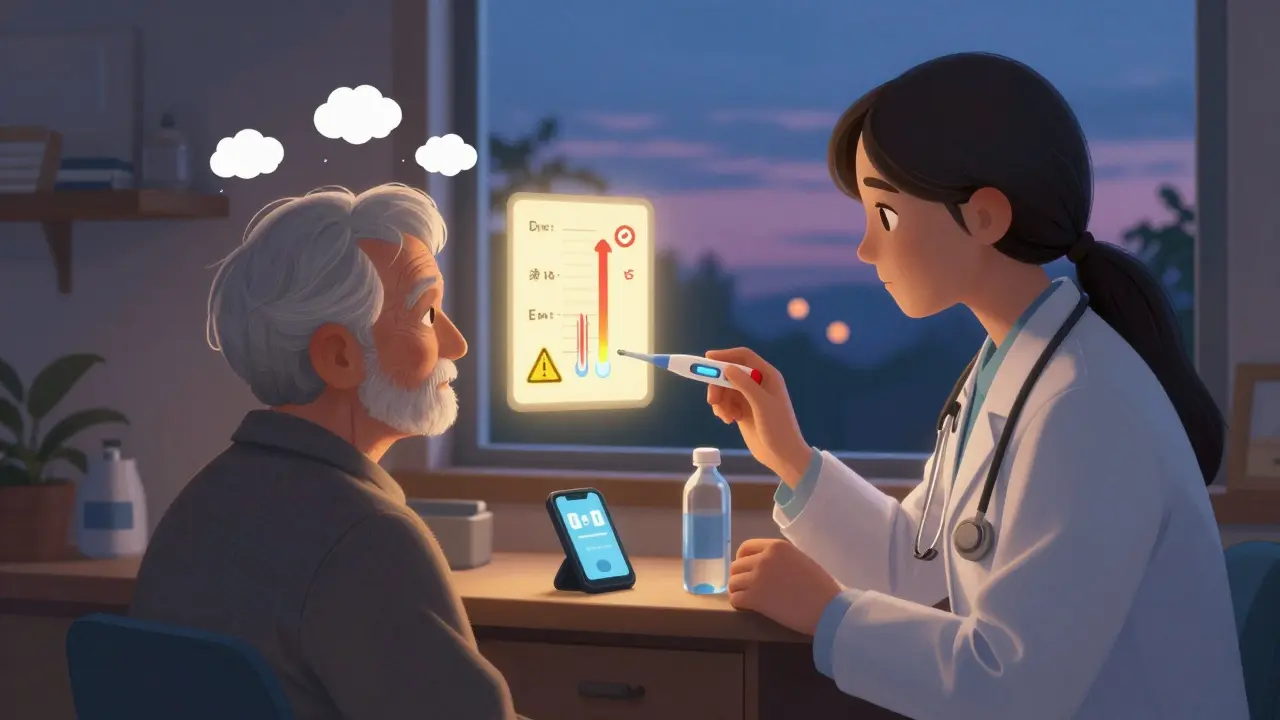
- Look for subtle changes: confusion, irritability, or not answering normally. These can be the first signs of heat stress. Research shows 78% of seniors show cognitive changes before physical symptoms.
- Keep a thermometer handy. If their temperature hits 100.4°F or higher, start cooling measures immediately.
- Use the CDC’s Heat and Medication Risk Assessment Tool (HM-RAT). It’s free online and lets you plug in meds to see personal risk levels.
Communities like Parkwood Heights have used a simple “I’m OK” check-in program since 2020. Staff call residents twice daily during heat alerts. Result? A 33% drop in hospitalizations.
New Tools and Future Steps
The good news? Tools are getting better. The National Institute on Aging and EPA now run HeatRisk.gov-a free website that combines local heat forecasts with medication risk data. Over 1.2 million seniors used it in 2023.Researchers are also testing a new “heat resilience” supplement with electrolytes and cooling compounds. Early trials showed a 28% improvement in thermoregulation for seniors on multiple meds.
But the most powerful tool is still simple: awareness. By 2050, extreme heat days could increase by 50%. Heat-related medication problems could become one of the top five preventable causes of death in seniors.
Don’t wait for a crisis. Talk to your doctor. Know your meds. Stay cool. Drink water. And never assume your loved one will tell you if something’s wrong.
Can I stop my diuretic during a heat wave to stay safe?
Never stop or change a medication without talking to your doctor. Stopping a diuretic suddenly can cause dangerous blood pressure spikes or fluid buildup. Instead, ask your doctor if you can adjust the timing-like taking it in the morning instead of evening-or if you can temporarily increase fluid intake under supervision.
Is it safe for seniors to use fans during heat waves?
Fans only help if the air is cooler than your body. When temperatures hit 95°F or higher, fans just blow hot air around and can make things worse. They don’t lower your core temperature. Air conditioning is the only reliable option. If you don’t have AC, go to a public cooling center.
What if my senior relative refuses to drink water?
Try alternatives: ice chips, popsicles made with electrolyte drinks, broth, or water-rich fruits like watermelon and oranges. Some seniors dislike the taste of plain water. Add a slice of lemon or cucumber. Set alarms to remind them to sip every hour-even if they say they’re not thirsty.
Do all seniors on blood pressure meds need to worry about heat?
Not all. Beta-blockers and calcium channel blockers have less impact on heat regulation than ACE inhibitors or diuretics. But if someone is taking two or more meds-including diuretics or anticholinergics-the risk goes up. Always check the full list. The CDC’s HM-RAT tool helps sort this out.
How can I tell if heat is affecting my senior’s meds?
Watch for new or worsening symptoms during hot weather: confusion, dizziness, nausea, reduced urination, rapid heartbeat, or dry skin. If these show up, cool them down immediately and call their doctor. Don’t wait for a fever. Heat stress often hits without a high temperature.
What to Do Right Now
If you or someone you care for is on medication and over 65:- Make a list of every pill, patch, and supplement taken daily.
- Call your pharmacist or doctor. Ask: “Which of these increase heat risk?”
- Download HeatRisk.gov or ask for the CDC’s HM-RAT tool.
- Plan your daily routine around heat: stay indoors between 10 a.m. and 4 p.m.
- Keep a bottle of water and a phone nearby at all times.
Heat doesn’t care how strong you are. It doesn’t care if you’ve lived 80 years without trouble. With the right meds, one hot afternoon can change everything. Prevention isn’t optional. It’s essential.
Comments
Jenna Allison
My grandma’s on hydrochlorothiazide and losartan-she didn’t even know these meds could make heat deadly. I printed out the CDC’s HM-RAT tool and we went over her meds with her pharmacist last week. She’s now drinking electrolyte water every morning and keeps a fan-turned-air-conditioner in her living room. Small changes, huge difference.
Also, she started wearing those light cotton shirts I bought her. No more synthetic stuff. She says she feels like she’s not sweating through her clothes anymore. Honestly, this post saved her life.
January 22, 2026 at 15:43
Vatsal Patel
Oh wow, so now we’re blaming Big Pharma for global warming? Next you’ll say the sun is a government plot to kill grandmas with diuretics. Meanwhile, in India, people over 70 still walk 5 miles to the well in 110°F heat-no AC, no pills, no panic. Maybe the real issue is that we’ve turned aging into a medical emergency instead of a natural process.
Also, who the hell drinks electrolyte water like it’s Gatorade? My grandfather drank tap water and lived to 92. Coincidence? I think not.
January 23, 2026 at 16:53
John McGuirk
They’re not telling you the whole truth. Did you know that the FDA approved 14 new anticholinergics in 2022? All of them came with a ‘heat risk’ warning buried in the fine print. But the pharmaceutical reps told doctors to ‘downplay it’ because ‘seniors don’t complain.’
And don’t get me started on the CDC’s ‘HeatRisk.gov’-it’s hosted on a .gov server that hasn’t been updated since 2021. The data’s outdated. This is all a distraction so we don’t ask why Medicare won’t cover cooling systems for seniors. It’s not about meds-it’s about neglect.
January 25, 2026 at 05:32
Darren Links
Look, I get it. But let’s be real-this is just another woke health scare. Seniors have been surviving summers since before ‘medication’ was a word. Now we’re telling them they can’t even go to the mailbox without a risk assessment?
Meanwhile, my cousin’s 84-year-old dad still mows his lawn at noon in Texas. No AC. No water bottle. Just grit. He’s healthier than half the people on this thread. Maybe we’re coddling them too much.
Also, why are we letting the government tell us what to drink? Next they’ll ban coffee because it’s ‘dehydrating.’
January 25, 2026 at 22:26
Elizabeth Cannon
ok so i just read this and i’m crying. my mom is 78 and on 5 meds including benadryl for sleep and furosemide for her heart. she says she’s fine, but last week she passed out in the kitchen. i didn’t know it could be the meds.
i’m calling her doctor tomorrow. and i’m buying her those light cotton tees. and water bottles with time markers. and i’m putting a thermometer in her room.
thank you for writing this. i didn’t know i needed to know this.
ps: if you’re reading this and your parent is on meds-do something. now.
January 26, 2026 at 11:30
Marlon Mentolaroc
Biggest takeaway? It’s not the heat. It’s the combo.
My aunt took a diuretic + anticholinergic + ACE inhibitor. She thought she was just ‘getting older.’ She didn’t sweat, didn’t feel thirsty, didn’t even get dizzy-until she collapsed in the grocery store. Turned out her core temp was 104.5°F. No fever, no warning.
Now she’s on a heat-safe med regimen. She’s alive. And she texts me every morning: ‘I drank my electrolytes.’
Knowledge is power. And sometimes, it’s the only thing between your parent and an ambulance.
January 27, 2026 at 16:31
blackbelt security
Just a quick note: if you’re caring for someone older, treat heat like a silent enemy. No fanfare. No drama. Just consistency.
Water every hour. Shade when outside. AC or cooling center. Check in. No excuses.
It’s not hard. It’s not expensive. It’s just necessary.
Do it. Because when it’s too late, you won’t forgive yourself.
January 27, 2026 at 17:29
Patrick Gornik
Let’s deconstruct the metaphysics of thermoregulatory pharmacology. The body, in its ancient wisdom, evolved to endure heat through perspiration, vasodilation, and neural feedback loops. But modern pharmacopeia-this labyrinth of synthetic molecules-has weaponized homeostasis.
We’ve turned the human organism into a fragile algorithm, dependent on corporate-approved chemical scaffolds. And now, when the sun rises, we don’t blame the climate-we blame the patient for not drinking enough water.
Is it not poetic? That we’ve outsourced our biological autonomy to a pill-and now we’re surprised when the system crashes?
Wake up. This isn’t a medical advisory. It’s a cultural autopsy.
January 27, 2026 at 23:51
Karen Conlin
I’ve been a geriatric nurse for 27 years. Let me tell you-the number one thing families miss? They think if the senior isn’t complaining, they’re fine.
But heat stress doesn’t come with a siren. It comes with silence. A quiet confusion. A refusal to eat. A day spent sitting in a chair, not moving.
My rule? If it’s over 85°F and they’re on more than two meds, assume they’re at risk. Don’t wait for symptoms. Start cooling. Start hydrating. Start checking.
And if they say ‘I’m fine’? Say ‘I know. But I’m still bringing you a glass of water.’
Love is in the small things.
January 29, 2026 at 03:29
asa MNG
OMG I JUST REALIZED MY DAD TAKES TYLENOL PM EVERY NIGHT 😭😭😭 IT HAS DIPHENHYDRAMINE!! HE’S BEEN SLEEPING THROUGH HEAT WAVES AND NOT SWEATING!! I’M GOING TO KILL HIS DOCTOR 😭😭😭
also why is no one talking about how the FDA lets this stuff on the market?? this is a MASSIVE COVERUP!!
pls someone tell me if i can just stop giving him the pm?? i’m so scared 😭😭😭
edit: i just called his pharmacy and they said ‘don’t stop it cold turkey’ so i’m gonna bring him to the clinic tomorrow. thanks for the post, i’m not alone 😭
January 29, 2026 at 13:06
Chloe Hadland
my aunt is 82 and lives alone. she’s on three meds and refuses to turn on the AC because it ‘costs too much.’
i just sent her a gift card for a window unit. didn’t say anything. just told her i was buying one for myself and she could borrow mine if she wanted.
she turned it on yesterday. sent me a pic of her sipping iced tea in front of it.
small wins.
January 29, 2026 at 15:45
Dolores Rider
you know what’s really scary? the fact that they’re testing ‘cooling supplements’ like we’re all lab rats.
first they give us pills that make us overheat, then they sell us pills to fix it.
and who’s paying for this? Medicare? Medicaid? YOU.
they’re monetizing fear. always have been.
why not just tell people to drink water and stay inside? too simple. no profit in that.
January 30, 2026 at 20:15
venkatesh karumanchi
I’m from India. We’ve been dealing with 45°C heat for generations. My grandmother took blood pressure pills and walked to temple every morning. She never had AC. But she drank buttermilk, wore cotton, and never skipped her meds.
Maybe the answer isn’t just ‘cooling centers’-but also cultural wisdom. Hydration rituals. Light clothing. Timing your day.
Western medicine gives us tools. But tradition gives us rhythm.
Use both.
January 31, 2026 at 06:00
Michael Camilleri
Everyone’s acting like this is some groundbreaking revelation. Newsflash: doctors have known this for 20 years. But they don’t tell patients because they’re too busy selling prescriptions.
And now you want us to download some app to tell us our meds are killing us? How about we stop letting Big Pharma write our prescriptions?
My uncle died of heat stroke in 2019. His doctor never mentioned the diuretic risk. Never. He was just told ‘take it daily.’
That’s malpractice. Not ignorance.
January 31, 2026 at 19:30
lorraine england
Just a friendly heads-up: if your senior loves iced tea or soda, swap it for coconut water or low-sodium broth. They taste better than electrolyte drinks, and they actually help.
Also-don’t forget socks. Yes, socks. Cotton socks keep feet cool and help circulation. Weird, but true.
And if they say ‘I don’t need help,’ just say ‘I’m just checking in.’ Then leave a bottle of water on the table.
Love doesn’t need a speech. It just needs presence.
February 2, 2026 at 08:29
Write a comment