

Using a pill organizer can seem simple-just dump your meds into compartments labeled with days and times. But if you’re not careful, it can turn into a hidden risk. Every year, thousands of people accidentally overdose because they mixed up their pills, reused old organizers, or put the wrong meds in the wrong slot. The truth? A pill organizer doesn’t fix bad habits-it amplifies them. If you take four or more medications daily, this guide will show you exactly how to use your pill box without putting your life at risk.
Why Pill Organizers Can Be Dangerous
Pill organizers were designed to help people remember when to take their meds. But they’re not magic. A 2022 study in the Journal of the American Geriatrics Society found that improper use increases overdose risk by 23% in older adults. Why? Because people start treating the organizer like the original source of truth instead of just a helper tool. The biggest danger? Putting "as needed" (PRN) pills like painkillers or anxiety meds into daily compartments. Imagine you’ve got your morning dose of blood pressure medicine in the Monday AM slot, and your ibuprofen for headaches in the same slot. You take it because you feel a headache-and boom-you’ve doubled your dose. That’s how 38% of accidental overdoses happen, according to Memorial Sloan Kettering Cancer Center. Another hidden risk is using outdated labels. If you changed your prescription last week but kept filling your organizer from last month’s bottle, you’re basically guessing. WebMD reports that 28% of errors happen this way. And storing your organizer in the bathroom? That’s a bad idea. Humidity from showers can soften pills, cause them to stick together, or even break down the active ingredients. Kaiser Permanente says 47% faster degradation happens in high-moisture environments.What Kind of Pills Shouldn’t Go in a Pill Organizer
Not all pills are meant to live in a plastic box. Some medications need special handling:- Liquid medications - They leak, spill, and contaminate other pills.
- Refrigerated drugs - Like insulin pens or certain antibiotics. Room temperature ruins them.
- Chewable or dissolvable pills - They crumble or stick together.
- Soft gel capsules - Heat and pressure make them burst or fuse.
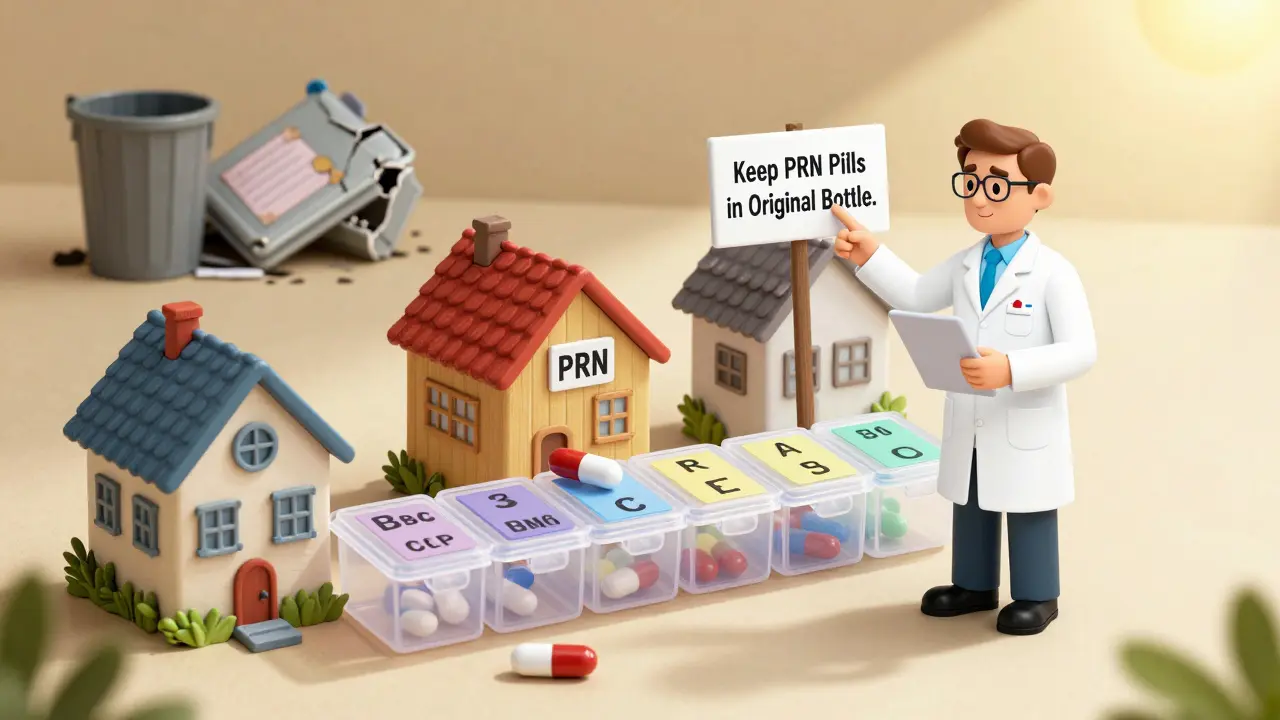
- PRN (as-needed) medications - Keep these in their original bottle, clearly labeled, and separate from your daily organizer.
The Five-Step Safety Protocol (Backed by Experts)
The National Health Care Coalition (NHCHC) and Memorial Sloan Kettering both agree: there’s a correct way to fill your organizer. Skip any step, and you’re gambling with your health. Here’s the exact method:- Verify your current medication list - Get the most up-to-date list from your pharmacist or doctor. Cross-check it with your prescription bottles. Don’t trust your memory. Write it down.
- Wash your hands - Use soap and water for at least 20 seconds. Dirty hands can transfer moisture or residue onto pills, especially if they’re sensitive to humidity.
- Organize bottles by time of day - Group all morning pills together, then afternoon, then evening. This reduces confusion. Keep the original bottles in front of you while filling.
- Fill one medication at a time - Don’t dump all your pills in at once. Take one drug, count it, place it in every compartment for that day, then move to the next. Dr. Jane Smith, Chief Pharmacist at Memorial Sloan Kettering, says this cuts double-dosing errors by 63%.
- Triple-check each compartment - After filling, go through each slot one by one. Compare what’s in there to your written list and the bottle label. Look for similar-looking pills. If two meds look alike (like metoprolol and lisinopril), use a pill splitter with color-coded labels or keep them in separate organizers.
Where to Store Your Pill Organizer (And Where Not To)
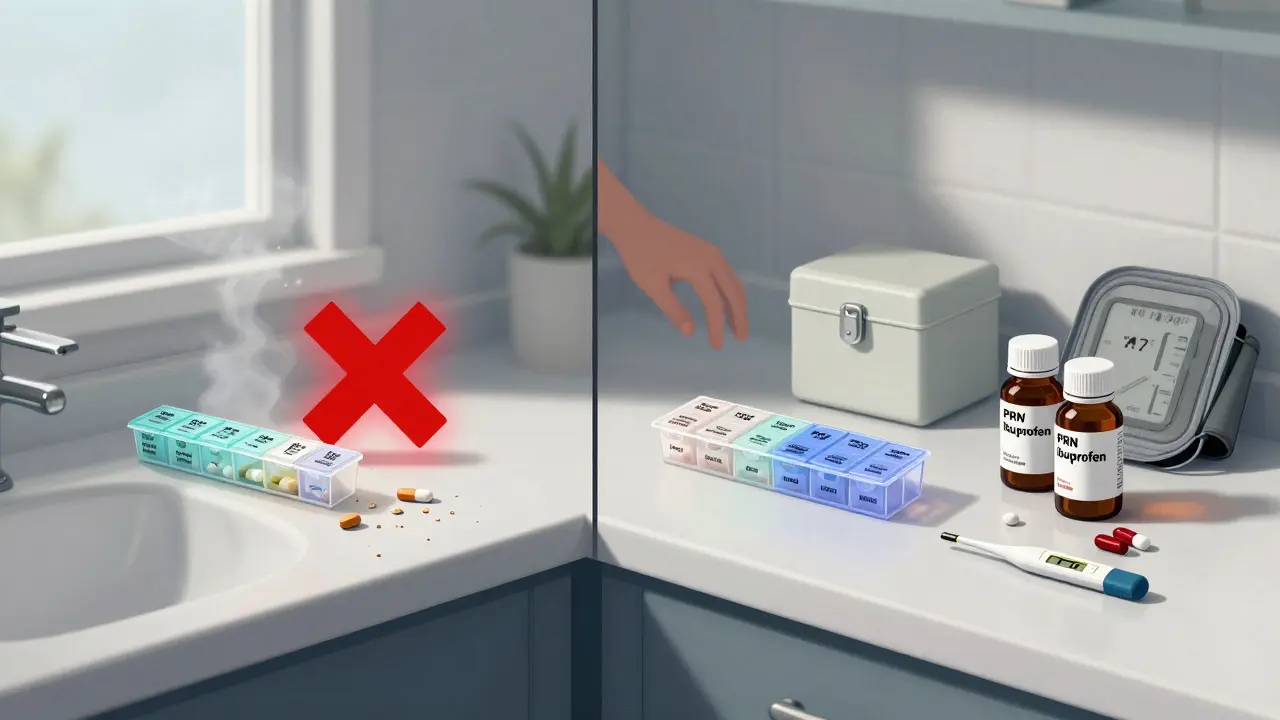
Your organizer’s location matters as much as how you fill it. Here’s the simple rule: Keep it dry, cool, and out of reach.- Best spots: A bedroom drawer, kitchen counter (away from the sink), or a cabinet in a dry room. Use a lockbox if kids or pets are around.
- Absolutely avoid: The bathroom. Steam from showers breaks down pills. Heat from radiators or windows can do the same. Humidity above 60% causes pills to degrade faster.
- Child-resistant features? Yes, they exist. Look for organizers that meet ASTM F3130-15 standards. These require two-step opening (press and slide). But even child-resistant doesn’t mean child-proof. Always lock it up.
When to Replace Your Pill Organizer
Plastic organizers wear out. Cracks, faded labels, sticky compartments, or warped lids aren’t just annoying-they’re dangerous. The National Council on Aging found that 28% of seniors use organizers older than 10 years. That’s a problem because:- Faded text makes it hard to tell AM from PM.
- Sticky compartments trap pills, leading to double doses.
- Cracked lids let in moisture.
- Labels peeling or smudged
- Compartments sticking together
- Plastic turning cloudy or brittle
- Missing or broken lids
Real Stories: What Goes Wrong
Reddit’s r/MedicationAdherence community tracked 142 overdose incidents in 2023 linked to pill organizers. The top causes:- 58 cases - PRN pain meds mixed into daily compartments
- 49 cases - Filling organizer with outdated bottle labels
- 35 cases - Combining medications that shouldn’t be stored together
How Pharmacies Can Help
Many U.S. pharmacies now offer free, pharmacist-filled pill organizers. In 2023, 68% of pharmacies started this service. It’s not just convenience-it’s safety. Pharmacists check for interactions, verify dosages, and ensure PRN meds stay separate. A Pharmacy Times report found this reduces errors by 52% compared to self-filling. If you’re on Medicare and take four or more chronic medications, you may qualify for a free smart organizer under Part D. These devices track when you open compartments and alert caregivers if you miss a dose.Final Checklist: Your Daily Safety Routine
Use this before every dose:- ✅ Did I check the label on the original bottle?
- ✅ Is this pill from today’s compartment or yesterday’s?
- ✅ Am I taking a PRN med? If yes, did I get it from its separate bottle?
- ✅ Is my organizer clean, dry, and in good condition?
- ✅ Did I refill it on the same day each week?
There’s no shortcut to safety. A pill organizer is a tool-not a solution. Use it right, and it protects you. Use it wrong, and it becomes a trap.
Can I put all my pills in one organizer, even if they’re from different doctors?
Yes, but only if you’ve verified every medication with your pharmacist. Mixing pills from different providers increases the risk of hidden interactions. Always get a complete list from your primary doctor or pharmacist before filling your organizer. Never assume two prescriptions are safe together.
What should I do if I accidentally take two doses?
Call your pharmacist or poison control immediately. Don’t wait for symptoms. Keep the pill organizer and original bottles handy-they’ll need to know exactly what you took and how much. In Australia, call Poison Help at 13 11 26. In the U.S., call 1-800-222-1222. Even if you feel fine, some overdoses show up hours later.
Are pill organizers safe for people with vision problems?
Yes, but only if they have Braille labeling or large, high-contrast text. Some organizers come with audio reminders or smartphone apps that speak the name of each pill. If you struggle to read labels, ask your pharmacist for a color-coded system or a smart organizer with voice alerts. Never rely on memory alone.
How often should I refill my pill organizer?
Always refill on the same day each week-like every Sunday morning. This builds a routine. If your meds change, refill immediately. Never wait until you run out. A gap in your schedule increases the chance of taking the wrong dose. Most organizers hold a week’s supply, so refill weekly. Monthly organizers exist but are riskier because you’re less likely to check for changes.
Can I use a pill organizer for vitamins and supplements?
You can, but only if they’re taken daily at the same time. Don’t mix supplements with prescription meds unless your pharmacist says it’s safe. Some vitamins (like vitamin K) can interfere with blood thinners. Always keep supplements in their original bottles too, so you can check ingredients and dosages. If you’re unsure, keep them separate.
Next Steps: What to Do Today
Don’t wait for a mistake to happen. Here’s what to do right now:- Grab your current pill organizer and your most recent medication list.
- Empty the organizer completely.
- Go to your pharmacy and ask them to verify your list and help you refill it.
- Replace your organizer if it’s older than a year.
- Set a weekly reminder to check your organizer every Sunday.
Comments
Justin Rodriguez
I’ve been using a pill organizer for my mom’s meds for over a year now. The one-tip that saved us? Writing the drug name on each compartment with a Sharpie. Even if the label fades, you can still read it. Also, we keep the original bottles right next to it-no guessing. Took some getting used to, but now it’s just routine. No more panic on Sunday mornings.
Also, never mix supplements with prescriptions unless your pharmacist says it’s okay. Vitamin K and warfarin? Bad combo. Learned that the hard way.
March 2, 2026 at 14:53
Raman Kapri
This entire post is a classic example of Western medical overengineering. In India, we’ve been managing complex polypharmacy for generations without plastic boxes. We use simple paper labels tied to the bottle, and family members remind each other. The real issue is not the organizer-it’s the overprescribing culture in the U.S. that forces people into these systems in the first place.
March 4, 2026 at 04:33
Divya Mallick
Oh my GOD. I just read this and I’m crying. My uncle died last year because he took his blood thinner AND his ibuprofen from the same slot. He thought they were both for "heart pain." He was 71. They didn’t even label the pills properly. This isn’t just advice-it’s a public health emergency. Why isn’t the government mandating pharmacist-filling? Why aren’t we suing these pill box manufacturers for not having warning labels? I’m so angry right now. 💔
March 4, 2026 at 22:10
Pankaj Gupta
The five-step safety protocol is exceptionally well-structured. I would only add a sixth step: document the refill date and initial on the organizer’s label. This creates accountability and enables cross-verification by caregivers. Furthermore, the recommendation to use a separate container for PRN medications is not merely prudent-it is clinically non-negotiable. I have observed numerous cases where the conflation of scheduled and as-needed dosing led to iatrogenic harm.
March 6, 2026 at 03:12
RacRac Rachel
THIS. THIS IS SO IMPORTANT 😭 I just started using one for my dad’s meds and I was about to put his melatonin in the PM slot next to his blood pressure pill… then I read this and nearly had a panic attack. Thank you for writing this!! I’m getting a smart organizer with alarms now 🙌 Also, Braille labels are a game-changer for my grandma. She’s blind but still takes her meds like a boss 💪
March 7, 2026 at 13:38
Jane Ryan Ryder
Wow. A 15-minute ritual to not kill yourself. How novel. Next you’ll tell us to brush our teeth. Maybe we should all just stop taking meds altogether and let nature take its course. Or better yet-don’t be old. Problem solved.
March 7, 2026 at 19:28
Callum Duffy
A thoughtful and meticulously researched exposition. The emphasis on environmental factors-particularly humidity and temperature-is often overlooked in public health discourse. I would only add that, in temperate climates, a sealed plastic container within a dry drawer may offer superior preservation compared to open-air organizers. The distinction between durability and safety is paramount. Thank you for the clarity.
March 8, 2026 at 07:04
Chris Beckman
lol i used to fill my organizer on thursdays cause i was lazy. then i took 2 doses of my antidepressant and ended up in the er. the nurse said "you’re lucky you didn’t have a seizure." now i refill every sunday like a good little boy. also dont put your organizer in the car. i did that once and my pills turned to mush. 🤦♂️
March 9, 2026 at 09:28
Levi Viloria
There’s a deeper cultural layer here. In many collectivist societies, medication adherence isn’t an individual chore-it’s a shared responsibility. My grandmother in Mexico never used a pill box. Her neighbors checked on her daily. Her daughter called every morning. The organizer is a symptom of isolation, not a solution to it. Maybe the real fix isn’t better boxes-it’s better community.
March 10, 2026 at 12:56
Dean Jones
Let’s interrogate the premise: why do we assume that the human body is best served by rigid, mechanical adherence schedules? The modern pill organizer enforces a Cartesian model of health-linear, quantifiable, predictable. But biology is not a spreadsheet. Circadian rhythms vary. Liver metabolism fluctuates. Stress alters absorption. To treat medication as a series of discrete, interchangeable events is to reduce the body to a machine. And machines, as we know, are prone to error. The real danger isn’t the organizer-it’s the belief that we can control biological complexity through external systems. Perhaps the most dangerous pill is the one we take because we were told to, not because we understood why.
March 10, 2026 at 23:51
Mike Dubes
Yesss! I’m a pharmacy tech and this is 100% true. I refill like 50 of these a week. The #1 mistake? Mixing PRN meds. Always. Always. I had a lady bring in her organizer once-she had 3 different painkillers in the same slot. I almost fainted. Just keep the as-needed stuff in the original bottle. Easy. Also, if your organizer looks like it’s been through a war? Toss it. Plastic gets brittle. Pills stick. It’s not worth the risk. You got this 💪
March 12, 2026 at 15:48
Helen Brown
I think the government is putting something in the pills. That’s why we need organizers. They want us to take the wrong ones so they can track us. I read online that the FDA uses the refill patterns to build profiles. And the humidity thing? That’s not moisture. That’s a signal. Don’t trust any plastic box. Use glass jars. And never refill on Sunday. That’s when the satellites are strongest.
March 12, 2026 at 18:25
Donna Zurick
I started using this system last month and my anxiety dropped so much. I used to stress about missing a dose. Now I just check the label, take it, and feel calm. I even made a little checklist on my fridge. It’s not perfect but it’s mine. You got this. You’re doing better than you think. 💕
March 12, 2026 at 22:47
Tobias Mösl
Let’s be real: this entire guide is corporate propaganda. Who funds the National Health Care Coalition? Pharma. Who profits from $100 smart organizers? Big Med. Who gets paid when you go to the ER for a "mistake"? Hospitals. This isn’t safety-it’s a monetized fear cycle. Stop trusting institutions. Learn to read your own labels. Question every pill. And if you’re taking more than 4 meds? You’re being overmedicated. The real solution? Stop taking so damn many pills in the first place.
March 14, 2026 at 10:23
Write a comment