
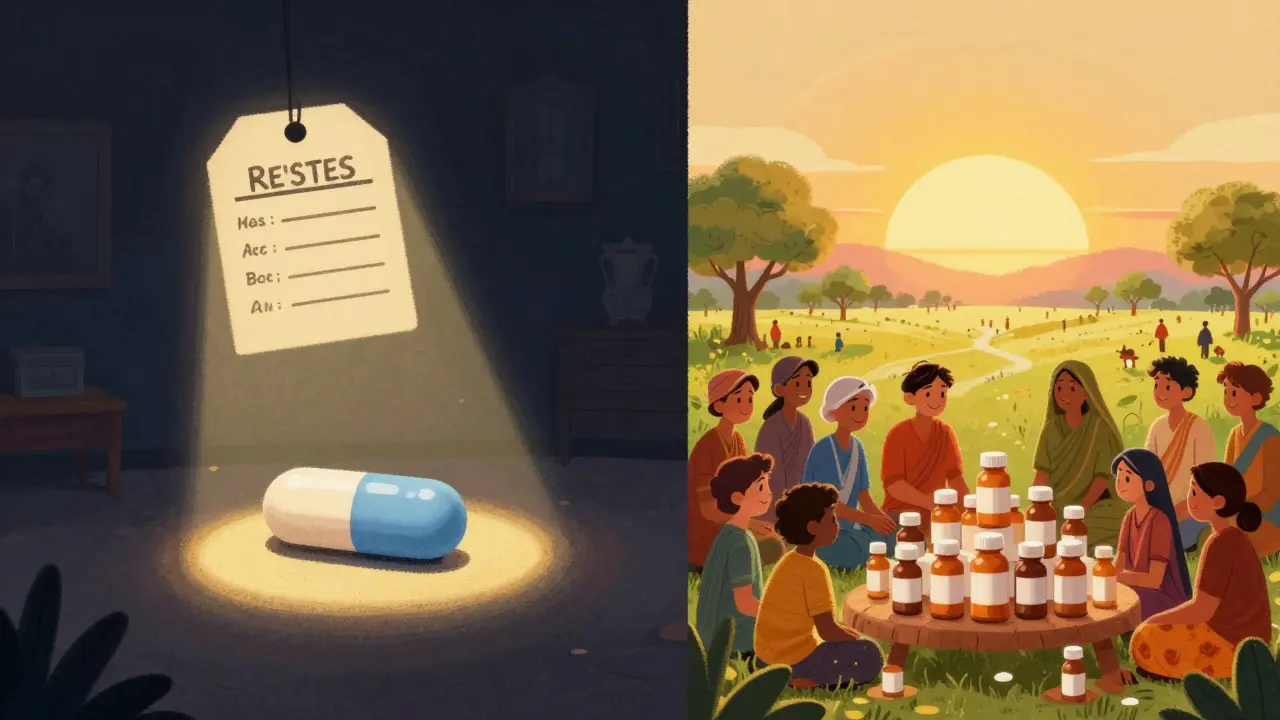
Imagine a world where a life-saving HIV treatment costs $10,000 per year. For many, that price tag is a death sentence. Now, imagine that same treatment costing just $100. This isn't a hypothetical scenario; it's the real-world impact of Indian generic manufacturers is a vast network of pharmaceutical companies in India that produce high-quality, low-cost versions of off-patent drugs. By breaking the monopoly of expensive branded medicines, India has effectively become the "pharmacy of the world," ensuring that healthcare isn't just for those with deep pockets.
But how did a single country manage to dominate the global supply of affordable medicine? It wasn't an accident. It was a calculated strategic move. Back in the mid-1970s, India amended its Patents Act to remove product patents for pharmaceuticals. This allowed local companies to reverse-engineer drugs and manufacture them locally. This shift turned India from a dependent importer into a global powerhouse, creating a landscape where quality meets affordability on a massive scale.
The Scale of India's Pharmaceutical Engine
To understand why India is so dominant, you have to look at the sheer numbers. We aren't talking about a few large factories, but an entire ecosystem. India hosts over 3,000 pharmaceutical companies and more than 10,000 manufacturing facilities. This infrastructure allows them to pump out over 60,000 different generic drugs.
One of the biggest hurdles for any drug manufacturer is regulatory approval. If the US FDA (U.S. Food and Drug Administration) doesn't approve a plant, those drugs can't enter the American market. India has solved this by building 650 US-FDA-compliant plants-the highest concentration of such facilities anywhere outside the United States. Additionally, with over 2,000 WHO-GMP approved sites, they can export to more than 150 countries without breaking a sweat.
They don't just stick to simple pills, either. Indian firms have mastered complex dosage forms, such as extended-release tablets and sterile injectables. This technical depth is why they can supply everything from cardiology and oncology drugs to respiratory treatments.
Global Reach: Where do these medicines go?
If you live in the US, UK, or Africa, there is a very high chance your medicine cabinet contains something made in India. In the United States, about 40% of all generic prescriptions are filled by Indian manufacturers. In the UK, the National Health Service (NHS) relies on Indian generics for about 33% of its prescriptions. For many in Sub-Saharan Africa, the situation is even more critical; Indian firms supply roughly 50% of their pharmaceutical needs.
The value proposition is simple: cost. Indian generics are typically 30% to 80% cheaper than their branded counterparts. In Africa, organizations like Doctors Without Borders have seen treatment costs for antimalarials and antibiotics drop by 65% thanks to these imports, while still maintaining 95% efficacy in the field. This isn't just about saving money for insurance companies; it's about survival for millions of people.
| Feature | India | China | European Hubs (e.g., Teva) |
|---|---|---|---|
| Primary Strength | Cost + Regulatory Compliance | Low-cost Raw Materials (API) | High-Value Specialized Drugs |
| FDA-Approved Plants | ~650 | ~153 | Moderate/High |
| Market Focus | High-volume generics | Active ingredients (APIs) | Complex/Specialized therapies |
| Global Volume Share | ~20% | Significant (API dominant) | Lower volume, higher value |

The Achilles' Heel: The API Dependency
Despite the dominance in finished pills, India has a glaring vulnerability: Active Pharmaceutical Ingredients (APIs). An API is the actual chemical that makes the drug work; everything else in the pill is just a filler. Currently, India imports about 70% of its API needs from China.
This dependency became a major talking point during the COVID-19 pandemic when supply chains snapped. To fix this, the Indian government launched Production Linked Incentive (PLI) schemes, putting roughly ₹3,000 crore ($400 million) on the table to encourage companies to make their own raw materials. The goal is to hit 53% API self-sufficiency by 2026, reducing the risk that a geopolitical spat or a pandemic could shut down the world's pharmacy.
Moving from Volume to Value
For a long time, India played the "volume game"-selling massive amounts of cheap drugs. But there's a problem with that model: it's a race to the bottom on price. While India supplies 30% of the US generic market by volume, it only captures about 10% of the market's value. To grow, the industry is pivoting toward Biosimilars.
Biosimilars are essentially generic versions of complex biological drugs, which are grown in living cells rather than synthesized from chemicals. These are far more expensive to develop and produce than traditional generics. Giants like Biocon and Dr. Reddy's are now investing over $500 million annually into biologics. Biosimilars already make up about 8% of India's export value, up from 3% in 2020. This shift is crucial if India wants to evolve from a factory for old drugs into a hub for modern medical innovation.

Quality Control and the Regulatory Tightrope
It isn't all smooth sailing. When you produce medicines at this scale, quality control becomes a monumental task. There have been reports of inconsistent dissolution rates in certain batches and occasional "dangerous" drug alerts. However, the trend is overwhelmingly positive. In 2015, the FDA compliance rate for Indian plants was around 60%; by 2022, that number climbed to 85-90%, matching global averages.
The industry is also digitizing. About 92% of manufacturers now use electronic common technical documents (eCTD) for their submissions, which reduces the paperwork errors that used to plague their applications. Recent updates to the "Schedule M" guidelines in early 2024 have further tightened the screws on manufacturing quality, pushing the industry toward even higher standards.
The Road to 2047
India isn't resting on its laurels. The "Pharma Vision 2047" initiative is an ambitious roadmap aiming for $190 billion in exports by the centenary of India's independence. To get there, they aren't just looking at more factories, but better science. Companies like Sun Pharma are reinvesting 6-8% of their global revenue back into R&D.
The future of the industry depends on three things: breaking the API dependence on China, mastering the shift to biosimilars, and maintaining a near-perfect regulatory record. If they nail this, India won't just be the place the world goes for cheap pills-it will be where the next generation of affordable cures is invented.
Why are Indian generic drugs so much cheaper than branded ones?
Indian manufacturers don't have to spend billions on the initial research, clinical trials, and marketing that original patent holders do. They use reverse-engineering to create the same chemical formula. Combined with lower labor costs and massive economies of scale, they can offer the same efficacy at a fraction of the price.
Are Indian generics safe to use?
Yes, the vast majority are safe and effective. India has the largest number of US-FDA compliant plants outside the US. While there have been isolated incidents of quality issues, the industry's compliance rates have risen significantly, with most major exporters adhering to strict WHO-GMP and FDA standards.
What is the difference between a generic drug and a biosimilar?
Generic drugs are exact chemical copies of simple molecules. Biosimilars are versions of biological drugs (made from living organisms). Because biological molecules are much larger and more complex, biosimilars are "highly similar" rather than "identical" and require more complex manufacturing and testing.
Why is India dependent on China for APIs?
China has an established lead in bulk chemical manufacturing and lower costs for the raw materials needed to create APIs. India focused heavily on the final formulation (making the pill), while China focused on the chemical building blocks. India is now using PLI schemes to build its own API capacity to reduce this risk.
Which Indian companies are the biggest players?
Some of the most prominent names include Sun Pharma, which is the largest by market cap, as well as Cipla and Dr. Reddy's Laboratories. These companies have huge global footprints and significant investments in R&D and biosimilars.