
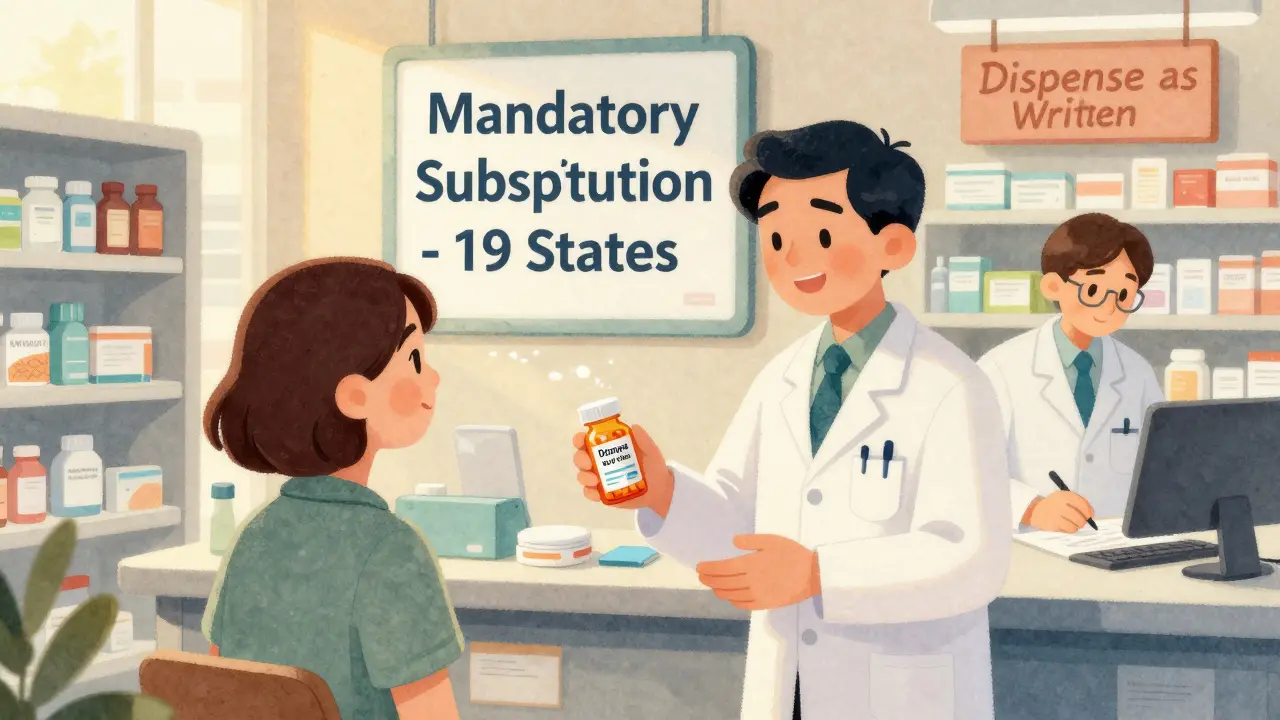
When you pick up a prescription, you might assume the pharmacist will always give you the cheapest option - a generic version of your brand-name drug. But that’s not true everywhere. In some states, pharmacists must swap your brand drug for a generic. In others, they can only do it if you say yes. These rules aren’t the same across the U.S. - and they directly affect how much you pay, whether you stick with your treatment, and even how safe your meds are.
What’s the Difference Between Mandatory and Permissive Substitution?
Mandatory substitution means the law forces pharmacists to give you a generic drug whenever it’s available and approved as equivalent by the FDA. Unless your doctor writes "Dispense as Written" or "Brand Medically Necessary," the pharmacist has no choice. This happens in 19 states as of 2020, including Alabama, Arizona, Connecticut, Indiana, and West Virginia.
Permissive substitution is the opposite. Pharmacists can choose to switch your drug to a generic - but they don’t have to. In these states, the default is the brand name. The pharmacist has to ask you first, or at least give you a chance to say no. About 30 states and Washington, D.C. operate under this model.
It sounds simple, but the real difference shows up in the numbers. A 2011 study found that six months after a brand drug lost its patent, states with mandatory substitution filled nearly 50% of prescriptions with generics. In permissive states? Just 30%. That’s almost a 20-point gap - all because of a state law.
Why Do These Laws Exist? The History Behind the Rules
The foundation for all this started in 1984 with the Hatch-Waxman Act. This federal law made it easier for generic drugs to get approved - but it didn’t say anything about who could swap them in. Instead, it left that decision to each state. That’s why today, you have a patchwork of rules.
States created these laws to control costs. Generic drugs cost 80-85% less than brand names. Medicaid programs, in particular, saw huge savings when generics were used more. But lawmakers also worried about safety. Some drugs, like seizure medications or blood thinners, have a narrow therapeutic index - meaning even tiny differences in how they’re made can cause problems. So, states added layers: consent rules, notification requirements, and liability protections.
Today, the FDA’s Orange Book - a list of approved generic drugs and their therapeutic equivalents - is the gold standard. Most states use it to decide what can be swapped. But some states go further. A few have their own lists of drugs that can’t be substituted, even if the FDA says they’re equivalent.
The Four Rules That Actually Matter
Not all substitution laws are created equal. Four key features separate the strictest from the most flexible:
- Duty to substitute - Is the pharmacist required to switch, or just allowed to?
- Notification - Does the pharmacist have to tell you, in writing, that they’re switching your drug? (31 states and D.C. require this, separate from the generic label.)
- Consent - Do you have to sign or say yes before the switch happens? (7 states plus D.C. require this - and it’s the biggest barrier to generics.)
- Liability - If something goes wrong after a substitution, is the pharmacist protected from lawsuits? (24 states offer no clear protection.)
The consent rule is the most powerful. In states where patients must give permission, generic use drops to 32% - even if the law says substitution is mandatory. In states without consent requirements, generic use hits 98%. That’s not a typo. One extra step - asking for your approval - cuts generic adoption by two-thirds.
And here’s the catch: pharmacists in states with consent rules are nearly twice as likely to avoid substituting drugs with narrow therapeutic indexes - even when it’s safe to do so - because they fear legal trouble or patient complaints.
How It Plays Out in Real Life
Imagine you’re on simvastatin, a cholesterol drug. Your doctor prescribes the brand. You go to the pharmacy.
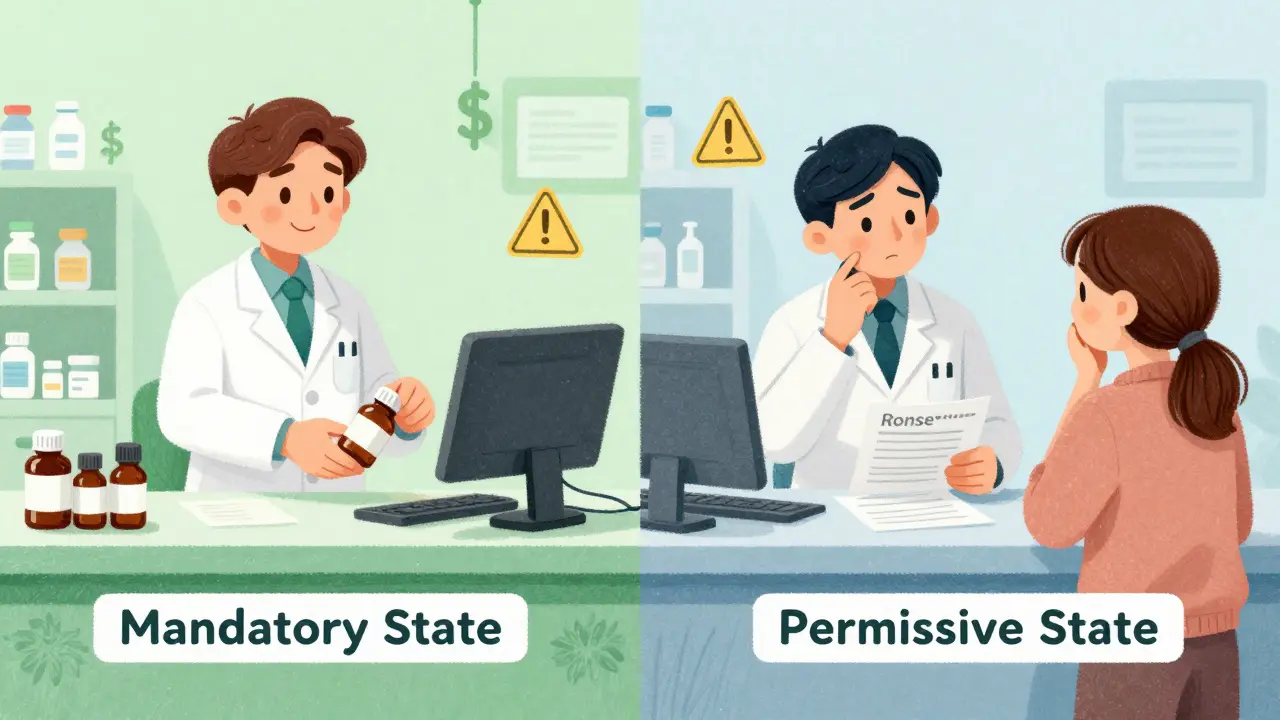
In a mandatory state without consent? The pharmacist swaps it automatically. You get the generic. You pay less. You keep taking it because it’s cheaper and just as effective.
In a permissive state with consent? The pharmacist calls you. Says, "This is cheaper. Want it?" You’re tired. You say yes. But the next time, you forget. Or you’re confused. Or you think the brand is better. You don’t pick it up. Your cholesterol rises. You end up in the ER.
That’s not hypothetical. Studies show patients in permissive states with consent requirements are more likely to stop taking their meds - not because they don’t need them, but because the system made it harder to get them.
For pharmacists, it’s a headache. In mandatory states, they’re expected to know every drug’s substitution rules. In permissive states, they’re stuck playing guesswork: Is this patient going to say yes? Should I even ask? And if I don’t substitute, am I missing a chance to save them money?
Biologics Are a Whole Other Story
These rules get even more complicated with biologic drugs - things like insulin, rheumatoid arthritis treatments, or cancer drugs. These are made from living cells, not chemicals. They’re expensive - sometimes over $10,000 a month.
Now, biosimilars (generic versions of biologics) are starting to appear. But 45 states treat them differently than regular generics. Most require the doctor to be notified before substitution. Some require written consent. A few don’t allow substitution at all.
Why? Because switching biologics carries more uncertainty. Could your immune system react differently? Could the drug stop working? These are real concerns - but they’re also being used to block competition. The cost difference between a biologic and its biosimilar can be 30-50%. Yet, in most states, you still need your doctor’s okay to switch.
Only nine states and D.C. treat biosimilars the same as small-molecule generics. That means in most places, you’re stuck paying more - even if a cheaper, equally safe option exists.
What This Means for You
If you take a generic drug, you’re probably in a state that makes it easy. But if you’re on a brand-name drug - especially a new one - you might be paying more than you need to.
Here’s what you can do:
- Ask your pharmacist: "Is this substitution mandatory here?"
- Check your prescription: Does it say "Dispense as Written"? If not, you might be getting a generic without knowing it.
- Ask about cost: Even if substitution isn’t required, pharmacists can often switch you to a cheaper generic if you ask.
- For biologics: Ask if a biosimilar is available - and whether your state allows substitution without extra paperwork.
Don’t assume your pharmacist will tell you. Most won’t. It’s not their job to educate you on state law - it’s yours to ask.
What’s Changing?
The number of mandatory substitution states has grown from 14 in 2014 to 19 in 2020. That trend is likely to continue. States are under pressure to cut healthcare costs - and generics are the easiest win.
But as more complex drugs enter the market - combination pills, injectables, specialty meds - lawmakers are getting more cautious. Some are adding new restrictions: mandatory recordkeeping, pharmacist training, or even limits on which drugs can be swapped.
One thing’s clear: The system isn’t broken. It’s just uneven. And until all states align their rules, you’ll keep getting different experiences depending on where you live.
What Prescribers Need to Know
If you’re a doctor, your handwriting on the prescription matters more than you think. "Dispense as Written" isn’t just a phrase - it’s a legal barrier. If you write it, you override state law.
But here’s the problem: Many doctors don’t know which states require it. Or they write it out of habit, not necessity. That means patients in mandatory states are getting brand drugs they don’t need - and paying more.
Best practice: Only write "Dispense as Written" if there’s a real medical reason. For most drugs - especially common ones like statins, blood pressure meds, or antibiotics - generics are just as safe and effective.
And if you’re prescribing a biologic? Know your state’s rules. In most places, you’ll need to notify the patient and pharmacist in writing. Skip that step, and the pharmacy won’t substitute - even if it’s safe.
Do pharmacists have to tell me if they switch my drug to a generic?
In 31 states and Washington, D.C., yes - they must notify you separately from the drug label. This could be a slip of paper, a note on your receipt, or a verbal warning. In other states, the generic packaging is the only notice you get - which isn’t enough for many patients to realize a change happened.
Can I refuse a generic drug even if my state has mandatory substitution?
Yes - but only if your doctor writes "Dispense as Written" or "Brand Medically Necessary" on the prescription. If they don’t, and your state requires substitution, the pharmacist must give you the generic. You can still ask to keep the brand, but you’ll likely pay more out of pocket.
Why do some states require patient consent for substitution?
These rules were created out of concern for safety, especially with drugs that have a narrow therapeutic index - like warfarin or levothyroxine. But studies show they backfire. Requiring consent cuts generic use by two-thirds, increases costs, and reduces adherence. Patients often don’t understand the difference between brand and generic - so they say no out of fear, not science.
Are biosimilars treated the same as regular generics?
No. In 45 states, biosimilars face stricter rules than small-molecule generics. Most require physician notification, written consent, or both. Only 9 states and D.C. treat them the same. This is because biosimilars are more complex and expensive - but it also slows down cost savings. Many experts argue this is unnecessary, since clinical data shows biosimilars are just as safe as their brand counterparts.
How much money can I save with a generic drug?
On average, generics cost 80-85% less than brand-name drugs. For a monthly prescription that costs $300, switching to a generic could save you $240-$255 per month - or over $3,000 a year. In states with mandatory substitution, patients save more because they’re automatically getting the cheaper option without having to ask.