

Meglitinides Meal Timing Calculator
This tool helps you understand the risk of hypoglycemia based on when you take your meglitinide medication and when you eat. For safety, you should always take meglitinides 15-30 minutes before eating.
Results
Enter your medication and meal times to see your risk level.
When you’re managing type 2 diabetes, meal timing isn’t just about eating healthy-it can be the difference between stable blood sugar and a dangerous drop. For people taking meglitinides, skipping even one meal can trigger hypoglycemia fast. These drugs aren’t like most diabetes pills. They work quickly, disappear quickly, and demand precision. If you don’t eat when you’re supposed to, your body ends up with too much insulin and not enough glucose. The result? Shaking, sweating, confusion-and sometimes, emergency care.
How Meglitinides Actually Work
Meglitinides, which include repaglinide and nateglinide, are designed to mimic the body’s natural insulin spike after food. Unlike older drugs like sulfonylureas that keep pumping out insulin all day, meglitinides act like a short burst. They bind to special receptors on pancreatic beta cells, forcing them to release insulin within 15 to 30 minutes. Peak levels hit around one hour after taking the pill, and by three to four hours, most of the drug is gone.
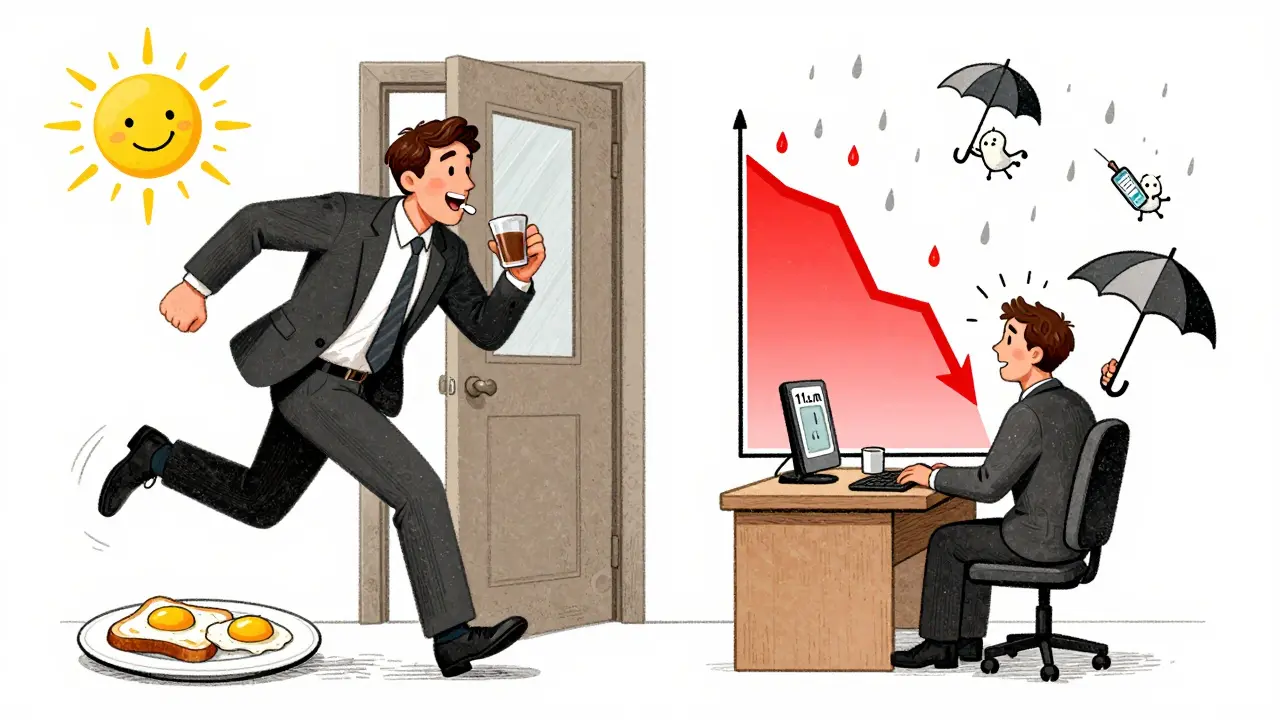
This rapid action is why doctors prescribe them to people with unpredictable schedules-shift workers, people with busy lifestyles, or those who don’t eat at the same time every day. But here’s the catch: the same feature that makes them flexible also makes them risky. If you take the pill and then don’t eat, insulin surges into your bloodstream with nothing to act on. Your blood sugar plummets.
The Real Risk: Skipping Meals
Studies show that skipping a meal after taking a meglitinide increases your risk of hypoglycemia by more than three times. In one 2017 study, patients who missed a meal after dosing saw their blood sugar drop below 70 mg/dL within 90 minutes. That’s fast. And it’s not rare. About 41% of all hypoglycemia events in people using these drugs happen between two and four hours after taking the pill-the exact window when the drug is strongest and meals are most likely to be delayed.
It’s not just about forgetting lunch. Even eating a smaller meal than usual can trigger symptoms. One patient, a 68-year-old retired teacher, took her repaglinide before breakfast as usual but skipped eating because she wasn’t hungry. Within an hour, she felt dizzy, broke out in a cold sweat, and passed out. Her glucose monitor read 52 mg/dL. She ended up in the ER. Her doctor later told her: “This drug doesn’t care if you’re hungry. It’s going to drop your sugar whether you eat or not.”
Who’s Most at Risk?
Not everyone on meglitinides faces the same level of danger. Certain groups are far more vulnerable:
- Older adults: As people age, appetite changes, memory lapses, and routines break down. The American Diabetes Association warns that irregular meal intake is a major contributor to hypoglycemia in seniors on these drugs.
- People with kidney disease: While repaglinide is cleared mostly by the liver (making it safer than sulfonylureas in kidney patients), those with advanced chronic kidney disease (eGFR below 30) still face a 2.4-fold higher risk of low blood sugar. Dose adjustments are critical.
- Those on multiple diabetes meds: Combining meglitinides with insulin or sulfonylureas multiplies the risk. One study found that using meglitinides with insulin increased hypoglycemia events significantly (p=0.018).
It’s not just about the drug. It’s about lifestyle. People with dementia, depression, or those living alone are more likely to miss meals. And that’s when meglitinides become dangerous.
How Meglitinides Compare to Other Diabetes Drugs
It helps to understand how meglitinides stack up against other options:
| Drug Class | Duration of Action | Hypoglycemia Risk | Meal Timing Required |
|---|---|---|---|
| Meglitinides (repaglinide, nateglinide) | 2-4 hours | High if meals skipped | Must take 15 min before eating |
| Sulfonylureas (glipizide, glyburide) | 12-24 hours | High, regardless of meals | Take once or twice daily, meals less critical |
| Metformin | 6-8 hours | Very low | Not required |
| GLP-1 agonists (semaglutide) | 24-72 hours | Low unless combined with insulin | Not required |
Notice the difference? Sulfonylureas can cause low blood sugar even if you eat regularly. Meglitinides only cause it when you skip meals. That’s why they’re still used-when the alternative is worse. But it also means the patient has to be hyper-aware of food timing.
What to Do If You’re on Meglitinides
If you’re prescribed repaglinide or nateglinide, here’s what you need to do:
- Dose only when you’re about to eat. Never take it “just in case.” The official guidance from Memorial Sloan Kettering says: “Take it 15 minutes before you eat. Waiting too long raises the risk of hypoglycemia.”
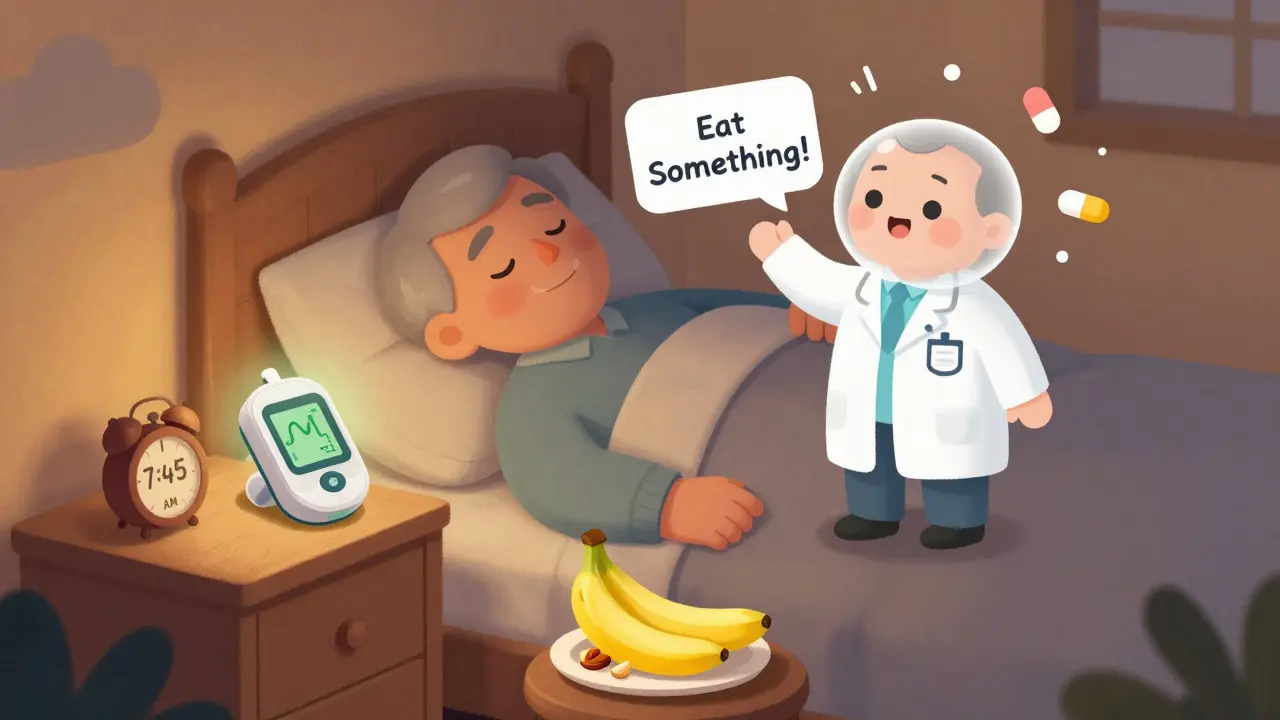
- Never skip meals. Even if you’re not hungry, eat something small-half a banana, a handful of nuts, a slice of toast. Carbs are your safety net.
- Use a reminder app. A 2023 trial showed that smartphone alerts reminding patients to eat reduced hypoglycemia by 39%. Set a phone alarm for 15 minutes before your usual meal times.
- Consider a continuous glucose monitor (CGM). If you’ve had even one episode of low blood sugar, a CGM can warn you before you feel symptoms. Studies show it cuts hypoglycemia events by 57% in meglitinide users with irregular eating patterns.
- Carry fast-acting sugar. Keep glucose tablets, juice boxes, or hard candy with you at all times. If you feel shaky, dizzy, or sweaty, treat it immediately.
Some doctors recommend the “dose-to-eat” approach: only take the pill when you know you’re going to eat within the next 15-30 minutes. This reduces risk without sacrificing flexibility.
The Future: Safer Options?
Pharmaceutical companies are working on solutions. One new version of repaglinide, called repaglinide XR (extended-release), is in Phase II trials. Early results show a 28% drop in hypoglycemia episodes compared to the standard version-without losing the meal-time flexibility. That could be a game-changer.
But for now, the safest option remains patient education. The FDA required stronger warnings on all meglitinide labels in 2021. The message is clear: “Do not take this medication if you are not going to eat.”
Meanwhile, newer drugs like GLP-1 agonists (semaglutide, liraglutide) are gaining popularity because they lower blood sugar without triggering hypoglycemia-unless combined with insulin. But they’re expensive, injectable, and not right for everyone. Meglitinides still have a place-for those who need oral meds, can’t tolerate metformin, or have kidney issues.
Bottom Line
Meglitinides aren’t for everyone. They’re a tool for a very specific situation: people who need insulin spikes after meals but can’t stick to a fixed schedule. But that flexibility comes at a cost. Every time you skip a meal, you’re gambling with your blood sugar. The drug doesn’t pause. It doesn’t wait. It acts-and if there’s no food, your body pays the price.
If you’re on one of these drugs, talk to your doctor about whether it’s still the right choice for you. If your schedule is too unpredictable, or you’ve had even one low-blood-sugar episode, it might be time to switch. But if you stick to the rules-take it before you eat, never skip meals, carry glucose, and use reminders-you can use meglitinides safely. Just don’t treat them like a normal pill. Treat them like a timer set to explode if you don’t feed it.”
Can I take meglitinides without eating?
No. Meglitinides cause your pancreas to release insulin immediately. If you don’t eat, that insulin has nothing to act on, and your blood sugar can drop dangerously low within minutes. Always take these drugs only when you plan to eat a meal within 15-30 minutes.
What should I do if I forget to eat after taking meglitinide?
If you realize you’ve taken the pill but haven’t eaten, eat something with fast-acting carbohydrates right away-even a small snack like fruit, juice, or glucose tablets. Monitor your blood sugar closely. If you feel symptoms like shaking, sweating, or confusion, treat for hypoglycemia immediately. Do not wait to see if you feel better.
Are meglitinides safe for people with kidney problems?
Repaglinide is generally safer than sulfonylureas for people with kidney disease because it’s cleared mainly by the liver. However, if your kidney function is severely reduced (eGFR below 30), your doctor should lower your dose-usually to 60 mg per meal instead of 120 mg. Always tell your doctor about your kidney health before starting this medication.
Can I switch from sulfonylureas to meglitinides to avoid low blood sugar?
Switching might help if your hypoglycemia happens even when you eat regularly-sulfonylureas last all day and can cause lows anytime. Meglitinides are shorter-acting and only cause lows if you skip meals. But if your meals are unpredictable, meglitinides might not be safer. Talk to your doctor about your eating habits before switching.
Do I need a continuous glucose monitor (CGM) if I’m on meglitinides?
If you have irregular meals, are over 65, have had a previous hypoglycemia episode, or take other diabetes drugs like insulin, a CGM is strongly recommended. Studies show it reduces low-blood-sugar events by 57% in this group. It gives you early warnings so you can eat before you feel sick.
For those managing diabetes with meglitinides, success isn’t about the drug-it’s about the rhythm between food and medicine. Treat the pill like a key that only turns when food is ready. Miss the meal, and the lock stays closed-until your body pays the price.
Comments
Alvin Bregman
Man I thought I was the only one who forgot to eat after taking my repaglinide
One time I was rushing to work and took it then got stuck in traffic for 45 minutes
Ended up in the break room chugging orange juice like it was a beer at a party
My boss thought I was drunk
Turns out I was just one step away from passing out
Now I keep glucose tabs in my glovebox and my sock
Its weird but it works
January 15, 2026 at 02:26
Robert Way
so if u take this drug and dont eat u just drop like a rock
no warning no nothing
my uncle did that and ended up in the er with a seizure
doc told him he was lucky he didnt die
now he takes it only when he sits down to eat
even if its just toast
January 15, 2026 at 06:12
Sarah Triphahn
People treat these drugs like candy
You think its just a pill you pop
No its a biological grenade with a 15 minute fuse
And you think skipping lunch is no big deal
Until your brain starts glitching
And your hands shake like you’re cold
And you can’t remember your own name
Then you realize
You were never in control
You were just waiting for the crash
January 16, 2026 at 11:16
shiv singh
US doctors are so lazy
They just hand out these pills like free candy
Why not just put a warning on the bottle that says
IF YOU SKIP MEAL = YOU DUMPED IN HOSPITAL
And then charge the patient 10k for the ER visit
Maybe then they’d stop being stupid
My cousin took this drug and didn’t eat for 8 hours
She woke up on the floor with vomit everywhere
And still blames the doctor
She’s lucky she didn’t die
January 17, 2026 at 02:07
Vicky Zhang
I want to hug everyone who reads this and says oh I’ll just skip breakfast today
You don’t know how close you are to falling
My mom used to take repaglinide and she’d skip meals because she wasn’t hungry
One day she passed out in the kitchen
I found her on the floor with her phone still in her hand
She was trying to call 911 but couldn’t move
She’s fine now but she never skips again
I made her a little sticky note that says
“Pill = Food. No food = No pill.”
She puts it on her mirror
And she’s never had another episode
You can do this. You’re not alone.
January 18, 2026 at 16:08
Allison Deming
It is imperative to emphasize that meglitinides are not adjunctive therapies for irregular dietary patterns
They are pharmacological agents with a narrow therapeutic window
And their pharmacokinetic profile necessitates precise temporal alignment with caloric intake
Failure to adhere to this temporal constraint constitutes a clinically significant deviation from the prescribed regimen
It is not merely an inconvenience
It is a potentially lethal oversight
Patients must be educated not merely about the mechanism of action
But about the existential consequence of noncompliance
And healthcare providers bear a moral obligation to ensure this education is not perfunctory
But thorough, repeated, and reinforced
January 19, 2026 at 10:27
Susie Deer
Why do we even have these drugs
If you have to eat every time you take a pill
Then why not just take metformin
And stop pretending this is convenient
Its just another way doctors make money
And patients pay with their health
And then they blame us for being lazy
When the real problem is the system
January 20, 2026 at 05:31
says haze
There’s a deeper philosophical layer here
That we treat medicine like a vending machine
Insert pill, get result
But the body isn’t a machine
It’s a rhythm
A dance between insulin and glucose
And meglitinides force a solo dancer into a tango
Without a partner
It’s not dangerous because of the drug
It’s dangerous because we’ve forgotten that biology demands reciprocity
We want pills that fix us without effort
But life doesn’t work that way
And maybe that’s the real illness
January 20, 2026 at 20:52
Sarah -Jane Vincent
Did you know the FDA knew this was a problem since 2010
But the drug companies lobbied to keep the labels weak
And now they’re selling these pills like they’re energy drinks
And you’re all just blaming the patients
While the real criminals are the ones making billions off your panic
They don’t care if you pass out
They care if you keep buying
And guess what
The next drug they’re pushing is even more expensive
And just as dangerous
But with a fancy new name
January 22, 2026 at 09:55
Henry Sy
bro i took repaglinide once cause my doc said it was better than metformin
didn’t eat for 3 hours
started seeing stars
thought i was having a stroke
ran to the fridge and ate a whole jar of peanut butter
then a banana
then a bag of gummy bears
felt like a demon was crawling outta my chest
my girlfriend called 911
i cried in the ambulance
now i take it only when i’m sitting at the table
and i keep a candy stash in every room
its not a pill
its a hostage situation
January 22, 2026 at 16:50
Anna Hunger
As a certified diabetes care and education specialist, I have witnessed firsthand the devastating consequences of non-adherence to meglitinide dosing protocols.
Patients who do not understand the precise temporal relationship between medication administration and nutrient intake are at significant risk for severe hypoglycemic events.
It is not sufficient to simply inform patients; we must employ structured, repeated, and individualized education strategies.
Visual aids, meal-planning tools, and behavioral reinforcement techniques have demonstrated measurable reductions in hypoglycemia incidence.
Furthermore, integration of continuous glucose monitoring is not merely beneficial-it is essential for high-risk populations.
Healthcare providers must prioritize this education with the same urgency as prescribing the medication itself.
The patient’s life depends on it.
January 24, 2026 at 08:41
Write a comment