
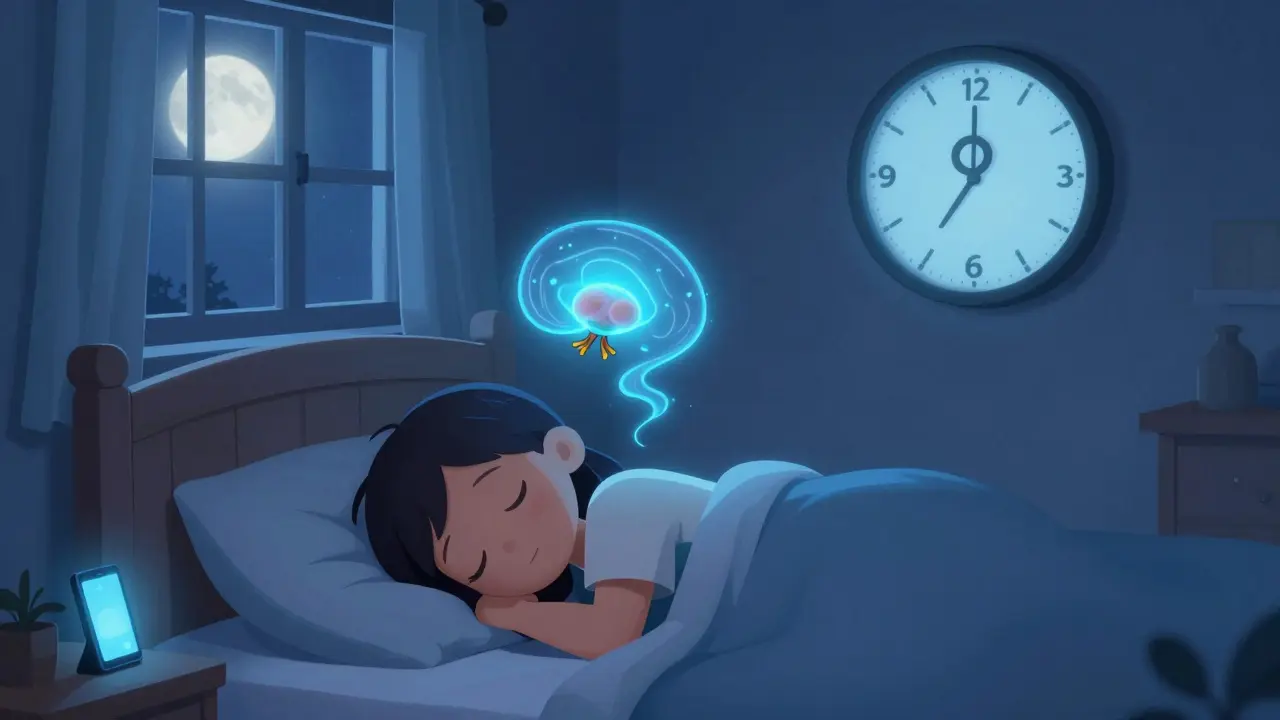
Most people think melatonin is a sleeping pill. It’s not. It’s a signal. A quiet, biological whisper that says, "It’s dark. Time to wind down." If you’ve ever taken a 5mg gummy at midnight and woke up groggy, confused, or with vivid nightmares, you’re not alone. You didn’t fail. You just misunderstood how it works.
What Melatonin Actually Does
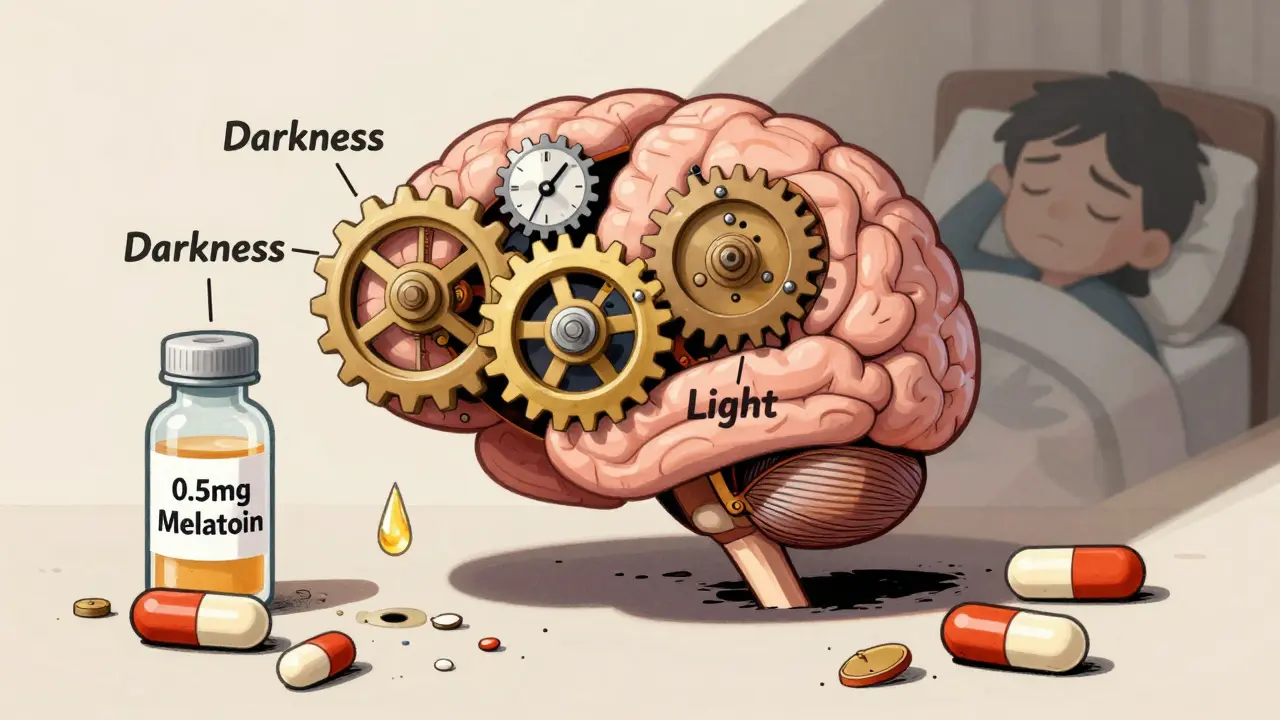
Melatonin is made in your brain - specifically in the pineal gland, a tiny structure shaped like a pine cone. It’s not a sedative like Ambien or Lunesta. It doesn’t knock you out. Instead, it tells your body’s internal clock that night is here. Your body naturally produces melatonin in response to darkness, with levels starting to rise around 9 PM and peaking between 2 and 4 AM. That’s why you feel sleepy at night - not because you’re tired from the day, but because your body is receiving this chemical signal.
Light, especially blue light from phones and LED screens, shuts this signal off. That’s why scrolling in bed messes with your sleep. Your pineal gland doesn’t know if it’s 2 AM or 2 PM. It just responds to light. No light? Melatonin rises. Bright light? Melatonin drops. Simple. Biological. No magic.
Why Most People Take It Wrong
The supplement market is flooded with melatonin doses of 3mg, 5mg, even 10mg. That’s 10 to 100 times more than your body naturally makes. And it’s not helping - it’s hurting.
Research shows that doses above 0.5mg offer no extra sleep benefit. In fact, higher doses increase side effects: next-day drowsiness, headaches, vivid dreams, and even disrupted sleep cycles. One study of over 3,000 users found that 28% reported morning grogginess, and 22% had intense nightmares. Most of those users were taking 3mg or more.
And timing? Even more important than dose. Taking melatonin at 11 PM when your body is already making its own? You’re just flooding your system. It won’t help. If you take it too late, you might even delay your sleep cycle instead of advancing it. That’s why some people say melatonin “stopped working” after a few weeks. It’s not tolerance - it’s bad timing.
When Melatonin Actually Works
It’s not a cure-all. But it’s incredibly effective for specific problems:
- Jet lag (especially eastbound): Flying from Sydney to London? Your body thinks it’s 3 AM when it’s really 7 AM. Taking 0.5mg at local bedtime for two days before and after travel helps your clock adjust faster. Studies show people adjust in 2 days instead of 5.
- Delayed sleep phase syndrome (DSPS): If you naturally fall asleep at 2 AM and can’t wake up before noon, melatonin taken 2-3 hours before your target bedtime can shift your rhythm. One study found it advanced sleep onset by about 40 minutes and shifted the body’s natural melatonin release by over an hour.
- Shift work disorder: If you work nights and need to sleep during daylight, melatonin taken before your daytime sleep can help your body accept nighttime as “daytime.”
For general insomnia - lying awake at night with no clear rhythm issue - melatonin has little to no effect. A 2013 Cochrane review found it only improved sleep onset by about 7 minutes on average. That’s less than a cup of tea. Prescription sleep aids work better here, but they come with risks. Melatonin doesn’t.
The Dose and Timing Rule
Forget what the bottle says. Here’s what actually works:
- Start with 0.3mg to 0.5mg. That’s less than half a standard gummy. Many supplements don’t even offer this dose - you may need to cut a tablet or find a low-dose option.
- Take it 2-3 hours before your target bedtime. Not when you feel tired. Not right before bed. Two to three hours before. This gives your body time to absorb it and signal your brain.
- Only increase if needed. If 0.5mg does nothing after 3-5 nights, try 1mg. Go no higher unless under medical supervision.
- Use it for 3-7 days max. It’s meant to reset your rhythm, not replace it. Once your body adjusts, stop. Let your natural melatonin take over.
For jet lag: Take it at the destination’s bedtime. For DSPS: Take it 2-3 hours before you want to fall asleep. For shift work: Take it before your daytime sleep.
The Big Problem: Supplements Aren’t Regulated
In the U.S., melatonin is sold as a dietary supplement. That means no FDA approval for safety or effectiveness. Manufacturers don’t have to prove what’s in the bottle matches the label.
A 2022 ConsumerLab test found melatonin content in supplements ranged from 83% to 478% of what was printed. One product labeled 5mg actually had 12.3mg. Another had almost no melatonin at all. And only 28% of top-selling products gave clear timing instructions.
This isn’t a conspiracy. It’s a loophole. The 1994 Dietary Supplement Health and Education Act (DSHEA) lets companies sell melatonin without proving it works. The European Union treats it as a prescription drug. In Australia, it’s available only with a prescription. The U.S. is the wild west.

What’s Next for Melatonin?
Scientists aren’t done. New drugs like agomelatine and tasimelteon are being developed to target melatonin receptors more precisely. These aren’t just “more melatonin” - they’re smarter. Agomelatine, approved in Europe for depression, helps reset circadian rhythms without heavy sedation. Tasimelteon helps blind people with no light perception maintain a 24-hour cycle.
Right now, researchers are testing melatonin for post-COVID sleep issues, Alzheimer’s-related sleep disruption, and even irritable bowel syndrome. Early results are promising, but nothing replaces the basics: timing, dose, and darkness.
Real-World Experience
On Reddit’s r/sleep, thousands share stories. One user took 0.5mg at 8:30 PM for three weeks and shifted from falling asleep at 2 AM to 12:30 AM. Another flew from New York to Tokyo and took 0.5mg at local bedtime - slept through the night on day one. A third took 10mg every night for months and woke up exhausted. Then switched to 0.5mg at 9 PM. Slept like a baby.
The pattern is clear: low dose. Early timing. Short-term use. Consistency.
What Doesn’t Work
- High doses (3mg+)
- Taking it after 10 PM
- Using it every night for months
- Expecting it to fix stress, anxiety, or chronic insomnia
- Buying random brands off Amazon without checking the label
Melatonin isn’t a quick fix. It’s a tool. Like a key. If you use it wrong, it won’t open the door. If you use it right, it can reset your whole night.
Is melatonin addictive?
No, melatonin is not addictive. Unlike prescription sleep medications like zolpidem (Ambien), it doesn’t cause physical dependence, withdrawal, or tolerance in the traditional sense. However, some users report reduced effectiveness after several weeks of daily use, which may be due to receptor desensitization or poor timing, not addiction. Stopping melatonin doesn’t cause rebound insomnia.
Can I take melatonin every night?
It’s not recommended. Melatonin is designed to help reset your internal clock, not replace your body’s natural rhythm. Long-term daily use (more than 2-4 weeks) can reduce its effectiveness. If you still need help after a few weeks, the issue is likely not melatonin deficiency - it’s light exposure, stress, or sleep habits. Focus on fixing those instead.
What’s the best time to take melatonin?
For most people, take it 2-3 hours before your target bedtime. If you want to sleep at 11 PM, take it at 8:30 PM. Taking it too late (after 10 PM) can delay your circadian rhythm instead of advancing it. For jet lag or shift work, timing depends on your schedule - always match it to the desired sleep time in your new environment.
Does melatonin help with anxiety or depression?
Not directly. While poor sleep worsens anxiety and depression, melatonin alone won’t treat them. Some newer drugs like agomelatine (not available in the U.S.) combine melatonin receptor action with serotonin effects to help with depression, but regular melatonin supplements don’t have this benefit. If sleep issues are linked to mood disorders, talk to a doctor - you may need therapy or medication, not just melatonin.
Are melatonin supplements safe for kids?
Some pediatricians prescribe low-dose melatonin (0.5-1mg) for children with autism, ADHD, or severe sleep onset delays, but only under supervision. It’s not approved for routine use in healthy children. The long-term effects on developing brains are still unknown. Never give melatonin to a child without consulting a doctor.
Why does melatonin sometimes make me feel wired?
This usually happens when you take too high a dose or take it too late. High doses can overstimulate melatonin receptors, leading to paradoxical effects like alertness or vivid dreams. Taking it after midnight can shift your internal clock later, making you feel awake when you want to sleep. Stick to 0.3-0.5mg and take it early - that’s the sweet spot.
Should I take melatonin with food?
It’s best taken on an empty stomach or with a light snack. Heavy meals, especially those high in fat or protein, can slow absorption. Don’t take it with alcohol - it can increase drowsiness and disrupt sleep quality. Keep it simple: water, 2-3 hours before bed, no big meals.
Comments
James Moreau
Really appreciate this breakdown. I used to take 5mg like it was candy and wondered why I felt like a zombie the next day. Switched to 0.5mg at 8:30 PM and now I actually wake up feeling rested. No more nightmares, no grogginess. Just quiet, deep sleep. It’s wild how such a tiny dose makes all the difference.
March 22, 2026 at 16:35
J. Murphy
melatonin aint no magic pill lmao
March 24, 2026 at 03:02
rebecca klady
I’ve been using this for jet lag after my trip to Tokyo and it worked like a charm. Took 0.5mg at bedtime there, slept straight through. No more 3am staring at the ceiling. Just wish more people knew about the timing part.
March 24, 2026 at 11:09
peter vencken
Yup. I’m a nurse and I’ve seen so many patients take 10mg because they think ‘more is better.’ One guy took it with a beer and woke up screaming about dragons. The supplement industry is a free-for-all. I always tell people: if your bottle doesn’t say ‘0.5mg’ on it, don’t trust it. And yeah, check ConsumerLab. It’s worth 5 minutes.
Also, if you’re taking it every night for months? You’re not fixing sleep. You’re masking a habit problem. Fix your screen time. Fix your light exposure. Melatonin’s just the nudge.
March 25, 2026 at 16:40
Chris Crosson
Wait - so you’re saying the whole ‘sleep aid’ marketing is a scam? I’ve been buying those gummies for years. My wife thinks I’m addicted. But now I get it. I was just poisoning myself with 5mg doses. I’m switching to 0.3mg tonight. Fingers crossed.
March 26, 2026 at 10:25
Linda Foster
This is an exceptionally well-researched and clearly articulated exposition on the physiological mechanisms and clinical applications of melatonin supplementation. I commend the author for adhering to evidence-based guidelines and for highlighting the regulatory deficiencies within the dietary supplement industry. A model of scientific communication.
March 28, 2026 at 06:54
Rama Rish
0.5mg at 8pm. Done. No more 2am scrolling. My kid started taking it too for ADHD sleep issues. Doctor said it’s fine. Just low dose. Simple.
March 29, 2026 at 13:14
Darlene Gomez
What I love about melatonin isn’t that it makes you sleepy - it’s that it reminds you that your body knows what to do. We’ve just drowned out its whisper with blue light and 5mg gummies. It’s not about fixing sleep. It’s about listening to your biology again. That’s why timing matters more than dosage. You’re not giving your body a drug. You’re giving it a cue. A quiet one. A gentle one. And if you’re patient? It listens.
Also - the fact that we treat a hormone like a candy is a symptom of how disconnected we’ve become from our own rhythms. We don’t need more pills. We need more darkness. More routine. More respect for the night.
And yeah, if you’re taking it for anxiety? That’s not the tool. Talk to someone. Walk outside. Breathe. Melatonin won’t heal your soul. But it might help you rest long enough to start healing.
It’s not magic. But it’s medicine. And medicine should be used with care.
Thanks for writing this. It’s the kind of post that makes me believe people still care about the truth.
March 30, 2026 at 22:05
Namrata Goyal
Lol so you’re telling me the ‘natural sleep aid’ is actually a hormone that’s regulated as a drug in most developed countries? Of course the US lets Big Supplement sell 12mg pills labeled as 5mg. Typical. People are so gullible. I took melatonin once. Felt like I was in a David Lynch movie. Never again. Just go to bed earlier. Duh.
March 31, 2026 at 14:00
Alex Arcilla
Bro I took 10mg for 6 months and thought I was ‘building tolerance’ - turns out I was just poisoning my pineal gland. Switched to 0.5mg at 8:30pm. Slept like I was in a hammock on a beach. Now I tell everyone. This post is gold. Also - stop buying gummies. They’re basically sugar bombs with a hint of hormone. Cut a tablet. Use a pill cutter. Life changed.
Also - if you’re still scrolling at midnight? Melatonin won’t help. Your phone is the enemy. Not your brain.
April 1, 2026 at 08:53
Brandon Shatley
i didnt even know melatonin was a hormone. i thought it was like a sleeping pill. i took 5mg for a year. woke up tired. switched to 0.5mg. now i sleep fine. weird. also i cut the pill with scissors. lol. dont know why but it works.
April 2, 2026 at 14:27
Blessing Ogboso
As someone from Nigeria where sleep issues are often dismissed as ‘just stress’ or ‘not trying hard enough,’ I want to say thank you for this. In my community, people either don’t talk about sleep or they just pop pills. I’ve seen cousins take melatonin at midnight, then blame their insomnia on ‘bad karma.’ This isn’t about karma. It’s about biology. Light. Timing. Dose. I’ve shared this with my whole family. My aunt, who works night shifts at the hospital, started taking 0.5mg before her 7am nap - and she’s been sleeping 6 hours straight for the first time in 10 years. This isn’t just science. It’s dignity. It’s respect for the body. And honestly? It’s a quiet revolution.
We don’t need more pills. We need more understanding. And you just gave us that.
April 3, 2026 at 10:35
Raphael Schwartz
USA lets anyone sell this like candy while Europe treats it like a drug? Classic. We’re the land of the free… and the stupid. Take your 10mg gummies and sleep on the couch. I’m out.
April 4, 2026 at 23:16
Write a comment