

Chronic diarrhea that won’t go away-no blood, no fever, no obvious cause-can be one of the most frustrating health problems out there. You’ve tried diet changes, probiotics, antidiarrheals, and still, you’re running to the bathroom 6, 8, even 10 times a day. If this sounds familiar, you might be dealing with microscopic colitis. It’s not as well-known as Crohn’s or ulcerative colitis, but it’s just as real, and for many people, it’s the hidden reason behind their daily struggles.
What Exactly Is Microscopic Colitis?
Microscopic colitis is an inflammation of the colon that doesn’t show up on a regular colonoscopy. Your colon looks perfectly normal to the doctor’s eyes. That’s why it’s called microscopic-you need a microscope to see the damage. Two types exist: collagenous colitis and lymphocytic colitis. Both cause the same symptoms, but under the scope, they look different. In collagenous colitis, there’s a thick band of collagen (a structural protein) under the colon lining. In lymphocytic colitis, there’s a flood of white blood cells stuck between the cells lining the colon. This condition mostly hits people over 50, and women are far more likely to get it than men. It’s not rare. Studies show about 5 in every 100,000 people are diagnosed each year, and that number has been rising since the 1990s. Why? Better testing. More colonoscopies. More awareness. Doctors are finally looking for it.What Does It Actually Feel Like?
The hallmark is watery diarrhea-no blood, no mucus, no cramps (though some people do have them). You might have 5 to 10 loose bowel movements a day, often at night. Fecal incontinence? Common. Weight loss? Happens in up to 40% of cases, especially with collagenous colitis. Many people say they feel like their body is leaking water. It’s not just inconvenient-it’s exhausting. People describe it as losing control of their life. Unlike Crohn’s or ulcerative colitis, microscopic colitis doesn’t cause ulcers, bleeding, or structural damage. But that doesn’t mean it’s mild. Symptoms can drag on for months or even years before someone gets the right diagnosis. The average time from first symptom to confirmed diagnosis? Nearly a year. That’s a long time to suffer without answers.Why Budesonide? The Gold Standard Treatment
When you’re diagnosed, the first thing your doctor will likely recommend is budesonide. It’s not a cure, but it’s the most effective treatment we have for bringing symptoms under control. Budesonide is a corticosteroid, but it’s not like prednisone. It’s designed to work mostly in your gut. About 90% of it gets broken down by your liver before it ever hits your bloodstream. That’s why side effects are much lower. The standard dose is 9 milligrams a day for 6 to 8 weeks. In clinical trials, 75% to 85% of people saw their diarrhea stop completely by week 6. Compare that to placebo-only 25% to 30% got better. That’s a massive difference. In one major study, 84% of people with collagenous colitis went into full remission on budesonide versus just 38% on a sugar pill. What makes budesonide stand out? It works fast. Many patients report feeling better within 10 days. One Reddit user wrote, “Went from 10 bathroom trips a day to 2 in 10 days. Finally felt like myself again.” That kind of turnaround is why doctors trust it.How It Compares to Other Options
There are other drugs out there, but none match budesonide’s results. Bismuth subsalicylate (Pepto-Bismol) helps some people, but only about 26% see real improvement. Mesalamine, often used for ulcerative colitis, works in 40% to 50% of cases-better than nothing, but not great. Cholestyramine can help if bile acid malabsorption is part of the problem, which it often is. Some people do better on a combo: budesonide plus cholestyramine. Prednisone? It works just as well as budesonide-but with way more side effects. Weight gain, high blood sugar, mood swings, bone thinning. That’s why doctors avoid it unless they have to. Anti-TNF drugs like infliximab? They’re expensive ($2,500 per infusion), risky (infection danger), and only help 20% to 30% of people. They’re saved for when budesonide fails.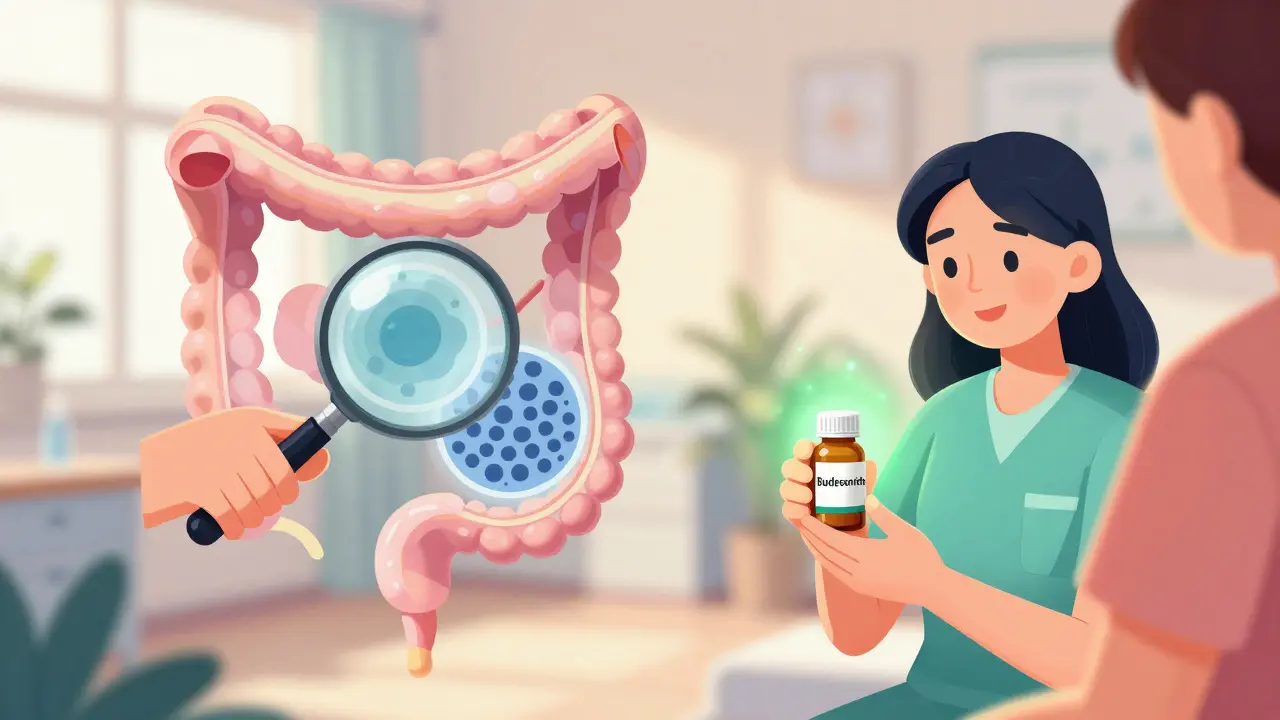
The Catch: Relapse Is Common
Here’s the tough part: budesonide doesn’t fix the root cause. It just quiets the inflammation. Once you stop taking it, symptoms come back for 50% to 75% of people. That’s why many need maintenance therapy. After the initial 8 weeks, doctors often drop the dose to 6 mg daily for a few more months, or even longer. About 30% to 40% of patients stay on a low dose for over a year. Some people can taper off successfully. Others find they’re stuck on it. One patient on PatientsLikeMe said, “Worked great for 6 weeks. Then symptoms returned. Now I’ve been on maintenance for two years.” That’s not failure-it’s the reality of the disease.Side Effects and Safety
Budesonide is safe for most people, but it’s not harmless. The most common complaints: trouble sleeping (15%), acne (12%), and mood changes (8%). These are mild for most, but they matter. Elderly patients, especially those over 65, need monitoring. Long-term use could affect bone density or adrenal function. That’s why doctors check blood pressure, HbA1c, and do bone scans before starting-and sometimes again after 6 months. It’s not safe for people with severe liver disease. Since the liver breaks down most of the drug, if your liver isn’t working right, too much of it can build up in your blood. That’s why your doctor will ask about your liver history.Cost and Access
Generic budesonide costs $150 to $250 for an 8-week course in the U.S. The brand name, Entocort EC, can hit $800 to $1,200. Insurance usually covers it, but without it, the price is a barrier. Many patients on forums say cost is their biggest struggle. In countries with public healthcare, access is easier. In the U.S., copays and prior authorizations can delay treatment.
What Comes Next? The Future of Treatment
Research is moving fast. A new drug called vedolizumab, originally for Crohn’s, just got Fast Track status from the FDA for microscopic colitis. Early results show 65% of patients went into remission after 14 weeks. That’s promising for people who don’t respond to budesonide. Scientists are also looking at genetics. Early data suggests people with certain genes (HLA-DQ2 or HLA-DQ8) respond better to budesonide. That could mean future testing to predict who will benefit most. For now, budesonide remains the standard. It’s the first drug you try, the one that gets you back to normal, and often the one you stay on longer than you expected.What Should You Do If You Suspect You Have It?
If you’ve had chronic watery diarrhea for more than a few weeks-with no clear trigger-you need a colonoscopy with biopsies. Don’t assume it’s IBS. Ask for deep biopsies from multiple parts of the colon. One biopsy isn’t enough. The inflammation can be patchy. If you’re diagnosed, don’t panic. Budesonide has a strong track record. Talk to your doctor about the plan: how long you’ll take it, how you’ll taper, what side effects to watch for, and what comes next if it doesn’t work.Final Thoughts
Microscopic colitis isn’t flashy, but it’s real. It steals your days, your sleep, your confidence. But it’s treatable. Budesonide isn’t perfect-it doesn’t cure, and relapses happen-but it’s the best tool we have. For most people, it’s the difference between living in fear of the bathroom and living again.Is microscopic colitis the same as IBS?
No. IBS is a functional disorder-there’s no inflammation or structural damage. Microscopic colitis is an inflammatory disease, visible only under a microscope. Both cause diarrhea, but IBS doesn’t show up on biopsies, and budesonide doesn’t work for IBS. If your diarrhea doesn’t improve with diet changes or probiotics, microscopic colitis should be ruled out.
Can you get microscopic colitis if you’re under 50?
Yes, though it’s less common. Most cases are in people over 60, but it’s been diagnosed in people as young as their 20s and 30s. Women in their 40s are increasingly being diagnosed, especially if they’re taking NSAIDs, statins, or proton pump inhibitors, which are linked to the condition.
Does budesonide cause weight gain?
It can, but much less than prednisone. Weight gain is a known side effect of steroids, but because budesonide is mostly broken down by the liver, systemic exposure is low. In clinical trials, less than 10% of patients reported noticeable weight gain. Still, monitoring your diet and activity during treatment helps.
How long until budesonide starts working?
Most people notice improvement within 1 to 2 weeks. By week 4, about 70% to 80% are in remission. It’s not instant, but it’s faster than most other treatments. If you haven’t seen any change after 4 weeks, talk to your doctor. You might need a longer course or a different approach.
Can you stop budesonide cold turkey?
No. Stopping abruptly can trigger a rebound flare. Doctors recommend tapering slowly-usually reducing the dose by 3 mg every 2 to 4 weeks. Even after stopping, symptoms can return. That’s why maintenance therapy is common. Always follow your doctor’s tapering plan.
Are there natural remedies that help?
Dietary changes can help manage symptoms-like avoiding caffeine, dairy, or fatty foods-but they won’t treat the inflammation. Some people find relief with bile acid binders like cholestyramine or probiotics. However, no natural remedy has proven effective in clinical trials for inducing remission. Budesonide remains the only treatment with strong evidence.
Is microscopic colitis linked to cancer?
Current evidence says no. Unlike ulcerative colitis, microscopic colitis doesn’t increase your risk of colon cancer. Long-term studies over 10 to 15 years show no higher cancer rates. That’s good news. The main concern is quality of life, not cancer risk.
Why do some people need maintenance therapy for years?
Because the inflammation keeps coming back. The immune system in these patients seems to stay overly reactive. Budesonide suppresses that reaction, but doesn’t reset it. For 30% to 40% of people, stopping the drug leads to relapse within months. Maintenance therapy keeps symptoms away and avoids repeated cycles of flare-ups and recovery.
Comments
Mark Able
I was diagnosed with this last year and budesonide saved my life. Went from 12 trips a day to basically normal in two weeks. No joke, I cried the first time I made it through a movie without running to the bathroom.
December 19, 2025 at 01:34
Chris Davidson
Budesonide is just another steroid coverup. Big Pharma doesn't want you to know the real cause is glyphosate in your food and water. They profit off chronic treatment not cures.
December 19, 2025 at 10:15
Kinnaird Lynsey
Wow. I’ve been on this drug for 18 months and I still feel like I’m walking on eggshells around my own digestive system. At least I’m not peeing out water anymore. Small wins.
December 20, 2025 at 12:54
Nicole Rutherford
Of course it’s budesonide. Everyone just takes the easy pill instead of fixing their gut microbiome. You’re all just lazy and scared of real healing. Probiotics and fasting would’ve fixed this in a month.
December 22, 2025 at 07:02
Erica Vest
Important note: budesonide’s low systemic absorption is why it’s preferred over prednisone, but it still suppresses adrenal function over time. Always get baseline cortisol levels checked before starting, and monitor during maintenance. Don’t assume it’s ‘safe’ just because side effects are rarer.
December 22, 2025 at 08:27
Frank Drewery
Thank you for writing this. I’ve been suffering for 14 months and finally got diagnosed last week. I was starting to think I was crazy. Knowing there’s a treatment that actually works… I can breathe again.
December 23, 2025 at 05:12
Ashley Bliss
This isn’t just a medical issue. It’s a spiritual awakening. Your body is screaming that you’ve been living out of alignment with your truth. The diarrhea? It’s your soul purging toxicity. Budesonide just masks the message.
December 23, 2025 at 12:23
Matt Davies
Been on budesonide for 3 years now. I call it my ‘life raft pill’. Not glamorous, not sexy, but it lets me go to my kid’s soccer games without packing a change of clothes. Worth every penny.
December 23, 2025 at 20:42
Andrew Kelly
Microscopic colitis is just a diagnosis the medical system uses to avoid admitting they don’t know what’s really going on. Same with IBS. It’s all placebo and profit. I cured mine with a 30-day lemon water cleanse and no more wheat.
December 23, 2025 at 23:26
mary lizardo
The assertion that budesonide is the ‘gold standard’ is misleading. Clinical trial data from 2018 demonstrates a 17% higher relapse rate in patients over 65 compared to younger cohorts. The term ‘gold standard’ implies universality, which is empirically inaccurate.
December 24, 2025 at 00:03
Dev Sawner
Based on the statistical prevalence and demographic distribution, it is evident that the rise in microscopic colitis correlates directly with the increased pharmaceuticalization of Western diets. The consumption of proton pump inhibitors has increased by 300% since 1998, and this is not coincidental.
December 25, 2025 at 03:50
Mike Rengifo
Just started budesonide. 3 days in. Already feel like I can sleep through the night. Still scared it’ll all come back, but… for now, I’m just grateful.
December 26, 2025 at 04:32
Janelle Moore
They’re hiding the truth. Budesonide is made by the same company that makes the pesticides that cause this. They want you addicted so you keep buying it. Check the ingredients. Look at the patent dates. It’s all connected.
December 27, 2025 at 11:14
Write a comment