

INR Target Range Calculator
Your INR Target Range
Your Target INR Range
What Is INR and Why Does It Matter?
INR stands for International Normalized Ratio. It’s a number doctors use to measure how long it takes your blood to clot. If you’re taking a blood thinner like warfarin, your INR tells you if your dose is too high, too low, or just right. Too low, and you’re at risk for clots that could cause a stroke or pulmonary embolism. Too high, and you’re at risk for dangerous bleeding - even from a small cut or bump.
This number isn’t arbitrary. It’s based on a blood test called the prothrombin time (PT), which measures how long your plasma takes to clot after adding certain chemicals. But here’s the problem: different labs used different reagents, so your PT result could vary wildly depending on where you got tested. That’s why the WHO created the INR in 1983 - to standardize results so a reading of 2.5 in Brisbane means the same thing as 2.5 in Chicago or Tokyo.
For someone not on blood thinners, a normal INR is 1.0. But if you’re on warfarin, your target range is usually between 2.0 and 3.0. Some conditions need tighter control: mechanical heart valves, especially mitral valves, often require 2.5 to 3.5. Atrial fibrillation and deep vein thrombosis usually stay in the 2.0-3.0 range. Staying within that narrow window saves lives. Studies show that keeping your INR in range reduces stroke risk by 42% and major bleeding by 28%.
How Often Do You Need to Test?
When you first start warfarin, you might need testing every few days. Your dose is being fine-tuned, and even small changes in diet, medications, or illness can swing your INR. Once you’re stable - meaning your INR stays within target for several weeks - testing usually drops to once a month. But stability doesn’t mean you can stop paying attention.
Some people need testing every week or even twice a week. That’s common if you’re recovering from surgery, have liver disease, or are starting new medications like antibiotics or anti-seizure drugs. These can interfere with how warfarin works. Even something as simple as switching from spinach to lettuce can change your INR because vitamin K counteracts warfarin.
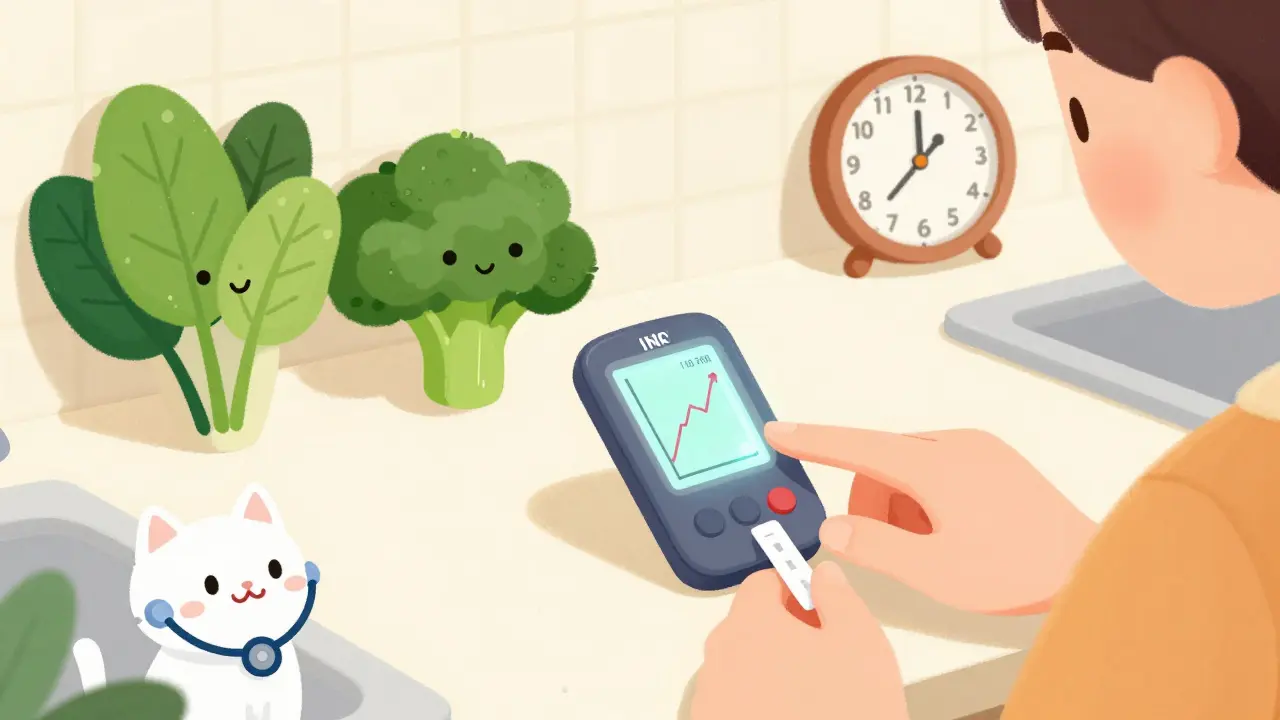
Home testing devices like the Roche CoaguChek or Abbott Acelis let you check your INR with a single drop of blood from your finger. Results come in under a minute. These devices are FDA-approved and accurate enough for clinical use. In fact, people who test at home spend 72% of their time in the target range, compared to just 58% for those who rely on clinic visits. That difference means fewer clots, fewer bleeds, and fewer hospital trips.
Home Testing: Convenience vs. Challenges
Home INR testing isn’t for everyone, but for those who qualify, it’s a game-changer. You skip the drive to the clinic, the wait time, and the stress of missing an appointment. One user on Reddit said they went from biweekly clinic visits to monthly home tests - and saved $187 per visit in lost wages and transportation.
But it’s not without hurdles. About 42% of home testers struggle with the finger prick. Getting enough blood on the test strip without wasting a $6 strip takes practice. People with arthritis, shaky hands, or poor eyesight find it tough. Older adults, especially those over 65, report lower satisfaction with home devices - just 3.1 out of 5 compared to 4.3 for younger users.
Insurance coverage is another issue. Medicare covers 100% of home INR testing for eligible patients. But private insurers? Many require 20% coinsurance and have annual out-of-pocket caps between $1,500 and $7,500. Around 31% of users reported initial claim denials and had to get their doctor to appeal.
Still, for people with mechanical heart valves, home testing is often worth the cost. A 2022 survey found 57% of these patients preferred it, even if they paid more out of pocket. Less anxiety, less time off work, and more control over their health make the trade-off worthwhile.
What Happens If Your INR Is Too High or Too Low?
An INR below 1.5 means your blood is clotting too fast. That’s dangerous if you have atrial fibrillation or a mechanical valve. You could develop a clot in your heart, brain, or lungs. If your INR drops below 1.5, contact your doctor immediately. You might need a dose increase or even a temporary shot of vitamin K.
On the other end, an INR above 4.9 is a red flag. Each 0.5-point rise above 3.0 increases your risk of major bleeding by 27%. If your INR hits 5.0 or higher, you should stop taking your warfarin dose and call your provider within 24 hours. You might need vitamin K or even a blood transfusion in severe cases.
But here’s the thing: an INR of 3.5 isn’t automatically dangerous. If you’re on a higher target range for a mechanical mitral valve, that’s normal. Always ask your doctor what your personal target is - don’t assume all ranges are the same.
One common mistake? Panicking over a single high or low reading. INR can fluctuate due to diet, alcohol, illness, or even the time of day you test. The goal isn’t perfection - it’s consistency. Doctors look at trends, not single numbers.
Warfarin vs. Newer Blood Thinners: The Trade-Offs
Warfarin isn’t the only option anymore. Newer drugs like apixaban, rivaroxaban, and dabigatran - called DOACs - don’t require INR monitoring. They’re easier. You take them once or twice a day, no blood tests, no dietary restrictions.
But they’re not better for everyone. DOACs cost $550 to $650 a month. Warfarin? About $4. That’s a huge difference if you’re paying out of pocket. And DOACs aren’t safe for people with mechanical heart valves. Warfarin is still the only approved option for them.
Also, DOACs can’t be easily reversed if you bleed. Warfarin can be reversed with vitamin K or fresh frozen plasma. DOAC reversal drugs exist but are expensive and not always available in emergencies.
As of 2025, DOACs make up 70% of new anticoagulant prescriptions. But warfarin is still used by over 3 million Americans - mostly because it’s affordable, effective, and necessary for certain conditions. The key is matching the drug to the person, not just choosing the newest option.

How to Stay in Range: Practical Tips
- Test at the same time each day. Morning is best - between 8 a.m. and noon. Consistency reduces variability.
- Fast 4-6 hours before testing. Food, especially fatty meals, can affect results.
- Keep vitamin K intake steady. Don’t go from eating no greens to a giant salad every day. Spinach, kale, broccoli, and Brussels sprouts are high in vitamin K. Eat them consistently, not randomly.
- Tell every doctor you see you’re on warfarin. Even dentists and pharmacists need to know. Many antibiotics, painkillers, and supplements interfere with warfarin.
- Use a logbook or app. Track your INR, dose, diet, and any symptoms. This helps your doctor spot patterns.
- Don’t skip doses. If you miss one, don’t double up the next day. Call your provider for advice.
What’s Next for INR Monitoring?
The future is getting smarter. In early 2023, the FDA approved the first smartphone-connected INR device - the Bayer CoaguChek ProConnect. It automatically sends your results to your doctor’s system. No more manual entries or missed calls. Clinical trials showed 98.7% accuracy.
AI tools are also emerging. The INR Advisor platform, tested at Mayo Clinic, predicts the right warfarin dose with 83% accuracy by analyzing your history, diet, and meds. This could reduce guesswork and make dosing more precise.
But access remains uneven. Rural areas have far fewer anticoagulation clinics - only 35% offer full services, compared to 82% in cities. That gap puts rural patients at higher risk of complications.
As DOACs grow in popularity, the need for INR monitoring will decline. But for now, it’s still essential for millions. The goal isn’t to eliminate testing - it’s to make it as easy, accurate, and personalized as possible.
When to Call Your Doctor
- Your INR is below 1.5 or above 5.0
- You have unexplained bruising, nosebleeds, blood in urine or stool
- You fall hard or hit your head
- You start a new medication or supplement
- You’re sick with vomiting, diarrhea, or fever for more than two days
- You miss two or more doses in a row
Don’t wait. A quick call could prevent a hospital visit - or worse.
Comments
Mussin Machhour
I switched to home testing last year after my INR kept swinging at the clinic. Now I test every Monday and Friday. Saved me $200 a month on gas and time off work. My doctor says I'm in range 80% of the time now. Best decision I ever made.
December 25, 2025 at 03:34
sagar patel
Warfarin is a relic but it works and its cheap and if you dont care about your vitamin K intake youll die
December 25, 2025 at 09:50
Oluwatosin Ayodele
Most people dont realize the FDA approves these home devices because the labs pay them. The real accuracy is in the 80s not the 98.7% they claim. I work in med device QA and I know.
December 27, 2025 at 08:57
Linda B.
They say INR is standardized but did you know the WHO is controlled by Big Pharma? They designed the ratio to keep people dependent on warfarin so they can sell the reversal agents. Vitamin K is banned in 14 countries for a reason.
December 28, 2025 at 03:10
Christopher King
This whole system is a trap. They want you to fear your own blood. INR? That's just a number they invented to make you feel powerless. The real danger is the pharmaceutical-industrial complex. They profit from your anxiety. Wake up. The truth is in the vitamin K. Eat your kale and you'll be fine. They don't want you to know that.
December 28, 2025 at 08:23
Carlos Narvaez
DOACs are clearly superior. Warfarin is for people who enjoy bureaucracy. If you're still on it, you're either broke or masochistic.
December 30, 2025 at 07:33
Harbans Singh
I'm from India and we barely have access to INR testing outside big cities. My cousin on warfarin has to travel 200km every 3 weeks. Home devices would change everything here. Why aren't these cheaper in developing countries? It's not like the tech is that expensive.
December 31, 2025 at 03:43
Zabihullah Saleh
There's something poetic about measuring your blood's willingness to clot. It's not just medicine-it's a metaphor. We all want to clot sometimes. To hold together. But too much clotting? That's fear. That's control. The real target isn't 2.5-it's balance. The body knows. We just need to stop interfering.
January 1, 2026 at 23:24
Jason Jasper
I've been on warfarin for 12 years. I test every Thursday. I log everything. I eat the same salad every day. No drama. No panic. Just consistency. It's not glamorous but it works.
January 3, 2026 at 10:24
Winni Victor
I read this whole thing and still think the government is using INR to track us. Why else would they make it so complicated? And why do they care if I eat kale? This is surveillance dressed up as healthcare.
January 3, 2026 at 10:48
Sophie Stallkind
While the clinical utility of home INR monitoring is well-documented, one must not overlook the psychosocial burden imposed upon elderly patients who are required to perform capillary blood sampling. The ergonomic and cognitive demands may inadvertently exacerbate frailty in vulnerable populations. A compassionate, individualized approach remains paramount.
January 4, 2026 at 18:54
Katherine Blumhardt
I tried home testing but my fingers are so bad from arthritis I kept wasting strips. Then I just started taking my warfarin every other day and it 'seemed fine' so now I just wing it. My doctor said I was lucky. I think she was just tired of me.
January 4, 2026 at 20:23
Write a comment