
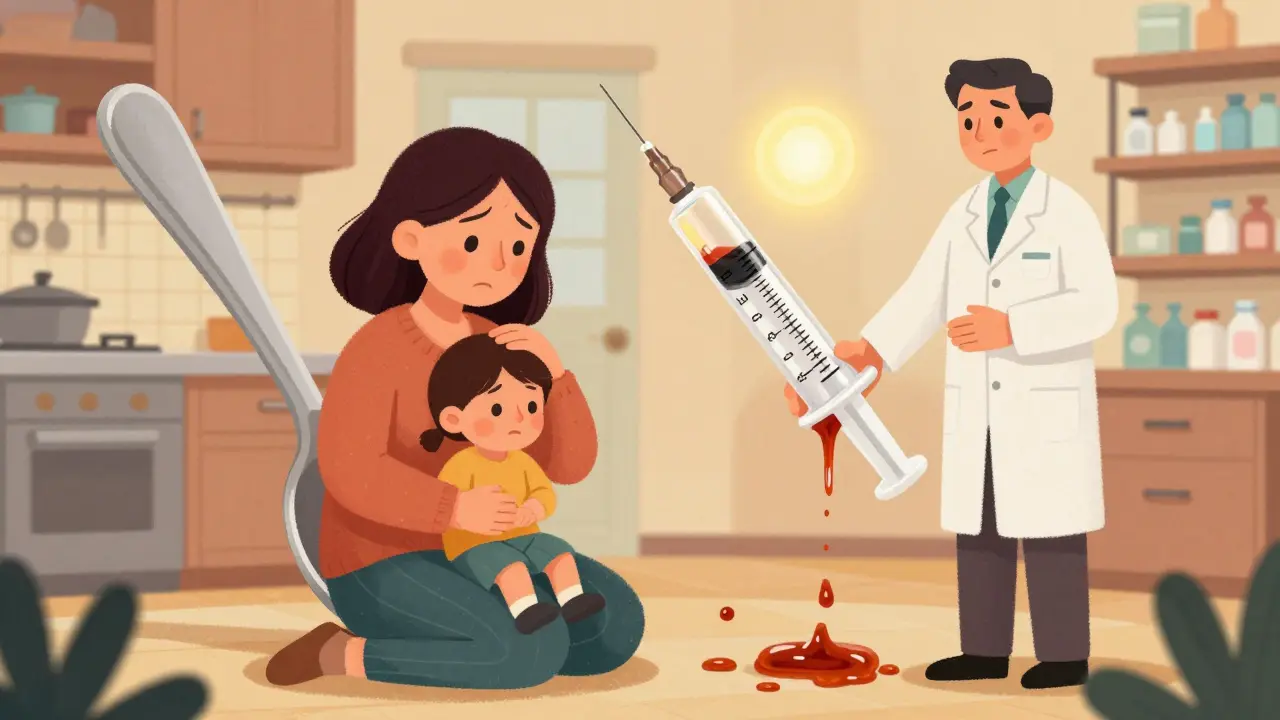
Every year, more than 10,000 calls are made to poison control centers in the U.S. alone because a child was given the wrong dose of liquid medicine. And the most common cause? A kitchen spoon.
It seems harmless. You’re in a rush, your child is sick, and you grab the teaspoon from the drawer. But that spoon isn’t designed for medicine. It’s designed for sugar, salt, or cereal. And that tiny difference - maybe half a milliliter - can be the difference between healing and hospitalization.
Why Kitchen Spoons Are Dangerous for Medicine
A medical teaspoon is exactly 5 milliliters (mL). Sounds simple, right? But household teaspoons? They vary wildly. Some hold 3 mL. Others hold 7 mL. That’s a 40% error before you even pour the medicine.
Think about it: if the doctor prescribes 7.5 mL, and you use a spoon that holds only 4 mL, you’re giving less than half the dose. The infection won’t clear. If you use a spoon that holds 7 mL, you’re giving almost double. That could mean vomiting, drowsiness, or worse - especially in small children whose bodies can’t handle extra medication like adults can.
Research from the Pediatrics journal in 2014 showed that nearly 40% of parents made dosing mistakes when using kitchen spoons. Over 41% of those mistakes were serious enough to affect how well the medicine worked - or how safe it was.
The Numbers Don’t Lie: mL Is the Only Safe Unit
The American Academy of Pediatrics (AAP), the CDC, and the FDA all agree: milliliters are the only safe unit for measuring children’s liquid medicine. Not teaspoons. Not tablespoons. Not drops. Milliliters.
Why? Because milliliters are exact. A 5 mL syringe is always 5 mL. A 2.5 mL syringe is always 2.5 mL. No guessing. No variation.
Studies show that when labels say “give 5 mL,” parents are far less likely to grab a spoon than when labels say “give 1 teaspoon.” In fact, one 2016 study found that 33% of parents said they’d use a kitchen spoon if the label said “teaspoon.” But only 9% would if it said “mL.” That’s a 24-point difference - just from changing the words on the bottle.
And it gets worse. If you use a tablespoon by mistake - thinking it’s a teaspoon - you’re giving three times the dose. That’s not a typo. That’s a medical emergency.
The Right Tools: Oral Syringes Are the Gold Standard
When it comes to accuracy, nothing beats an oral syringe. These are the small, plastic syringes with clear mL markings, often included with liquid medicine. They’re designed to measure as precisely as 0.1 mL. That’s important because many pediatric doses aren’t round numbers. Maybe it’s 3.2 mL. Or 1.8 mL. A spoon can’t do that. A dosing cup with only 5 mL and 10 mL marks can’t do that.
Oral syringes let you draw up the exact amount. You can even gently push the plunger to give the medicine slowly between your child’s cheek and gum - not down the throat. That reduces choking risk and makes it easier for kids who hate the taste.
Some parents worry: “Isn’t it messy?” Yes, sometimes. But a little cleanup is better than a trip to the ER. And if you’re worried about the syringe being hard to use - practice with water first. Fill it, squirt it into a cup, then refill. It takes two tries to get comfortable.
What About Dosing Cups?
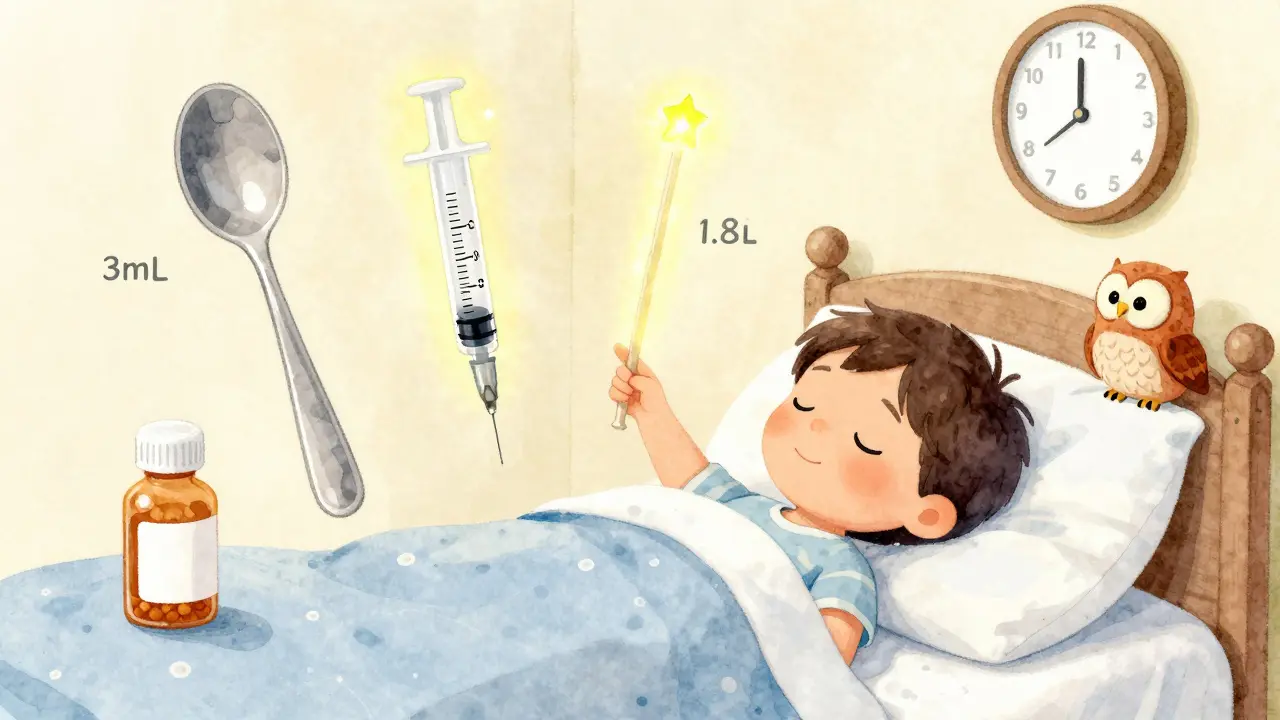
Dosing cups are better than spoons - but they’re still flawed. Most only have markings at 5 mL, 10 mL, 15 mL, and 20 mL. What if your child needs 8 mL? You’re guessing. You’re estimating. And estimation is where errors creep in.
Plus, many dosing cups are designed to be used with a spoon-like pour, not a precise draw. That means you’re pouring, not measuring. Pouring leads to spills. Spills lead to underdosing. And if you’re trying to measure 0.5 mL? Forget it. That cup won’t help.
Use a dosing cup only if it’s the only thing provided - and even then, read the lines carefully. Don’t guess. Don’t eyeball. Get a syringe instead.
What to Do Right Now: A Simple 5-Step Plan
Here’s what you do the next time your child needs liquid medicine:
- Check the label. Is it written in mL? If it says “teaspoon” or “tsp,” ask the pharmacist to rewrite it in mL. They’ll do it.
- Ask for a syringe. If one wasn’t included, ask for one. Most pharmacies give them for free. If they say no, ask why - and insist. You’re not being difficult. You’re being safe.
- Use the syringe, not the cup. Even if you got a dosing cup, use the syringe. It’s more accurate, especially for doses under 5 mL.
- Measure at eye level. Hold the syringe up to your eyes. Look straight at the line. Don’t look from above or below. That’s how you get it right.
- Don’t rush. Give the medicine slowly. Let your child swallow. Don’t squirt it into the back of the throat. That’s a choking risk.
Why This Still Happens (And How to Stop It)
Despite decades of warnings, about 75% of American families still use kitchen spoons for medicine. Why? Because it’s what they’ve always done. Because the bottle says “teaspoon.” Because they think, “It’s just a little bit.”
But here’s the truth: children aren’t small adults. Their bodies process medicine differently. A dose that’s safe for a 150-pound teen could be toxic for a 20-pound toddler. And the difference between right and wrong? Often less than a teaspoon.
Pharmacists are seeing this firsthand. At Aspirus and other health systems, they now routinely hand out oral syringes with every pediatric liquid prescription. They’ve seen error rates drop by 20 percentage points when families use the right tools.
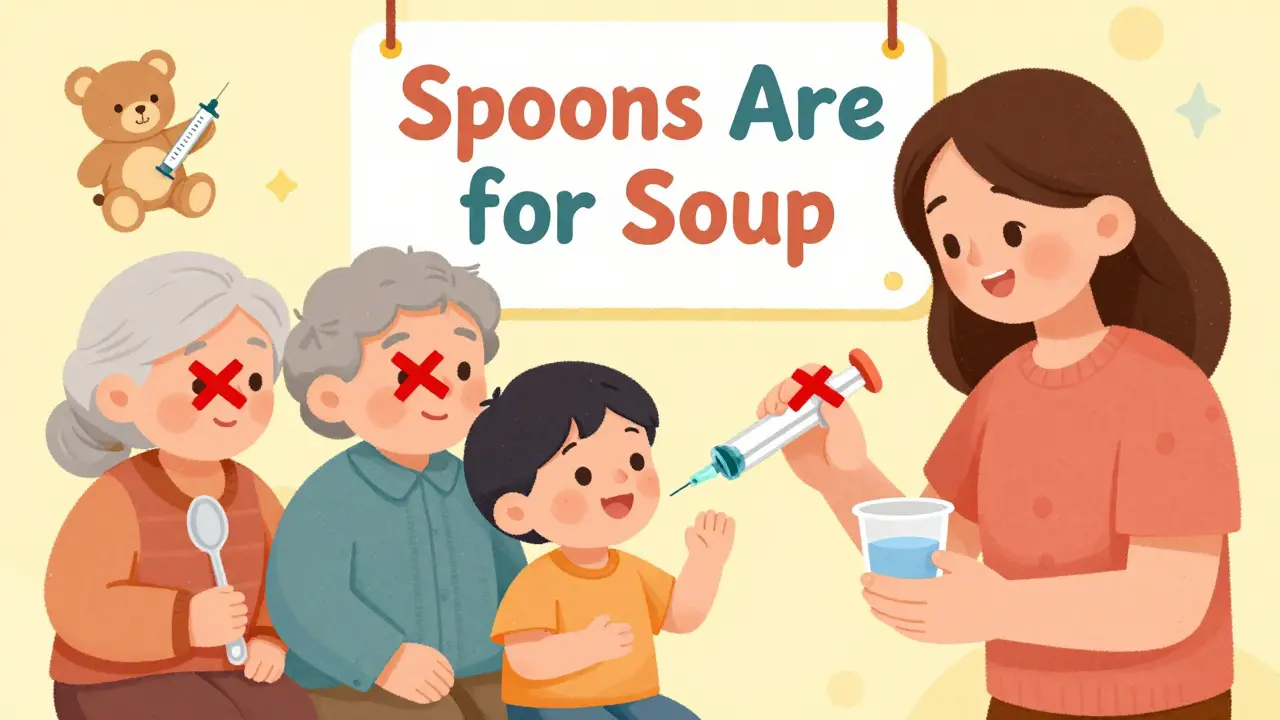
The CDC’s “Spoons Are for Soup” campaign isn’t just a slogan - it’s a life-saving rule. If you wouldn’t use a spoon to measure gasoline, don’t use it to measure medicine.
What You Can Do Today
You don’t need to wait for a new study. You don’t need to wait for the government to change labels. You can act now:
- Keep a few oral syringes in your medicine cabinet - even if you don’t have kids right now. Kids grow fast. Medicine doesn’t wait.
- Ask your pediatrician to write all liquid prescriptions in mL. If they don’t, ask why.
- Throw out old dosing spoons. They’re not tools - they’re traps.
- Teach grandparents, babysitters, and caregivers: “Use the syringe. Always.”
Medicine dosing isn’t about convenience. It’s about safety. And the safest tool isn’t the one you already have. It’s the one you get from the pharmacy - the one marked in milliliters.
Can I use a kitchen spoon if I don’t have a syringe?
No. Kitchen spoons are not accurate. Even if you think you know how much a teaspoon holds, they vary by up to 40%. A 5 mL dose could end up being 3 mL or 7 mL. That’s not safe for a child. If you don’t have a syringe, call your pharmacy. They’ll give you one for free.
Why do medicine labels still say “teaspoon”?
Some labels still use “teaspoon” because of old habits or lack of regulation. But the FDA and AAP strongly recommend using only milliliters (mL). If your label says “tsp,” ask your pharmacist to rewrite it in mL. They’re required to help you understand the dose - and they’ll do it.
Is a dropper better than a syringe?
Droppers are better than spoons, but not as good as syringes. Droppers often don’t have clear mL markings, and it’s hard to control how much you release. Syringes let you see the exact amount and push it slowly. For doses under 5 mL - which most children need - a syringe is the best choice.
What if my child spits out the medicine?
Don’t give another full dose. Call your pharmacist or doctor. Sometimes, giving half the dose again is enough. But giving too much can be dangerous. Never guess. Always ask.
Can I use a syringe for other liquids like vitamins or supplements?
Yes - and you should. Whether it’s vitamin D drops, iron syrup, or children’s ibuprofen, always use a syringe for accuracy. Vitamins and supplements can also be dangerous in the wrong dose. Keep one syringe labeled for medicine and another for supplements to avoid mix-ups.
Comments
Gloria Ricky
I just realized I've been using a spoon for my toddler's amoxicillin for months... 😳 Thanks for this post. I grabbed a syringe from the pharmacy today and it's been a game changer. No more guessing, no more panic. Also, why do pharmacies still give those stupid dosing cups? They're useless for anything under 5mL.
February 15, 2026 at 09:55
Stacie Willhite
This made me cry a little. My daughter had a bad reaction last year because we used a spoon. We didn't know any better. I wish someone had told us this before it happened. I now keep 3 syringes in the cabinet and label them 'medicine only'. I even showed my mom - she's 72 and still uses spoons. Changed her mind in 2 minutes.
February 15, 2026 at 17:59
Jason Pascoe
I'm from Australia and we've been pushing this for years here too. The 'spoons are for soup' campaign started here before it went global. Funny thing - we also had to fight against 'tablespoons' being used for adult meds. Turns out, even adults mess this up. I keep a syringe in my wallet now. Just in case. Better safe than sorry.
February 16, 2026 at 14:37
Sonja Stoces
Okay but why are we still talking about this in 2024? 🤦♀️ Every single pharmacy in the US has free syringes. Every. Single. One. If you're still using a spoon, you're either lazy or you don't care. And if you're a grandparent? You're a walking liability. I've seen kids hospitalized because of this. Stop. Just stop.
February 17, 2026 at 01:33
Annie Joyce
I used to think this was overkill until my 18-month-old got a bad case of ear infection. The pharmacist handed me a syringe like it was a lifeline. 'This isn't a suggestion,' she said. 'It's a rule.' And honestly? She was right. I used to think 'a little extra' wouldn't hurt. Turns out, it's like giving a toddler a shot of espresso. Now I measure at eye level like a NASA engineer. My kid's not sick anymore. And I'm not a nervous wreck anymore either.
February 18, 2026 at 06:21
Rob Turner
I think the real issue isn't the spoon - it's the language. 'Teaspoon' feels familiar. '5 mL' feels clinical. We're wired to trust what sounds like home. But here's the kicker: if we changed the wording on labels, we'd cut errors by 70%. Why hasn't the FDA mandated it? Maybe because change is scary. Maybe because they're still using paper forms from 1998. Either way, we have to be the ones to fix it - one syringe at a time.
February 19, 2026 at 17:35
Luke Trouten
I appreciate the intent of this post, and the data is compelling. But I wonder if we're overlooking a deeper issue: healthcare accessibility. Not everyone can walk into a pharmacy and ask for a syringe. Some live in rural areas with no 24-hour pharmacy. Others can't afford to wait in line. The solution isn't just personal responsibility - it's systemic change. Pharmacies should include syringes automatically. No questions asked. Period.
February 20, 2026 at 08:32
Gloria Ricky
You're so right about the dosing cups. I tried one once - ended up spilling half of it on the floor. Then I had to guess how much was left. I felt like a scientist in a lab trying to measure a drop of water with a bucket. Syringes are the only way. I even got one with a rubber grip. It's like a tiny magic wand for medicine.
February 22, 2026 at 04:52
Write a comment