
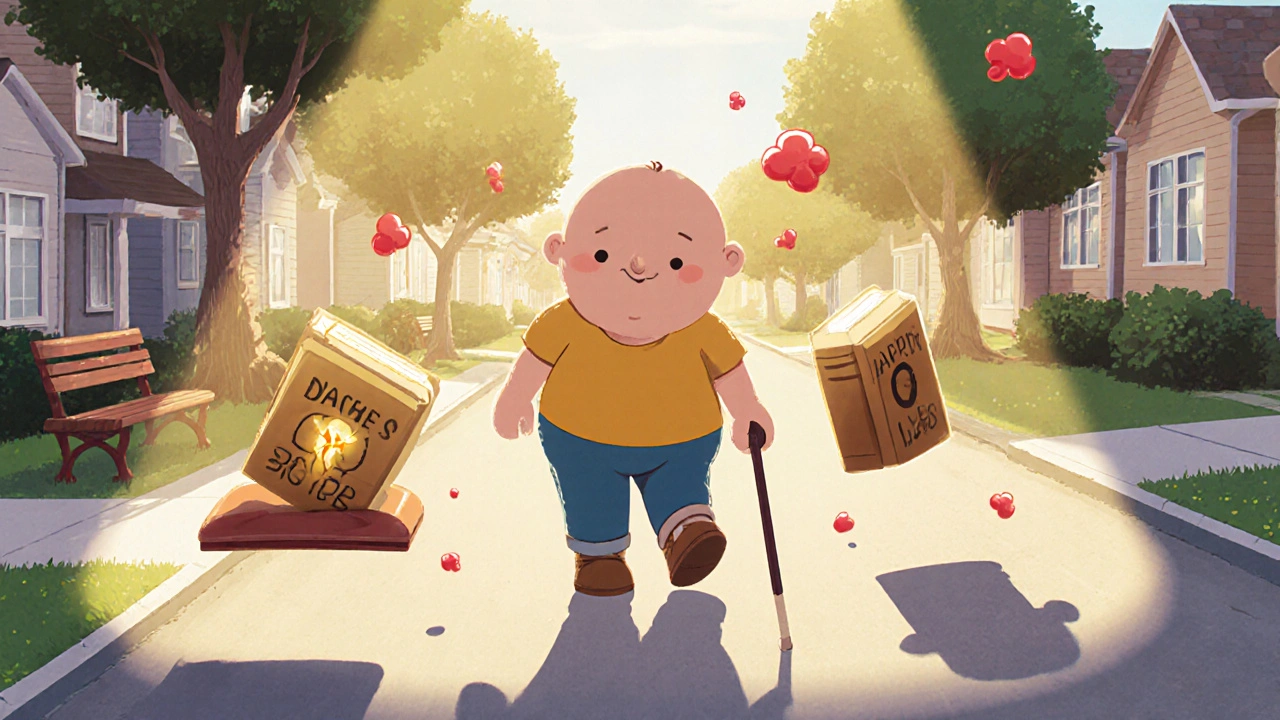
When your hip starts to ache with every step, it’s not just discomfort-it’s your body screaming that something’s off. Osteoarthritis of the hip isn’t just "wear and tear" as people often say. It’s a real, progressive breakdown of cartilage, inflammation in the joint, and changes in the bone underneath. And if you’re carrying extra weight, you’re adding pressure to an already struggling joint. The good news? Losing weight doesn’t just help your waistline-it can actually slow down the damage and help you move better.
Why Weight Matters for Your Hip
Your hip joint carries your whole body weight every time you stand, walk, or climb stairs. For every pound of excess weight, your hip experiences three to five times that force during movement. That means if you’re 30 pounds overweight, your hip is under 90 to 150 extra pounds of pressure with each step. Over time, that crushes the cushioning cartilage, speeds up bone spurs, and triggers chronic inflammation. Studies show that people with obesity (BMI ≥30) are far more likely to develop hip osteoarthritis. The CDC estimates over one-third of U.S. adults have obesity, which means millions are at risk. But it’s not just about getting the disease-it’s about making it worse. The more weight you carry, the faster the joint breaks down.What Does the Science Say About Weight Loss?
Here’s where things get tricky. For knee osteoarthritis, the link between weight loss and pain relief is clear-cut. Lose 5-10% of your body weight, and pain drops noticeably. But for the hip? The evidence is mixed. A 2023 study published in NEJM Journal Watch claimed, "Osteoarthritis of the Hips Is Unaffected by Weight Loss." That headline scared a lot of people. But that same year, a major study in Nature followed 65-year-olds with hip OA and obesity-and found something different. People who lost more than 10% of their body weight saw big improvements: pain dropped, mobility improved, and quality of life scores jumped by over 30%. The biggest gains? In the ability to do everyday activities without pain. Another study tracked 101 people with hip OA over a year. Half did a very-low-calorie diet plus exercise. The other half only exercised. At six months, there was no difference in pain levels. But by 12 months, the diet-and-exercise group had lost more weight, reported less pain, and moved better. The benefits didn’t show up right away-they took time. So what’s going on? The hip joint is deeper and more stable than the knee. It doesn’t bend and twist the same way. That means the mechanics of how weight affects it are different. You can’t assume what works for your knee will work exactly the same for your hip. But the data still points to one thing: bigger weight loss = bigger benefits.How Much Weight Do You Actually Need to Lose?
You’ve probably heard "lose 5% of your weight" for arthritis. That advice comes mostly from knee OA studies. For the hip, that number might not be enough. The Nature study found that losing 5-7% helped-but losing 10% or more made a real clinical difference. People who lost 10% saw improvements in pain, stiffness, walking speed, and even their ability to play sports or do hobbies. Losing 20% didn’t give them much more than 10% did, so there’s a sweet spot. Think of it like this: losing 10% of your body weight means a 200-pound person loses 20 pounds. That’s not a miracle cure-but it’s enough to take pressure off your hip, reduce inflammation, and give your joint a fighting chance to heal.What Works Best: Diet, Exercise, or Both?
If you’re thinking, "I’ll just diet," stop. If you’re thinking, "I’ll just exercise," stop again. Exercise alone? It helps maintain muscle strength around the hip, which stabilizes the joint. But without weight loss, you’re still carrying the same load. Diet alone? You’ll lose weight-but without movement, your muscles weaken. That makes your hip even less stable. The best results come from combining both. The OAHWFL program (Osteoarthritis Healthy Weight For Life), used in Australia and New Zealand, pairs a structured 18-week weight loss plan with tailored exercises for hip OA. Participants lost 7-10% of their body weight and saw major improvements in function. The program uses telehealth coaching, meal planning, and low-impact movement like cycling, swimming, and resistance training. A 2012 study of 35 people with hip OA showed that after eight months of diet and exercise, participants improved their physical function by 32.6%-measured by the WOMAC index. They walked faster, stood longer, and had less pain. This was the first real proof that combining these two approaches works for the hip.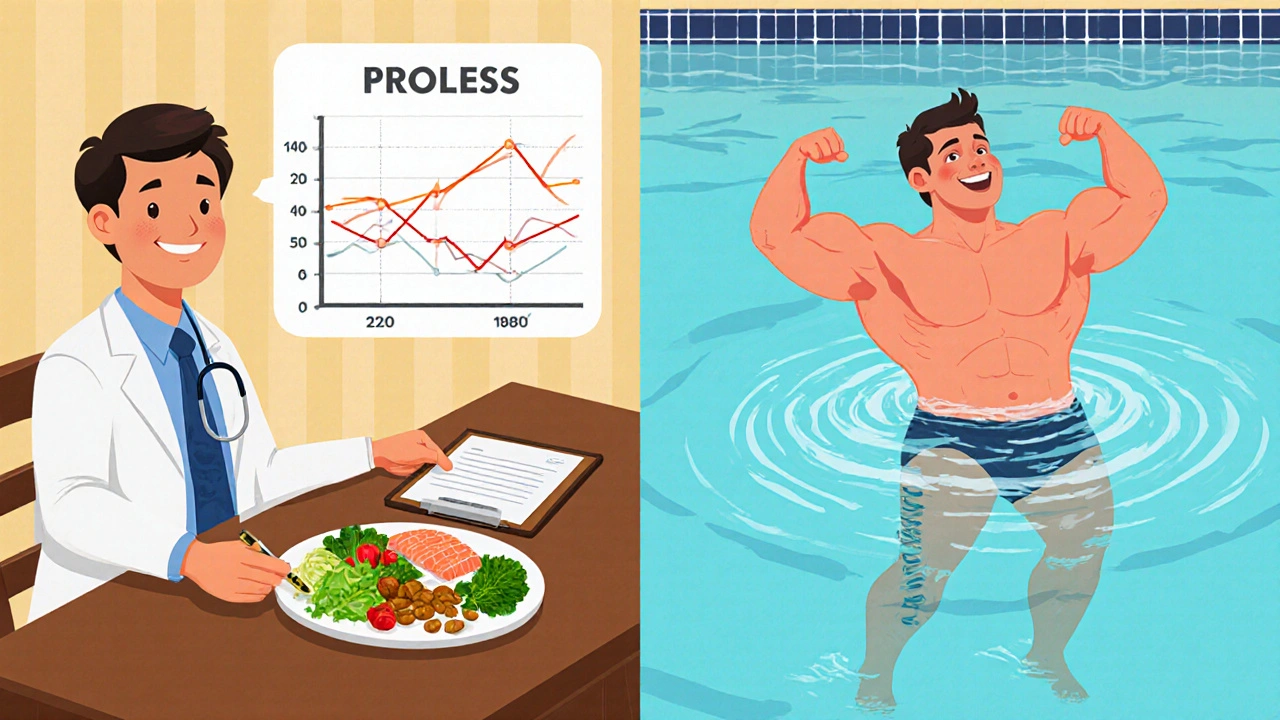
What Kind of Diet Works?
There’s no single "arthritis diet." But some patterns keep showing up in successful programs:- Lower in refined carbs and sugar-these spike inflammation.
- Higher in protein-helps preserve muscle while losing fat.
- Rich in omega-3s-found in fatty fish, flaxseeds, walnuts-helps reduce joint inflammation.
- Whole foods over processed-vegetables, fruits, legumes, lean meats, nuts.
Exercise That Protects Your Hip
You don’t need to run marathons. In fact, high-impact activities like jogging can make hip OA worse. Stick to these:- Swimming or water aerobics-zero impact, full range of motion.
- Cycling-stationary or outdoor, keeps the joint moving without pounding.
- Strength training-focus on glutes, quads, and hamstrings. Strong muscles act like shock absorbers.
- Balance exercises-Tai Chi or simple single-leg stands help prevent falls.
What About Weight Loss Medications?
If you’ve tried diet and exercise for six months and haven’t lost weight, medications like semaglutide (Wegovy) or tirzepatide (Zepbound) may be options. But they’re not first-line. The American College of Rheumatology says these drugs are only for people with BMI over 30 (or over 27 with other health risks) who haven’t responded to lifestyle changes. They’re expensive, have side effects, and aren’t meant to replace healthy habits. Think of them as a tool-not a shortcut.Can Weight Loss Actually Preserve Your Joint?
Yes. Not because it reverses cartilage damage-that’s not possible yet. But because it slows it down. Less weight = less force on the joint = less wear and tear. Lower inflammation = less breakdown of cartilage. Better muscle strength = better joint stability. One study showed that if obese men dropped just into the overweight range, their risk of knee OA dropped by 21.5%. For women, it was 33%. While hip OA data isn’t as strong, the same principle applies: reducing body weight reduces mechanical stress on the joint. That means you might delay or even avoid surgery-like a hip replacement-by years.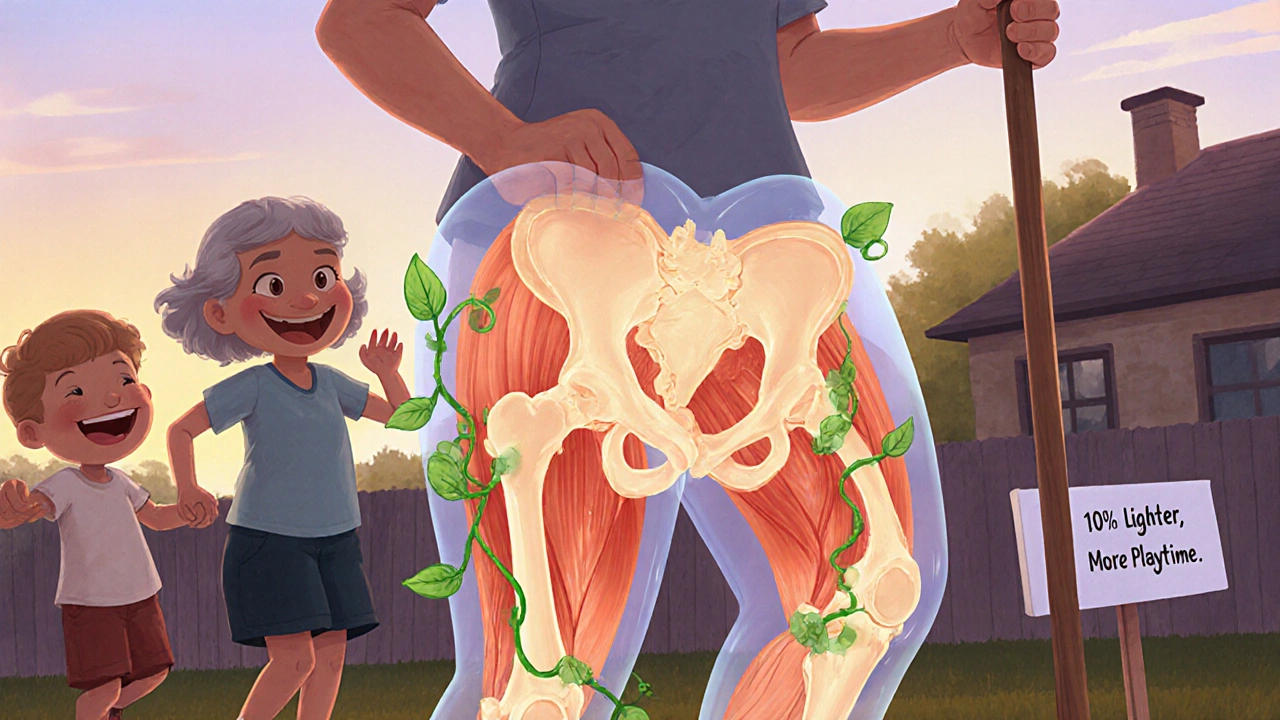
Who Struggles the Most?
Not everyone responds the same. The Nature study found that people with the worst hip pain at the start were less likely to finish the 18-week program. Pain makes movement hard. Hard movement makes weight loss harder. It’s a cycle. That’s why support matters. Coaching, group sessions, or even a buddy system can make the difference between giving up and sticking with it. Telehealth programs are proving effective because they bring help to you-no need to drive to appointments when your hip hurts.Realistic Expectations
Weight loss won’t make your hip pain vanish overnight. It won’t fix every symptom. But it can give you back control. If you lose 10% of your body weight, you might not feel "cured." But you might be able to walk to the store without stopping. You might sleep through the night. You might play with your grandkids without needing a nap after. That’s not magic. That’s science.Where to Start
1. Measure your baseline. Write down your current weight, how much pain you have on a scale of 1-10, and what daily tasks are hardest. 2. Set a 10% goal. If you weigh 220 pounds, aim for 20 pounds lost. Not 50. Not 100. Just 10%. 3. Choose one change. Cut out sugary drinks. Add two 15-minute walks a week. Don’t try to overhaul everything at once. 4. Track progress. Use a simple journal or app. Note weight, pain levels, and what you did each day. 5. Get support. Talk to your doctor about a referral to a dietitian or physical therapist who specializes in arthritis.Final Thought
Your hip doesn’t need perfection. It just needs less burden. You don’t have to be thin to feel better-you just need to be lighter than you are now. And every pound you lose is a gift to your joint. Not because it’s a cure. But because it’s a chance to keep moving-for longer, and with less pain.Can losing weight reverse hip osteoarthritis?
No, weight loss cannot reverse cartilage damage that’s already happened. But it can slow down further breakdown, reduce inflammation, and improve how your joint functions. That means less pain, better mobility, and a longer delay before you might need surgery.
Is weight loss more effective for hip OA than knee OA?
Actually, the opposite is true. Weight loss has stronger, more consistent results for knee osteoarthritis because the knee bears more direct mechanical stress during movement. Hip OA responds more slowly and requires greater weight loss-usually 10% or more-to see meaningful improvement.
How long does it take to see results from weight loss with hip OA?
Some people notice less stiffness or better sleep within 4-6 weeks. But for significant pain relief and improved function, most studies show it takes 6 to 12 months. The benefits build over time as inflammation decreases and muscles strengthen.
Do I need to follow a keto or low-carb diet?
No, but these diets often work well because they reduce inflammation and help control hunger. The key is eating whole foods, cutting sugar and processed carbs, and getting enough protein. You don’t need to be extreme-just consistent.
What if I can’t lose weight despite trying?
You’re not alone. Many people with hip OA struggle with mobility, pain, and fatigue, which make diet and exercise harder. Talk to your doctor about a referral to a registered dietitian or an obesity medicine specialist. Sometimes, medications or structured programs (like telehealth coaching) are needed to break through the plateau.
Can I avoid hip replacement by losing weight?
Yes, for many people. Studies show that losing 10% or more of body weight can delay the need for hip replacement by several years. It doesn’t guarantee you’ll never need surgery, but it gives you more time and better health to make that decision when the time comes.
Comments
Rajiv Vyas
Lose weight? Sure. But who says it's not Big Pharma pushing this to sell more meds? They don't want you to know that hip pain is actually caused by 5G towers and fluoridated water. I lost 30 lbs and my hip hurt worse. Coincidence? I think not. 🤡
November 30, 2025 at 05:50
farhiya jama
I tried losing weight. It was exhausting. Now I just take ibuprofen and watch Netflix. At least my hip doesn't have to deal with my drama.
November 30, 2025 at 15:17
Astro Service
This is why America is weak. We got fat because we're soft. Back in my day, we walked 10 miles uphill both ways to the clinic. No fancy diets. No telehealth. Just grit. Lose the weight or get a cane, loser.
December 1, 2025 at 21:50
DENIS GOLD
Oh wow, another 'lose weight and you'll feel better' article. Real groundbreaking. Next they'll tell us breathing improves lung health. 🙄
December 2, 2025 at 00:35
Ifeoma Ezeokoli
I see so many people treating their bodies like enemies. But your hip? It's been carrying you since day one. Losing weight isn't punishment-it's a love letter to yourself. You don't have to be thin. Just lighter than you are. And that? That's enough. 🌿❤️
December 3, 2025 at 18:06
Daniel Rod
It’s funny how we think of our bodies as machines that need fixing... but they’re alive. They feel. They adapt. Losing weight isn’t about ‘fixing’ your hip-it’s about giving it space to breathe again. 🤲🫶 Maybe we’re not broken. Maybe we’re just burdened.
December 4, 2025 at 15:25
gina rodriguez
I love how this article doesn't sugarcoat it. Small steps matter. I lost 12 lbs over 8 months by swapping soda for sparkling water and walking after dinner. My hip doesn't scream anymore. Just whispers. And that's a win.
December 4, 2025 at 21:36
Sue Barnes
If you can't lose 10% of your weight by now, you're just lazy. No excuses. Stop blaming the joint. Your willpower is the problem. Get off the couch. Eat less. Move more. Simple. Not hard. Just hard for you.
December 6, 2025 at 11:19
jobin joshua
I tried keto. Lost 8 lbs. But my hip still ached. Then I found out I had a vitamin D deficiency. Took supplements. Pain dropped 60%. Weight loss? Maybe. But it's not the whole story. 🤔
December 7, 2025 at 18:59
Sachin Agnihotri
I'm 72, have hip OA, and I lost 18% of my body weight over 14 months-slowly, with a physical therapist, swimming three times a week, and eating mostly plants. I still have pain-but I can now walk to the park, play with my grandkids, and not cry afterward. It's not magic. It's discipline. And yes, it works.
December 8, 2025 at 03:38
Diana Askew
They never tell you the truth: weight loss programs are run by corporations who profit from your failure. You’ll never reach 10% because they want you to keep buying their shakes, apps, and supplements. This is all a scam. I know. I’ve seen the documents.
December 8, 2025 at 04:25
King Property
You're all missing the point. The real issue is insulin resistance. You think it's about calories? No. It's about hormones. Eat protein, avoid carbs, lift weights. That's it. Everything else is noise. I've seen 500 patients. This is basic physiology. You're wasting time with 'walks' and 'swimming'. Do real work.
December 8, 2025 at 07:12
Pranab Daulagupu
Progress > perfection. Even 5% helps. Movement > intensity. Consistency > speed. You don’t need to be perfect. Just present. 🙏
December 9, 2025 at 03:56
Barbara McClelland
I started with just 10 minutes of water aerobics twice a week. No goals. No scale. Just showing up. After 3 months, I could tie my shoes without stopping. That’s the win. You don’t need to lose 20 lbs to feel like yourself again. Just start.
December 11, 2025 at 00:36
Alexander Levin
I lost 15 lbs. Still can't walk without pain. So yeah. This whole thing is a lie. 🤷♂️
December 12, 2025 at 21:57
Write a comment