
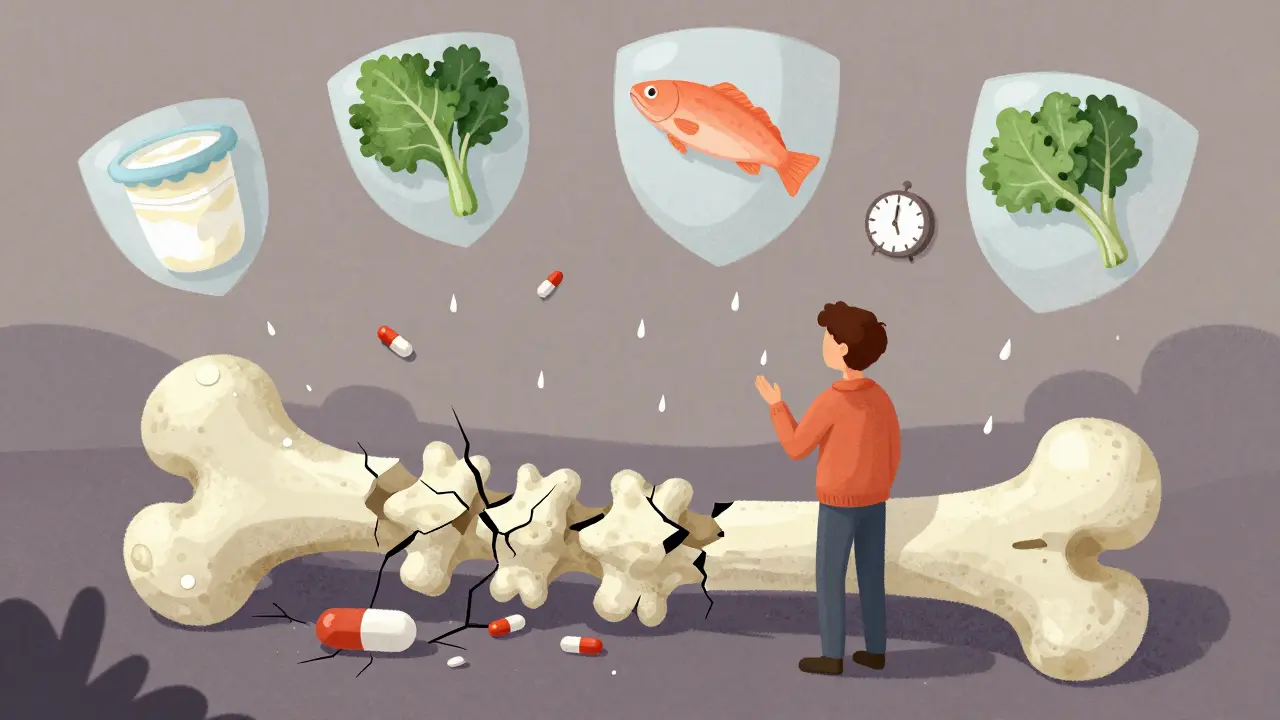
Steroid-Induced Bone Loss Risk Calculator
This tool calculates your risk of bone loss from long-term steroid use based on key factors identified in the article. Early prevention is critical—bone loss starts within weeks of beginning steroids. Click "Calculate" to see your risk level and get personalized recommendations.
Why Long-Term Steroids Can Eat Away at Your Bones
If you’ve been on prednisone or another corticosteroid for more than three months, your bones might be in danger-even if you feel fine. This isn’t a rare side effect. It’s one of the most common and dangerous complications of long-term steroid use. About 30-50% of people taking daily steroids for arthritis, asthma, or autoimmune diseases develop glucocorticoid-induced osteoporosis (GIOP). And the damage doesn’t wait years to show up. Bone loss starts within weeks, with up to 15% of bone density gone in the first year, especially in the spine.
Unlike regular osteoporosis, which creeps in slowly with age, GIOP hits fast. Fracture risk jumps by 70-100% in the first 3 to 6 months of treatment. That’s why waiting until you break a bone to act is like locking the barn after the horse is gone. The good news? You can stop it. But only if you start early and follow a clear plan.
How Steroids Actually Destroy Bone
Steroids don’t just weaken bones-they actively sabotage the cells that build and maintain them. Here’s how it works:
- They shut down osteoblasts, the cells that make new bone.
- They keep osteoclasts alive longer, the cells that break bone down.
- They reduce calcium absorption in your gut by about 30%.
- They make your kidneys dump more calcium into your urine.
- They blunt the effect of weight-bearing exercise, making your workouts 25% less effective for bone strength.
It’s a perfect storm. Your body stops building bone, starts breaking it down faster, and can’t hold onto the calcium it needs. The result? Your spine and hips become fragile. And because bone loss happens so quickly, you can’t afford to wait for symptoms. No pain doesn’t mean no damage.
The Minimum Dose That Triggers Risk
You don’t need high doses to be at risk. The threshold is shockingly low: 2.5 mg of prednisone per day for 3 months or longer. That’s less than half a pill for many people. At this level, your fracture risk begins to climb. Once you hit 7.5 mg daily, your risk doubles. And for every extra milligram you take, your spine loses another 1.4% of bone density each year.
That’s why doctors should never prescribe more than necessary. Reducing your dose from over 7.5 mg to 7.5 mg or below can cut your fracture risk by 35% in just six months. If you’re on steroids long-term, ask: Is this the lowest dose that still controls my condition? Sometimes, switching to a different medication or adding a biologic can help you taper off safely.
What You Must Do Right Now: The Non-Negotiables
There are three things you must do from day one of long-term steroid therapy. No exceptions.
- Get enough calcium and vitamin D - Aim for 1,000-1,200 mg of calcium daily. Get as much as you can from food: yogurt, cheese, fortified plant milks, sardines, kale. If you can’t reach the target through diet, supplement. For vitamin D, take 800-1,000 IU daily. Studies show this combo cuts spine bone loss by almost 2% per year compared to no supplements.
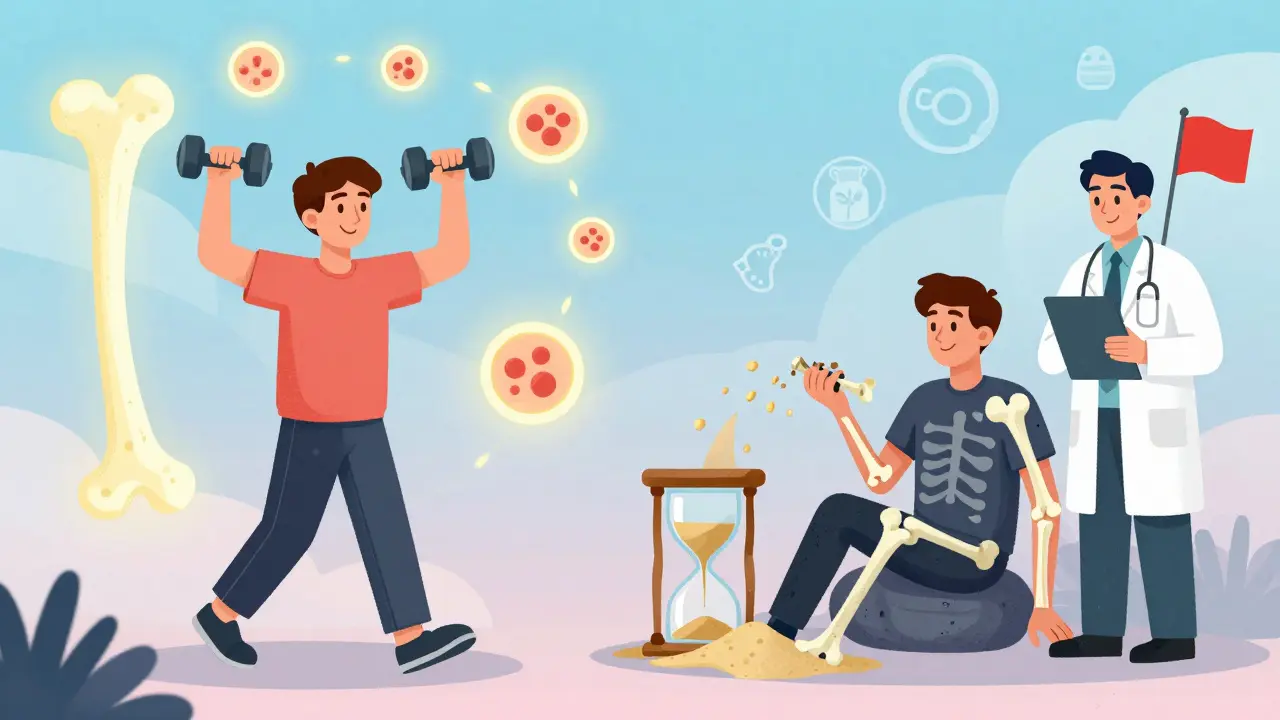
- Movement matters - Walk 30 minutes most days. Lift light weights. Do heel drops or step-ups. Even standing on one foot for 30 seconds helps. Weight-bearing exercise tells your bones to stay strong. But steroids blunt this signal-so you need to be more consistent than ever.
- Quit smoking and limit alcohol - Smoking alone increases fracture risk by 25-30%. Alcohol over 3 units per day (about 2 glasses of wine) makes bone loss worse. If you smoke, get help now. If you drink, cut back. These aren’t "nice-to-haves." They’re survival tools.
When You Need More Than Supplements
If you’re on steroids for more than 3 months and have other risk factors-like being over 50, having a prior fracture, or a family history of osteoporosis-you likely need a prescription.
The first-line treatment? Bisphosphonates. Risedronate (5 mg daily or 35 mg weekly) reduces spine fractures by 70% and other fractures by 41% in steroid users. Alendronate works too. These pills are cheap, effective, and taken orally. But they can upset your stomach. Take them on an empty stomach with a full glass of water, and stay upright for 30 minutes after.
If bisphosphonates don’t work for you, or you can’t tolerate them, here are your alternatives:
- Zoledronic acid - A yearly IV drip. Increases spine bone density by 4.5% in a year.
- Denosumab - A shot under the skin every 6 months. Boosts spine density by 7% in a year.
- Teriparatide - A daily injection that actually builds new bone. Best for severe cases (T-score ≤-2.5) or if you’ve already broken a bone. It increases spine density by 9.1% in a year-more than double what bisphosphonates do.
Teriparatide is powerful, but expensive and only approved for 2 years. It’s not for everyone. But if you’re at high risk, it’s the most effective tool we have.
Why So Few People Get the Right Care
Here’s the ugly truth: Even though we’ve known how to prevent steroid-induced bone loss for decades, only 15% of people on long-term steroids get full, guideline-approved care.
Why? Three big reasons:
- Doctors don’t always think about it. Only 22% of primary care providers feel confident managing this when a patient is seen by a rheumatologist.
- Patients think it’s inevitable. Nearly half believe bone loss from steroids is unavoidable. It’s not.
- Systems don’t remind anyone. In most clinics, no one flags when a steroid prescription hits 3 months. No alert. No order set. No follow-up.
But some places are fixing this. In the U.S. Veterans Affairs system, adding automatic electronic alerts to the EHR when steroids exceed 2.5 mg/day for 3 months pushed prevention rates from 40% to 92%. Pharmacist-led education programs boosted compliance from 35% to 85%. Change is possible. But it takes systems, not just good intentions.
What You Should Ask Your Doctor
Don’t wait for them to bring it up. Be ready with these questions:
- "Am I at risk for bone loss with this dose?"
- "Should I get a bone density scan (DXA) now?"
- "What’s my FRAX score with my steroid dose?"
- "Should I be on a bone medication? Which one and why?"
- "Can we review my steroid dose-is there a way to lower it?"
Insist on a DXA scan at the start of long-term therapy and every 1-2 years after. If your bone density improves by 3-8% after starting treatment, you’re on the right track.
Sticking With It: The Real Challenge
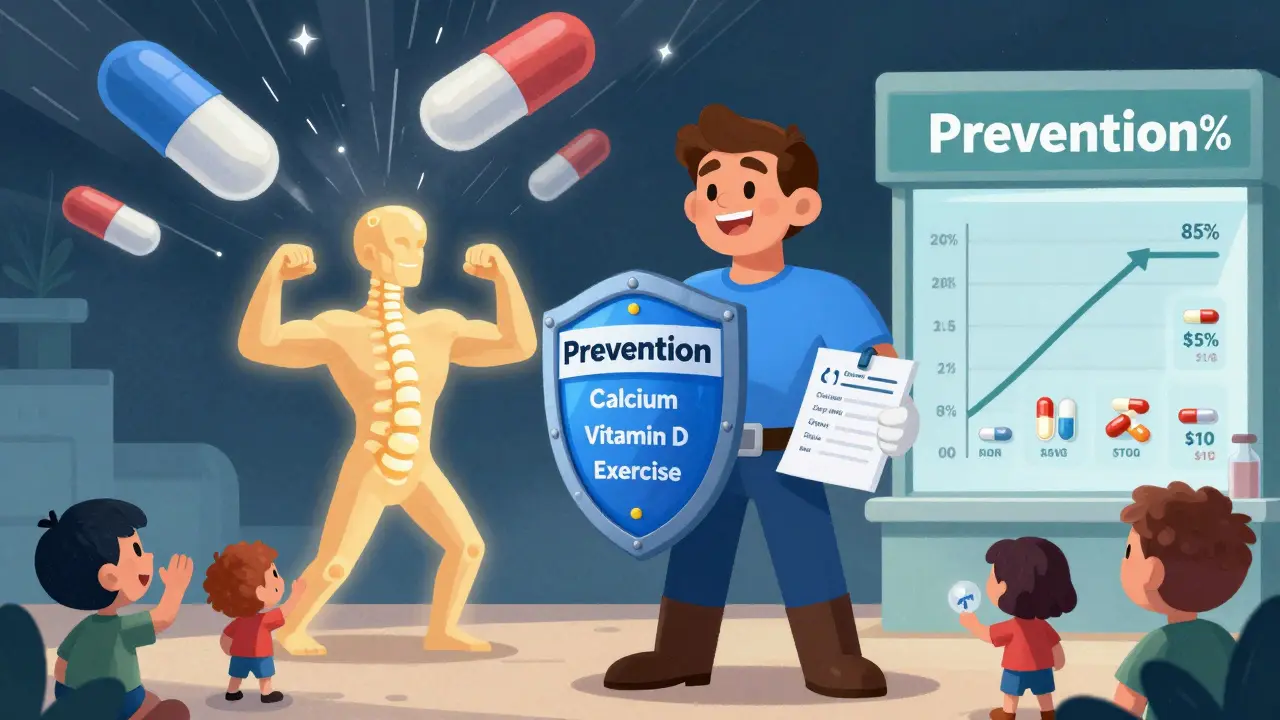
Even when you know what to do, sticking to it is hard. Only 55% of patients remember their fracture risk after being told. Calcium and vitamin D adherence drops to 40% after a year. Bisphosphonate use falls to 45% after 12 months-mostly because of stomach upset.
Here’s how to beat the odds:
- Set phone reminders for your pills.
- Use a pill organizer.
- Keep your supplements next to your toothbrush or coffee maker.
- If bisphosphonates upset your stomach, ask about zoledronic acid or denosumab.
- Find a walking buddy. Make movement social.
One of the biggest mistakes people make? Thinking "I’m not old enough yet." GIOP doesn’t care about age. It cares about dose and duration. If you’re on steroids for 6 months, your bones are aging faster than your calendar.
Final Thought: This Is Preventable
You don’t have to accept broken bones as the price of living with a chronic illness. Steroid-induced osteoporosis is one of the most preventable complications in medicine. But prevention isn’t passive. It’s active. It’s asking questions. It’s taking pills. It’s walking every day. It’s saying no to smoking.
The window to protect your bones opens the moment you start steroids-and it closes fast. Don’t wait for a fracture to wake you up. Start today. Your future self will thank you.
Can I stop my steroids to protect my bones?
No-don’t stop steroids on your own. They’re prescribed to control serious conditions like autoimmune diseases or severe asthma. Stopping suddenly can be life-threatening. Instead, work with your doctor to find the lowest effective dose. Sometimes, adding other medications like biologics can help you reduce or eliminate steroid use safely.
Is a bone density scan (DXA) necessary if I feel fine?
Yes. Bone loss from steroids happens silently. You won’t feel it until you break a bone. The American College of Rheumatology recommends a DXA scan at the start of long-term steroid therapy and every 1-2 years after. This is the only way to know if your bones are thinning and whether your prevention plan is working.
Do I need to take calcium and vitamin D if I eat a healthy diet?
Probably. Even with a healthy diet, most people don’t get enough calcium and vitamin D to counteract steroid damage. Steroids reduce calcium absorption by 30% and increase kidney loss. The recommended daily doses-1,000-1,200 mg calcium and 800-1,000 IU vitamin D-are higher than normal maintenance levels. Supplements are usually needed to reach those targets.
Why is teriparatide only used for 2 years?
Teriparatide stimulates new bone growth, but long-term use increases the risk of rare bone cancers in animal studies. That’s why it’s limited to 2 years total in a lifetime. After that, doctors usually switch to a bisphosphonate or denosumab to maintain the gains. It’s a powerful short-term tool, not a lifelong solution.
Can exercise fully prevent bone loss from steroids?
No. Exercise helps, but steroids blunt its effect by about 25%. Weight-bearing activity is still essential, but it’s not enough on its own. You need calcium, vitamin D, and often medication too. Think of exercise as part of the team-not the whole team.
Are men at risk for steroid-induced osteoporosis too?
Yes-and they’re less likely to get screened. Studies show only 44% of men on long-term steroids receive any bone health intervention, compared to 76% of women. Men are often overlooked, but they lose bone just as fast. Risk isn’t gender-based-it’s dose and duration-based.
What if I can’t afford bisphosphonates or other meds?
Generic risedronate and alendronate are very affordable, often under $10 per month in Australia and the U.S. If cost is still a barrier, talk to your doctor about patient assistance programs, generic alternatives, or IV zoledronic acid, which may be covered under certain insurance plans. Never skip treatment because of cost-unprotected bone loss leads to far more expensive complications like hip fractures.
Next Steps: What to Do Today
If you’re on long-term steroids, here’s your action plan:
- Check your daily prednisone dose. If it’s 2.5 mg or higher for 3+ months, you’re at risk.
- Call your doctor and ask for a DXA scan. Don’t wait.
- Start taking 1,000-1,200 mg calcium and 800-1,000 IU vitamin D daily.
- Walk 30 minutes most days. Add light weights twice a week.
- Quit smoking if you smoke. Limit alcohol to 3 units or less per day.
- Ask: "Should I be on a bone medication?" If yes, get the prescription.
One step today can prevent a lifetime of pain. Don’t delay. Your bones are counting on you.
Comments
pradnya paramita
Glucocorticoid-induced osteoporosis (GIOP) is a well-documented iatrogenic condition with a biphasic bone remodeling imbalance: suppressed osteoblast activity and prolonged osteoclast survival. The 30-50% prevalence rate aligns with meta-analyses from the Journal of Bone and Mineral Research. Early intervention with bisphosphonates (e.g., risedronate) reduces vertebral fracture risk by 70%, per ACR guidelines. Calcium and vitamin D supplementation must exceed dietary intake due to steroid-induced malabsorption and renal wasting. DXA scans at initiation are non-negotiable - T-scores below -1.5 warrant pharmacologic therapy even without prior fracture.
February 2, 2026 at 16:32
caroline hernandez
Reading this felt like someone finally put into words what my rheumatologist kept half-saying. I’ve been on 5mg prednisone for 14 months for lupus, and no one ever mentioned bone density until I asked. Got my DXA scan last month - spine T-score of -2.1. Started risedronate and vitamin D3. Walking every morning now. It’s scary, but I feel like I’m fighting back. You’re not alone. And yes, you CAN protect your bones. 💪
February 3, 2026 at 05:27
Jhoantan Moreira
This is the kind of post that makes me believe in the internet again 🙏. I’m on 7.5mg for RA and was totally unaware how fast the damage happens. Just scheduled my DXA. Also told my doc I’m cutting back on wine - 2 glasses a night was my ‘stress relief.’ Turns out it’s my bone’s worst enemy 😅. Thanks for the clarity. And hey - if you’re reading this and on steroids? Do the 3 things. Your future self will hug you.
February 4, 2026 at 15:59
Joseph Cooksey
Let’s be honest - the medical establishment has been asleep at the wheel for decades on this one. You’re telling me that 85% of patients on long-term steroids aren’t getting proper bone protection? And you want us to believe this is about ‘guidelines’? No. It’s about profit. Bisphosphonates are cheap generics, but the pharma giants make billions off biologics and IV infusions. Meanwhile, patients are left to stumble through this maze while their spines crumble. The VA system’s 92% success rate? That’s because they forced the issue. In private practice? Doctors don’t get paid to prevent - they get paid to treat fractures. This isn’t negligence. It’s systemic corruption dressed in white coats.
February 5, 2026 at 13:32
Meenal Khurana
DXA scan. Now. Don’t wait.
February 6, 2026 at 15:15
Joy Johnston
Thank you for this meticulously researched and clinically accurate breakdown. As a healthcare professional, I can confirm that the data presented here aligns precisely with current ACR and NOF guidelines. The 2.5 mg/day threshold is critical - many clinicians still mistakenly believe only high-dose, long-term use poses risk. The emphasis on non-pharmacologic interventions - particularly weight-bearing activity despite steroid-induced blunting - is essential. Supplement adherence remains the greatest barrier, with studies showing only 38% of patients maintain compliance beyond 12 months. Structured patient education, pill organizers, and pharmacy follow-ups are underutilized but highly effective. This post should be required reading for all prescribers of chronic corticosteroids.
February 8, 2026 at 07:02
Sherman Lee
Okay, but what if the DXA scan is wrong? What if the whole osteoporosis thing is just a scam to sell drugs? I read a guy on TruthSocial who said the bone density machines are calibrated to make people look worse than they are. And what about that study from Sweden that got retracted? And why do they always push bisphosphonates? Because they’re cheap? Or because Big Pharma owns the FDA? I’ve been on 5mg for 2 years and I’m 34 - I don’t feel brittle. Maybe my bones are just stronger than yours. 🤔
February 9, 2026 at 16:11
Daz Leonheart
man i just started 7.5mg last month for my asthma and i had no clue this was even a thing. i’ve been walking every day since reading this. not because i’m scared, but because i wanna feel strong. also started taking my vitamins with my morning coffee - it’s become part of my routine now. no fancy apps, no reminders. just me and my coffee and my bones. we got this.
February 10, 2026 at 21:08
Amit Jain
Simple truth: steroids hurt bones. Calcium + Vitamin D + walk = help. If dose is high or long, ask for medicine. No shame. Bones don’t care how old you are. Do it now. Easy.
February 12, 2026 at 05:04
Keith Harris
Oh wow, another ‘trust your doctor’ propaganda piece. Let me guess - you’re also telling us to take fluoride for ‘stronger teeth’ and get mammograms at 40? The pharmaceutical-industrial complex is laughing all the way to the bank while you swallow your bisphosphonates like obedient sheep. Did you know that 40% of hip fractures occur in people who were taking osteoporosis meds? The drugs don’t prevent fractures - they just delay them until you’re too frail to recover. And don’t even get me started on the jaw necrosis. You think you’re protecting yourself? You’re just becoming a walking billboard for Merck’s quarterly earnings. Wake up.
February 13, 2026 at 22:27
Demetria Morris
It’s irresponsible to tell people to take calcium supplements without first testing their vitamin D levels. Many people are already overloaded - and too much calcium without adequate D can lead to arterial calcification. And why is no one talking about the fact that most Americans are deficient in magnesium, which is critical for bone metabolism? This post reads like a drug rep’s script - full of half-truths and cherry-picked stats. If you’re going to give medical advice, at least be comprehensive. Otherwise, you’re doing more harm than good.
February 14, 2026 at 05:56
Write a comment