
Penicillin Allergy Risk Assessment Tool
Assess Your Penicillin Reaction
Answer a few questions to determine if your reported reaction is likely a true allergy or a side effect.
Your Risk Assessment
Enter your information above and click 'Assess My Risk' to see your result.
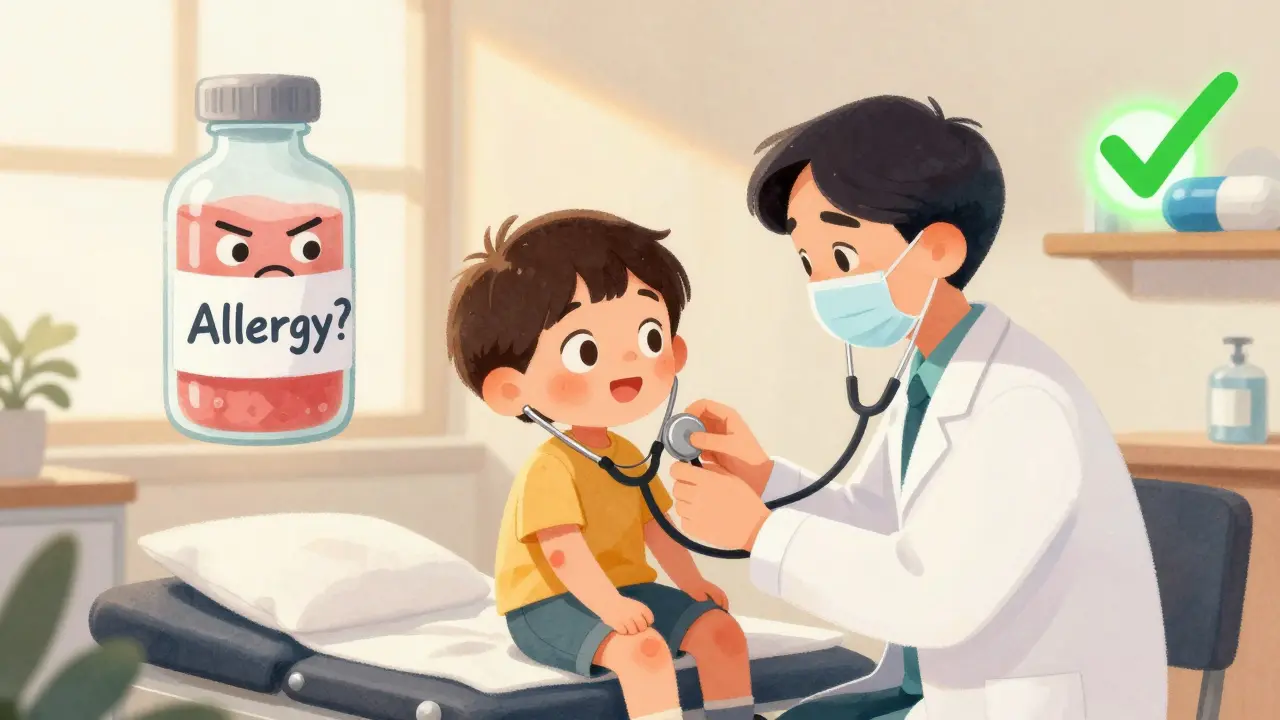
More than 10% of people in the U.S. say they’re allergic to penicillin. But here’s the surprising truth: penicillin allergy is often misdiagnosed. Most of those people aren’t truly allergic at all. They’re confusing side effects-common, harmless reactions-with real immune system responses. And that mistake is costing lives, money, and effective treatment.
What’s the real difference between an allergy and a side effect?
A true penicillin allergy means your immune system mistakes the drug for a threat and attacks it. That’s an IgE-mediated reaction. It can happen within minutes to an hour after taking the drug. Symptoms? Hives, swelling of the face or throat, trouble breathing, wheezing, or even a sudden drop in blood pressure. These are serious. They need immediate treatment-epinephrine, oxygen, hospital care.
Side effects? Those are not immune reactions. They’re just how your body reacts to the chemical. Nausea? Common. Diarrhea? Happens in 1-2% of people. Vaginal yeast infections? A known side effect of antibiotics killing off good bacteria. Headache? Possible. These don’t mean your body is attacking penicillin. They’re uncomfortable, sure, but not dangerous in the way an allergy is.
Here’s the catch: people often label a rash from a virus as a penicillin allergy. If you took penicillin while sick with mono or another virus and broke out in a rash, that’s not an allergy. It’s the virus. But that label sticks. And once it’s in your chart, doctors avoid penicillin-even if you haven’t taken it in 20 years.
Why does mislabeling matter so much?
If you’re labeled allergic to penicillin, your doctor won’t give you penicillin. They’ll pick something else-often a broader-spectrum antibiotic like clindamycin, vancomycin, or a fluoroquinolone. These drugs are more expensive. They’re harder on your gut. And they increase your risk of dangerous infections like C. diff.
According to CDC data, patients with a mislabeled penicillin allergy are twice as likely to get a C. diff infection. That’s not just uncomfortable-it can be life-threatening. One study found patients with fake penicillin allergies had 6 more deaths per 1,000 hospital stays than those who could safely take penicillin.
Costs add up too. A 2018 JAMA study showed that mislabeling adds about $1,000 per hospital admission. That’s because broader antibiotics cost more, hospital stays get longer, and complications pile up. Across the U.S., this mistake contributes to $20 billion in extra healthcare spending every year.
Most penicillin allergies aren’t real-here’s the proof
Here’s the shocking part: only about 1% of people who say they’re allergic to penicillin actually are. That means over 30 million Americans think they’re allergic. But only 330,000 of them have a confirmed, true IgE-mediated reaction.
Why the gap? Because most reactions were never properly tested. A rash at age 7? A stomach ache after a course of amoxicillin? Those get labeled as allergies without any lab work. And they stay on your record forever.
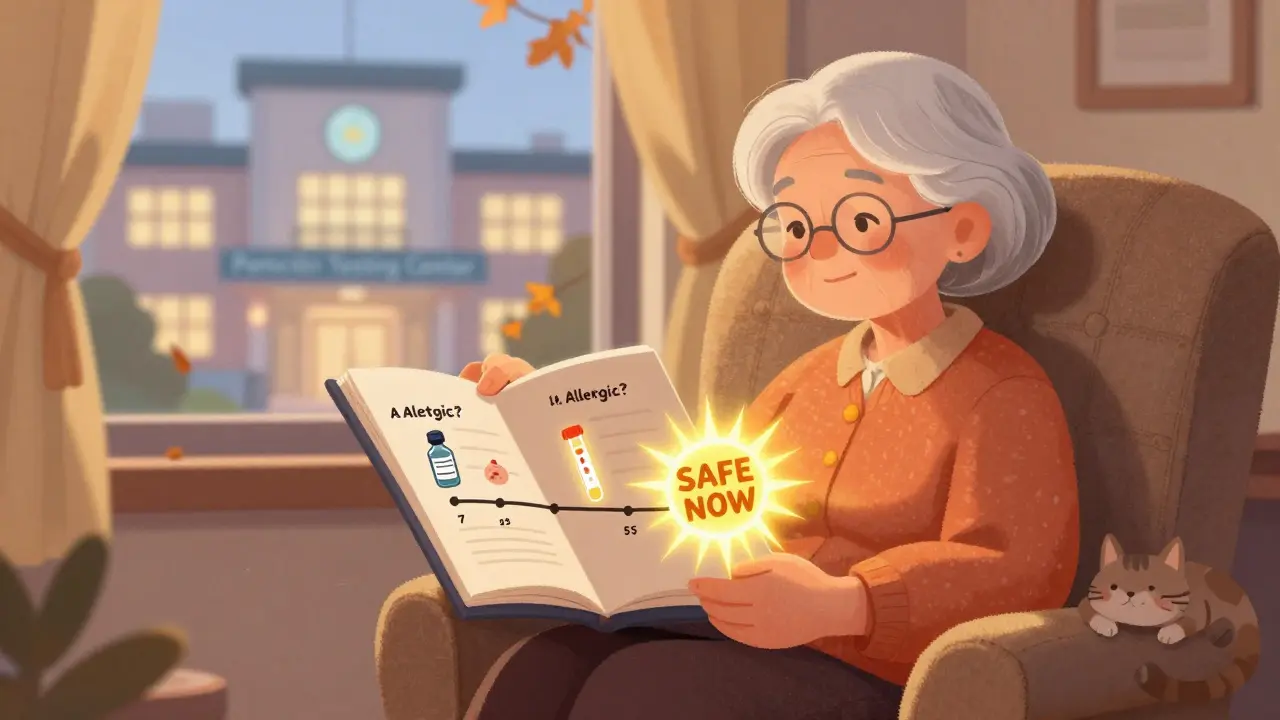
Even more telling: 80% of people who had a true penicillin allergy 10 years ago no longer have it. Your immune system forgets. The antibodies fade. You’re no longer allergic. But unless you get tested, you’ll keep avoiding penicillin-and all the risks that come with avoiding it.
How do you know if you’re really allergic?
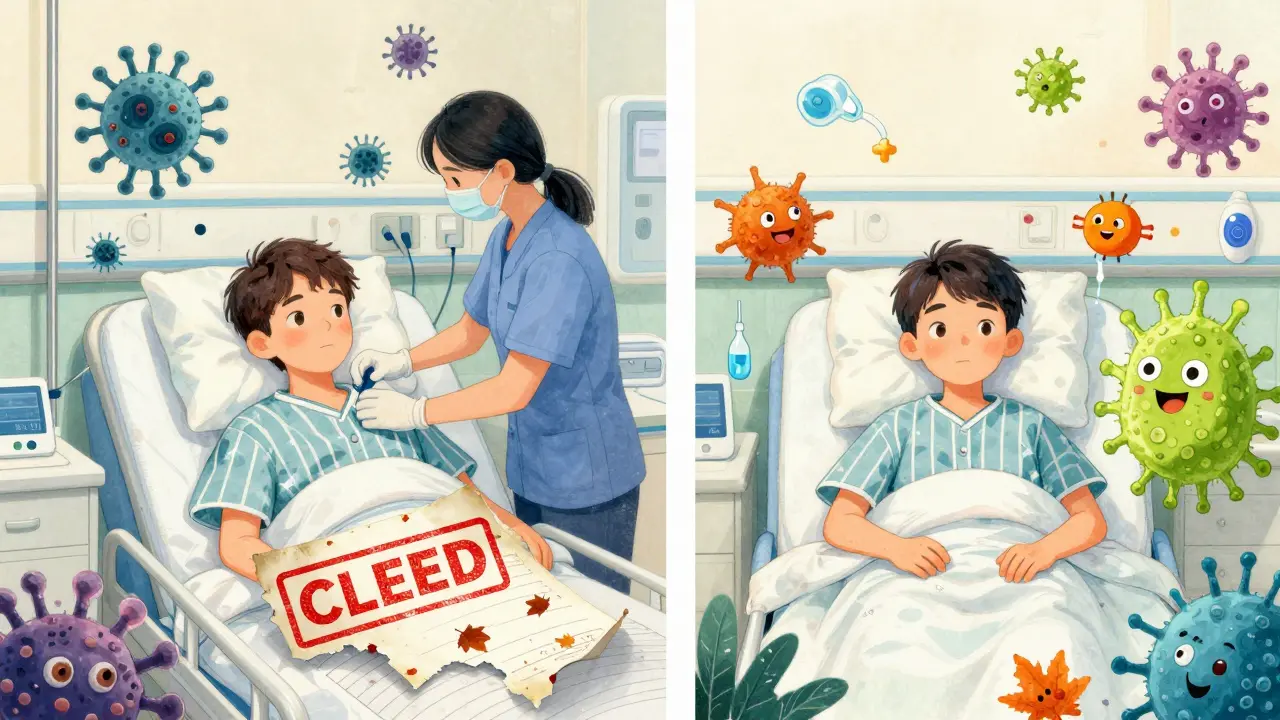
There’s a clear, safe, three-step process doctors use to find out:
- History review - Your doctor asks detailed questions: When did it happen? What were the symptoms? Did you need epinephrine? Was it within an hour? Did you have swelling or trouble breathing? Tools like PEN-FAST help score your risk. If your reaction was mild, delayed, or happened more than 10 years ago, you’re likely low-risk.
- Skin testing - A tiny amount of penicillin (and its breakdown products) is placed under your skin. If you’re allergic, you’ll get a red, itchy bump within 15-20 minutes. This test is over 95% accurate.
- Oral challenge - If skin testing is negative, you’re given a small dose of amoxicillin under supervision. You’re watched for an hour. If nothing happens, you’re cleared. No more allergy label.
At the Mayo Clinic, over 50,000 people went through this process between 2015 and 2022. Only 2.3% ended up with a confirmed allergy. The rest? They were cleared. No reactions. No problems.
What if you had a serious reaction in the past?
If you had anaphylaxis-swelling, breathing trouble, collapse-you should still be cautious. Those cases are rare, but real. You’ll need testing by an allergist. Don’t try to test yourself. But even then, many people who had severe reactions years ago can safely take penicillin again after proper evaluation.
And here’s something most people don’t know: penicillin skin testing isn’t just for adults. Kids can be tested too. If your child had a rash after amoxicillin, don’t assume it’s an allergy. Get it checked.
Why aren’t more people getting tested?
It’s not because the test doesn’t work. It’s because most doctors don’t offer it.
A 2022 study found only 39% of primary care doctors knew that delayed rashes are rarely true allergies. Many still think any rash = allergy. Pharmacies don’t offer testing. Insurance doesn’t always cover it. And patients are scared.
One survey found 32% of people refused testing because they were afraid they’d have a reaction. But here’s the kicker: 99.2% of those who did the test had no reaction at all. The fear is worse than the risk.
Some hospitals are fixing this. Kaiser Permanente runs a pharmacist-led program that tests 15-20 patients a week. They’ve de-labeled 92% of low-risk patients. No serious events. Huge cost savings.
What’s changing in 2026?
Things are shifting fast. The CDC and HHS are pushing hard on this issue. In 2023, the U.S. government gave $8.7 million to fund de-labeling programs. Medicare now pays 37% more for penicillin skin testing. Hospitals that don’t address allergy mislabeling will lose money starting in 2025, because value-based payment programs now track how often patients get the right antibiotic.
Electronic health records like Epic now have built-in tools that flag patients with allergy labels and suggest testing. A smartphone app called PAAT, cleared by the FDA in 2022, helps doctors quickly assess risk. It’s 94% accurate at spotting who needs testing.
By 2026, expect to hear your doctor say: “You’ve been labeled allergic to penicillin. Let’s check if that’s still true.” It’s becoming as routine as checking your blood pressure.
What should you do now?
If you’ve ever been told you’re allergic to penicillin:
- Don’t assume it’s true.
- Look at your medical records. What was the reaction? Was it a rash? Nausea? Or trouble breathing?
- Ask your doctor: “Can I be tested to confirm this allergy?”
- If your doctor says no, ask for a referral to an allergist.
- Don’t wait. If you’ve avoided penicillin for 10+ years, your allergy is likely gone.
Getting tested isn’t risky. Not getting tested is. Every time you take a stronger, costlier, less effective antibiotic because of a label that might be wrong, you’re putting yourself at higher risk-for infection, for side effects, for longer hospital stays, even for death.
Penicillin is one of the safest, most effective antibiotics ever made. It’s not dangerous. The fear of it is.
Ask for the test. Clear your record. Take back your health.
Comments
Anjula Jyala
Penicillin allergy misdiagnosis is a systemic failure rooted in lazy clinical documentation and poor patient education. IgE-mediated reactions are rare but well-defined. Most rashes are viral exanthems coinciding with antibiotic use. The immune system doesn't remember non-IgE reactions. Yet we carry these labels like scars. This isn't just medical error-it's institutional inertia. 80% of true allergies fade. We're overtreating and under-testing. The cost isn't just financial. It's biological. C. diff mortality spikes because we avoid narrow-spectrum agents. The data is clear. The solution is simple. Why aren't we acting?
January 26, 2026 at 17:06
Murphy Game
They're lying. This is all part of the pharmaceutical agenda. Penicillin is cheap. They want you on the expensive ones. The CDC? Controlled by Big Pharma. The 'testing' is just a way to upsell you on allergist visits and lab fees. That '99.2% no reaction' stat? Manufactured. They don't want you to know penicillin can still cause long-term microbiome damage. They just want you hooked on their next-gen antibiotics. Watch what happens after 2026. More forced testing. More surveillance. This isn't medicine. It's control.
January 27, 2026 at 03:58
John O'Brien
Bro. I had a rash after amoxicillin at 8. Got labeled allergic. Never got tested. Last year I got pneumonia. Docs gave me azithromycin. Cost me $1,200. Took me 3 weeks to recover. I could've had penicillin. 3 days. $40. I'm getting tested next week. If you think you're allergic? Stop assuming. Get checked. It's not scary. It's just common sense. Your body forgets. Your chart doesn't. Fix it.
January 28, 2026 at 04:04
Kegan Powell
It’s wild how we treat medical labels like tattoos when they’re more like sticky notes 🤔 We hold onto 'allergy' like it’s a truth carved in stone but it’s just a note from a 7-year-old’s rash. The immune system is fluid. It adapts. It forgets. We’re the ones who don’t. And now we’re paying with longer hospital stays, worse infections, and more $$$ for drugs that wreck our guts. Maybe the real allergy is to change. To asking 'what if we’re wrong?' 🌱 Let’s stop treating medicine like a spreadsheet and start treating it like a living system. We’re not broken. We’re just mislabeled.
January 28, 2026 at 19:57
Desaundrea Morton-Pusey
Why are we even talking about this? America has the best healthcare in the world. If you're allergic, you're allergic. Stop trying to fix what isn't broken. Other countries don't do this nonsense. We're overtesting, overanalyzing, and wasting money on 'de-labeling' programs that just give doctors more paperwork. Penicillin is old. New drugs are better. Let people take what they're prescribed. End of story.
January 30, 2026 at 00:35
Andrew Clausen
The claim that 80% of penicillin allergies resolve after 10 years is statistically misleading. The original study cohort was not randomized. It excluded patients with prior anaphylaxis. The oral challenge protocol lacks standardization across institutions. Furthermore, the 2.3% confirmed allergy rate at Mayo Clinic reflects selection bias-only low-risk patients were referred. Without universal skin testing and double-blind placebo controls, the conclusion is not evidence-based. The data is not as clean as presented.
January 31, 2026 at 10:25
Kirstin Santiago
Hey, if you’ve ever been told you’re allergic to penicillin, I get it. I was too. I was scared to even say the word out loud. But I got tested last year after my mom got C. diff from an 'alternative' antibiotic. Turns out I was never allergic. Just had a stomach bug and a rash. The test took 45 minutes. No drama. No pain. Just a nurse and a tiny prick. Now I feel like I got my health back. You don’t have to be brave. Just curious. Ask your doctor. They’ll help. You’re not alone in this.
February 1, 2026 at 16:08
Kathy McDaniel
i had the rash thing too like 15 yrs ago and never thought twice abt it but now i read this and im like wait… maybe i should check? i dont wanna get sick again and be stuck on some crazy expensive antibiotic. im gonna ask my doc next time. thanks for the nudge 🙏
February 3, 2026 at 09:02
Paul Taylor
Let’s be real. The reason this isn’t fixed isn’t because doctors don’t know. It’s because the system doesn’t reward it. Hospitals get paid for prescribing broad-spectrum antibiotics. Labs make money on testing. Insurance denies coverage unless you jump through 17 hoops. And patients? They’re tired. They just want to get better. So they take what’s handed to them. We’re not dealing with ignorance. We’re dealing with incentives. Until the payment model changes, until EHRs auto-flag and auto-refer, until testing is bundled and free and automatic-this will keep happening. The science is settled. The system is broken. Fix the system first. The people will follow.
February 3, 2026 at 17:18
Write a comment