

When you buy a medical device, a prescription drug bottle, or even a smart insulin pump, you don’t think about the factory where it was made. You assume it’s perfect. But behind every product, there’s a chain of decisions, machines, and people - and right now, that chain is under more stress than ever. In 2025, 93% of U.S. manufacturers said quality wasn’t just important - it was mission-critical. But here’s the twist: the same companies that say quality is everything are also the ones struggling the most to deliver it.
Quality Isn’t Just a Process - It’s a Promise
Brands don’t sell products. They sell trust. And trust is built on consistency. When a patient opens a pill bottle and finds a tablet with a crack, or a nurse plugs in a glucose monitor that gives inconsistent readings, they don’t blame the user. They blame the brand. That’s brand psychology in action: the emotional contract between a company and its customer. One slip-up doesn’t just cost a sale - it costs loyalty. In 2025, the ZEISS U.S. Manufacturing Insights Report found that 44% of manufacturers listed rising material costs as their top concern. But right behind it? The cost of rework - 38%. That means for every 100 units made, nearly 40 are flawed enough to be thrown back into production. That’s not just waste. It’s a broken promise. And customers feel it - even if they don’t know why.The Skills Gap Is the Silent Killer
You can buy the most advanced 3D metrology system in the world. You can install AI-powered inspection software that spots defects invisible to the human eye. But if no one knows how to use it, it’s just expensive decoration. 47% of manufacturers say the biggest hurdle to quality isn’t technology - it’s people. There’s a growing gap between older workers who learned quality control with calipers and micrometers, and younger hires who expect real-time dashboards and automated alerts. On Reddit’s r/Manufacturing forum, 87% of respondents said their biggest frustration was inconsistent data between departments. One production manager wrote: “We’re expected to maintain aerospace-grade precision while moving at consumer electronics speed.” That’s not a technical problem. It’s a cultural one. And brands that ignore it are setting themselves up for failure. A medical device company in Ohio spent $2.3 million on automated inspection tools - but didn’t train their team. Within a year, error rates went up 40%. The machines were flawless. The people weren’t.Technology Alone Won’t Save You
There’s a dangerous myth floating through manufacturing floors: if we buy the right tech, quality will fix itself. It won’t. The truth? Manufacturers using integrated systems - where inspection data flows directly into production scheduling, supplier tracking, and customer feedback loops - see 22% lower rework costs and 18% faster time-to-market. But 61% still struggle with legacy systems that don’t talk to each other. Data silos are the new dirt. And they’re hiding defects. Cloud-based Quality Management Systems (QMS) are now the standard. In 2025, 68% of new enterprise deployments used them - up from 52% just two years ago. Why? Because they let a factory in Michigan and a supplier in Mexico share the same quality rules in real time. That’s not just efficiency. That’s control. And control builds trust. But here’s the catch: 54% of users on Capterra reported integration took longer than expected. That’s not a glitch. It’s a warning. If your tech rollout feels like a hostage situation - with IT, production, and quality teams locked in separate rooms - you’re not fixing quality. You’re adding layers of confusion.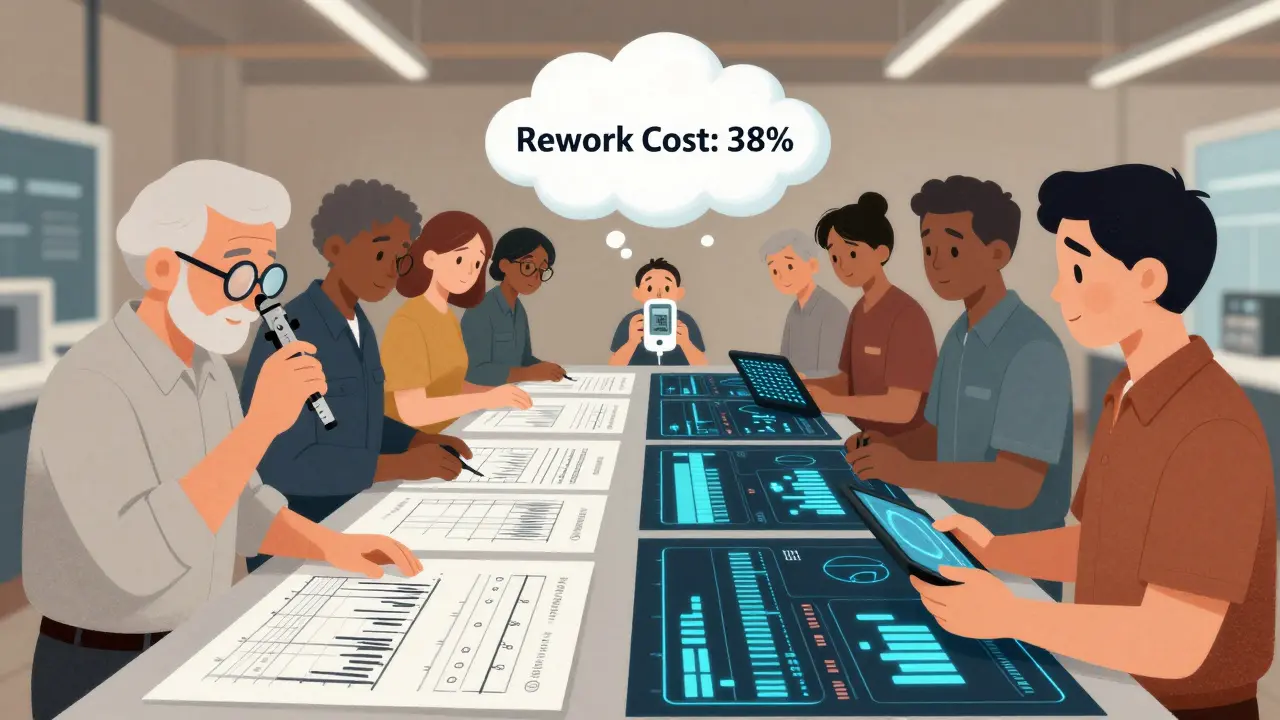
The Regulatory Pressure Cooker
In healthcare, quality isn’t optional. It’s enforced. In 2025, 63% of manufacturers said compliance documentation got harder than the year before. New FDA guidelines, EU MDR updates, and global sustainability mandates mean every batch, every material, every calibration log must be traceable - down to the serial number. Aerospace and medical device makers lead the pack, with 78% and 72% adoption of advanced quality tech, respectively. But even they’re stretched thin. One device maker in California reduced rework costs by $1.2 million a year by using precise metrology to cut material waste. But they had to rebuild their entire quality team to do it. That’s the cost of compliance - not just in money, but in time, training, and trust. Meanwhile, general manufacturers - those making consumer goods, appliances, or non-critical components - are falling behind. Only 48% have adopted advanced tools. That’s not just risky. It’s a branding liability. If your product is used alongside medical devices or in a hospital setting, consumers will assume your quality is just as high. And when it isn’t? They don’t blame the supplier. They blame the brand on the box.What Happens When Quality Fails
Think about the last time you bought something that broke after a week. You didn’t call the factory. You called customer service. You left a bad review. You told your friends. You avoided that brand next time. That’s brand psychology. One quality failure doesn’t just cost a return. It costs a relationship. And in 2026, customers have more choices than ever. They can switch to a competitor who uses AI-driven quality analytics to guarantee fewer defects. One automotive supplier saw a 37% improvement in defect detection after switching to AI inspection. Their customer retention jumped 21% in six months. Manufacturers who wait to act are playing Russian roulette. Forrester Research predicts that by 2027, companies that delay investing in predictive quality analytics will have 23% higher defect rates than early adopters. That’s not a future risk. It’s a current disadvantage.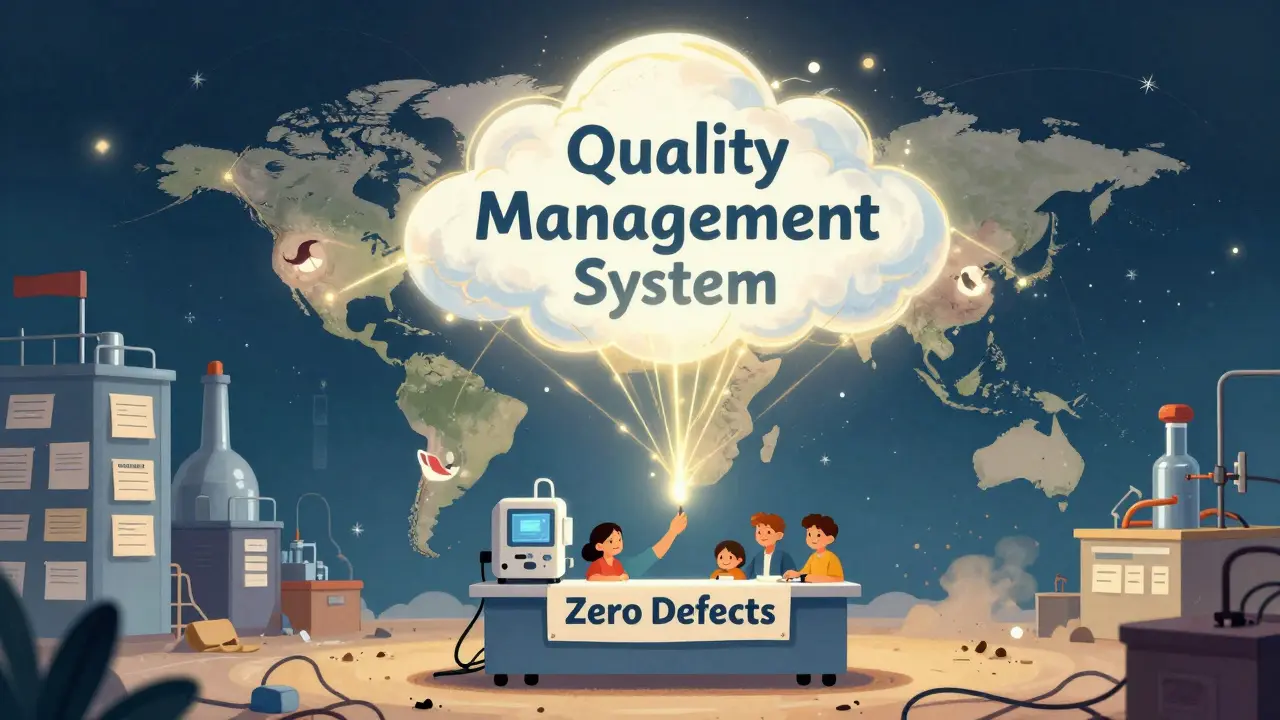
The Path Forward: Quality as Strategy, Not a Cost Center
The best manufacturers don’t treat quality as a department. They treat it as a core business function. They align quality metrics with customer feedback. They train their teams on both old-school inspection and new AI tools. They build cross-functional teams - quality engineers, IT, production - from day one of any tech rollout. They don’t buy technology to impress investors. They buy it to protect their reputation. And it works. Companies that treat quality as strategic see 28% higher profit margins by 2030, according to Deloitte. They don’t just avoid recalls. They earn loyalty. They turn customers into advocates. The fear isn’t that quality is hard. The fear is that we’re pretending it’s not broken - while the world moves on without us.What You Can Do Right Now
If you’re a brand owner, a supply chain manager, or even a consumer who cares about what’s in your medicine cabinet, here’s what matters:- Ask your supplier: “How do you measure quality - and how do you prove it?”
- Look for certifications that require real-time data tracking - not just paper logs.
- Support brands that publish transparency reports on their quality processes.
- Push back when you see products rushed to market without visible quality assurances.
Comments
Terri Gladden
ok but like… i just bought a glucose monitor last month and it gave me a reading that was off by 40 points?? i called customer service and they said ‘oops, must’ve been a glitch’?? like??? i’m not a glitch, my blood sugar is not a glitch, and now i’m scared to use it??
January 4, 2026 at 13:22
en Max
It is imperative to recognize that the systemic dissonance between technological investment and human capital development constitutes a critical vulnerability in contemporary manufacturing ecosystems. The misalignment of operational workflows, compounded by inadequate upskilling initiatives, engenders a latent risk profile that transcends mere rework metrics-it undermines the foundational covenant of consumer trust.
January 6, 2026 at 01:17
Jacob Milano
Man, I love how this post nails it. It’s not about fancy robots or AI magic-it’s about the person who’s actually holding the caliper, staring at a screen that doesn’t make sense, and just wants to do their job right. We’re treating factories like video games where you just upgrade your gear and boom, problem solved. Nah. You gotta train the people, not just the machines.
January 6, 2026 at 13:28
Allen Ye
There’s a deeper existential tension here, one that mirrors the broader collapse of institutional trust in late capitalism. The factory floor, once a cathedral of craftsmanship, has been reduced to a data stream-a performance metric on a dashboard, stripped of its human soul. We optimize for output, not integrity. We quantify defects, but not dignity. And when the patient opens that cracked pill, they’re not just seeing a manufacturing flaw-they’re seeing the erosion of a social contract that once promised safety, reliability, and care. We’ve outsourced morality to algorithms, and now we’re surprised when the algorithm doesn’t care.
January 7, 2026 at 20:46
mark etang
Quality must be institutionalized as a core strategic pillar, not treated as a peripheral operational function. Organizations that fail to align leadership incentives with quality KPIs are setting themselves up for catastrophic reputational failure. Proactive investment in integrated QMS platforms is not optional-it is existential.
January 8, 2026 at 03:34
Brendan F. Cochran
So let me get this straight-American factories are failing because we’re letting foreigners run the machines? I bet if we just fired half the HR department and hired more veterans, this whole mess fixes itself. Also, who the hell lets a ‘supplier in Mexico’ have access to our quality rules? That’s not collaboration, that’s surrender.
January 8, 2026 at 16:19
jigisha Patel
While your analysis is superficially compelling, it fails to account for the heterogeneity of global manufacturing standards. The 44% material cost metric is misleading without normalization by GDP per capita. Furthermore, the reliance on Capterra user reviews as a proxy for system efficacy is methodologically unsound. The sample is self-selected, non-representative, and lacks statistical rigor. Your conclusion is premature.
January 9, 2026 at 19:49
Jason Stafford
They’re using AI to hide the truth. The FDA, Big Pharma, and the factory owners are all in on it. The ‘defects’? They’re intentional. They want you to keep buying new devices because the old ones ‘fail’ on purpose. The real cost of rework? It’s not money-it’s control. You think your insulin pump is safe? It’s programmed to fail every 18 months. They need you dependent. Wake up.
January 10, 2026 at 21:10
Justin Lowans
I’ve seen this play out in three different plants over the last decade. The ones that succeed? They treat quality like gardening-you don’t just plant seeds and walk away. You water, you prune, you listen to the soil. The tech helps, sure-but it’s the daily check-ins, the open-door policy between floor and office, the shared pride in a batch that passed with zero rework-that’s what turns good factories into great ones.
January 12, 2026 at 07:45
Michael Rudge
Oh wow, a 28% profit margin increase? How revolutionary. I guess the only reason any of this matters is because someone finally put a dollar sign in front of ‘doing the right thing.’ We didn’t need a 10,000-word essay to tell us not to ship broken products. We just needed someone with a conscience. Or a board meeting.
January 13, 2026 at 01:01
Ethan Purser
Every single person who works in manufacturing right now is just one bad day away from a nervous breakdown. They’re told to do more with less, then blamed when the machines break or the data doesn’t sync. And the worst part? No one in corporate has ever touched a screwdriver. They’re all just scrolling through dashboards, thinking they’re saving the world. Meanwhile, the guy who noticed the crack in the pill bottle? He got yelled at for ‘slowing down the line.’
January 13, 2026 at 02:50
Doreen Pachificus
I work in a lab that uses these devices. We don’t know how they’re made. We just know when they don’t work. And honestly? We don’t ask. We just swap them out. But I’ve seen three in the last year that gave false readings. One almost killed a patient. We just assumed it was user error. Maybe it wasn’t.
January 14, 2026 at 10:49
Cassie Tynan
So we’re supposed to believe that a $2.3 million machine is ‘flawless’ but the people aren’t? That’s like saying a Ferrari is perfect but the driver’s just bad at driving. Maybe the problem isn’t the driver. Maybe the problem is you gave them a Ferrari… and a bicycle helmet.
January 15, 2026 at 03:27
Rory Corrigan
we’re all just trying to survive in a system designed to break us. the machines don’t care. the managers don’t care. the customers don’t care until it’s their kid’s medicine that’s cracked. and then? they blame the brand. but the brand didn’t make it. someone did. and no one’s listening to them. 😔
January 15, 2026 at 07:45
Write a comment