
Statin Rechallenge Risk Calculator
This tool uses the SAMS-CI (Statin Associated Muscle Symptoms - Clinical Index) to assess your risk of successfully restarting statin therapy after experiencing muscle symptoms. Based on clinical evidence, patients with a low SAMS-CI score have a 91% chance of tolerating a rechallenge.
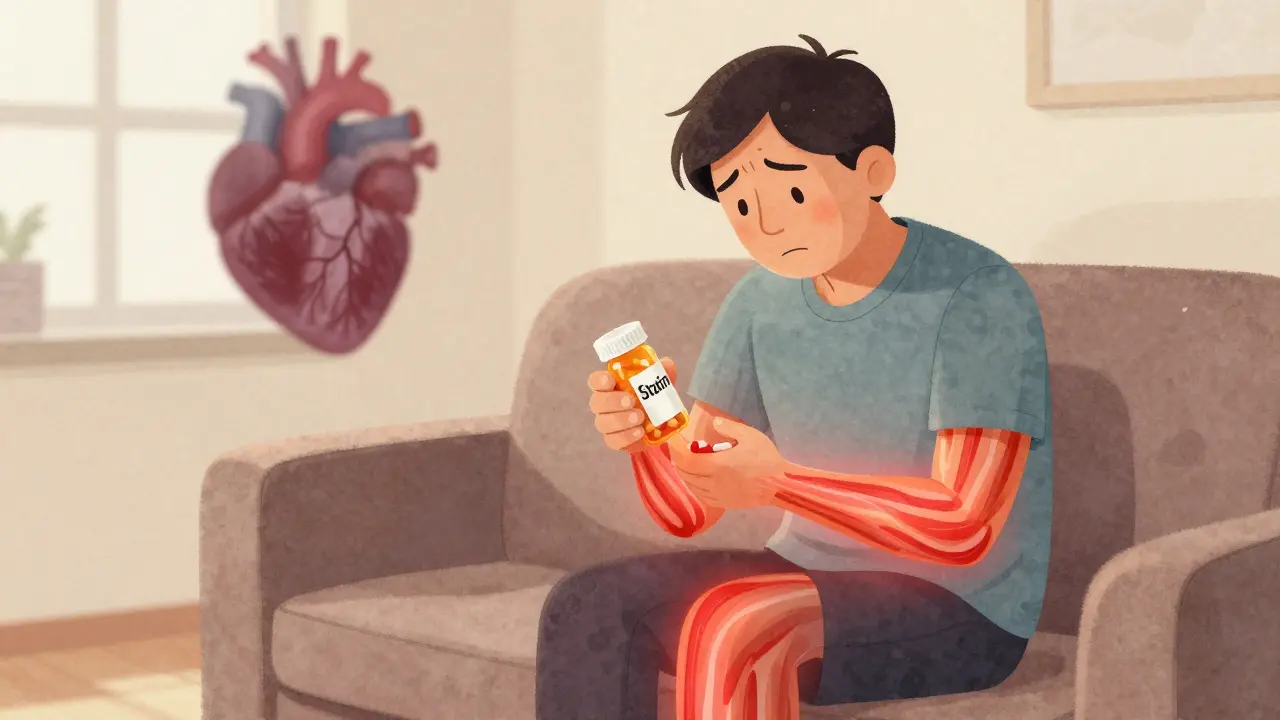
When muscle pain hits after starting a statin, it’s hard not to panic. You’ve been told these pills save lives - but now your legs ache, your arms feel weak, and your doctor says to stop. You’re not alone. About 7 to 29% of people on statins quit because of muscle symptoms. But here’s the truth: most of those symptoms aren’t even caused by the statin. And if you stop forever, you’re putting yourself at higher risk for a heart attack or stroke.
What Really Causes Statin-Induced Myopathy?
Statin-induced myopathy isn’t one thing. It’s a spectrum. At the mild end, you might feel soreness or fatigue - the kind that shows up after a long walk or a new workout. At the severe end, you get rhabdomyolysis: muscle breakdown so extreme your creatine kinase (CK) levels spike over 40 times the normal limit. That’s rare - less than 0.1% of users. But even mild muscle pain can scare people off statins for good.
The problem? Many of these symptoms aren’t from the drug. A major 2018 American Heart Association review looked at 12 trials with over 100,000 patients. In double-blind studies, muscle pain happened just as often in people taking a sugar pill as in those taking statins. That’s the nocebo effect - your brain expects side effects, so you feel them. But that doesn’t mean the pain isn’t real. It just means the cause might not be the statin.
True statin myopathy usually shows up in the first year, especially if you’re over 70, female, have kidney issues, or are on other drugs like gemfibrozil. That combo can jack up your risk of rhabdomyolysis by more than tenfold. And if you test positive for anti-HMGCR antibodies? That’s immune-mediated necrotizing myopathy - a real autoimmune reaction. You need steroids, not another statin.
Why Rechallenge Matters More Than You Think
Stopping statins isn’t a neutral choice. Atherosclerotic plaques don’t wait. A 2022 review found that even four weeks off statins can make plaques unstable. That’s when heart attacks happen - not years later, but soon after treatment stops.
And the cost? Generic statins cost $4 to $10 a month. PCSK9 inhibitors like evolocumab? Around $5,850. That’s not just a financial burden - it’s a barrier for most people. But here’s the kicker: if you can get back on a statin, your risk of heart events drops by 28% compared to staying off them entirely, according to the 2022 REDUCE-IT follow-up.
Yet a 2021 survey found 73% of patients who quit statins due to muscle pain were never offered a plan to try again. That’s a gap in care. And it’s fixable.
The MEDS Approach: A Step-by-Step Plan
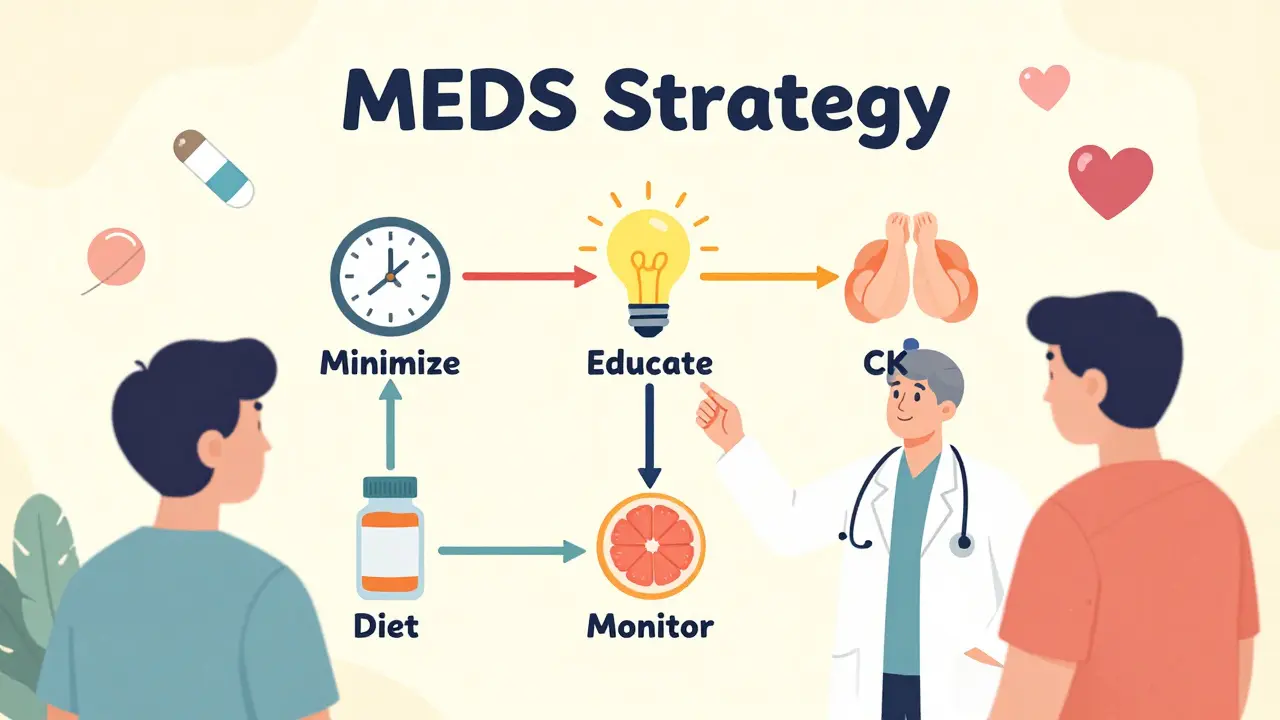
The International Lipid Expert Panel created the MEDS strategy - and it works. It’s not guesswork. It’s a protocol.
- Minimize time off: Don’t wait months. If symptoms fade, restart in 2 to 4 weeks. That’s the window most patients recover in.
- Education: Know the difference between nocebo and real toxicity. Understand that muscle pain alone doesn’t mean you’re intolerant. Your doctor should explain this - clearly.
- Diet and nutraceuticals: Coenzyme Q10 doesn’t have strong proof, but vitamin D deficiency can worsen muscle pain. Check your levels. Also, avoid grapefruit juice with certain statins. It’s a known interaction.
- Systematic monitoring: Check CK and symptoms at 2 and 4 weeks after restarting. Don’t just assume it’s fine.
This isn’t theory. In a 2023 American Heart Association Support Network survey, 62% of patients who used a structured rechallenge plan stayed on statins long-term. The key? They didn’t just try the same dose again.
Rechallenge Strategies That Actually Work
Not all statins are equal. Some are easier on muscles than others.
Switch statins: If you had trouble with simvastatin or atorvastatin, try pravastatin or fluvastatin. They’re less likely to cause muscle issues. In patient reports, switching from simvastatin to pravastatin worked for 41% of those who succeeded.
Lower the dose: Go from 40mg to 20mg. Or even 10mg. A 2021 Reddit thread shared: “After stopping atorvastatin 40mg due to pain, I restarted at 10mg. Zero issues after six months.” That’s common.
Try every-other-day dosing: This isn’t a hack - it’s evidence-backed. Studies show it maintains LDL-lowering while cutting muscle side effects. It works best with longer-acting statins like atorvastatin or rosuvastatin. One patient wrote: “I take 20mg every other day. My muscles feel fine. My cholesterol is still under control.”
Use the SAMS-CI tool: Developed by Dr. Christie Ballantyne, this clinical index scores your risk of true statin intolerance. It looks at your symptoms, timing, and medical history. If your score is low, you have a 91% chance of tolerating a rechallenge. Ask your doctor to use it. Only 43% of primary care docs do - but lipid clinics use it 85% of the time.
When Rechallenge Isn’t the Answer
There are times you shouldn’t try again.
- If you had rhabdomyolysis (CK >40x ULN) - don’t restart. The risk is too high.
- If you’re anti-HMGCR antibody positive - this is an autoimmune disease. You need immunosuppressants, not more statins.
- If you’ve tried three different statins at low or intermittent doses and still have pain - it’s time to consider alternatives.
For these cases, PCSK9 inhibitors are the gold standard. They’re injectable, given every two weeks, and cut LDL by 50-60%. The FOURIER and ODYSSEY trials showed they reduce heart attacks and strokes by 15-17% in high-risk patients. They’re expensive, yes - but many insurance plans cover them if you’ve tried and failed statins.
Ezetimibe is another option. It’s a pill that lowers LDL by 15-20%. It’s cheap and safe, but it doesn’t have the same outcome data as statins or PCSK9 inhibitors. It’s often used as an add-on, not a replacement.
What to Do If Your Doctor Won’t Help
Too many patients are told, “It’s just in your head,” or “Try it again - you’ll be fine.” That’s not care. That’s dismissal.
If your doctor won’t use the SAMS-CI or offer a rechallenge plan, ask for a referral to a lipid specialist. These are doctors trained in cholesterol management. They see this every day. They know how to balance risk and tolerance.
Also, check your genetic profile. The SLCO1B1 gene affects how your body clears statins. If you have the *5/*5 variant, your risk of muscle side effects from simvastatin jumps by 222%. Testing isn’t routine - but if you’ve had repeated issues, it’s worth asking.
Real Stories, Real Outcomes
One woman in Brisbane, 68, stopped her statin after severe leg cramps. She was terrified. Her cardiologist used the SAMS-CI - her score was low. They switched her to pravastatin 10mg every other day. Two months later, her CK was normal. Her LDL was 72. She’s been on it for two years.
A man in his 50s had three failed attempts. He switched from rosuvastatin to fluvastatin, then tried every-other-day dosing. Still no luck. He ended up on evolocumab. His LDL dropped from 180 to 58. He says: “I hated the shots at first. But now I’d rather inject than be in pain.”
These aren’t outliers. They’re the rule when you use the right strategy.
Final Takeaway: Don’t Give Up on Statins Too Soon
Statin intolerance is real - but it’s rarer than you think. Most people can get back on a statin with the right approach. You don’t have to choose between muscle pain and heart disease. There’s a middle path.
Start by asking: Did I have a true reaction? Was my CK checked? Did I try a different statin? Did I use a lower dose or alternate-day dosing? Did I get help from a specialist?
If you’ve been told to quit statins forever, ask for a second opinion. Your heart isn’t just a pump - it’s your life. And statins, when used right, are still the best tool we have to protect it.
Comments
Robyn Hays
Okay but have we talked about how the nocebo effect is basically your brain playing horror movies on loop when you take a pill? I used to swear simvastatin wrecked my quads until I did a blind restart with placebo and realized I was tensing up before I even swallowed it. Mind = blown. And yeah, switching to pravastatin was like swapping a sledgehammer for a feather. Still lowers my LDL like a champ. 🙌
December 28, 2025 at 03:36
Liz Tanner
I’m so glad this post exists. My doc just told me to ‘tough it out’ when I said my legs felt like lead. No CK test, no switch options, nothing. I finally found a lipid specialist who used the SAMS-CI tool and switched me to every-other-day rosuvastatin. Two months in and I can actually walk up stairs again. It’s not magic-it’s just good medicine that doesn’t get shared enough.
December 29, 2025 at 00:51
Babe Addict
LMAO at the ‘MEDS’ acronym. This is just pharmaceutical marketing dressed up as science. Statins are basically synthetic cholesterol blockers that mess with your mitochondrial function-period. The whole ‘nocebo’ thing is a cop-out for Big Pharma to keep people on toxic drugs. And don’t even get me started on PCSK9 inhibitors-those are just glorified biologics with a $6k price tag to line the pockets of shareholders. Real medicine is diet, fasting, and movement. Not pills you swallow because you’re scared of a number.
December 29, 2025 at 11:04
Satyakki Bhattacharjee
Why do people trust pills more than their own body? God gave us natural ways to clean blood. Eat less sugar. Walk more. Pray. Statins are not from nature. They are chemical tricks. Your heart is not a machine to be fixed with drugs. It is a gift. Stop poisoning yourself for a number on a screen.
December 30, 2025 at 21:59
Anna Weitz
I’ve been on statins for 8 years and never had an issue until last year when I started feeling like my bones were dissolving. I didn’t stop because I was scared-I stopped because my doctor didn’t listen. Now I’m off and my energy is back. I don’t care what studies say. My body knows better than any journal. If you’re telling me to try again after that? I’d rather die of a heart attack than go back to that feeling.
January 1, 2026 at 12:39
Jane Lucas
just tried the every other day thing with atorvastatin 10mg and holy crap it worked. no more leg cramps at night and my ldl is still at 82. why does no one tell you this is an option? my dr acted like i was asking to turn into a vampire
January 3, 2026 at 09:53
Elizabeth Alvarez
Have you ever wondered if statins are just part of a larger agenda? The CDC, the AMA, the pharmaceutical lobby-they all push these drugs because they make money. But what if muscle pain is your body screaming that something’s wrong with the whole system? What if the real problem is processed food, stress, and sitting all day? And what if the real solution isn’t another pill but a complete lifestyle overhaul that no one wants to talk about because it doesn’t sell? I’ve seen people reverse plaque with keto and walking. Statins are a Band-Aid on a bullet wound.
January 5, 2026 at 04:54
Miriam Piro
They want you to believe it’s ‘just nocebo’ so you’ll keep taking the drug and not ask why you’re so tired all the time. I’ve seen too many people go from ‘I feel fine’ to ‘I can’t climb stairs’ to ‘I can’t get out of bed’ after statins. And now they’re telling you to try again? With a different brand? Like it’s a flavor of ice cream? The system is rigged. The SAMS-CI tool? That’s just another gatekeeping tool so only rich people with lipid specialists get to ‘rechallenge.’ Meanwhile, the rest of us get told to ‘push through’ while our muscles atrophy and our mitochondria die. 😔
January 5, 2026 at 17:50
dean du plessis
Been on pravastatin 20mg every other day for 18 months now after three failed attempts. My CK was through the roof before. Now I hike every weekend and my cholesterol is solid. It’s not about being brave or weak-it’s about finding what works for your body. And yeah, your doc might not know this stuff. But you can learn it. And you can ask. Just don’t give up. Your heart will thank you
January 6, 2026 at 08:11
Write a comment