
What Are Secondary Patents?
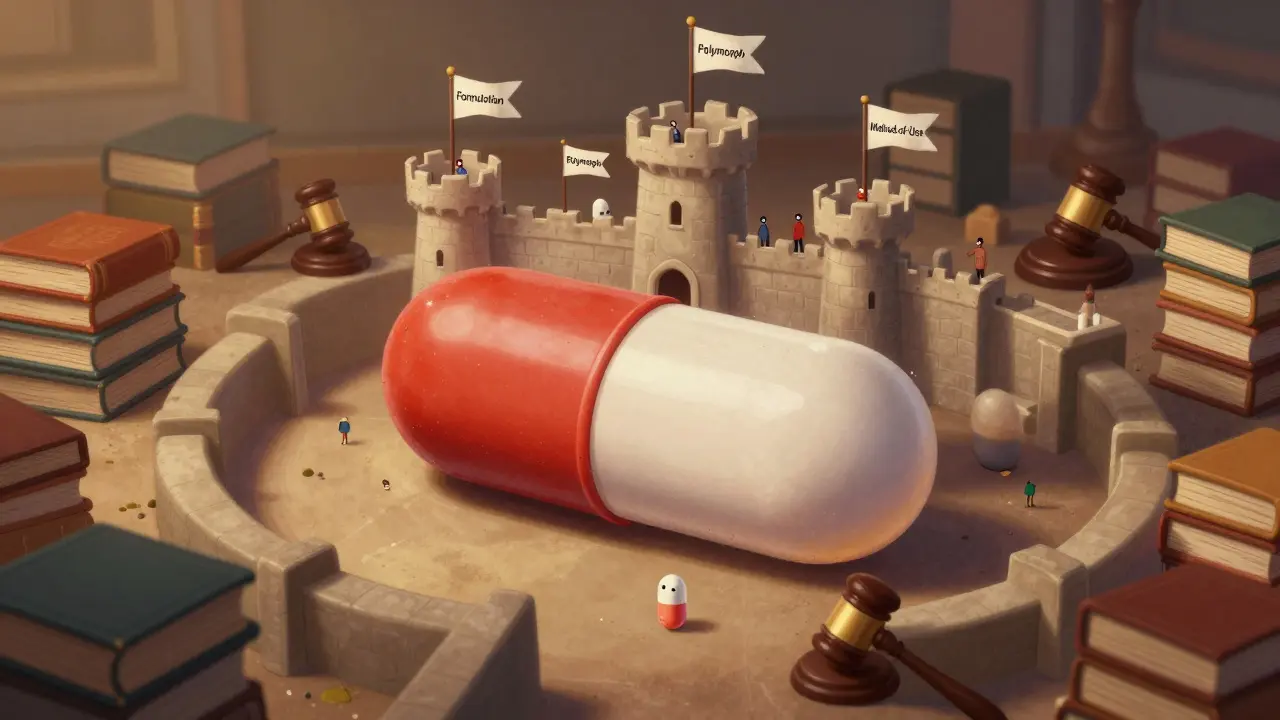
Secondary patents aren’t about the medicine itself-they’re about how it’s made, taken, or used. While the primary patent protects the active chemical ingredient (like ibuprofen or metformin), secondary patents cover everything else: the shape of the pill, the time it releases the drug, the way it’s mixed with other chemicals, or even a new disease it can treat. These aren’t new drugs. They’re tweaks. But in the pharmaceutical world, those tweaks can mean billions in extra revenue.
Take Nexium. Its active ingredient, esomeprazole, was originally part of Prilosec. Prilosec’s primary patent expired in 2001. But AstraZeneca had already patented the single-enantiomer version-esomeprazole-as a new compound. That’s a secondary patent. Even though it’s chemically almost identical, the FDA allowed it to be listed as a new drug. Sales of Nexium jumped to $5 billion a year, while generic Prilosec flooded the market. The difference? One patent, extended by eight years.
How Secondary Patents Work
Pharmaceutical companies file secondary patents at every stage of a drug’s life. Some are filed before approval. Others come years later, after the drug is already on the market. The goal? Delay generic competition as long as possible.
There are over a dozen types of secondary patents recognized globally. The most common ones include:
- Formulation patents: Protect how the drug is delivered-slow-release tablets, liquid suspensions, patches. AstraZeneca’s Nexium is one example.
- Method-of-use patents: Cover new conditions the drug can treat. Thalidomide was originally a sleep aid. Later, it got patents for leprosy and multiple myeloma.
- Polymorph patents: Protect different crystal structures of the same molecule. GlaxoSmithKline used this to delay generics for Paxil by four years after the main patent expired.
- Combination patents: Cover a drug paired with another. For example, a blood pressure pill that combines two active ingredients into one tablet.
- Prodrug patents: Protect a version of the drug that turns into the active form inside the body.
These aren’t just legal tricks. They’re strategic moves built into the business model. Companies spend $12-15 million per secondary patent application. They hire teams of patent lawyers, scientists, and marketers to coordinate timing. The goal? Launch the new version just before the old one goes generic.
The Patent Thicket Strategy
One drug doesn’t have one secondary patent. It has dozens. Sometimes over a hundred.
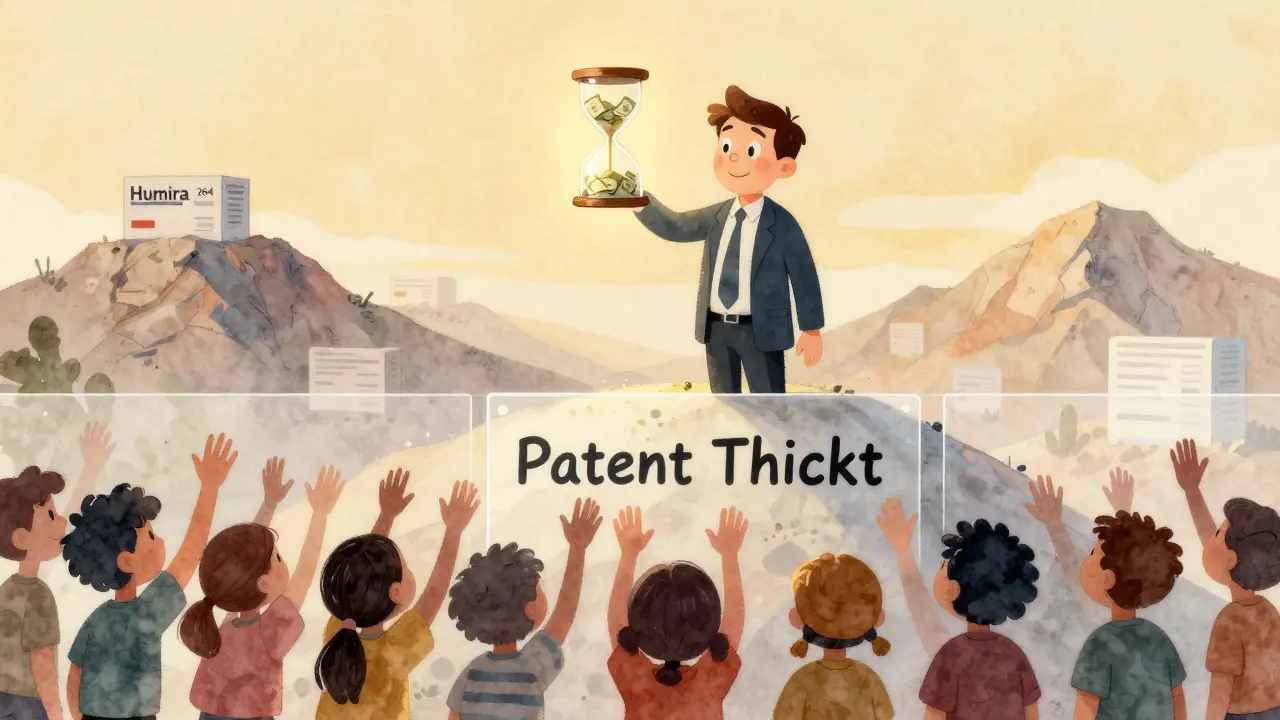
Humira, AbbVie’s blockbuster arthritis drug, had 264 secondary patents by 2023. The primary patent expired in 2016. But because of the thick wall of secondary patents-covering delivery devices, dosing schedules, manufacturing methods-generic versions couldn’t enter until 2023. During that time, Humira generated $20 billion in annual sales. Without those patents, generics would have cut prices by 80% within months.
This is called a “patent thicket.” It’s not one patent blocking competition. It’s a maze. Generic manufacturers have to challenge each one in court. Each challenge costs $15-20 million. Many run out of money before they get to the end.
The FDA’s Orange Book lists only certain types of patents-mainly formulation and method-of-use. But companies keep dozens of others hidden. These are “reserve patents,” filed just in case a generic challenger clears the listed ones. It’s like having backup keys to a locked door.
Who Benefits? Who Pays?
The pharmaceutical industry says secondary patents drive innovation. They point to improved safety, easier dosing, fewer side effects. The American Cancer Society credits secondary patents for reducing chemotherapy side effects by 37% in some cases.
But critics call it “evergreening.” A 2016 Harvard study found only 12% of secondary patents delivered real clinical improvements. The rest? Minor changes that don’t help patients-but keep prices high.
Patients pay the price. Pharmacy benefit managers like Express Scripts say secondary patents raise their costs by 8.3% each year. Doctors report “product hopping”-when companies push patients to switch to the new version right before generics hit. One California physician told Medscape: “Patients get confused. They think the new pill is better. It’s not. It’s just more expensive.”
And it’s not just patients. Governments pay too. Medicare and Medicaid spend billions more because of delayed generics. The 2022 Inflation Reduction Act in the U.S. started letting Medicare challenge some secondary patents. It’s a sign things are changing.
Global Differences: What’s Allowed Where
Not every country lets pharmaceutical companies play this game the same way.
In the U.S., the Hatch-Waxman Act of 1984 created the system that made secondary patents possible. It gave brand-name companies 30 months of automatic delay if a generic challenged a patent. That’s why U.S. drug prices stay high.
India doesn’t. Section 3(d) of its 2005 patent law says: no patent for a new form of an old drug unless it shows significantly better effectiveness. Novartis tried to patent a new crystal form of Gleevec. India rejected it. Generic versions hit the market in 2011. The drug cost $2,600 a month in the U.S. In India? $200.
Brazil requires health ministry approval before a patent can be enforced. The European Union demands “significant clinical benefit” for some secondary patents. These rules aren’t perfect, but they keep prices lower.
That’s why companies file secondary patents everywhere-but only enforce them where the rules let them.
The Future of Secondary Patents
Secondary patent filings have grown 7.2% a year since 2010. But pressure is mounting.
Courts are getting stricter. In 2023, the Federal Circuit ruled in Amgen v. Sanofi that broad antibody patents were too vague. That could limit future secondary patent claims.
Regulators are watching. The European Commission’s 2023 Pharmaceutical Strategy targets patent thickets as a barrier to generic access. The WHO says secondary patents are the top legal reason generic medicines are delayed in 68 low- and middle-income countries.
Some experts predict a shift. By 2027, companies may need to prove their secondary patents actually improve patient outcomes-not just extend profits. That could mean fewer low-value patents and more real innovation.
For now, though, the system still favors the big players. Pfizer alone holds over 14,200 active secondary patents. The top 10 drugmakers control 73% of them.
It’s not illegal. It’s just the rules as they stand. And until those rules change, brands will keep using secondary patents to stretch exclusivity-long after the original invention has run its course.
How Generic Manufacturers Fight Back
Generic companies don’t sit idle. They file what’s called a Paragraph IV certification when they challenge a listed patent. In 2022, 92% of secondary patents in the FDA’s Orange Book got challenged.
But winning is hard. Only 38% of those challenges succeed in court. Why? Because the burden of proof is on the generic company. They have to show the patent is invalid-either because it’s obvious, or it wasn’t invented, or it’s too broad.
Some generics team up. Others wait. They let the first challenger go to court. If they lose, they wait for the next opportunity. It’s a long game. One company told the Generic Pharmaceutical Association: “We don’t try to beat every patent. We wait for the one that cracks.”
What Patients Should Know
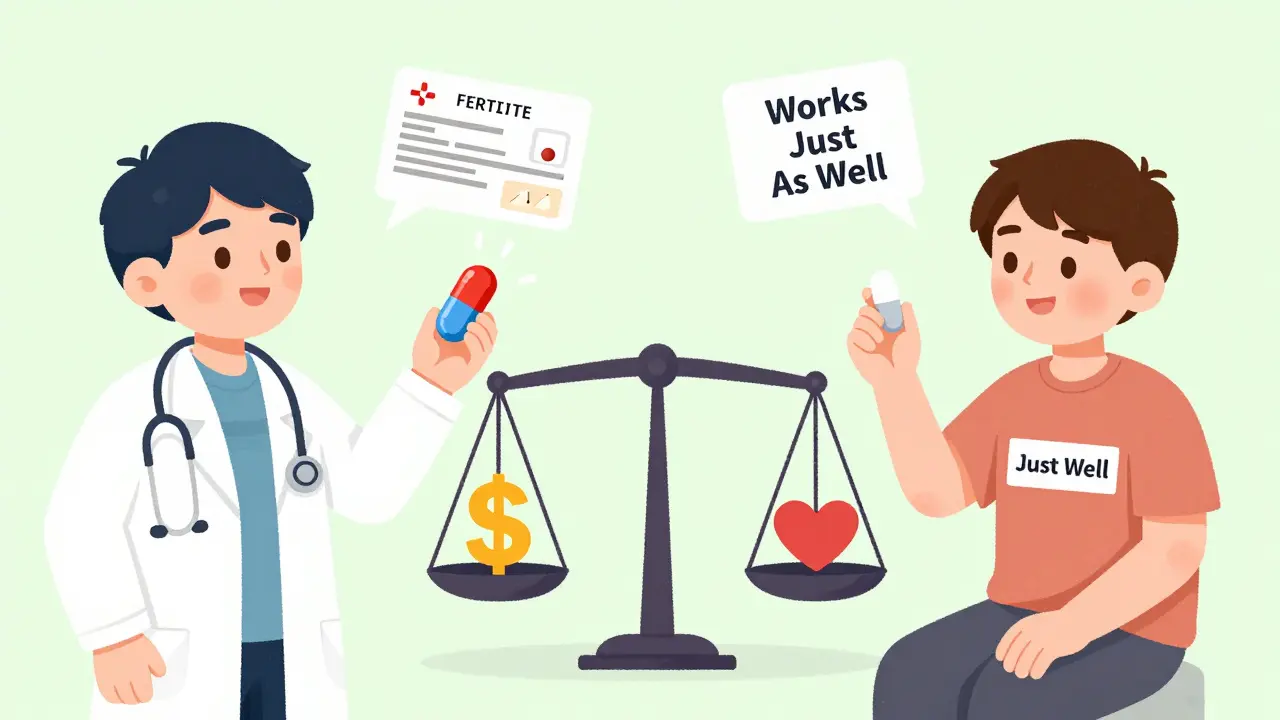
If your doctor prescribes a new version of a drug you’ve been taking-ask why. Is it better? Or just newer? Is it covered by insurance? Or is it more expensive because the old one just went off-patent?
Many times, the old generic still works just fine. The new version might be slightly easier to swallow. But it won’t cure more. It won’t work faster. It’s just protected by another patent.
Ask your pharmacist if a generic version is available. Ask your insurer if they cover the cheaper option. You’re not being difficult. You’re being informed.
Comments
Helen Leite
so like... the pharma giants are just playing monopoly with our meds?? 😱💊 they patent the COLOR of the pill now?? i swear i saw a commercial where they said "new improved formula" and it was literally the same chemical with a different shape. we're being ROBBED. #pharmabrainwash
January 23, 2026 at 12:21
Izzy Hadala
The structural and functional distinctions between primary and secondary patents are codified under 35 U.S.C. § 101 et seq., yet the application of these doctrines has deviated significantly from statutory intent. The strategic filing of polymorph and formulation patents constitutes a form of regulatory arbitrage, wherein patent term extension is leveraged to circumvent the public interest provisions of the Hatch-Waxman Act. This represents a systemic failure of the USPTO’s examination protocol.
January 24, 2026 at 22:36
Elizabeth Cannon
yall realize this is why your insulin costs $300?? 🤦♀️ i had to switch from brand to generic because my insurance dropped coverage, and guess what? the generic worked just fine. same chemistry, same results. but the company spent millions on a patent for a "new delivery system" that just made the pill glow in the dark (ok not really but it feels like it). we need to call this out. it’s not innovation, it’s exploitation. #pharmabullshit
January 26, 2026 at 00:30
Gina Beard
The illusion of progress masks the erosion of access. Innovation, when commodified, ceases to serve. It merely sustains.
January 26, 2026 at 15:43
Phil Maxwell
I didn’t even know this was a thing until I read this. Kinda wild how much legal tech is behind something so simple like a pill. I just take mine and don’t think about it. But now I’m kinda curious how many patents are on my blood pressure med...
January 28, 2026 at 08:15
Shelby Marcel
so wait… nexium is just prilosec but like… the fancy version?? and they got away with it?? i feel like my doctor’s been selling me upgradess for 10 years and i didn’t even know it 😅
January 28, 2026 at 19:48
blackbelt security
This isn’t about drugs. It’s about control. The system is designed to keep you dependent. They don’t want you cured. They want you subscribed.
January 30, 2026 at 13:55
Patrick Gornik
Ah, the sacred ritual of evergreening-where intellectual property morphs into a corporate sacrament. The patent thicket isn’t a legal construct; it’s a necromantic incantation, summoning monopoly rents from the corpse of innovation. These aren’t patents-they’re feudal fiefdoms, carved into the marrow of public health by mercenaries in pinstriped suits. And the FDA? A complicit court jester, nodding as the pharmakon becomes a pharmakos. The real drug here? Profit. The real disease? Capitalism.
January 30, 2026 at 23:47
Karen Conlin
Hey everyone-just wanted to say if you’re on meds and wondering if you should switch to generic, DO IT. Seriously. I used to take the brand-name version of my antidepressant because I thought it was "better." Turns out? Same exact molecule. The only difference? I was paying $200/month instead of $12. My therapist told me to ask my doctor about generics. I was so embarrassed I didn’t know this sooner. You’re not being cheap-you’re being smart. And if your doctor pushes the new version right when the old one goes generic? Ask them if they get kickbacks. It’s not rude. It’s your right.
January 31, 2026 at 15:20
asa MNG
ok but like… what if the new version has a different coating so it doesn’t give you acid reflux?? 😳 i had a bad reaction to the old one and the new one fixed it. so maybe it’s not ALL just money?? also i think the guy who wrote this is just salty because he can’t afford his meds. #firstworldproblems
February 1, 2026 at 09:13
Sushrita Chakraborty
In India, Section 3(d) of the Patents Act, 1970, as amended in 2005, explicitly prohibits evergreening by requiring enhanced therapeutic efficacy for new forms of known substances. The rejection of Novartis’s application for the β-crystalline form of imatinib mesylate in 2006 was a landmark decision, affirming public health over corporate exclusivity. This legal framework, though imperfect, remains a vital bulwark against patent abuse in the Global South.
February 1, 2026 at 09:25
Sawyer Vitela
92% of secondary patents get challenged? 38% success rate? That’s not a system. That’s a tax on generics.
February 2, 2026 at 14:38
Shanta Blank
THEY’RE TURNING MEDICINE INTO A LUXURY BRAND. NEXIUM? MORE LIKE NEXIUM: THE $5 BILLION GLOW-UP. 🤡 I swear if they patent the emoji on the pill packaging next, I’m moving to Canada. Who even came up with this? A corporate villain in a movie?? No. This is real life. And we’re the ones paying for the sequel.
February 3, 2026 at 19:10
Dolores Rider
i just found out my grandma’s heart med has 47 patents on it. 47. and she’s 82. and they’re telling her it’s "the best one." but the generic costs $5. i think they’re poisoning us on purpose. like… what if the side effects are designed to keep us buying more pills?? 😳 i’m not crazy. i’ve read the documents.
February 5, 2026 at 16:07
venkatesh karumanchi
This is why I believe in open-source medicine. If knowledge is power, then patents are the chains. India showed the world it’s possible to put people before profit. Maybe one day, we’ll all see medicine as a human right-not a corporate asset.
February 5, 2026 at 22:47
Write a comment