
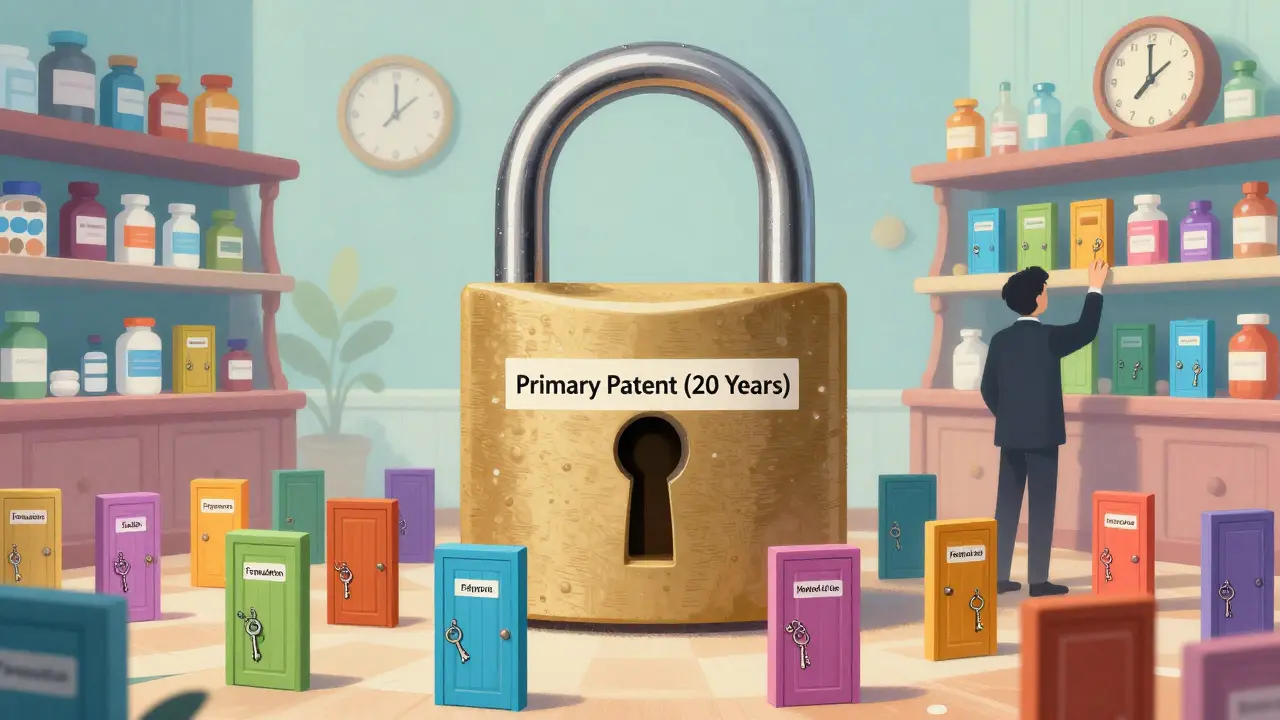
When a drug first hits the market, the company behind it gets a 20-year patent on the active ingredient. That’s the primary patent. But by the time the drug is approved and on shelves, five or six years might already have passed. That leaves just 14 to 15 years of real market control. So what do big pharmaceutical companies do? They file secondary patents-dozens of them-to keep generics off the shelves long after the original patent expires.
What Exactly Are Secondary Patents?
Secondary patents aren’t about the drug’s core chemical. They protect things like how it’s made, how it’s taken, or even what it’s used for. Think of them as legal side doors. The main door-the active ingredient-is locked after 20 years. But if you’ve got 20 other doors around it, each with its own key, you can keep people out for decades. These patents cover things like:- Formulations: A pill that releases medicine slowly instead of all at once
- Polymorphs: Different crystal structures of the same molecule
- Salts and esters: Chemical tweaks to improve absorption
- Combination therapies: Mixing two drugs into one pill
- Method of use: Patenting a new disease the drug can treat
Take Nexium. It’s the single-enantiomer version of Prilosec. Prilosec’s patent expired in 2001. But AstraZeneca had already patented esomeprazole-the purified form-and kept sales high for another eight years. The drug wasn’t more effective. It was just a slightly different version of the same thing.
How They Delay Generic Drugs
The FDA keeps a public list called the Orange Book. It includes patents that generic companies must legally challenge before they can sell their versions. But here’s the trick: companies don’t list every patent. They list only the ones they think will cause trouble. The rest? They’re hidden. These are called “reserve patents.” When a generic company files to sell a copy of a drug, they have to check every patent listed in the Orange Book. If they miss one, they risk a lawsuit. So they wait. And wait. And sometimes, they never get around to it. A 2019 study in Health Affairs found that drugs with secondary patents faced generic entry delays that were 2.3 years longer than drugs without them. For blockbuster drugs, that’s billions in lost revenue.The Patent Thicket Strategy
Pfizer, Merck, AbbVie-they don’t file one or two secondary patents. They file hundreds. Take Humira. Its primary patent expired in 2016. But AbbVie had filed 264 secondary patents around it. These covered everything from how the drug is stored to how it’s administered. Generic companies didn’t just need to prove their version was safe and effective. They had to fight through 264 legal roadblocks. By 2023, Humira still had no real competition in the U.S. Its annual sales hit $20 billion. That’s money that could’ve gone to cheaper generics. Instead, it went to legal teams. Drug Patent Watch found that in 2023, the average branded drug had more than 100 patents covering it. That’s not innovation. That’s legal engineering.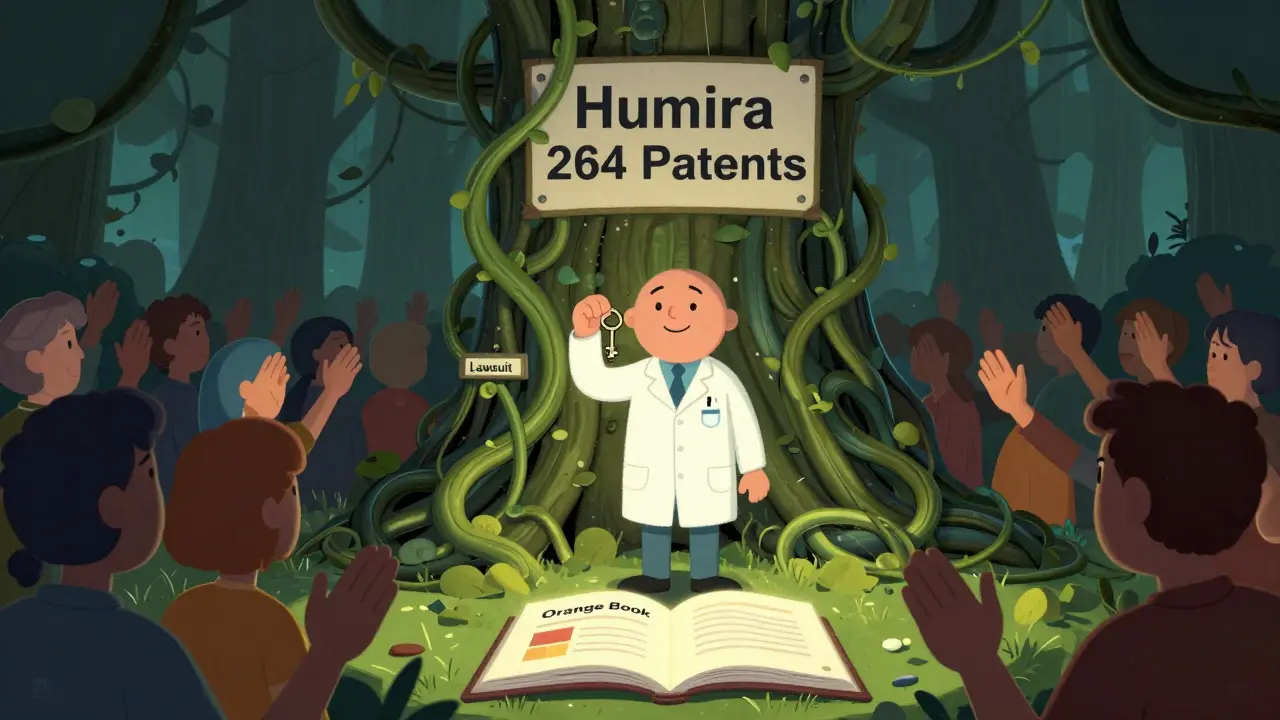
Who Benefits? Who Pays?
Pharmaceutical companies say secondary patents drive innovation. They point to new delivery systems, better dosing, fewer side effects. And yes-some of those improvements matter. A 2021 study from the American Cancer Society found that new formulations of chemo drugs reduced severe side effects by 37%. But here’s the problem: most secondary patents don’t improve patient outcomes. A 2016 Harvard study found that only 12% of secondary patents represented any real clinical benefit. The rest? They’re just tweaks-new salts, new shapes, new colors. They don’t make the drug better. They just make it harder to copy. The cost? Patients and insurers pay more. Pharmacy benefit managers like Express Scripts say secondary patents raise their annual drug costs by 8.3%. Generic manufacturers say navigating these patent thickets adds $15-20 million in legal fees per drug. And it delays access by an average of 3.2 years.Global Differences: What Works in the U.S. Doesn’t Work Everywhere
The U.S. is the most permissive when it comes to secondary patents. But not every country plays by the same rules. India’s patent law, Section 3(d), says you can’t patent a new form of an existing drug unless it shows “enhanced efficacy.” That blocked Novartis from patenting a new crystalline form of Gleevec in 2013. Generic versions hit the market in 2014. Brazil requires approval from its health ministry before a patent can be enforced. That adds another layer of scrutiny. The European Union is slowly tightening rules too. The European Medicines Agency now asks for “significant clinical benefit” before approving certain secondary patents. In countries with strict rules, generics arrive faster. In the U.S., they often don’t arrive at all.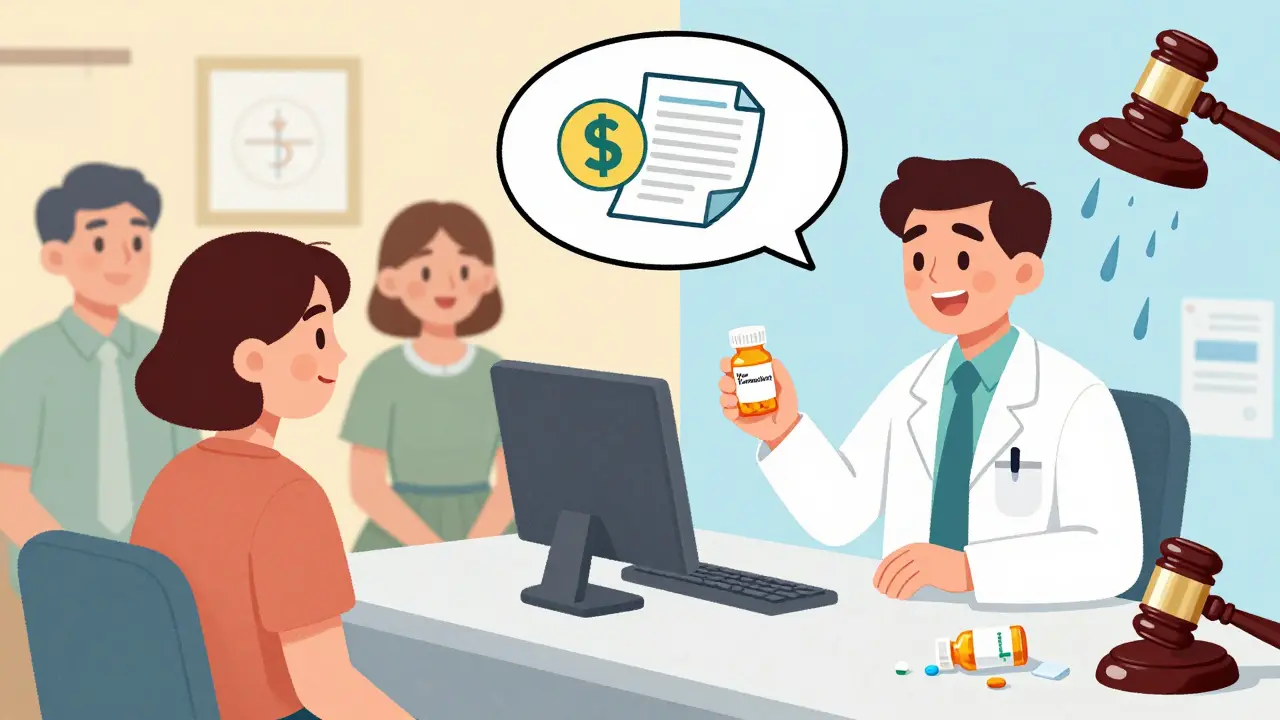
How Companies Time Their Moves
Secondary patenting isn’t random. It’s a carefully planned lifecycle strategy. Pharmaceutical companies start planning secondary patents 5 to 7 years before the primary patent expires. They file formulation patents 3-4 years out. Method-of-use patents often come after the drug is already on the market. Then comes “product hopping.” A company releases a new version of the drug-maybe a pill you swallow instead of an injection-just before generics hit. They market it as “improved.” Doctors switch. Patients switch. And suddenly, the old version is gone. Even if the new version isn’t better, it’s the only one covered by a patent. A 2021 survey of U.S. physicians found that 78% had been pushed by pharmaceutical reps to switch patients to a new formulation right before generic availability. Patients didn’t always know they were being moved off a cheaper drug.The Future Is Uncertain
There’s growing pressure to rein in secondary patents. The 2022 Inflation Reduction Act in the U.S. gave Medicare the power to challenge certain secondary patents. The European Commission’s 2023 Pharmaceutical Strategy explicitly calls out “patent thickets” as a barrier to affordable medicines. Courts are also getting stricter. In 2023, a federal appeals court ruled against Amgen’s broad antibody patent, signaling that vague claims won’t fly anymore. But the industry isn’t backing down. Companies are now combining secondary patents with data exclusivity, regulatory exclusivity, and pediatric exclusivity. They’re stacking protections like bricks. Some experts predict that by 2027, companies will need to prove their secondary patents offer real clinical value-or risk losing them in court.What This Means for Patients
If you’re taking a branded drug, chances are it’s protected by more than one patent. You might think you’re paying for innovation. But you’re often paying for legal strategy. The next time you see a new version of a drug you’ve been taking, ask: Is this better? Or is it just newer? Because in many cases, the answer is the same: It’s the same medicine. Just with a new patent.Are secondary patents legal?
Yes, secondary patents are legal in the U.S. and many other countries. They’re protected under patent law as long as they meet basic requirements for novelty and non-obviousness. But their legitimacy is heavily debated. Countries like India and Brazil have laws that limit or block them, especially when they don’t show improved therapeutic benefit.
How do secondary patents affect drug prices?
They keep prices high. Without generic competition, branded drugs can charge premium prices for years longer than intended. A 2023 study found that drugs with secondary patents generate 58% of their lifetime revenue during the extended exclusivity period. Generic versions typically cost 80-90% less. When secondary patents delay generics, patients and insurers pay billions more each year.
Can a generic drug maker challenge a secondary patent?
Yes, but it’s expensive and risky. Generic companies can file a Paragraph IV certification, claiming the patent is invalid or won’t be infringed. But doing so triggers a lawsuit from the brand-name company. The generic manufacturer must defend itself in court, which can cost $15-20 million and take years. Only about 38% of these challenges succeed, according to Lex Machina’s 2023 data.
What’s the difference between a primary and secondary patent?
A primary patent protects the active pharmaceutical ingredient-the actual chemical compound that treats the disease. It lasts 20 years from filing. Secondary patents protect modifications: how the drug is formulated, delivered, or used. They can be filed at any time-even after the drug is approved-and can extend exclusivity for years beyond the primary patent’s expiration.
Do secondary patents lead to better medicines?
Sometimes. Some secondary patents cover real improvements-like a pill that reduces nausea or a long-acting injection that cuts dosing from daily to monthly. But studies show most don’t. A 2016 Harvard study found only 12% of secondary patents provided meaningful clinical benefits. Many are minor chemical tweaks with no patient advantage, designed solely to delay generics.
Why do pharmaceutical companies file so many secondary patents?
Because money is on the line. A single blockbuster drug can earn over $1 billion a year. Extending exclusivity by even two years means billions in extra revenue. Companies invest heavily in patent teams because the payoff is enormous. Firms with higher sales are 17% more likely to file secondary patents, according to PLOS ONE research. It’s not just innovation-it’s a financial strategy.
Comments
Helen Leite
so like... the pharma giants are just playing chess with our lives?? 😱💸 they patent the COLOR of the pill now?? i swear i saw a commercial for a new version of my blood pressure med and it was just... a different shade of blue. same pills. same side effects. same price. but now it's "advanced". i feel like i'm in a sci-fi movie where corporations own our bodies. 🤖💊
January 24, 2026 at 17:41
Izzy Hadala
The phenomenon of secondary patenting constitutes a strategic exploitation of the intellectual property regime, wherein minor modifications to pharmaceutical formulations are leveraged to extend monopolistic market control beyond the statutory term. This practice, while technically compliant with patent law, undermines the foundational purpose of patent systems: to incentivize innovation while ensuring public access to essential medicines. The empirical data cited in the post-particularly the 8.3% increase in pharmacy costs and the 3.2-year delay in generic entry-strongly suggest a systemic misalignment between legal permissibility and ethical efficacy.
January 25, 2026 at 01:33
Elizabeth Cannon
ok but like... why are we letting this happen?? 🤦♀️ i work at a pharmacy and i see people skipping doses because they can’t afford the branded version even though the generic is 90% cheaper. and the reps come in with their fancy pens and say "this new version is better for your kidneys"-but the science says NOPE. same molecule. same everything. just a new patent. and the FDA lets it slide?? we need to call this what it is: corporate greed dressed up as innovation. #pharmabullshit
January 25, 2026 at 03:46
Gina Beard
The illusion of progress. The quiet theft of time. We are told we are buying better medicine, but we are merely paying for the delay of inevitability. The molecule does not change. The body does not care. Only the balance sheet does.
January 25, 2026 at 08:15
Phil Maxwell
kinda wild how this is just... normal now. i used to think patents were for real breakthroughs. now it’s like a game of whack-a-mole with lawyers. i take a drug that’s been around since 2005 and now there’s 3 versions. none of them actually work better. but i gotta take the new one because my insurance won’t cover the old one. just... sigh. i don’t even know who to be mad at anymore.
January 27, 2026 at 00:54
Shelby Marcel
wait so if i change the shape of the pill from oval to round... thats a patent?? 😭 my grandma takes a pill that’s been around forever and now its called "time release pro" but it’s literally the same thing. i think i just lost faith in capitalism.
January 28, 2026 at 05:36
blackbelt security
This isn’t innovation. It’s a fortress. And the people paying the price aren’t shareholders-they’re the ones with chronic conditions, the ones who can’t afford to wait. The system’s rigged. We’re not fighting drug companies. We’re fighting a machine designed to extract every cent it can. Time to upgrade the code.
January 28, 2026 at 11:08
Patrick Gornik
Ah, the sacred alchemy of pharmaceutical capitalism: transmute a humble molecule into a gold-plated monopoly through the occult arts of legal engineering. The primary patent? A mere prelude. The secondary patents? The true sacrament-a liturgy of polymorphs, salts, and method-of-use incantations whispered into the ears of patent examiners who, like temple priests, have long since traded their skepticism for quarterly dividends. The FDA’s Orange Book? A gilded ledger of deferred justice. And the patient? The sacrificial lamb at the altar of shareholder value. India’s Section 3(d) is not merely law-it is a moral clarion call. The U.S. doesn’t have a patent problem. It has a soul problem. And the only thing more patentable than a new crystal structure is the delusion that this is medicine.
January 29, 2026 at 05:02
Karen Conlin
Let’s not forget the human side here. I’ve mentored people on Medicaid who’ve had to choose between insulin and rent. And every time a company does this patent trick, it’s not just a legal loophole-it’s someone skipping doses, someone’s child going without, someone’s elderly parent rationing pills. The companies say they’re innovating? Okay, then innovate a way to make drugs affordable. Don’t just make the same pill in a different color and call it a day. We need real change-not more patents, but more access. And if that means breaking up patent thickets? Good. Let’s do it. This isn’t about corporate rights. It’s about human survival. We can do better. We have to.
January 29, 2026 at 18:03
Write a comment