
SGLT2 Inhibitor DKA Risk Assessment
Warning: This tool calculates your risk of euglycemic DKA (euDKA) based on key factors. It does not replace medical advice. If you have symptoms, test for ketones immediately regardless of blood sugar level.
Risk assessment pending...
When you’re managing type 2 diabetes, finding a medication that helps control blood sugar, protects your heart, and reduces kidney damage feels like a win. SGLT2 inhibitors-drugs like canagliflozin, dapagliflozin, and empagliflozin-deliver on all three. But behind the benefits lies a quiet, dangerous risk: diabetic ketoacidosis (DKA) that doesn’t look like DKA at all.
What Makes This DKA Different?
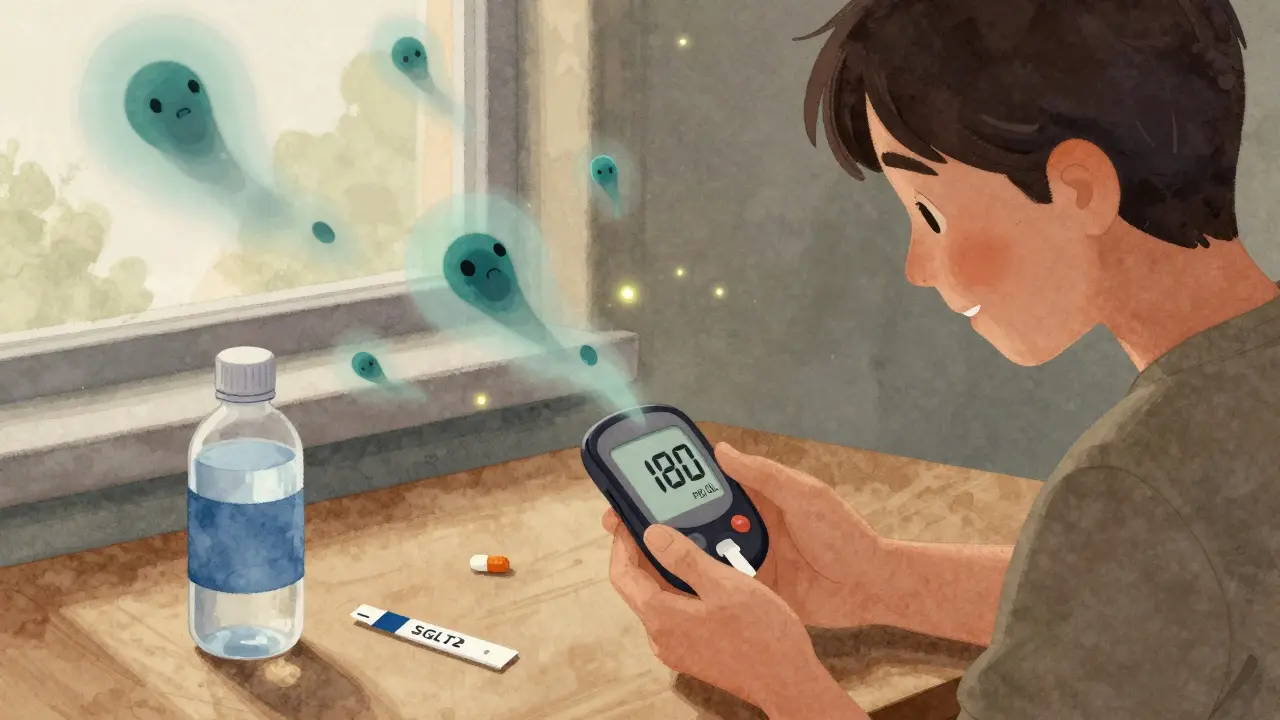
Most people think of DKA as a crisis with blood sugar soaring above 250 mg/dL, fruity breath, vomiting, and confusion. That’s classic DKA, usually seen in type 1 diabetes. But with SGLT2 inhibitors, things get tricky. A lot of cases now show up with blood sugar levels below 200 mg/dL-sometimes even normal. This is called euglycemic DKA, or euDKA. It’s not rare. Studies show euDKA makes up 30-40% of all DKA cases in people taking these drugs. And here’s the problem: if your doctor checks your blood sugar and sees it’s "not that high," they might not think to test for ketones. That’s when things go wrong. Patients end up in the ER with severe acidosis, dehydration, and abdominal pain-sometimes after days of feeling just "off."Why Do SGLT2 Inhibitors Cause This?
These drugs work by making your kidneys dump glucose into your urine. That lowers blood sugar. But here’s the side effect no one talks about: they also reduce insulin levels slightly and increase glucagon. That pushes your body into fat-burning mode-producing ketones-even when glucose is low. Add in a trigger-like skipping meals, getting sick, cutting back on carbs, or having surgery-and your body starts flooding with ketones. No high sugar? No warning. Just fatigue, nausea, rapid breathing. It’s easy to mistake for the flu.The Numbers Don’t Lie
A 2024 review in Metabolites analyzed over 350,000 people with type 2 diabetes. Those on SGLT2 inhibitors had nearly three times the risk of DKA compared to those on DPP-4 inhibitors. The incidence? About 0.1 to 0.5 cases per 100 patient-years. That sounds small. But when you consider millions are on these drugs, that’s thousands of preventable hospitalizations. And the death rate? One 2021 study found it was 4.3% for SGLT2-related DKA-more than double the rate of traditional DKA. Why? Because diagnosis is delayed. People don’t get tested for ketones because their sugar looks fine.Who’s at Highest Risk?
Not everyone on SGLT2 inhibitors gets euDKA. But certain people are far more vulnerable:- Those with low insulin production (C-peptide <1.0 ng/mL)
- People who recently cut insulin doses or stopped insulin entirely
- Patients with type 1 diabetes using SGLT2 inhibitors off-label
- Anyone fasting, sick, or preparing for surgery
- Those drinking heavily or on very low-carb diets

When It Happens-And How to Spot It Early
Most cases occur within the first year. The median time from starting the drug to DKA? Just 28 weeks. That’s less than 7 months. Symptoms to watch for:- Nausea or vomiting
- Abdominal pain (often mistaken for stomach flu)
- Unexplained fatigue or weakness
- Rapid, deep breathing
- Fruity-smelling breath
- Confusion or difficulty concentrating
What Doctors Should Do
Guidelines from the American Diabetes Association, the European Association for the Study of Diabetes, and the Endocrine Society all agree: check ketones when sick. If you’re feeling unwell, stop your SGLT2 inhibitor. Drink water. Test your urine or blood ketones. If ketones are moderate or large, go to the ER. Don’t wait. Don’t assume it’s just a virus. Before any surgery-even a dental procedure-stop the drug at least 3 days ahead. Same for severe illness: pneumonia, heart attack, stroke. These drugs aren’t safe when your body is under stress.What You Can Do
If you’re on one of these drugs, here’s your action plan:- Ask your doctor for a ketone test kit (urine strips or a blood meter).
- Keep it in your medicine cabinet. Don’t wait until you’re sick to buy it.
- Test ketones if you’re vomiting, nauseous, or feeling unusually tired-even if your sugar is normal.
- Never stop insulin without talking to your doctor-even if you’re on an SGLT2 inhibitor.
- Inform all healthcare providers you’re taking an SGLT2 inhibitor before any procedure or hospital admission.

The Bigger Picture: Benefits vs. Risk
Yes, these drugs carry risk. But they also reduce heart failure hospitalizations, slow kidney disease, and lower death rates in people with heart disease. The EMPA-REG OUTCOME and DECLARE-TIMI 58 trials proved that. The key isn’t avoiding these drugs. It’s using them wisely. For someone with strong insulin production, no history of DKA, and good access to ketone testing? The benefits far outweigh the risk. For someone with borderline insulin output, a history of ketoacidosis, or no way to monitor ketones? This drug might not be right.What’s Next?
Pharmaceutical companies are working on next-gen drugs-like licogliflozin, a dual SGLT1/2 inhibitor-that may carry less DKA risk. The FDA now requires all new SGLT2 trials to monitor for euDKA specifically. Machine learning models are being trained to predict who’s most at risk. One 2024 study built an algorithm using 15 factors-like age, kidney function, insulin use, and BMI-that predicted DKA with 87% accuracy. Soon, doctors might screen patients before prescribing.Final Thought
SGLT2 inhibitors aren’t dangerous. But they’re not harmless, either. They’re powerful tools-and like any powerful tool, they need respect. The biggest mistake isn’t taking them. It’s assuming they’re safe because your sugar looks fine. If you’re on one, know the signs. Test your ketones. Talk to your doctor. Your life might depend on it.Can SGLT2 inhibitors cause DKA even if my blood sugar is normal?
Yes. This is called euglycemic DKA (euDKA), and it’s a known risk of SGLT2 inhibitors. Blood sugar may be below 200 mg/dL, even normal, while ketones rise dangerously. Symptoms like nausea, vomiting, fatigue, and rapid breathing can appear without high glucose. Always test for ketones if you feel unwell, regardless of your blood sugar reading.
How common is DKA with SGLT2 inhibitors?
About 0.1 to 0.5 cases occur per 100 patient-years. That means roughly 1-5 people out of every 1,000 on these drugs will develop DKA each year. While rare overall, the risk is 2-3 times higher than with other diabetes medications like DPP-4 inhibitors. Most cases happen within the first year of use.
Should I stop taking my SGLT2 inhibitor if I’m sick?
Yes. If you have an infection, fever, vomiting, or are fasting for surgery, stop your SGLT2 inhibitor immediately. These drugs increase DKA risk during metabolic stress. Restart only after you’re fully recovered and eating normally. Always consult your doctor before restarting.
Can I use SGLT2 inhibitors if I have type 1 diabetes?
They are not approved for type 1 diabetes in most countries, but some doctors prescribe them off-label. This significantly increases DKA risk. If you have type 1 diabetes and are on an SGLT2 inhibitor, you must monitor ketones daily when ill and never reduce insulin without medical supervision. The risk is high and requires strict management.
What should I do if I have moderate or large ketones?
Seek emergency medical care immediately. Do not wait for symptoms to worsen or for your blood sugar to rise. Moderate or large ketones mean your body is in acidosis, even if your glucose is normal. Delaying treatment can lead to coma or death. Call 911 or go to the nearest ER.
Are there safer alternatives to SGLT2 inhibitors?
Yes. Metformin remains the first-line treatment for most people with type 2 diabetes. GLP-1 receptor agonists like semaglutide (Ozempic) or liraglutide (Victoza) offer similar heart and kidney benefits with a much lower DKA risk. DPP-4 inhibitors like sitagliptin are another option with minimal risk of ketoacidosis. Talk to your doctor about what fits your health profile.
Do I need to test ketones every day?
No. Daily ketone testing isn’t needed unless you’re on insulin or have type 1 diabetes. But you should test whenever you’re sick, stressed, vomiting, fasting, or feeling unusually tired. Keep ketone strips on hand and know how to use them. Prevention is simple: test when in doubt.
Can alcohol increase my risk of DKA on SGLT2 inhibitors?
Yes. Binge drinking or heavy alcohol use can trigger euDKA in people on SGLT2 inhibitors. Alcohol lowers blood sugar and suppresses glucose production, while the drug pushes fat breakdown and ketone formation. This double effect can rapidly lead to acidosis. Avoid heavy drinking while on these medications.
Comments
MARILYN ONEILL
I've been on dapagliflozin for a year and honestly? I thought it was magic until I got sick last winter and ended up in the ER with ketones at 3.0 and a blood sugar of 168. No one even thought to check. My doctor said, 'Your sugar's fine, you're fine.' I was literally shaking and couldn't stand. They didn't catch it until I screamed for a ketone test. If this post saves one person from my nightmare, it's worth it.
Don't let 'normal' sugar fool you. This isn't hype. It's survival.
PS: I now carry ketone strips in my purse like condoms. You never know when you'll need them.
January 21, 2026 at 11:38
Coral Bosley
My cousin died from this. Not even 45. Took her two days to go from 'just feeling off' to coma. The ER doctor said she had 'viral gastroenteritis' until her blood gas came back with a pH of 6.9. They didn't test ketones because her glucose was 172. She was on empagliflozin for six months. Her chart didn't even flag it. I swear, the system is designed to let people slip through. And now I have to explain to her kids why their mom died because a drug company didn't warn them hard enough.
It's not a side effect. It's a silent assassin.
January 22, 2026 at 00:05
Steve Hesketh
Brothers and sisters, I want to speak to you from the heart. I’m a nurse in Lagos, and I’ve seen this happen three times in my unit this year alone. One patient, 52, diabetic for 12 years, on canagliflozin, thought he was fine because his sugar was 150. He was vomiting, breathing fast, confused. We didn’t even think of DKA until his wife said, 'He’s been on that new diabetes pill.' We tested ketones. He was in acidosis. We saved him. But we almost lost him because no one told him this could happen.
Let me say this clearly: if you’re on these drugs, you must know your body. If you feel wrong, test. Don’t wait. Don’t hope. Test. And if your doctor doesn’t know this, find one who does. Your life is not a gamble.
God bless you all. Stay safe. Stay informed.
- Steve, from Nigeria, where we don’t have fancy gadgets but we have heart.
January 22, 2026 at 04:03
shubham rathee
pharma is lying again. sglts2 inhibitors were designed to kill poor people quietly. why? because they make you pee sugar and ketones. that’s a profit loop. you get sick → go to er → get billed → insurance pays → company gets rich. they don’t care if you die as long as the data says 'low incidence'.
and the 'test ketones' advice? laughable. most people can’t afford strips. and even if they can, doctors won’t teach them. it’s all about keeping you dependent on the system.
metformin is free in india. why aren’t we pushing that? because it doesn’t have a patent. think about it.
January 22, 2026 at 12:28
MAHENDRA MEGHWAL
Thank you for this comprehensive and clinically accurate exposition. The distinction between euglycemic diabetic ketoacidosis and classical diabetic ketoacidosis is profoundly underappreciated in primary care settings. The physiological mechanism-reduced insulin secretion coupled with elevated glucagon and suppressed renal glucose reabsorption-creates a state of relative insulin deficiency despite normoglycemia.
It is imperative that patient education materials be revised to reflect this paradigm shift. Furthermore, the integration of ketone monitoring protocols into electronic health record alerts for patients prescribed SGLT2 inhibitors may significantly mitigate adverse outcomes.
I would respectfully suggest that future guidelines include mandatory patient handouts in multiple languages, distributed at the time of prescription.
January 24, 2026 at 07:53
Sangeeta Isaac
soooo... i took my gliflozin to the beach and forgot to bring ketone strips. then i got sunburnt, drank a margarita, and felt 'kinda weird.' my sugar was 180. i thought 'eh, it's just the tequila.'
turns out i was 3 hours from passing out. now i have a little ketone strip case taped to my fridge next to my hot sauce. because apparently my body is a ticking time bomb and i didn't even know it.
thanks for the scare, internet. now i'm officially the most paranoid diabetic in san diego.
also, who else is mad that the FDA didn't make this a black box warning? like, come on. this isn't a side effect. it's a glitch in the matrix.
January 24, 2026 at 09:09
Alex Carletti Gouvea
Why are we letting foreign drug companies dictate our healthcare? These drugs are made in Europe and India, tested on Americans, and the side effects are buried in tiny print. We need to ban these and bring back insulin-only protocols. American patients deserve American solutions.
Also, why are we letting people with type 1 diabetes take these? That’s not medicine, that’s negligence. Someone needs to get fired over this.
January 25, 2026 at 17:14
lokesh prasanth
the real problem isn't the drug
it's that we treat diabetes like a math problem
not a biological system
you can't just remove sugar
you have to understand why it's there
and why your body fights back
we're playing god with insulin
and losing
January 25, 2026 at 23:59
Uju Megafu
Oh honey, I knew this was coming. I told my sister when she started on dapagliflozin, 'This is not medicine, this is a trap.' You think you're being saved? No. You're being conditioned. The system wants you dependent on testing strips, ER visits, and endless follow-ups. They profit from your fear. I saw it happen to my cousin-he went from 'healthy' to 'critical' in 72 hours because no one told him to test ketones. And now he's got a kidney transplant and PTSD from the ER.
They don't care if you live. They care if you pay.
Stop trusting doctors who don't know the difference between glucose and ketones. Start trusting your body. And if you feel off? Don't wait. Don't ask. Test. Now.
January 26, 2026 at 16:42
Write a comment