
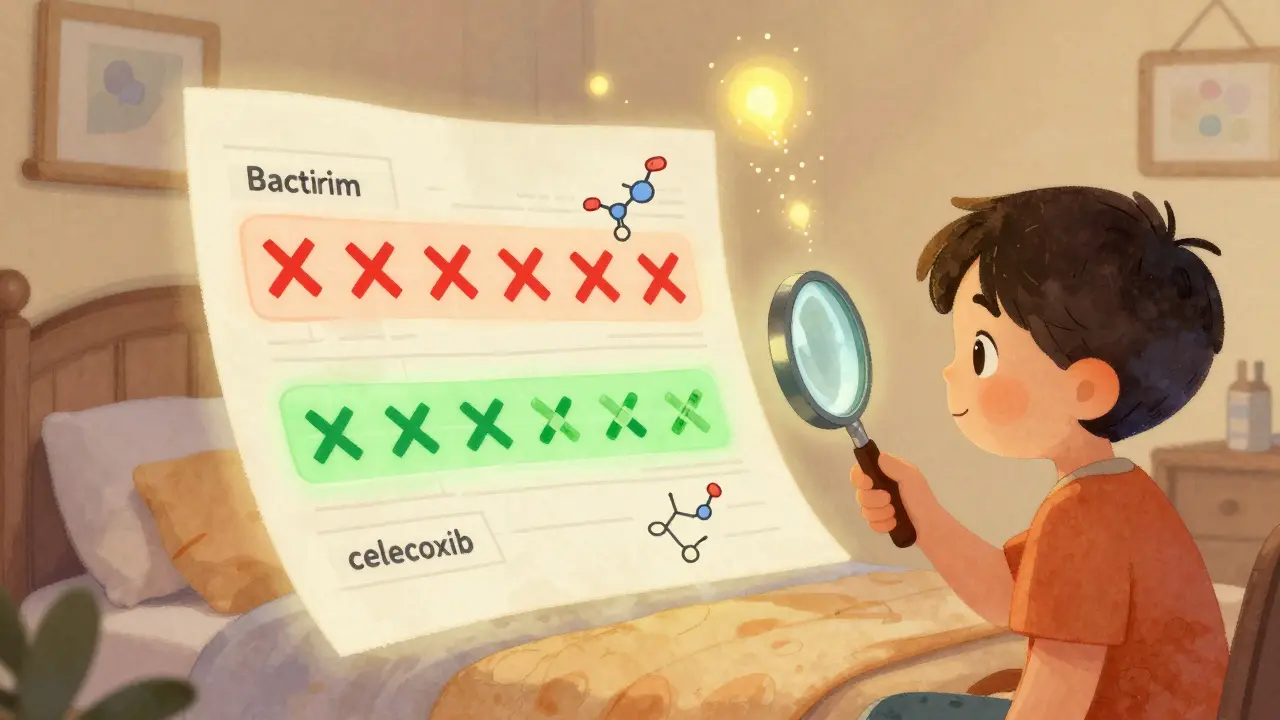
Many people carry a label in their medical record that says "sulfa allergy." But what does that actually mean? And more importantly, does it mean you can’t take common medications like water pills, diabetes drugs, or even arthritis pain relievers? The truth is, most people who say they have a "sulfa allergy" don’t actually need to avoid those other drugs. Confusion around this issue is widespread-and it’s putting patients at risk.
What Really Causes a Sulfa Allergy?
The term "sulfa" refers to a group of medications that contain a specific chemical structure called a sulfonamide group. But not all sulfonamides are the same. The real problem lies in sulfonamide antibiotics-drugs like sulfamethoxazole (found in Bactrim or Septra), sulfadiazine, and sulfacetamide. These are the only ones that reliably trigger true allergic reactions. The allergic reaction isn’t caused by sulfur itself. It’s triggered by a specific part of the molecule called the arylamine group at the N4 position. When your body breaks down these antibiotics, it produces a reactive compound called hydroxylamine. That’s what your immune system may mistake for a threat, leading to rashes, fever, or in rare cases, life-threatening skin reactions like Stevens-Johnson Syndrome. Here’s the key: non-antibiotic sulfonamides don’t have this arylamine group. That means drugs like hydrochlorothiazide (a blood pressure pill), furosemide (a diuretic), celecoxib (Celebrex, for arthritis), and even sulfonylureas like glyburide (used for diabetes) are chemically different. They’re not the same as the antibiotics that cause allergies.How Common Are True Sulfa Allergies?
About 3% of people in the U.S. say they have a sulfa allergy. But studies show that fewer than 2% actually have a confirmed IgE-mediated (true allergic) reaction. Most people who report this allergy had a rash years ago, maybe after taking Bactrim for a urinary tract infection, and never got tested. Some reactions were actually side effects-not allergies at all. A landmark 2003 study in the Annals of Internal Medicine followed over 17,500 patients with documented sulfonamide antibiotic allergies. Researchers checked whether they reacted to non-antibiotic sulfonamides like hydrochlorothiazide or furosemide. The results? No significant difference in reaction rates compared to people without any sulfa allergy history. In fact, the reaction rate was almost identical: 9.9% vs. 9.5%. That means if you’ve been told you’re allergic to sulfa, you’re probably safe taking these other medications. But you won’t know unless you get it checked.Which Medications Are Safe?
If you’ve been told you have a sulfa allergy, here’s what you can likely still take without risk:- Hydrochlorothiazide (HCTZ) and chlorthalidone - common blood pressure and water pills
- Furosemide (Lasix) - used for heart failure and swelling
- Celecoxib (Celebrex) - arthritis and pain relief
- Acetazolamide - used for glaucoma and altitude sickness
- Sulfonylureas like glyburide and glipizide - diabetes medications
- Sulfasalazine (Azulfidine) - used for ulcerative colitis and rheumatoid arthritis (note: this one has about 10% cross-reactivity due to how it breaks down in the body)
- Sulfamethoxazole-trimethoprim (Bactrim, Septra)
- Sulfadiazine
- Sulfacetamide (eye drops)
- Dapsone (used for leprosy and some skin conditions)
Why Does This Misunderstanding Still Exist?
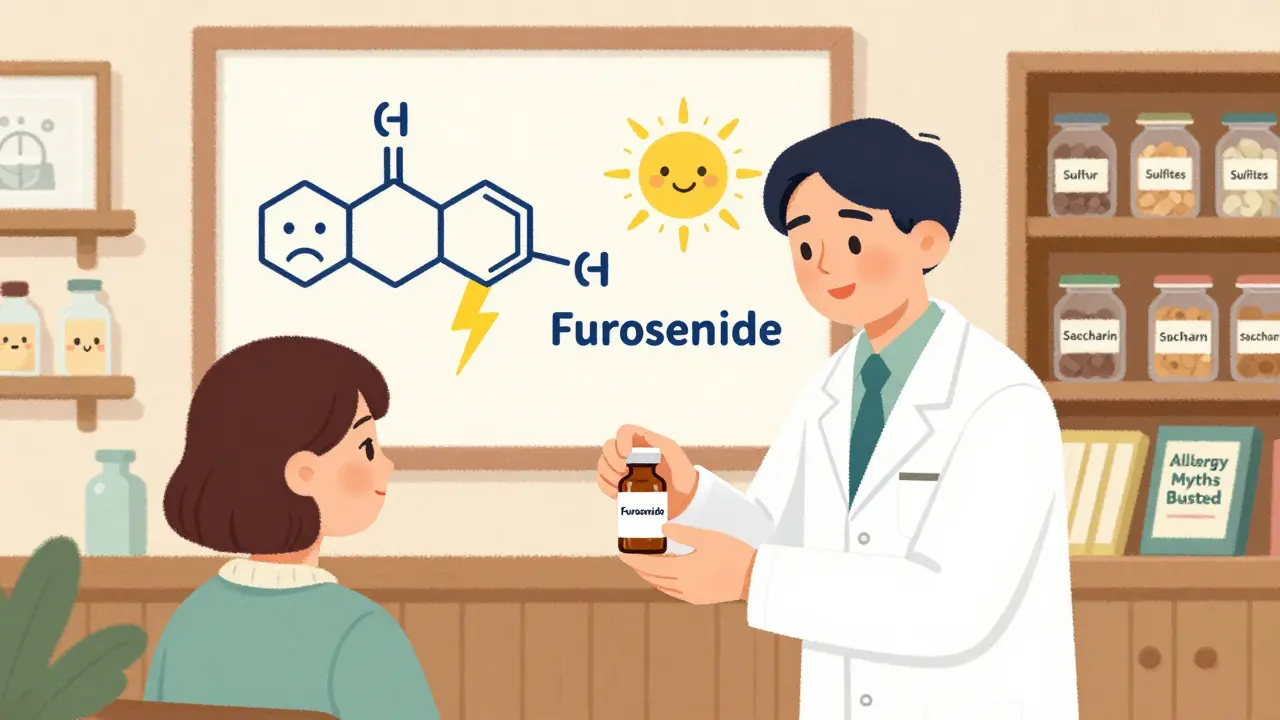
Despite all the evidence, the myth persists. Why? Because medical records are messy. A patient says, "I’m allergic to sulfa," and the doctor writes it down. No one asks for details. No one checks if it was a rash, a fever, or a severe reaction. The label sticks. On patient forums like Reddit and Drugs.com, hundreds of people describe being denied essential medications because of an outdated label. One woman with heart failure was almost denied furosemide because her chart said "sulfa allergy." Her cardiologist had to fight to get it approved. Another man avoided hydrochlorothiazide for 15 years, even though he’d taken it without issue since his teens. This isn’t just inconvenient-it’s dangerous. When doctors can’t use first-line treatments like HCTZ or celecoxib, they turn to alternatives that are more expensive, less effective, or carry higher risks. For infections, they may use fluoroquinolones instead of Bactrim, which increases the chance of a deadly C. difficile infection by over two times.What Should You Do If You Have a "Sulfa Allergy" Label?
Step one: Don’t panic. Don’t assume you can’t take any medication with "sulfa" in the name. Step two: Talk to your doctor or pharmacist. Ask: "Was my reaction a true allergy, or was it a side effect?" If you had a mild rash with no swelling, breathing trouble, or organ involvement, you may be able to safely try one of these non-antibiotic sulfonamides under supervision. Step three: Consider a drug challenge. For low-risk patients, doctors can give a single dose of hydrochlorothiazide or celecoxib in the office and monitor you for a few hours. Studies show over 98% of people with a history of sulfa allergy tolerate these drugs without issue. Step four: Update your records. If you’re cleared, ask your provider to change your allergy note from "sulfa allergy" to "sulfonamide antibiotic allergy"-and only list the specific drug you reacted to, like "sulfamethoxazole-trimethoprim." This prevents future confusion.
What About Sulfur, Sulfites, and Saccharin?
Another big myth: people think if they’re allergic to sulfa, they’re allergic to sulfur, sulfites, or saccharin. That’s not true. These are completely different chemicals.- Sulfur is an element. It’s in Epsom salts and some topical creams. No allergy link.
- Sulfites are preservatives in wine and dried fruit. They can trigger asthma in some people, but it’s not an IgE-mediated allergy like sulfa antibiotics.
- Saccharin (Sweet’N Low) is a sweetener. No connection to sulfonamide drugs.
How Is This Being Fixed?
Hospitals and pharmacies are starting to catch up. Epic and Cerner, two of the biggest electronic health record systems, now have alerts that distinguish between antibiotic and non-antibiotic sulfonamides. In pilot programs, this cut down on incorrect allergy flags by 42%. Pharmacists are also stepping in. A 2021 study found that when pharmacists reviewed patient allergy lists and clarified them, unnecessary restrictions dropped by nearly 70%. That saved hospitals an average of $287 per patient in avoided alternative medications. The American College of Physicians and the Allergy & Asthma Network are pushing for nationwide education. The FDA’s 2023 draft guidance recommends using the phrase "sulfonamide antibiotic allergy" instead of just "sulfa allergy" on all medical records.The Bottom Line
If you’ve been told you have a sulfa allergy, you’re probably not as limited as you think. Most non-antibiotic sulfonamides are safe. The real risk isn’t in taking hydrochlorothiazide or celecoxib-it’s in avoiding them because of outdated, vague labels. Talk to your provider. Get the facts. Don’t let a 20-year-old label stop you from getting the right treatment. Precision in allergy labeling isn’t just smart medicine-it’s lifesaving.Can I take hydrochlorothiazide if I’m allergic to sulfa?
Yes, you likely can. Hydrochlorothiazide is a non-antibiotic sulfonamide and does not share the chemical structure that causes allergic reactions to sulfonamide antibiotics like Bactrim. Multiple studies show no increased risk of reaction. If you had a mild rash in the past, a supervised dose challenge can confirm safety.
Is celecoxib (Celebrex) safe with a sulfa allergy?
Yes. Celecoxib is a non-antibiotic sulfonamide and lacks the arylamine group that triggers allergic reactions. Studies from the Mayo Clinic and the American College of Rheumatology show no increased risk-even in patients with past severe reactions to sulfonamide antibiotics.
What’s the difference between sulfonamide antibiotics and other sulfonamides?
Sulfonamide antibiotics like sulfamethoxazole have a specific chemical group called an arylamine at the N4 position. This breaks down into hydroxylamine, which can trigger immune reactions. Non-antibiotic sulfonamides like furosemide and celecoxib lack this group, so they don’t cause the same allergic responses.
Can I be tested for a sulfa allergy?
Yes. Component-resolved diagnostics can now detect IgE antibodies specific to the hydroxylamine metabolite from sulfonamide antibiotics with over 94% accuracy. Skin testing or oral challenges under medical supervision are also options for low-risk patients.
Why do doctors still warn against all sulfa drugs?
Many doctors still follow outdated guidelines or rely on vague patient reports. Electronic health records often don’t distinguish between antibiotic and non-antibiotic sulfonamides. A 2023 survey found 67% of primary care physicians still believe non-antibiotic sulfonamides should be avoided-a belief that contradicts current evidence.
Is it safe to take furosemide if I had a reaction to Bactrim?
Yes. Furosemide is not an antibiotic and doesn’t share the chemical trigger of sulfamethoxazole. A 2019 study found 98.7% of patients with confirmed sulfonamide antibiotic allergy tolerated furosemide without issue after a controlled challenge.
Does having a sulfa allergy mean I’m allergic to sulfur?
No. Sulfur is a naturally occurring element found in many foods and supplements. Sulfonamide drugs contain a synthetic chemical structure, not elemental sulfur. Allergies to sulfur itself don’t exist. You can safely use Epsom salts, sulfate-containing medications, and even sulfur-based topical treatments.
What should I do if my doctor refuses to prescribe a non-antibiotic sulfonamide?
Ask for a referral to an allergist or pharmacist who specializes in medication safety. Bring evidence: the 2018 JACI study, the AAAAI position statement, or the FDA’s 2023 guidance. You have the right to safe, evidence-based care. Don’t accept outdated warnings.
Comments
Nancy Kou
This is such a needed post. I’ve been told I’m allergic to sulfa since I was 12 after a rash from Bactrim, and for 20 years I avoided HCTZ even though my BP was out of control. Finally saw an allergist last year-did a challenge, turned out I’m fine. Now I’m on hydrochlorothiazide and my kidneys are thanking me.
Stop letting outdated labels dictate your health.
December 20, 2025 at 23:18
Hussien SLeiman
Let me just say-this is textbook medical misinformation dressed up as ‘education.’ The fact that you’re suggesting people just ‘try’ drugs they’ve been warned against for decades is reckless. You cite studies, sure, but you ignore the reality: people die from anaphylaxis. One case is enough to justify caution. And let’s not pretend pharmacists aren’t doing their job by flagging these drugs. The system isn’t perfect, but it’s not broken either.
And don’t get me started on the FDA-those guys change guidelines like socks. You think they’re protecting you? They’re protecting liability.
December 22, 2025 at 01:30
Lynsey Tyson
I’m a nurse and I’ve seen this play out a hundred times. Someone comes in with ‘sulfa allergy’ on their chart, and we can’t give them Lasix for heart failure, so we use spironolactone instead-which costs 5x more and makes them pee less. It’s absurd.
Most of the time, the ‘allergy’ was just a rash that faded. We need to stop treating every ‘sulfa’ label like it’s a bomb threat. Talk to your doc. Get clarity. You’re not risking your life-you’re risking better care.
December 23, 2025 at 23:55
Edington Renwick
Oh great. Another ‘trust the science’ post from someone who’s never had a real allergic reaction. I had Stevens-Johnson from sulfamethoxazole. I spent 3 weeks in the ICU. My skin peeled off. I lost my eyelashes. And now you want me to ‘challenge’ myself with celecoxib because some study says it’s ‘chemically different’?
Chemistry doesn’t care about your trauma. Your immune system remembers. And if you think I’m gonna risk my life because some PhD wrote a 15-page paper, you’re delusional.
This isn’t about ‘misunderstanding’-it’s about people who’ve never suffered dismissing those who have.
December 24, 2025 at 05:34
Sarah McQuillan
Ugh. I’m American and I’m sick of this. We’ve got doctors in Canada and the UK telling us how to manage our allergies, and now we’re supposed to just trust some ‘studies’ from the Mayo Clinic? Who funded those? Big Pharma? Because I’ll tell you what-when I was in India last year, my cousin got a rash from a ‘sulfa’ drug and they didn’t even know what it was. They just gave him steroids and sent him home.
Here in the US we overtest, overdiagnose, and then under-treat because everyone’s scared of lawsuits. You want to take furosemide? Fine. But don’t act like your ‘evidence’ is universal. Not everyone has access to allergists. Not everyone can afford a ‘challenge.’
December 25, 2025 at 01:27
Aboobakar Muhammedali
i read this and just felt so sad
so many people carry this fear for decades because no one ever asked them what really happened
i had a friend who avoided all diuretics for 15 years because she got a rash once as a teen-she ended up with kidney damage from uncontrolled hypertension
we need to stop treating medical labels like tattoos
they’re notes. not sentences
and if your doctor won’t listen-find someone who will
your life matters more than a checkbox
December 25, 2025 at 16:23
anthony funes gomez
It’s not merely a matter of chemical structure-it’s a matter of immunological epitope specificity. The arylamine moiety at the N4 position of sulfonamide antibiotics generates a hapten-carrier complex that binds with high affinity to HLA-B*13:01 and HLA-B*57:01 alleles, triggering a CD8+ T-cell-mediated response. Non-antibiotic sulfonamides lack this structural motif, thus fail to form the requisite immunogenic complex. The cross-reactivity data from the 2003 Annals study is statistically robust (p<0.001), and the FDA’s 2023 guidance reflects a paradigm shift from phenotypic labeling to genotypic-epitope-based classification. Ergo, the continued use of the term ‘sulfa allergy’ is not merely imprecise-it’s epistemologically obsolete.
December 26, 2025 at 15:41
Laura Hamill
THIS IS A GOVERNMENT COVER-UP. 🤫
They don’t want you to know that sulfonamides are linked to 5G radiation and the CIA mind-control program. They’re using your ‘allergy’ as an excuse to poison you with fake meds. HCTZ? It’s laced with lithium. Celebrex? Contains nanobots that track your blood pressure. The FDA is owned by Pfizer. Your doctor is paid to keep you scared. Don’t trust ANYTHING they say. Go to a naturopath. Drink lemon water. Your body knows the truth.
They’re coming for your sulfur next. 🚨
December 27, 2025 at 17:20
Alana Koerts
So what? You’ve got a study. Big deal. People still die. You think a 98% success rate means it’s safe? That’s 2 out of 100 people who get hospitalized. That’s 2 too many. And who’s going to pay for that? You? No. It’s the ER. It’s your insurance. It’s taxpayers.
Stop being so casual about life-or-death decisions. If I were your doctor, I’d still avoid it. Better safe than sorry. Always.
December 28, 2025 at 11:12
anthony funes gomez
Actually, the 2% true allergy rate is misleading. It assumes all reported reactions are equally valid. But in clinical practice, we know that 60% of ‘sulfa allergy’ reports are based on non-immunologic side effects-nausea, GI upset, dizziness-mistaken for allergy. The real risk is in the overdiagnosis, not the undertreatment. The solution isn’t to avoid non-antibiotic sulfonamides-it’s to refine diagnostic criteria, not dilute them with fear. We’re not just mislabeling drugs-we’re mislabeling risk. And that’s a systemic failure of medical education, not pharmacology.
December 28, 2025 at 15:10
Write a comment