
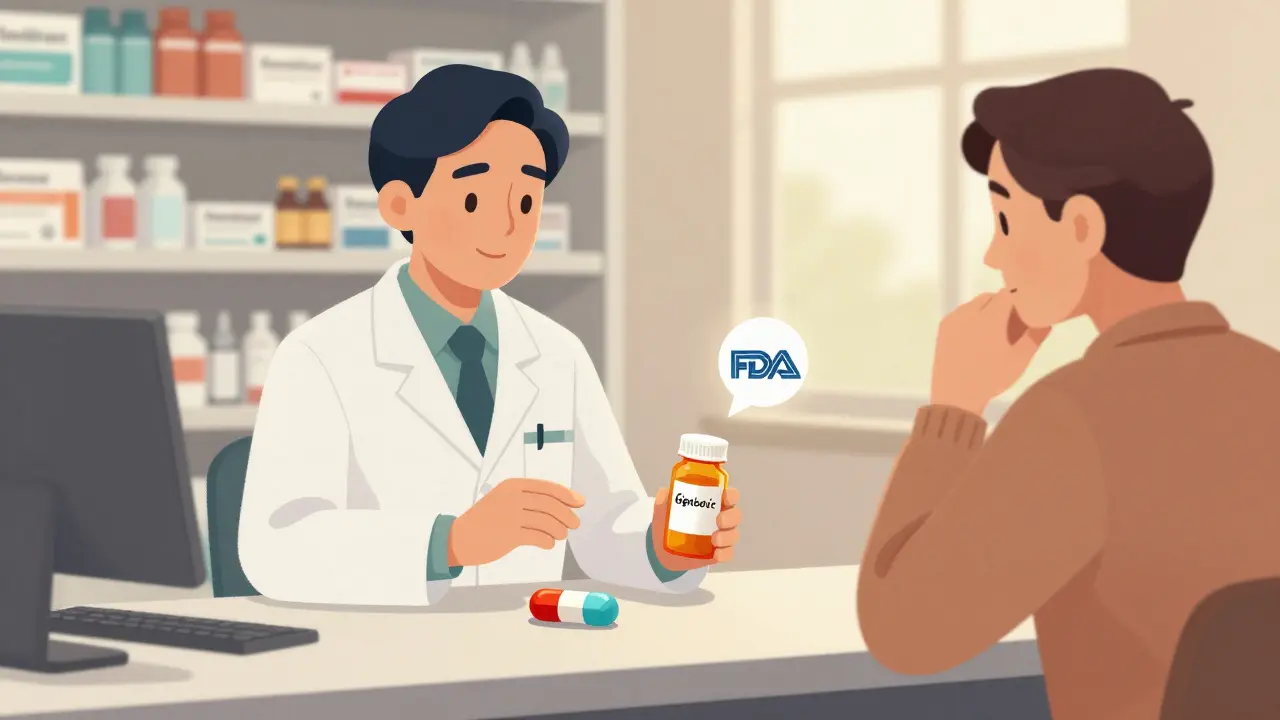
When your doctor prescribes a medication, you might notice the pharmacy gives you a pill that looks completely different from what you got last time. The name on the bottle has changed too. That’s not a mistake. You’ve been switched from a brand-name drug to a generic version. For most people, this switch makes no difference at all. For others, it can cause real problems. Knowing what to expect helps you stay in control of your health.
Why Do We Switch to Generic Drugs?
The main reason is simple: money. Brand-name drugs cost a lot because the company that made them spent years and millions developing them. Once the patent runs out, other companies can make the same drug. These are called generics. They don’t need to repeat expensive clinical trials. They just have to prove they work the same way. The U.S. Food and Drug Administration (FDA) requires generics to have the same active ingredient, strength, dosage form, and route of administration as the brand-name drug. They also have to be bioequivalent - meaning your body absorbs the drug at the same rate and amount. The FDA says there’s no proof generics are less safe or effective.
In 2023, about 90% of all prescriptions filled in the U.S. were for generic drugs. That’s not because doctors prefer them - it’s because insurance companies push them. Many plans won’t cover the brand-name version unless you’ve tried the generic first. Or they charge you $50 for the brand but only $5 for the generic. For people on tight budgets, that difference can mean the difference between taking your medicine and skipping it.
What Changes When You Switch?
The active ingredient doesn’t change. But everything else might. Generic pills can be a different color, shape, or size. They might have different fillers, dyes, or preservatives. These inactive ingredients don’t treat your condition, but they can affect how your body reacts.
For most people, this is harmless. But for some, it’s not. A 2021 survey in Massachusetts found that 63% of patients were worried about switching to generics because the pills looked different. One man switched from his brand-name epilepsy drug to a generic and started having seizures again. His doctor had to switch him back. Another woman switched from Synthroid (a brand-name thyroid drug) to a generic levothyroxine and saw her TSH level jump from 2.5 to 8.7 in six weeks. That’s a big change - it meant her thyroid wasn’t being controlled anymore.
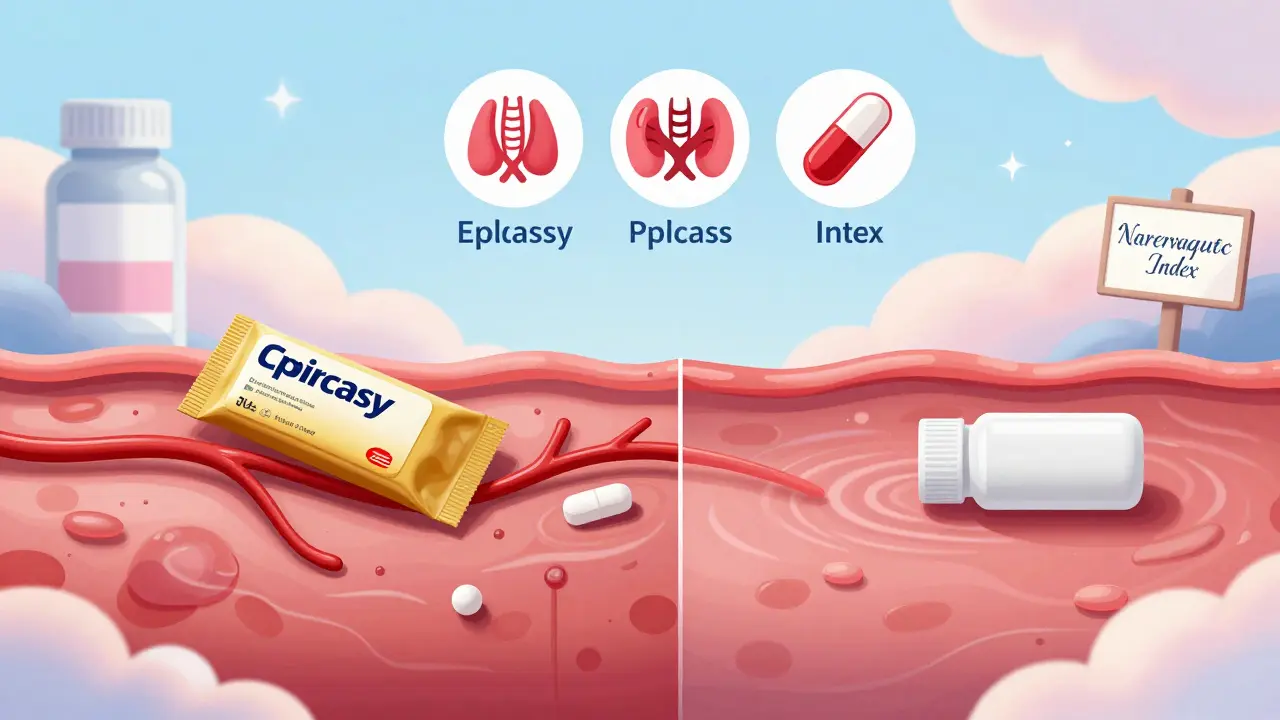
Why does this happen? Some drugs have a narrow therapeutic index. That means the difference between a dose that works and one that’s too much (or too little) is very small. Even tiny differences in how the body absorbs the drug can throw things off. This is most common with:
- Anti-epileptic drugs
- Thyroid medications like levothyroxine
- Blood thinners like warfarin
- Immunosuppressants after organ transplants
If you take one of these, switching isn’t just about saving money - it’s about safety.
Do Generics Work as Well?
For most drugs, yes. A review of 30 studies published between 2003 and 2013 found that for 72% of drugs studied, there was no difference in effectiveness between brand and generic. A 2022 analysis of 1,245 patient reviews on Drugs.com showed 78% rated generic medications as "good" or "excellent" in effectiveness.
But here’s the catch: the studies that found problems were almost always about drugs with narrow therapeutic windows. The same review found that switching in epilepsy patients led to increased seizure frequency. In thyroid patients, it led to unstable hormone levels. In blood thinners, it led to higher risk of clots or bleeding.
That’s why experts don’t say "generics are always fine." They say: "It depends." For antibiotics, pain relievers, or blood pressure meds, switching is usually safe. For the drugs listed above? Proceed with caution.
Why Do Some People Switch Back?
One study found that 25% of medications in Saudi Arabia’s public health system were switched between brand and generic versions over five years. Why? Because the government buys drugs through a bidding system - the lowest bidder gets the contract. That means every year, the pharmacy might get a different generic manufacturer. One year you get a blue pill from Manufacturer A. The next year, it’s a white pill from Manufacturer B. Then back to blue. That’s not just confusing - it’s dangerous.
Patients who switch back often report:
- New side effects (headaches, nausea, dizziness)
- Worsening of their condition (more seizures, higher blood pressure, weight gain)
- Feeling "not right" even if tests look normal
These aren’t "in your head." They’re real. And they happen because even small changes in how a drug is made - like different binders or coatings - can affect how fast it dissolves in your stomach. For some people, that’s enough to throw off their treatment.
What Should You Do Before Switching?
You don’t have to accept every switch. Here’s what to do:
- Ask your doctor if your drug has a narrow therapeutic index. If yes, ask if you should stay on the brand.
- Check the label every time you refill. If the pill looks different, call your pharmacy. Ask if it’s a new manufacturer.
- Don’t ignore symptoms. If you feel worse after switching - even slightly - tell your doctor. Don’t wait.
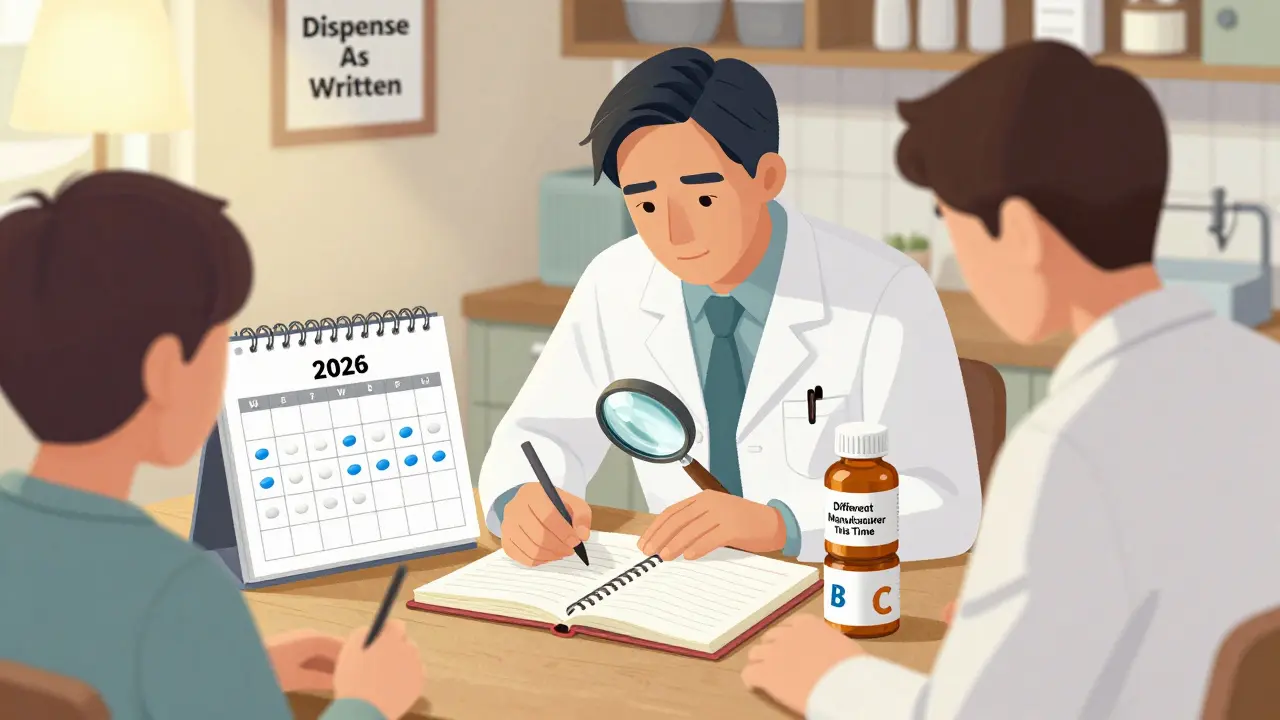
- Request "dispense as written" on your prescription. That means the pharmacy can’t substitute without your doctor’s OK. You have the right to ask for this.
- Track your symptoms. Keep a simple log: date, medication, how you felt. This helps your doctor spot patterns.
Many people assume generics are "inferior." They’re not. But they’re not always identical. And for certain drugs, that small difference matters.
Cost vs. Risk: What’s Really Saving You Money?
Generics save money - but not always in the way you think. The Association for Accessible Medicines (AAM) reported in 2019 that patients abandoned brand-name drugs 266% more often than generics because of cost. That means people skip doses, stop taking pills, or go without. That leads to hospital visits, ER trips, and worse outcomes. So yes, switching to generics can save money - if it keeps you taking your medicine.
But if switching causes side effects or makes your condition worse, you might end up paying more in doctor visits, lab tests, and emergency care. A 2017 review found that in some cases, the total cost of care went up after switching to generics.
The goal isn’t to save the most money on the pill. It’s to keep you healthy without making your life harder.
What’s Changing in 2026?
More pharmacies are now putting stickers on prescription bottles that say: "This is a different manufacturer than last time." That’s a small but important step. Some states are starting to require doctors to note "do not substitute" on prescriptions for high-risk drugs.
Also, insurance companies are starting to notice that frequent switching between generics causes problems. Some are now locking in one generic manufacturer for six months to a year to reduce confusion. That’s not because they care about your pill color - it’s because they’re realizing that switching too often costs them more in the long run.
The real shift? From automatic substitution to informed choice. You’re not just a number in a cost-cutting algorithm. You’re a person. And your body responds to more than just active ingredients.
Final Thoughts
Switching from brand to generic isn’t right or wrong. It’s a tool. Used well, it saves money and keeps people on their meds. Used poorly, it causes confusion, side effects, and even hospitalizations.
For most people - especially those taking statins, antidepressants, or antihistamines - generics are a safe, smart choice. But if you’re on a drug with a narrow therapeutic index, or if you’ve ever had a bad reaction after a switch, speak up. Ask your doctor. Ask your pharmacist. Don’t assume it’s "just a pill."
Your health isn’t a budget line item. It’s your life. Make sure the switch works for you - not just for the system.
Are generic drugs as safe as brand-name drugs?
Yes, for most drugs. The FDA requires generics to have the same active ingredient, strength, dosage, and bioequivalence as the brand-name version. That means your body processes them the same way. But safety isn’t just about the active ingredient - it’s also about fillers and coatings. Rarely, these can cause reactions in sensitive people. If you’ve had a bad reaction after switching, tell your doctor.
Can switching to a generic cause my condition to get worse?
Yes, for certain medications. Drugs with a narrow therapeutic index - like levothyroxine, warfarin, and anti-seizure medications - are sensitive to small changes in how they’re absorbed. Even minor differences in manufacturing can lead to unstable levels in your blood. If you notice new symptoms after switching - like more seizures, unexplained weight gain, or unusual bruising - contact your doctor immediately.
Why do generic pills look different?
Trademark laws prevent generic manufacturers from copying the exact appearance of brand-name pills. That means color, shape, size, and markings can change - even if the drug inside is identical. This is why you might get a blue pill one month and a white one the next. It doesn’t mean it’s weaker - but it can confuse you or make you think you got the wrong medicine.
Can I ask my doctor to keep me on the brand-name drug?
Absolutely. You have the right to request "dispense as written" on your prescription. That means the pharmacy can’t substitute a generic unless your doctor approves. This is especially important if you’ve had problems with generics before, or if you’re taking a high-risk medication. Insurance may require you to try the generic first - but you can still appeal.
Should I avoid generics because of recalls?
Recalls happen with both brand and generic drugs. The FDA inspects manufacturing facilities globally, including in the U.S., India, and China. A recall doesn’t mean all generics are unsafe - it means one batch had a problem. Check the FDA’s recall list if you’re concerned. If your drug is recalled, your pharmacy will notify you. Don’t stop taking your medicine without talking to your doctor first.
Comments
Desiree LaPointe
Oh honey, let me guess-you’re one of those people who thinks generics are "just as good" because the FDA said so, like the FDA is some kind of divine oracle? 🙄
Let me tell you about my cousin who went from brand-name Keppra to a generic and ended up in the ER with status epilepticus. The FDA doesn’t care if your brain turns into a lightning storm. They care about bioequivalence curves. Which, by the way, are measured in healthy volunteers-not 72-year-olds with three comorbidities and a liver that’s seen better days.
And don’t even get me started on the "fillers." Ever read the inactive ingredients list? One generic had lactose monohydrate. My cousin’s allergic to dairy. Guess what? She didn’t know. The pharmacist didn’t tell her. The doctor didn’t care. The insurance company? They saved $12.87. Mission accomplished.
Generics aren’t evil. But pretending they’re identical? That’s not science. That’s corporate propaganda dressed up in lab coats.
Also, the FDA’s bioequivalence threshold? 80–125%. That means a generic can be 20% weaker OR 25% stronger. And you’re okay with that? I’m not. I’m not your guinea pig.
March 21, 2026 at 23:55
Paul Cuccurullo
Thank you for this thoughtful and deeply informative piece. It is both timely and profoundly necessary in an era where cost-efficiency too often overshadows clinical nuance.
While the data overwhelmingly supports the safety and efficacy of generic medications for the majority of patients, we must not overlook the vulnerable minority whose lives hinge on minute pharmacokinetic stability.
For those managing conditions such as epilepsy, hypothyroidism, or post-transplant immunosuppression, the psychological and physiological toll of unpredictable drug performance cannot be overstated.
It is not merely about pill color or cost-it is about dignity, autonomy, and the sacred trust between patient and provider.
I urge all healthcare systems to adopt a patient-centered substitution policy-one that honors individual response, not just budgetary constraints.
March 23, 2026 at 22:36
Johny Prayogi
Yessss this is so needed!! 🙌
I’ve been on levothyroxine for 12 years and switched generics 3 times. First time I felt like a zombie. Second time, my hair started falling out. Third time? I asked my doc to write "DO NOT SUBSTITUTE" and my insurance tried to deny it. Took 3 calls, a letter from my endo, and a threat to switch plans to get it approved.
But it WORKED. My TSH is stable again.
Don’t let anyone tell you it’s "all in your head." Your body knows. Trust it. Advocate for yourself. You’re not being difficult-you’re being smart. 💪
March 24, 2026 at 02:56
Nicole James
Have you ever wondered... who really owns the FDA? 🤔
Big Pharma didn’t just "lose" their patents-they orchestrated the entire generic system. The same companies that make the brand drugs? They own the generics too. It’s not a competition-it’s a monopoly with a different label.
And the "bioequivalence" studies? Conducted by the same labs that get paid by the manufacturers. Conflict of interest? Nah. Just "standard procedure."
Ever heard of the 2018 valsartan recall? 300 million pills. All generics. All made in India. All contaminated with a carcinogen.
They’re not saving you money. They’re saving shareholders. And you? You’re the sacrifice.
Wake up. The system isn’t broken. It’s working exactly as designed.
March 25, 2026 at 23:42
Sandy Wells
Generic drugs are fine. Stop being dramatic.
March 27, 2026 at 13:21
Shaun Wakashige
I switched to generic blood pressure meds and felt fine. Maybe people just need to toughen up lol
March 28, 2026 at 13:01
Chris Dwyer
Big shoutout to everyone who’s spoken up here-this is exactly the kind of conversation we need.
I used to think generics were all the same too. Then my mom had a stroke after switching from brand to generic warfarin. Her INR went from 2.8 to 5.1 in two weeks. No warning. No testing. Just a new pill with a different logo.
She’s fine now, but it took 3 ER visits and a lawyer to get her insurance to cover the brand again.
Here’s the thing: if your drug has a narrow therapeutic index, don’t just accept the switch. Ask for documentation. Ask for consistency. Ask for your safety to matter.
You’re not being high-maintenance. You’re being responsible.
And if your pharmacist rolls their eyes? Find a new one. Your life isn’t a cost center.
March 30, 2026 at 01:41
shannon kozee
For patients on levothyroxine, switching manufacturers can cause measurable TSH fluctuations-even if the active ingredient is identical.
Studies show a 20–30% increase in TSH variability after switching generics.
It’s not placebo. It’s pharmacokinetics.
Always check the manufacturer name on the bottle. If it changes, notify your provider. Get your TSH rechecked in 6 weeks.
Simple. Evidence-based. No drama needed.
March 31, 2026 at 05:59
trudale hampton
My dad’s on generic warfarin. He’s 78, lives alone, takes 12 pills a day. Last month they switched him to a new generic and he started bruising like crazy.
He didn’t say anything because he didn’t want to "be a bother."
Turns out his INR was 6.7. He was one nosebleed away from a hemorrhage.
Now we’ve got his script locked to the same brand. Insurance hates it. We don’t care.
He’s alive. That’s the only metric that matters.
April 1, 2026 at 15:42
Solomon Kindie
people act like generics are some kind of conspiracy but the truth is most of us arent even aware of what we take the active ingredient is the same and if you feel weird its prob stress or you just dont like the pill size or color lol and also the FDA is not some puppet of big pharma they are overworked and underfunded and the reason they allow 80-125 bioequivalence is because its scientifically valid and if you have a real issue you should get tested not panic on reddit
April 2, 2026 at 19:10
Write a comment