
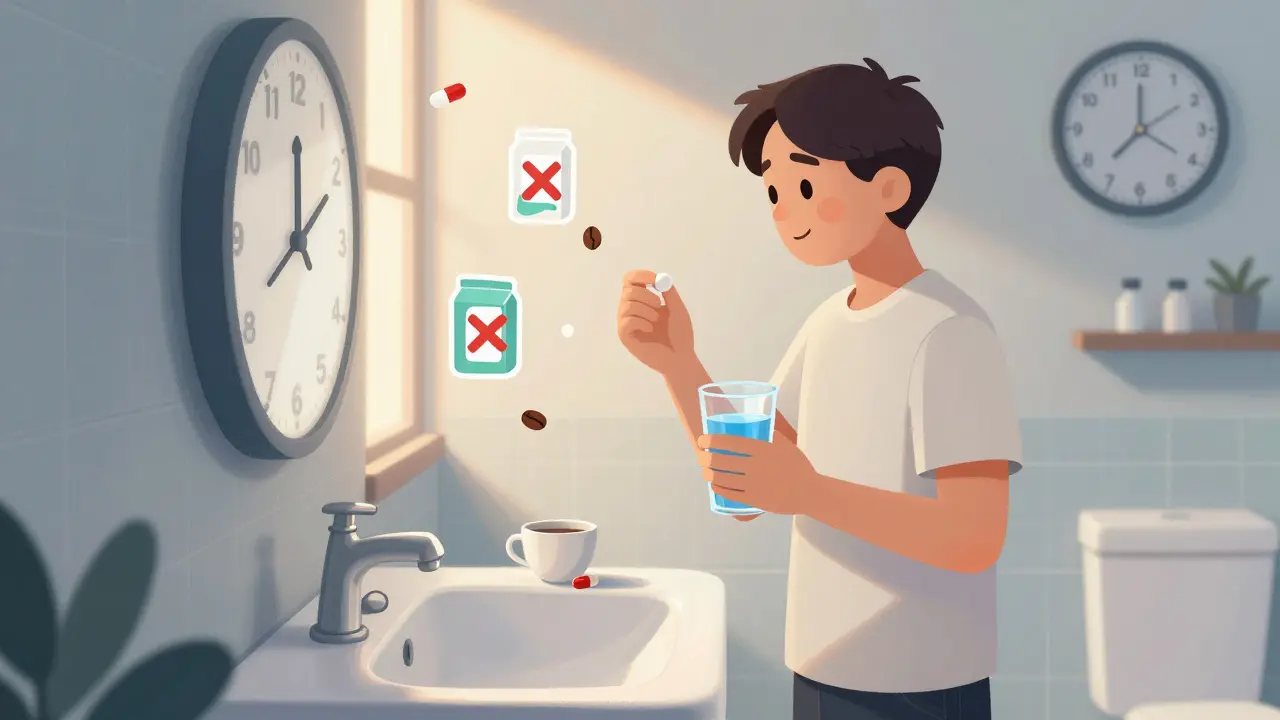
Getting the most out of your levothyroxine isn’t just about taking the pill-it’s about when you take it. For millions of people with hypothyroidism, the difference between a stable TSH level and a frustrating spike can come down to 30 minutes and whether you had coffee that morning.
Why Timing Matters More Than You Think
Levothyroxine is a synthetic version of the thyroid hormone your body no longer makes. It’s simple in theory: one pill a day. But in practice, it’s finicky. Studies show only 60% to 80% of the dose gets absorbed if you don’t follow the rules. That means if you take it with breakfast, you might as well be taking half a pill-and your body knows it. Your stomach needs to be empty and acidic for levothyroxine to dissolve properly. Food, drinks, and even other meds can block absorption. The result? Your TSH levels bounce around. And when TSH is out of range-especially above 4.0 mIU/L-you risk fatigue, weight gain, brain fog, and long-term heart problems.The Gold Standard: Morning Fasting
The most proven method? Take your pill first thing in the morning, 30 to 60 minutes before eating or drinking anything except water. This is the recommendation from the American Thyroid Association, the FDA, and most endocrinologists. Why? Because your stomach acid is naturally higher in the morning before food dilutes it. And you’re less likely to forget. A 2021 study in the journal Thyroid tracked 45 patients over several months. Those who took levothyroxine on an empty stomach had an average TSH of 1.9. Those who took it with breakfast? Their TSH jumped to 2.9. That’s not just a number-it’s a sign your body isn’t getting enough hormone.What You Must Avoid
Even if you take your pill on an empty stomach, one mistake can undo everything. Here’s what interferes:- Calcium supplements - Reduce absorption by up to 36%. Take them at least 4 hours apart.
- Iron supplements - Can cut absorption by nearly 60%. Separate by 4+ hours.
- Coffee - Even one cup can lower absorption by 9-14%. Wait at least an hour after your pill.
- Soy products - Tofu, soy milk, edamame - reduce absorption by 20-30%.
- High-fiber meals - Oatmeal, bran cereal, whole grains - drop absorption by 15-25%.
- Proton pump inhibitors (PPIs) - Like omeprazole or esomeprazole - these reduce stomach acid, which your pill needs. Some patients on PPIs need 12-17% higher doses.
And yes, that means no almond milk latte before work. No fiber bar on your commute. No antacids after lunch. It’s not just advice-it’s science.

Bedtime Dosing: A Viable Alternative?
You’re not alone if mornings are chaotic. Kids, jobs, coffee routines-it’s hard to wait 60 minutes before breakfast. That’s why many patients try bedtime dosing. Some studies show it works just as well. In a 2022 trial with 150 patients, TSH levels were nearly identical whether people took levothyroxine in the morning or at night-so long as they didn’t eat for 3-4 hours before bed. But there’s a catch. People who take it at night are more likely to stick with it. A 2022 survey found 79% of patients maintained bedtime dosing, compared to 63% with morning dosing. Why? Because once you’re in bed, you’re not distracted. Still, not everyone should switch. If you have trouble sleeping, or if you’re on other nighttime meds, it might add confusion. And if you have thyroid cancer, your TSH target is tighter (0.1-0.5 mIU/L). For you, sticking to morning fasting is non-negotiable.Real People, Real Struggles
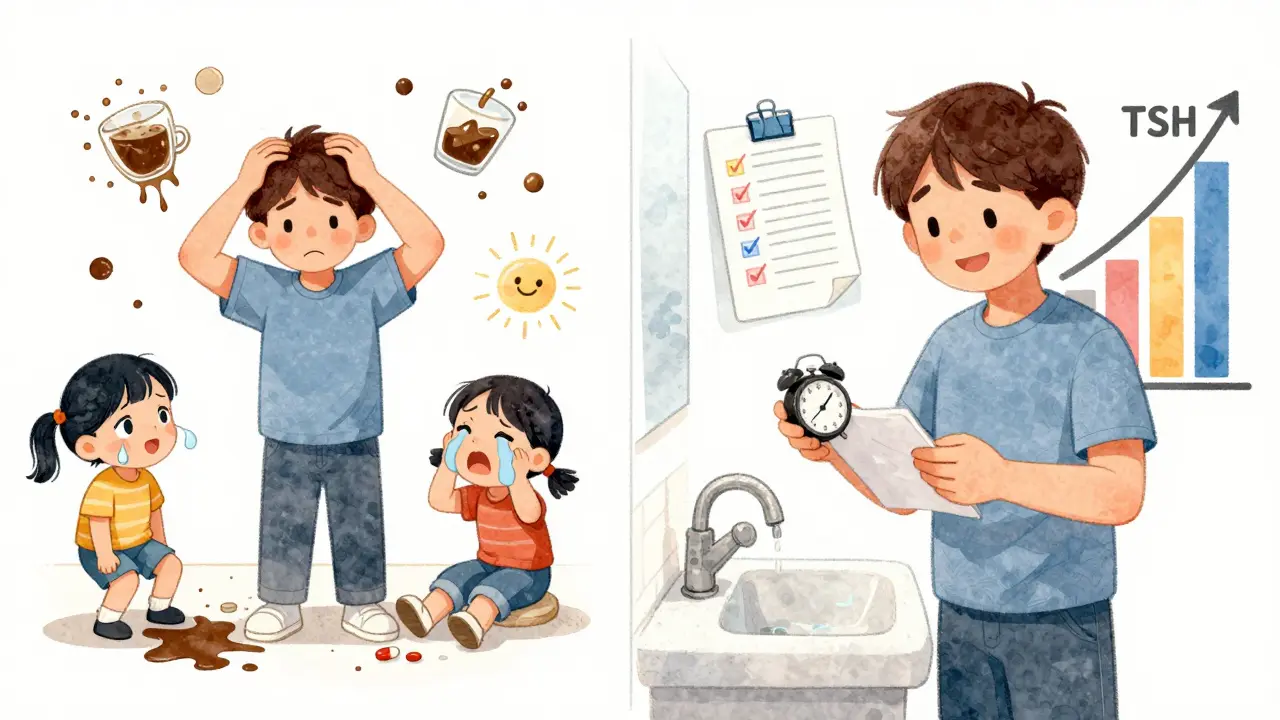
On Reddit’s r/Hypothyroidism, over 1,200 people shared their experiences. Nearly 70% said they couldn’t stick to the 30-minute fast before breakfast. Some got stomach pain-what they call “levo belly.” Others forgot and took it with coffee, only to feel exhausted for weeks until their dose got adjusted. One user, “ThyroidWarrior42,” wrote: “I switched to bedtime dosing after 3 years of TSH swings. My endocrinologist didn’t believe me-until my lab results showed my TSH dropped from 3.8 to 1.6.” Another, “HypoMama,” said: “I took my pill with my morning coffee. My TSH jumped from 1.8 to 5.2. I was dizzy, gaining weight, and crying for no reason. It took three months to fix.” These aren’t anecdotes. They’re data points from real people trying to live with a condition that demands precision.How to Make It Stick
Consistency beats perfection. Here’s how to build a routine that works:- Keep your pill next to your toothbrush. It’s the first thing you see in the morning. 78% of endocrinologists recommend this.
- Use a pill organizer with labels. Write “NO FOOD FOR 60 MIN” on the compartment.
- Set two alarms. One for taking the pill. One for breakfast.
- Use a tracking app. MyThyroidMedication showed a 34% improvement in adherence in a 2022 study.
- Drink a full glass of water. It helps the pill dissolve and move through your system.
Don’t try to do it all at once. Pick one habit-maybe moving your pill to the bathroom-and stick to it for two weeks. Then add another.
What About New Formulations?
Not all levothyroxine is the same. The brand Tirosint comes in a soft gel capsule filled with liquid. It’s less affected by food-absorption drops only 8-12% when taken with breakfast, compared to 20-30% for regular tablets. But it costs 3 to 5 times more. Generic levothyroxine runs $10 a month. Tirosint can hit $50. For most people, sticking to timing rules is cheaper and just as effective. The FDA is also tightening standards for generic versions to reduce variability. That could mean fewer surprises down the road.When to Talk to Your Doctor
If your TSH keeps bouncing, even after you’ve nailed your timing, talk to your doctor. You might need a different brand, a dose change, or to check for other issues like celiac disease or H. pylori infection-both can mess with absorption. Also, if you’re on PPIs, iron, or calcium regularly, ask if you can space them out. Some patients need to take levothyroxine at bedtime just to avoid interactions. And if you’re pregnant or planning to be-your dose will likely go up. Thyroid needs change fast during pregnancy. Don’t assume your old routine still works.Bottom Line: It’s Not Just a Pill. It’s a Habit.
Levothyroxine isn’t like taking an aspirin. It’s a hormone replacement that requires discipline. But it doesn’t have to be perfect-just consistent. Take it on an empty stomach, 30-60 minutes before breakfast. Or take it at night, 3-4 hours after your last meal. Either way, avoid food, coffee, and supplements for that window. Your body doesn’t care if you’re busy, tired, or distracted. It only cares if you give it what it needs-on time, every day.If you get it right, you’ll feel better. Your energy will come back. Your brain will clear. Your weight will stabilize. And you won’t have to keep going back to your doctor for dose tweaks.
It’s not magic. It’s science. And it works-if you let it.
Comments
Solomon Ahonsi
Wow, another ‘just take it on an empty stomach’ lecture. Real helpful, Captain Obvious. I’ve been taking mine with coffee for five years and I’m still alive. Maybe my body just doesn’t care what your study says. Also, who has time to wait an hour before breakfast? I’m a dad. I have two toddlers and a coffee addiction. My TSH is ‘fine’-whatever that means. Stop shaming people for living.
February 3, 2026 at 01:12
George Firican
The real issue here isn’t timing-it’s the assumption that biology is a machine that obeys linear protocols. Levothyroxine isn’t a key turning a lock; it’s a whisper in a storm. The body doesn’t care about your calendar, your alarm, or your pill organizer. It cares about consistency, yes-but also about rhythm, stress, sleep cycles, gut flora, and the quiet chaos of being human. The 30-minute rule is a heuristic, not a law. Some of us thrive on bedtime dosing. Others need to take it with a sip of water while standing over the sink, half-asleep, because that’s the only moment they feel grounded. The science is useful, but it shouldn’t become a moral test. What if the real cure isn’t perfect timing, but self-compassion?
February 3, 2026 at 20:48
Matt W
I switched to bedtime dosing last year after my TSH went from 2.1 to 4.7. I was exhausted, gaining weight, and crying during commercials. I didn’t believe it would work-but I was desperate. Took it at 10 PM, no food after 7 PM. Three months later, my TSH was 1.4. I didn’t even tell my doctor until my bloodwork came back. He was stunned. Now I take it with a big glass of water and just… go to sleep. No more morning stress. No more coffee guilt. It’s not perfect, but it’s mine. If you’re struggling, try it. No judgment.
February 4, 2026 at 04:14
Anthony Massirman
Just take it before coffee. Done. Stop overthinking it.
February 4, 2026 at 19:23
Marc Durocher
So let me get this straight-you’re telling me I can’t have my oatmeal latte with my 7:30 AM pill, but I can have a soy milk smoothie at 10 PM? That’s not science, that’s a cult. Also, ‘levo belly’? That’s not a thing. That’s just your gut screaming at you for being a caffeine addict. And why is everyone acting like this is the first time anyone’s ever heard of drug-food interactions? We’re not in 1992.
February 4, 2026 at 23:02
larry keenan
While the temporal pharmacokinetics of levothyroxine are well-documented in peer-reviewed literature, the clinical variability in patient adherence patterns remains a significant confounding variable in longitudinal outcomes. The data presented in the 2021 Thyroid study demonstrates a statistically significant difference in serum TSH levels between fasting and postprandial administration (p < 0.01), yet real-world compliance is influenced by psychosocial determinants including socioeconomic status, cognitive load, and circadian disruption. Further investigation into pharmacogenomic influences on intestinal absorption may yield more personalized protocols.
February 5, 2026 at 22:05
Nick Flake
THIS. IS. LIFE-CHANGING. 🌟 I was a walking zombie for 4 years. TSH at 5.8. Couldn’t get out of bed. My dog started avoiding me because I smelled like defeat. Then I moved my pill to the bathroom. Set two alarms. One for pill. One for breakfast. And guess what? I got my life back. I can think again. I can laugh. I can hold my kid without wanting to cry. This isn’t just medicine-it’s a second chance. Thank you for writing this. I’m not alone anymore. 🙏
February 6, 2026 at 03:45
Chinmoy Kumar
hi i tried bed time dosing but i forgot to take it for 3 days and my tsh went up again 😭 i think i need to get one of those pill boxes with the alarms. also i took mine with soy milk once and felt like i was drugged for a week. my doc said it was probably the soy but i think it was my soul. thanks for the post, it helped me feel less crazy 🤍
February 7, 2026 at 07:51
Write a comment