
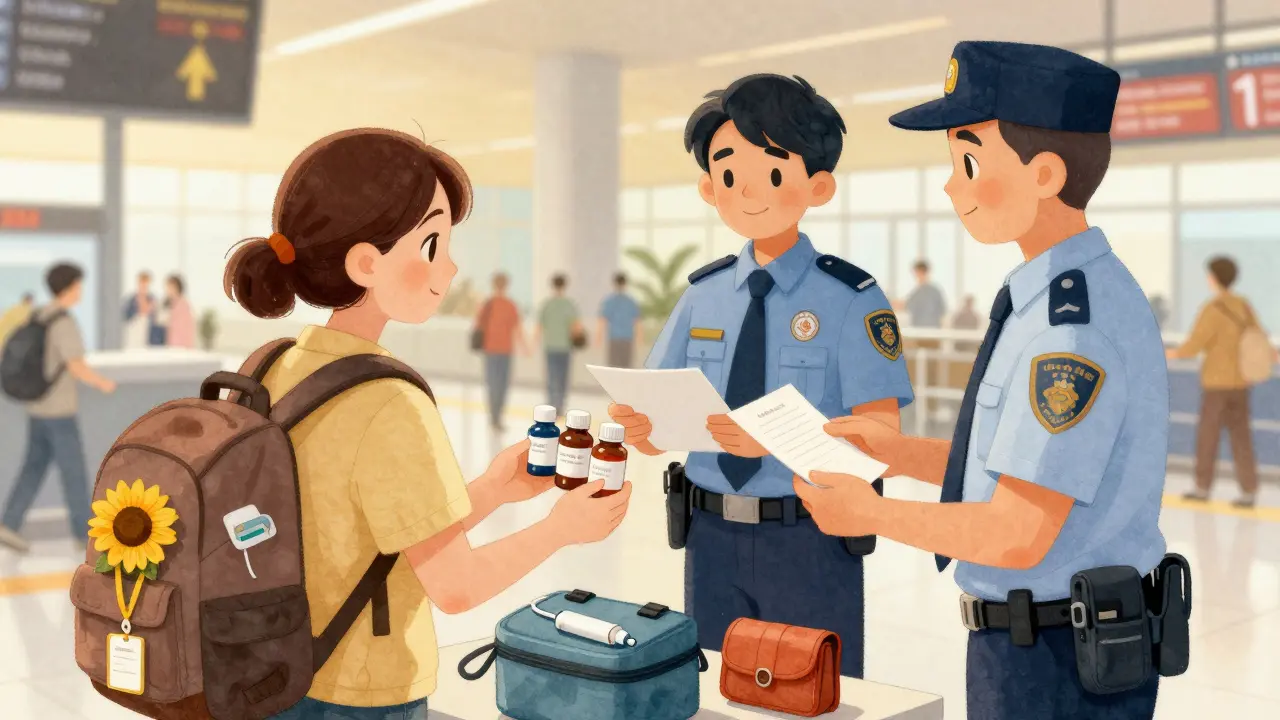
Traveling with medications isn’t just about packing pills-it’s about avoiding airport delays, customs seizures, or worse, a medical emergency halfway across the world.
If you’ve ever stood at security with a bag full of bottles, wondering if your insulin pump will get flagged, or worried your anxiety meds might get confiscated in another country, you’re not alone. In 2024, over 12% of international travelers reported having medication seized or delayed at borders. That’s not a small risk. But with the right prep, you can travel safely, legally, and without stress.
The rules changed in 2025. TSA updated its guidelines, 31 countries now accept digital prescriptions, and some of the most common U.S. prescriptions are outright banned in places like Japan, Sweden, and the UAE. This isn’t just about knowing what to pack-it’s about understanding what’s allowed, how to prove it, and what to do if things go wrong.
What You Can and Can’t Bring Through Security
TSA allows all medications in carry-on luggage, no matter the quantity. That includes pills, liquids, injections, and even medical devices like insulin pumps. But there’s a catch: how you pack them makes all the difference.
Liquids over 3.4 ounces (100ml) used to be banned. Now, if it’s medically necessary-like insulin, liquid painkillers, or oral steroids-you can bring as much as you need. But you must declare it at the checkpoint. Don’t just toss it in your bag and hope for the best. Tell the officer: “I have medically necessary liquids.” They’ll likely ask you to remove it from your bag for separate screening. That’s normal. It’s faster than trying to hide it.
For pills and capsules? No limits. But packing them in unlabeled containers? Big mistake. TSA’s own data shows that medications in original pharmacy bottles with labels are inspected 63% less often than those in pill organizers or ziplock bags. Labels prove the medication is legitimate. No label? You’re asking for extra screening, delays, or even confiscation.
Medical devices like insulin pumps, nebulizers, or glucose monitors? Always carry them in your carry-on. FAA rules require lithium batteries in medical devices to stay in the cabin. Power banks for these devices can’t exceed 100 watt-hours unless you get airline approval. Most portable insulin coolers use batteries under 50 watt-hours-so you’re fine. Just don’t check them.
International Rules Are a Minefield
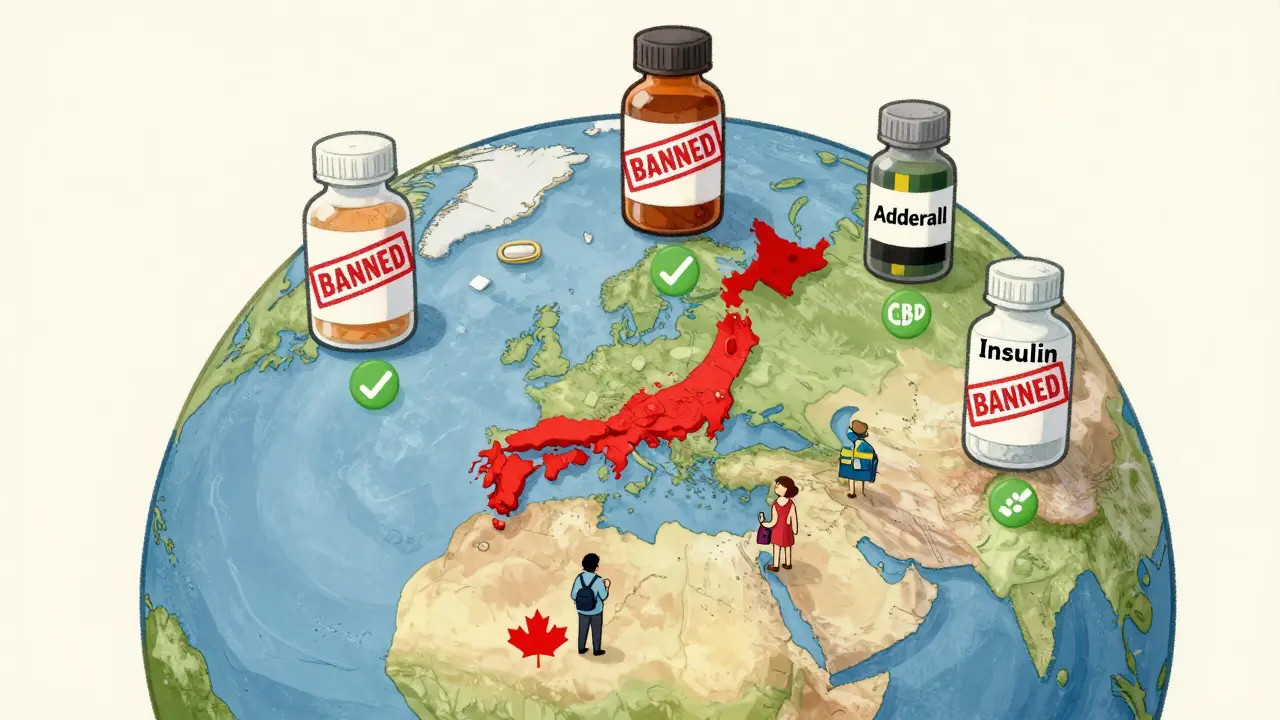
What’s legal in the U.S. isn’t legal everywhere. And the differences are shocking.
Japan bans any medication containing pseudoephedrine-so cold and allergy meds like Sudafed are illegal. Thailand requires government approval to bring alprazolam (Xanax) or diazepam (Valium). The UAE has a zero-tolerance policy for opioids-oxycodone, hydrocodone, even tramadol can get you arrested. France and Sweden ban Adderall and Vyvanse completely. And CBD? Even if it’s legal in your state and contains less than 0.3% THC, countries like Singapore, Dubai, and Russia treat it like heroin.
The CDC’s 2025 Yellow Book lists five medications that cause the most problems abroad: hydrocodone, oxycodone, alprazolam, diazepam, and zolpidem. Twenty-eight percent of countries restrict at least one of these. And if you’re taking stimulants for ADHD? You’re in a high-risk group. Seventeen countries ban them outright.
Don’t rely on Google. Don’t trust travel blogs. Check the International Narcotics Control Board (INCB) database-they update country rules every October. Contact the embassy of your destination. Ask: “Is [medication name] allowed for personal use by tourists?” Get their answer in writing. Save it. Print it. Carry it with you.
Documentation: Your Legal Shield
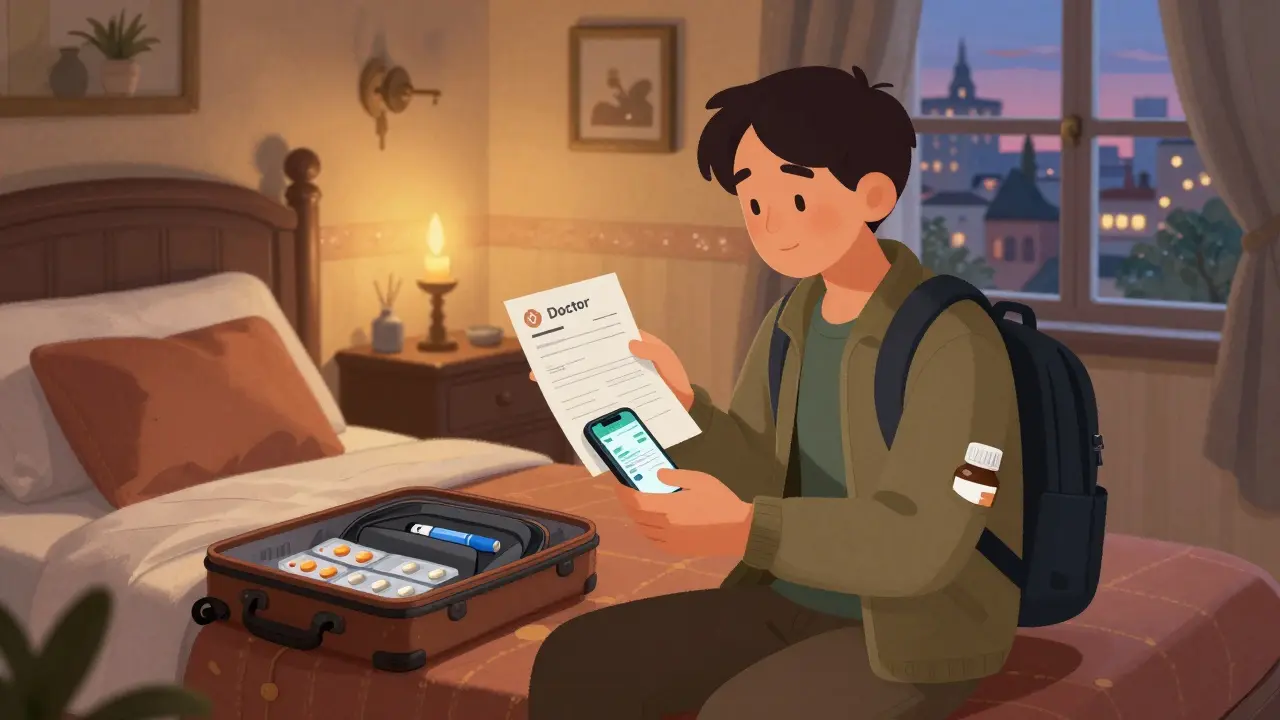
Having a doctor’s letter isn’t optional-it’s your lifeline.
67% of countries require medications to be in original containers with pharmacy labels. But if you’re flying internationally, you also need a letter from your doctor. It should include:
- Your full name and date of birth
- Medication names (generic and brand)
- Dosage and frequency
- Medical condition being treated
- Doctor’s name, license number, and contact info
- Statement that the medication is for personal use during travel
Translation matters. If you’re going to a non-English-speaking country, get the letter translated. Many embassies offer translation services. If not, use a certified translator-Google Translate won’t cut it at customs.
Carry a copy of your prescription too. Even if your country doesn’t require it, having it reduces suspicion. Some countries now accept digital copies via email or apps. But always bring a printed backup. Power can die. Phones can break.
Storage: Keeping Medications Safe and Effective
Heat, cold, and humidity can ruin your meds faster than a TSA officer with a clipboard.
Insulin? Must stay between 36°F and 46°F (2°C-8°C). If it gets too hot-say, left in a checked bag in Dubai-it loses potency. Too cold? It can freeze and become useless. The same goes for biologics, thyroid meds, and some antibiotics.
Use a pharmaceutical-grade cooling wallet. These are tested to maintain 2°C-8°C for up to 72 hours, even in 40°C heat. Over 70% of insulin users who use them report zero temperature issues during tropical trips. They’re small, fit in a purse, and don’t need ice packs-just activate them before you leave.
For short trips, a small insulated pouch with a cold pack works. But never put meds in checked luggage. Temperatures in cargo holds can drop below freezing or spike above 120°F. That’s not a risk you take with your health.
And don’t forget: keep your meds with you at all times. If your checked bag gets lost, you need your daily pills. Distribute your supply across carry-ons. One bottle in your jacket pocket, another in your backpack. That way, if one bag vanishes, you’re not stranded.
Getting Refills Abroad
What if your trip stretches beyond 90 days? You can’t just walk into a pharmacy in Italy and ask for a refill of your U.S. prescription.
The FDA allows you to bring in a 90-day supply for personal use. For longer stays, you can have additional medication mailed to you-but only under strict rules. You need:
- A copy of your passport and visa
- A letter from your doctor explaining why you need the refill
- A copy of your original U.S. prescription
- Proof that the medication is for personal use only
Mail it to a friend, hotel, or a mail-forwarding service. Don’t send it directly to your address unless you’ve checked local customs rules. Some countries scan all incoming packages. A bottle of Adderall arriving from the U.S.? That’s a red flag.
Some travelers use international pharmacies. But be careful. Many online pharmacies outside the U.S. sell counterfeit or unregulated drugs. Stick to licensed pharmacies in countries with strong regulatory systems-like Canada, the UK, or Australia. Always ask for the batch number and check it against the manufacturer’s website.
How to Speed Up Security: Use TSA Cares
There’s a hidden tool most travelers don’t know about: TSA Cares.
This is a free service that assigns a trained officer to help you through security if you have a medical condition, disability, or need special assistance with medications. You can request it 72 hours in advance by calling 1-855-787-2227 or asking at the checkpoint.
They’ll give you a sunflower lanyard to wear. It signals to staff that you need extra help. No more standing in line while they dig through your bag. You get priority screening. The average wait time drops by 41% for people who use it.
Even if you’re not disabled, if you’re carrying complex medications, use it. It’s there for you.
What to Do If Something Goes Wrong
Let’s say your meds get seized. Or you’re denied entry. Or you’re asked to surrender your insulin.
Stay calm. Don’t argue. Ask for a supervisor. Request a written explanation. Contact your embassy immediately. The U.S. State Department handles these cases daily. They can’t force a country to let you in-but they can help you get legal advice, find a local doctor, or arrange emergency medication.
Always carry emergency contact info: your doctor’s number, your pharmacy’s number, your embassy’s 24/7 line. Save them in your phone and write them on paper. If your phone dies, you still have access.
And if you’re traveling with someone else? Give them a copy of your meds list and doctor’s letter. If you collapse or get separated, they need to know what you take and why.
Final Checklist: Before You Leave
- ✅ All meds in original pharmacy containers with labels
- ✅ Doctor’s letter printed and translated (if needed)
- ✅ Prescription copies in digital and paper form
- ✅ Check INCB database for your destination’s rules
- ✅ Contact embassy if unsure about any medication
- ✅ Pack temperature-sensitive meds in a cooling wallet
- ✅ Distribute meds across carry-ons
- ✅ Request TSA Cares if you need help at security
- ✅ Know your embassy’s emergency number
- ✅ Bring extra meds-just in case
Traveling with medication isn’t about being paranoid. It’s about being prepared. The system isn’t perfect. But if you do your homework, you’ll fly without fear, land without hassle, and stay healthy wherever you go.
Can I bring my insulin pump on a plane?
Yes, you can and must bring your insulin pump in your carry-on. FAA rules require all medical devices with lithium batteries to stay in the cabin. Never check it. Declare it at security, and keep it on your person. TSA allows it as long as it’s clearly for medical use. Bring a doctor’s letter if you’re flying internationally.
Are over-the-counter meds like Advil or Benadryl allowed abroad?
Most are fine, but not all. Advil (ibuprofen) is generally allowed. Benadryl (diphenhydramine) is restricted in Japan and some Middle Eastern countries. Even simple OTC meds can contain banned ingredients. Always check the INCB database for your destination. When in doubt, leave it at home or buy it locally after arrival.
Can I mail medication to myself while traveling?
Yes, but only under FDA guidelines. You need your passport copy, doctor’s letter, and a copy of your U.S. prescription. The medication must be for personal use, not resale. Send it to a trusted address like a hotel or friend’s place. Avoid direct shipping to your home unless you’ve confirmed local customs allow it. Some countries automatically open incoming packages.
What if my medication is banned in my destination country?
Don’t bring it. If you’re caught, you risk arrest, deportation, or a criminal record. Talk to your doctor before you go. They can often prescribe an alternative that’s legal in your destination. For example, if Adderall is banned, methylphenidate (Ritalin) may be allowed. Always get written confirmation from the embassy before making any changes.
Do I need to declare my meds at U.S. customs when I return?
You’re not required to declare medications you brought out with you. But if you bought new meds abroad and are bringing them back, you must declare them. U.S. Customs can seize unapproved drugs-even if they’re legal in another country. Keep receipts and prescriptions for anything you purchase overseas.
Comments
Sandeep Jain
bro i just threw all my pills in a ziplock and hoped for the best. survived 3 trips to thailand. no one even looked twice. 🤷♂️
December 26, 2025 at 22:39
Natasha Sandra
OMG YES!! 🙌 I used TSA Cares last month with my anxiety meds and the officer literally walked me through like a VIP. I cried. Not because I was scared-because someone *saw* me. 🫂
December 27, 2025 at 14:53
roger dalomba
Wow. A 10-page essay on how to not get arrested while carrying Tylenol. Next up: 'How to breathe without getting detained in Dubai.'
December 27, 2025 at 20:24
sakshi nagpal
This is incredibly thorough. As someone from India who travels frequently with insulin, I’ve learned the hard way-original packaging and a doctor’s letter are non-negotiable. Even at Mumbai airport, they asked for proof. Better safe than stranded.
December 29, 2025 at 19:10
Erwin Asilom
The INCB database is the only authoritative source. Relying on Reddit or travel blogs for medication legality is like using Wikipedia for surgical instructions. Always verify.
December 31, 2025 at 10:09
Sophia Daniels
People still think 'it's just Adderall' and waltz into Japan like it's a yoga retreat? 😒 You don't get to be 'edgy' with controlled substances. If your brain needs chemical help, get a prescription that doesn't make you a criminal abroad. #StopBeingADumbass
January 2, 2026 at 08:36
Nikki Brown
I’m so tired of people acting like the U.S. is the center of the medical universe. Just because your doctor wrote you a script doesn’t mean the world owes you access to your pills. 🤦♀️ Learn the rules or stay home.
January 2, 2026 at 11:38
Brittany Fuhs
I don’t care if you’re 'disabled'-if you’re bringing opioids into a country that bans them, you’re not a patient, you’re a liability. And if you need TSA Cares? Maybe you shouldn’t be flying at all.
January 3, 2026 at 00:48
Peter sullen
It is imperative to underscore that the utilization of pharmaceutical-grade thermal containment systems, in conjunction with the adherence to FAA regulatory mandates regarding lithium-ion battery capacity thresholds, constitutes a non-negotiable prerequisite for the safe transit of biologic pharmaceuticals across international airspace corridors.
January 3, 2026 at 13:31
Sumler Luu
I just read this whole thing and realized I’ve been lucky. I’m going to print the checklist. Right now. And I’m telling my sister to do the same. This isn’t overkill-it’s survival.
January 3, 2026 at 15:11
Write a comment